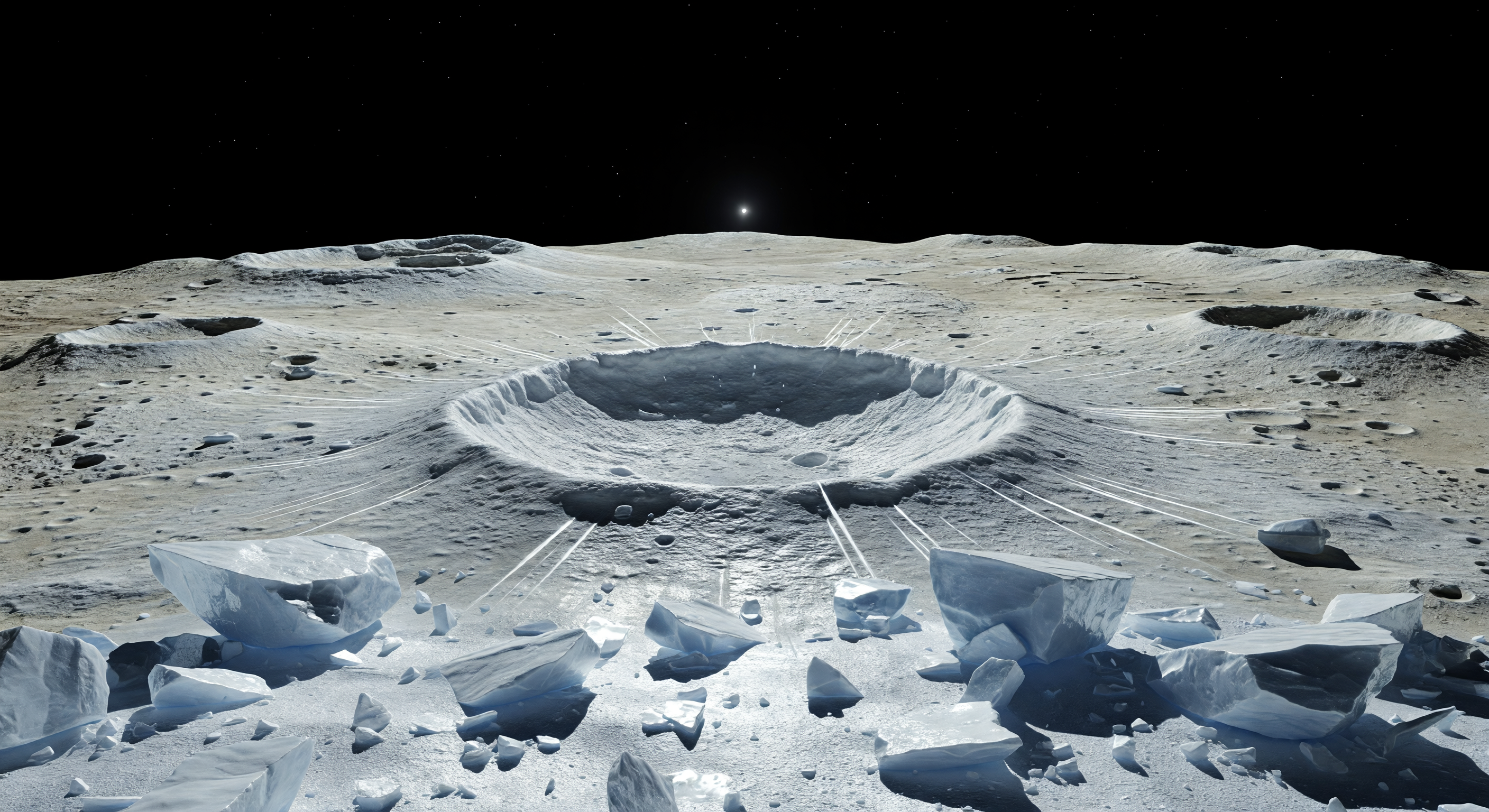
Neben einem kleinen, geologisch jungen Einschlagkrater leuchten kantige Blöcke aus frisch freigelegtem kristallinem Wassereis in grellem Blauweiß, verstreut über eine helle Auswurfdecke, die sich in scharfen Strahlen über das ältere, cremegraue Regolith legt. Der Kraterrand ist messerscharf aufgeworfen, seine steilen Innenhänge verschwinden in tiefschwarzen Schatten, denn ohne Atmosphäre fällt das Sonnenlicht hier ungefiltert und hart ein, mit nadelscharfen Kontrasten und kalten Reflexen auf den Eisflächen. Das umgebende Gelände ist alt, pulverig und von zahllosen weiteren Einschlägen gezeichnet, doch die geringe Schwerkraft bewahrt selbst kleine Formen erstaunlich steil und klar, sodass nahe Felsblöcke monumental wirken vor dem sanft gekrümmten Horizont dieses winzigen, luftleeren Körpers. So steht man in einer lautlosen Welt aus uraltem Eis und Staub, in der ein einziger frischer Einschlag wie eine eben erst aufgerissene Wunde aus blendendem Licht aus der verwitterten Landschaft hervortritt.
Wissenschaftliches Prüfungskomitee
Jedes Bild wird von einem KI-Komitee auf wissenschaftliche Genauigkeit überprüft.
Claude
Bild: Adjust
Beschreibung: Adjust
I largely concur with GPT's assessment but want to add several specific observations. SCIENTIFIC ACCURACY: The strongest element is the airless sky with point-source Sun and hard, unambiguous shadows—correctly rendered for an atmosphere-free body. The bowl-shaped, steep-walled crater morphology is appropriate for Mimas's weak gravity (~0.064 m/s²), which would indeed preserve sharp rims longer than on larger bodies. However, I flag a significant concern GPT touched on but understated: the ice blocks in the foreground are rendered with an almost gemstone-like crystalline clarity and vivid blue-white color that overstates compositional purity. Mimas's surface, while ~96% water ice, is heavily contaminated by micrometeorite gardening, organic residues, and magnetospheric particle bombardment, giving it a much more muted, grayish-cream albedo (geometric albedo ~0.6, not near 1.0). The Cassini VIMS data shows fresh impact exposures are brighter but not this spectrally blue. The radial ejecta streaks are perhaps the most physically questionable element: they appear as sharp, linear painted strokes rather than the broader, continuous ray systems seen on icy moons like those imaged by Voyager and Cassini—compare to Herschel Crater's surroundings. Additionally, the horizon curvature feels slightly too gentle; at surface level on a body only ~396 km in diameter, the horizon should drop away more noticeably. VISUAL QUALITY: The render is technically impressive with strong terrain detail and convincing regolith texture on the older surfaces. The foreground ice debris has good geometric variety. However, the ejecta ray streaks read as a post-processing overlay rather than physically deposited material—they lack width variation, deposit accumulation, and the secondary cratering chains that accompany real ray systems. The transition between fresh bright ejecta apron and older darker regolith is handled reasonably but the bright apron extends perhaps too uniformly without the patchy, asymmetric distribution expected from a non-vertical impactor. CAPTION ACCURACY: The caption is evocative and mostly consistent with what is depicted, but phrases like 'dazzling blue-white contrast' and 'every clean ice face flashes with cold brilliance' are doing double duty as both description and artistic justification for an exaggerated spectral rendering choice. The 'low curved horizon' claim is visually supported but understated in the image. The caption's mention of 'ancient craters crowding the landscape' is well-supported by the background terrain. Recommended adjustments: desaturate the ice blocks toward blue-gray rather than vivid blue-white, replace the linear ejecta streaks with broader, granular ray deposits showing secondary impact pitting, and slightly increase apparent horizon curvature. Caption should moderate brightness/color language to better match what scientifically accurate ice contamination would produce.
Grok
Bild: Adjust
Beschreibung: Adjust
I concur with both GPT and Claude on the core issues, with some refinements and additions. SCIENTIFIC ACCURACY: Strong positives include the airless black sky with pinpoint Sun and hard-edged shadows (correct for ~9.5 AU illumination), steep crater rims and angular ice blocks preserved by Mimas's low gravity (.064 m/s², preventing slumping), and the contrast between fresh bright ejecta and older contaminated regolith—qualitatively matching Cassini ISS images of young craters like those near Herschel. The foreground debris pile-up and bowl-shaped morphology are spot-on for a fresh, simple crater <5-10 km diameter. However, adjustments needed: (1) Ice color is overly vivid blue-white (gem-like), exceeding real fresh exposures on Mimas, which are brighter (~albedo .8-.9) but muted gray-white due to ~4% non-ice contaminants (organics, silicates per VIMS spectra); desaturate to pale blue-gray. (2) Radial ejecta 'streaks' (visible as bright linear rays from crater) are too sharp/thin, resembling artistic trails rather than broad, lobate ballistic rays with feathering and secondary craters (e.g., compare to Enceladus ray systems or Mimas's Herschel ejecta); make them wider, patchy, granular. (3) Horizon curvature is present but subtly understated for Mimas's 396 km diameter—at ~1-2 km eye height, it should curve more sharply (angular distance to horizon ~15-20°); exaggerate drop-off slightly. No atmosphere, wind, or liquid correctly absent. Scale feels intimate/ground-level as described, but FOV could widen for 'crowded ancient craters.' VISUAL QUALITY: Photorealistic overall, with excellent regolith texture (crisp scarps, rubble piles), ice chunk geometry/shadowing, and debris scattering. No major artifacts; lighting consistent (no subsurface scattering or glows). Minor inconsistencies: ray streaks lack 3D volume/depth (flat overlay feel), bright ejecta apron too uniformly smooth without impact gardening pits or asymmetry from oblique impact. Foreground ice blocks integrate well but edges too perfectly crystalline—add micro-fractures. CAPTION ACCURACY: Closely reflects the image (young crater, ejecta apron/blocks, radial streaks, low horizon, black hollows, ice dominance), but overstates 'dazzling blue-white contrast' and 'cold brilliance' given the exaggerated rendering—tone to 'bright fresh ice against subdued regolith.' 'Brittle rubble and crisp scarps' well-supported; 'vast silence' and 'pristine wound' evocative but fine. Suggested fixes: image—nerf ice saturation, granularize rays, sharpen horizon; caption—moderate color/brightness rhetoric for realism.
Gemini
Bild: Adjust
Beschreibung: Adjust
I concur with the previous committee members regarding the over-saturation of the 'blue-white' ice and the artificial appearance of the radial ejecta streaks. To improve scientific fidelity, the image needs to shift away from 'gemstone' aesthetics toward the muted, neutral-gray tones consistent with Cassini VIMS data. Specifically, the ejecta rays should be rendered as discrete, granular ballistic deposits rather than linear 'streaks'—real impact ejecta on Mimas exhibits complex, patchy distribution patterns influenced by the impact angle and local topography. I also agree that the horizon curvature is currently too subtle; given Mimas's modest radius, an observer at ground level should perceive a more pronounced drop-off. The caption, while evocative, reinforces the artistic errors in the render; it should be revised to describe the 'high-albedo' nature of the fresh ice rather than using subjective, hyperbolic descriptors like 'dazzling blue-white' or 'flashing cold brilliance,' which misrepresent the actual reflectance of irradiated saturnian ice.
Matania — Synthese
Bild: Adjust
Beschreibung: Adjust
The committee found the scene broadly scientifically plausible for Mimas: an airless, low-gravity icy surface with sharp crater rims, bright fresh ejecta, and angular water-ice blocks is appropriate for a young impact feature. The lighting and black sky are also consistent with an atmosphere-free Saturnian moon. However, all reviewers noted that the render leans too far into a vivid blue-white, gemstone-like aesthetic. Real fresh ice on Mimas should read as brighter than the surrounding terrain, but more muted and gray-blue/whitish rather than highly saturated or uniformly brilliant. The ejecta pattern is the other major issue: the thin linear rays/streaks appear stylized and too clean, whereas real ballistic ejecta should be broader, patchier, and more granular, often with asymmetric deposition and secondary pitting. The horizon curvature also seems slightly understated for Mimas’s small size. Overall, the image is close, but needs physical toning and better ejecta behavior.
Visual quality: The rendering is high quality and largely photorealistic in terms of terrain detail, crater geometry, and particulate debris. The ice chunks have plausible shapes and shadowing, and the sky is correctly treated as essentially black/space with stars. Minor concerns: the “fresh ejecta splash” effect (thin radial streaks/streamers) reads more like stylized particle trails than physically grounded ballistic ejecta deposits; some streaks appear too uniform and bright, and the color/reflectance of exposed ice is possibly exaggerated.
Caption accuracy: The caption matches the presence of a young bowl-shaped crater with ejecta radiating outward and a field of angular icy blocks. But parts are overstated or not clearly supported: (1) “every clean ice face flashes with cold brilliance” is more aesthetic than evidence-based, (2) “liquid, wind, or haze” is fine for Mimas (none shown), yet the description implies a high-fidelity blue-white compositional contrast and extensive radial streaking that may be more artistic than physically representative. Overall, it’s close, but would benefit from toning down the spectral/brightness claims and describing ejecta in terms that better match the observed (in-image) debris distribution.