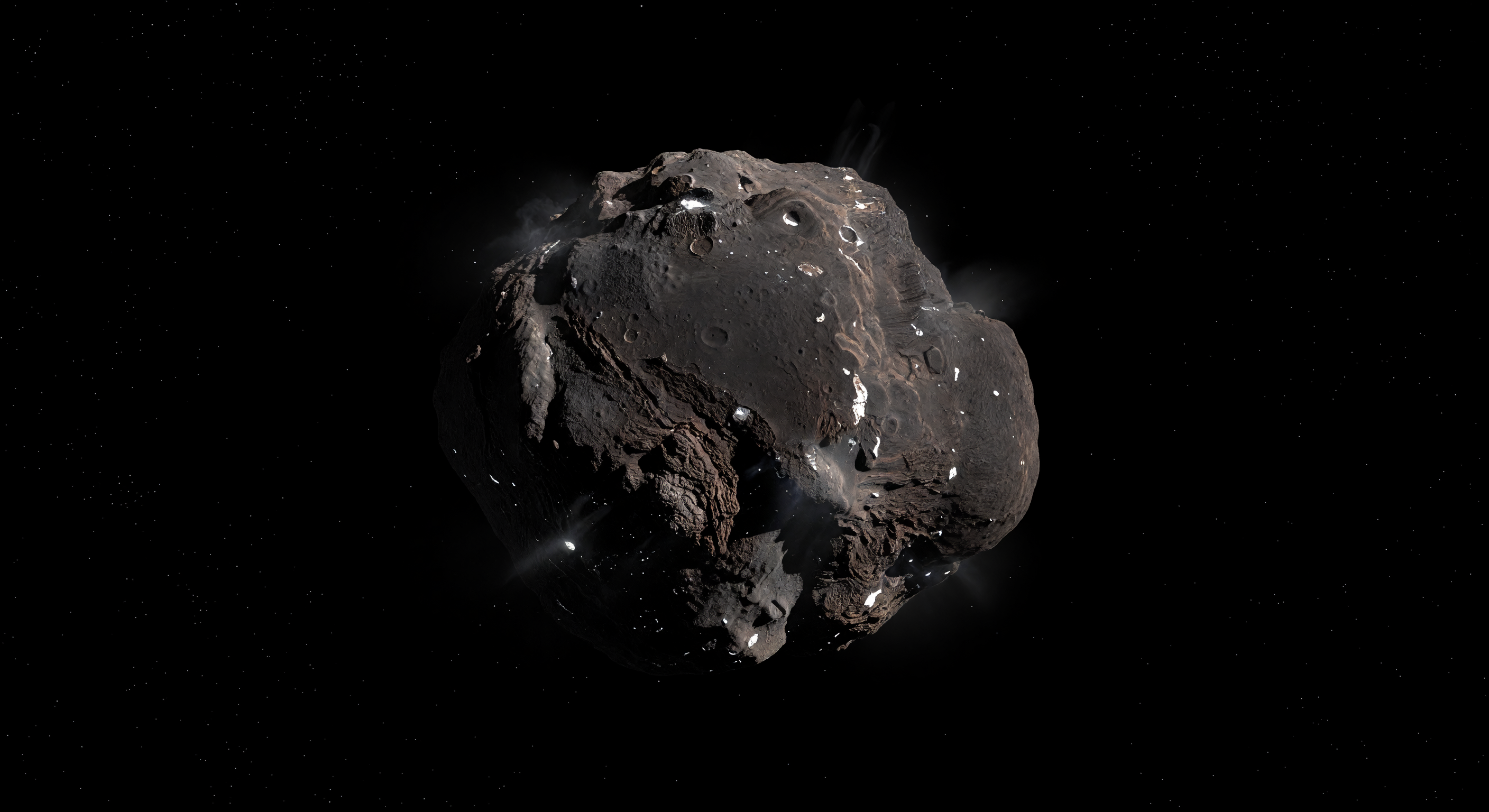
Scientific confidence: Medium
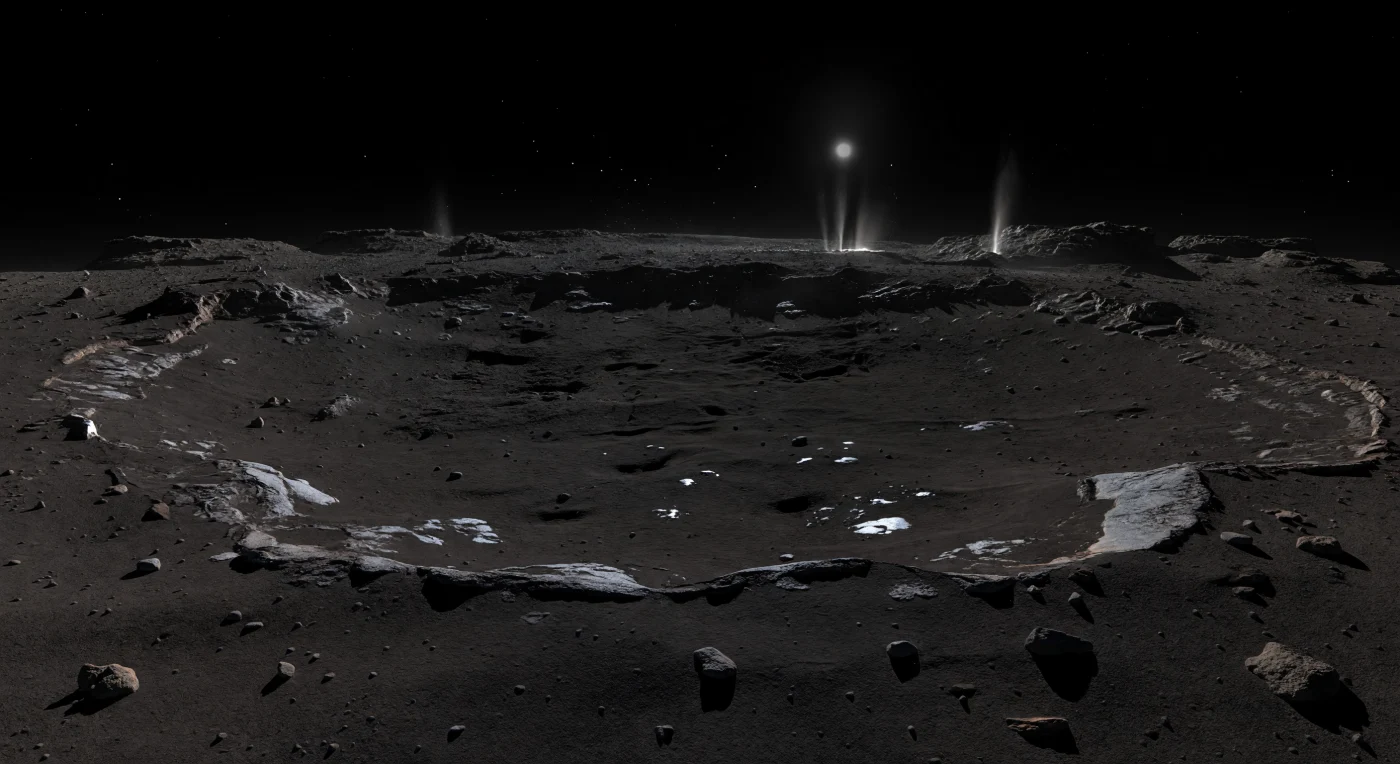
From this low vantage, a smooth equatorial basin spreads away as a near-lightless plain of charcoal-black fallback dust, so dark it seems to swallow the hard white sunlight except where sparse pebbles, scattered boulders, and a few weakly glinting ice patches interrupt the matte surface. The horizon curves abruptly and close by, revealing the comet’s tiny scale, while beyond it rise low hummocky rims, fractured scarps, and knobby mesas whose exposed faces hint at a layered nucleus: a thin, dark, organic-rich crust draped over brighter, volatile-rich material that includes dirty water ice. In the airless vacuum, the sky remains pure black even at midday, and every rock throws a razor-edged shadow, while a few dust grains drift lazily above the ground, barely restrained by gravity. Far off, thin sublimation jets lift from sunlit scarps like ghostly fountains, a reminder that this stark, frozen landscape is not static but slowly reshaped as buried ices warm and escape into space.
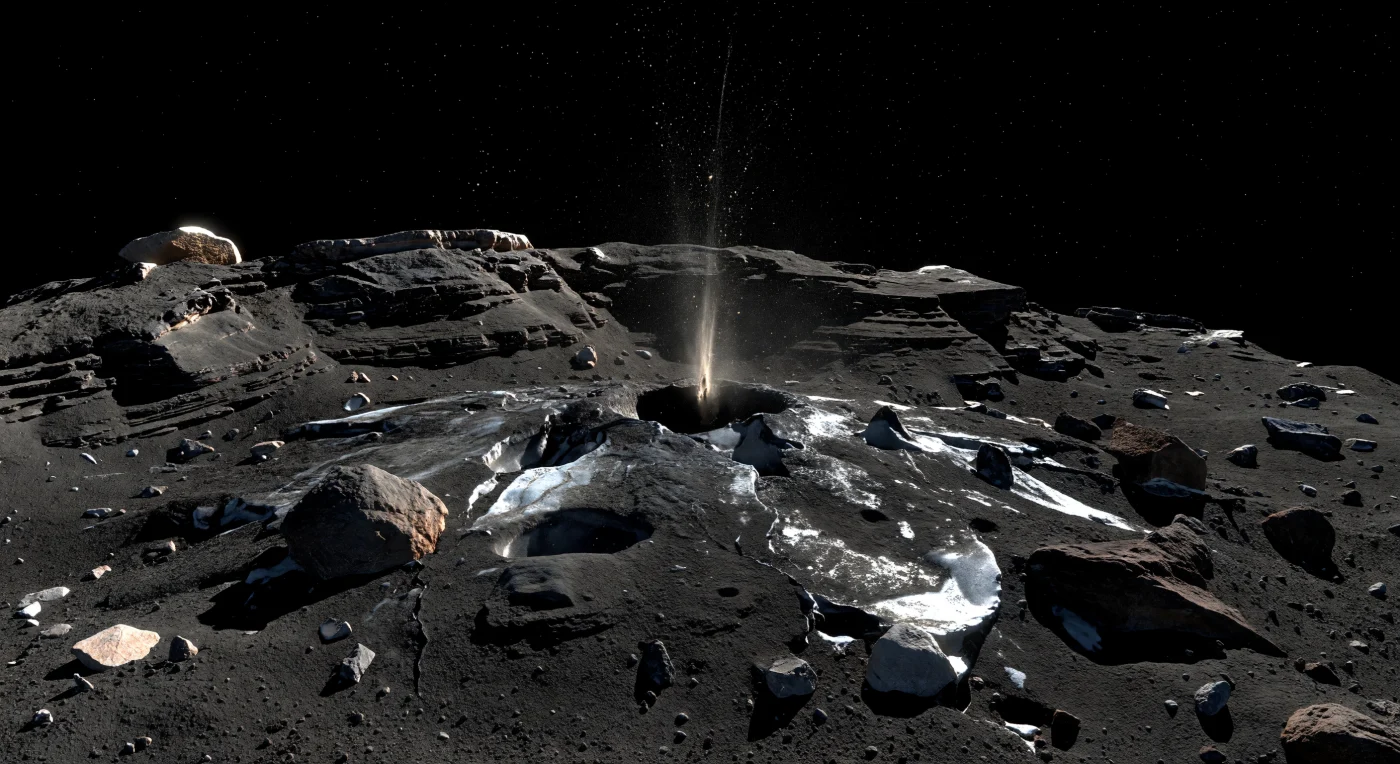
You stand on a steep, fractured slope of material darker than charcoal, where a crumbly black vent has split the organic-rich crust and opened a window into brighter, dirty ice beneath. In the hard, airless sunlight near perihelion, that exposed volatile-rich ground is actively sublimating: a thin, filamentary jet rises like a delicate fountain, carrying glittering dust grains and tiny pebbles upward in the comet’s feeble gravity before they drift and disperse into vacuum. Layered scarps, brittle overhangs, collapse pits, and precariously balanced boulders reveal a porous nucleus built of alternating dusty and ice-rich bands, its surface shaped as much by erosion and outgassing as by impact. With the horizon curving nearby under a star-filled black sky and every shadow cut razor-sharp, the scene feels both intimate and immense—a small, fragile world literally exhaling into space.

A maze of knobby ridges, jagged hummocks, fractured black crust, and house-sized angular blocks fills the view, broken by collapsed pits and steep scarps whose interiors drop into absolute shadow beneath a hard white Sun in a sky that stays perfectly black. The surface is so dark—an organic-rich, devolatilized mantle reflecting only a few percent of the light—that most of the landscape swallows illumination like soot, while occasional bright seams and frost patches reveal buried dirty water ice within a layered mixture of dust and frozen volatiles. In this tiny-gravity highland, loose talus and fine fallback debris cling precariously to slopes, overhangs rise at improbable angles, and thin fan-shaped jets of gas and dust seep from sunlit fractures as sublimation lifts particles gently upward instead of letting them fall. With the horizon close and subtly curved, the whole scene feels both miniature and immense: a fragile, active crust on a porous cometary nucleus, silent, airless, and startlingly raw in the glare of perihelion sunlight.
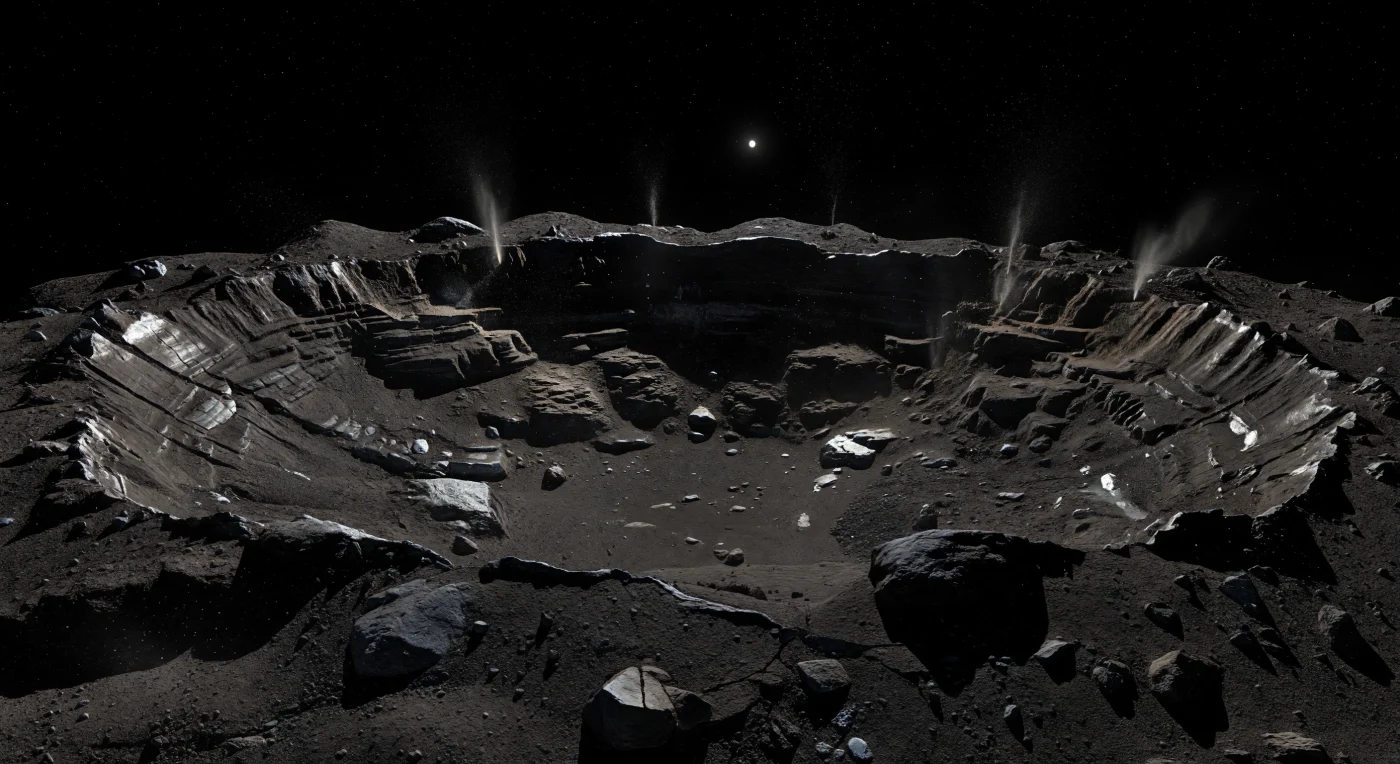
A vast scalloped basin sinks into the comet’s near-black surface, its broken rims, arcuate scarps, and stepped collapse terraces dropping through brittle crust and hummocky debris to a smoother floor mantled in charcoal-colored dust. In the harsh, airless sunlight, razor-sharp shadows carve out layers and fractures in the dark organic-rich crust, while a few dull bluish-white patches of exposed dirty ice glint from fresh scarps and shadowed recesses, hinting at volatile-rich material hidden below the devolatilized surface. Narrow jets of gas and dust rise from sunlit cracks along the rim, lofting grains and icy particles in slow, delicate arcs that seem to hang above the ground in the comet’s feeble gravity. Beyond the basin, the horizon falls away abruptly and curves close at hand beneath a pure black sky, making this several-hundred-meter depression feel immense on a tiny, porous world that is still actively reshaped by sublimation and collapse.

At sunrise, a towering cliff of charcoal-black crust rises from the rough granular plain, its nearly 100-meter face etched into terrace-like layers by collapse and erosion, while the base disappears into absolute black shadow under the hard light of vacuum. The surface is extraordinarily dark—darker than most coal—made of devolatilized organic-rich dust and crust that conceals a colder interior, revealed here in narrow dirty-white to faint bluish icy streaks and frost-rich patches exposed on fresh slump scars. Angular blocks, crumbly ledges, and smooth pockets of fallback dust lie almost weightless in the comet’s feeble gravity, and a few fine grains or weak wisps of escaping gas may drift upward from sunlit fractures where buried volatiles are beginning to sublimate. Above the subtly curved, close horizon, the sky remains pure black even in daylight, with a sparse starfield beyond the low Sun, giving the whole scene the uncanny feeling of standing on a tiny, porous relic from the early Solar System.

An ultra-dark plain of black-brown crust and dirty ice stretches toward a nearby, gently curved horizon, where low layered scarps rise like frozen waves under a perfectly black sky crowded with sharp stars. In the dim sub-horizon glow of a distant Sun, only the faintest cold highlights catch on polygonal fractures, crumbly ledges, meter-scale boulders, and rare bright patches where water ice breaks through the darker devolatilized surface. These scarps and smooth dust plains record the structure of a porous, weak-gravity comet nucleus built from dusty ice and organic-rich material, with exposed layers, fallback debris, and brittle surface crust shaped by repeated heating and freezing over many orbits. Here at aphelion the landscape is utterly dormant—no jets, no coma, no drifting dust—just a silent, light-swallowing world where every shadow is razor-edged and the scale feels both intimate and immense.

At your feet, meter-sized blocks of charcoal-dark crust sprawl across a steep slope in an arrangement that looks impossibly fragile, each angular boulder touching the ground at only a few points and casting long, razor-edged shadows through the black vacuum. Thin veneers of fallback dust and granular regolith gather in the gaps, while fresh fractures expose small patches of brighter dirty ice beneath the comet’s extraordinarily dark, organic-rich surface, a crust reflecting only about four percent of the sunlight that strikes it. Layered scarps, narrow cracks, collapse pits, and hummocky terraces reveal a porous, stratified nucleus shaped by repeated heating and sublimation, and from some shadowed fractures faint jets of gas and dust rise in delicate fans, lofting grains that drift in slow arcs under almost negligible gravity. With no atmosphere to soften the light, the Sun appears as a hard white disk above a close, slightly curved horizon, making this tiny landscape feel both intimate and vast—an unstable apron of debris on a small active world where even dust seems only loosely held in place.

At the lip of a narrow, twisting trench, the surface drops from a tar-dark, charcoal-brown mantle into a fissure so black it seems to swallow the sunlight, while along the broken rim thin veneers and crusty patches of dirty bluish-white water ice glint sharply against the comet’s ultra-dark dust. The walls reveal a thin devolatilized crust—organic-rich, brittle, and only about 4% reflective—overlying brighter, more volatile-rich icy material, exposed where collapse and fracturing have cut through the surface. In the weak gravity, powdery debris, angular slabs, and loosely settled boulders rest uneasily across the hummocky ground, and farther off, a few sunlit fractures may vent faint jets of gas and entrained dust as buried ice sublimates directly into vacuum. Under a perfectly black sky with hard stars and a small, fierce Sun casting razor-edged shadows, the close, subtly curved horizon makes this fractured landscape feel both intimate and immense: a fragile crust on a tiny active world still slowly shedding itself into space.
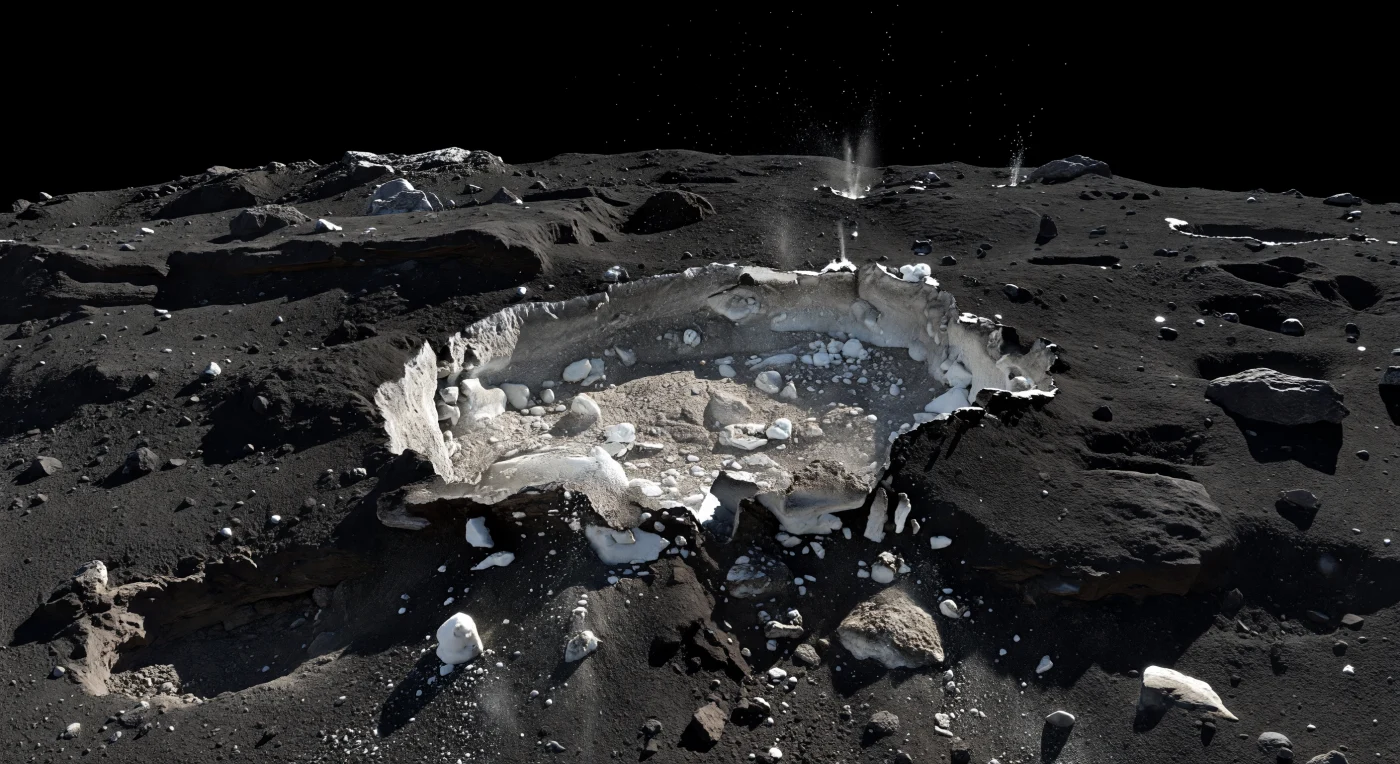
At your feet, a fresh wound tears through an almost coal-black surface, exposing a startling patch of pale ash-gray to dirty white rubble where granular water ice, frost-dusted clasts, and brighter icy debris gleam in hard sunlight. Around it, the mature crust is among the darkest known in the Solar System—an organic-rich, devolatilized skin only a few percent reflective—broken into crumbly talus, angular boulders, shallow fractures, low scarps, and irregular pits, with sharp shadows cutting across every ledge in the airless vacuum. The raw exposure’s jagged margins and visible layering reveal how volatile-rich material lies beneath this blackened mantle, while weak gravity lets fine grains hover and spreads mixed dark dust and bright ejecta in a delicate downslope fan. Beyond the house-sized blocks, the horizon curves away unnervingly close under a pure black sky, and in the middle distance a few narrow jets rise from sunlit fractures, carrying sparkling dust off this tiny, active world.

From the crest of a jagged ridge at the day-night boundary, the nucleus curves away so quickly that the horizon feels almost within reach, its black-brown surface darker than charcoal and broken into brittle plates, angular rubble, layered scarps, and steep-walled hollows that seem too sharp and overhung to survive anywhere but in such feeble gravity. Fresh fractures reveal the comet’s true makeup beneath the devolatilized crust: dusty, volatile-rich layers with small gleams of dirty water ice, while fine grains and tiny pebbles drift just above the ground, only weakly bound to this porous body. Beyond the ridge, narrow jets burst from sunlit fractures and pit walls as sunlight warms buried ices into gas, lofting dust in glittering fountains that rise into a sky with no air, no haze, and no mercy. On the other side, the terrain drops instantly into absolute blackness where stars remain visible above the night side, making the contrast between blazing limb, razor-edged shadows, and the tiny world’s curling ridges feel at once scientifically stark and profoundly alien.