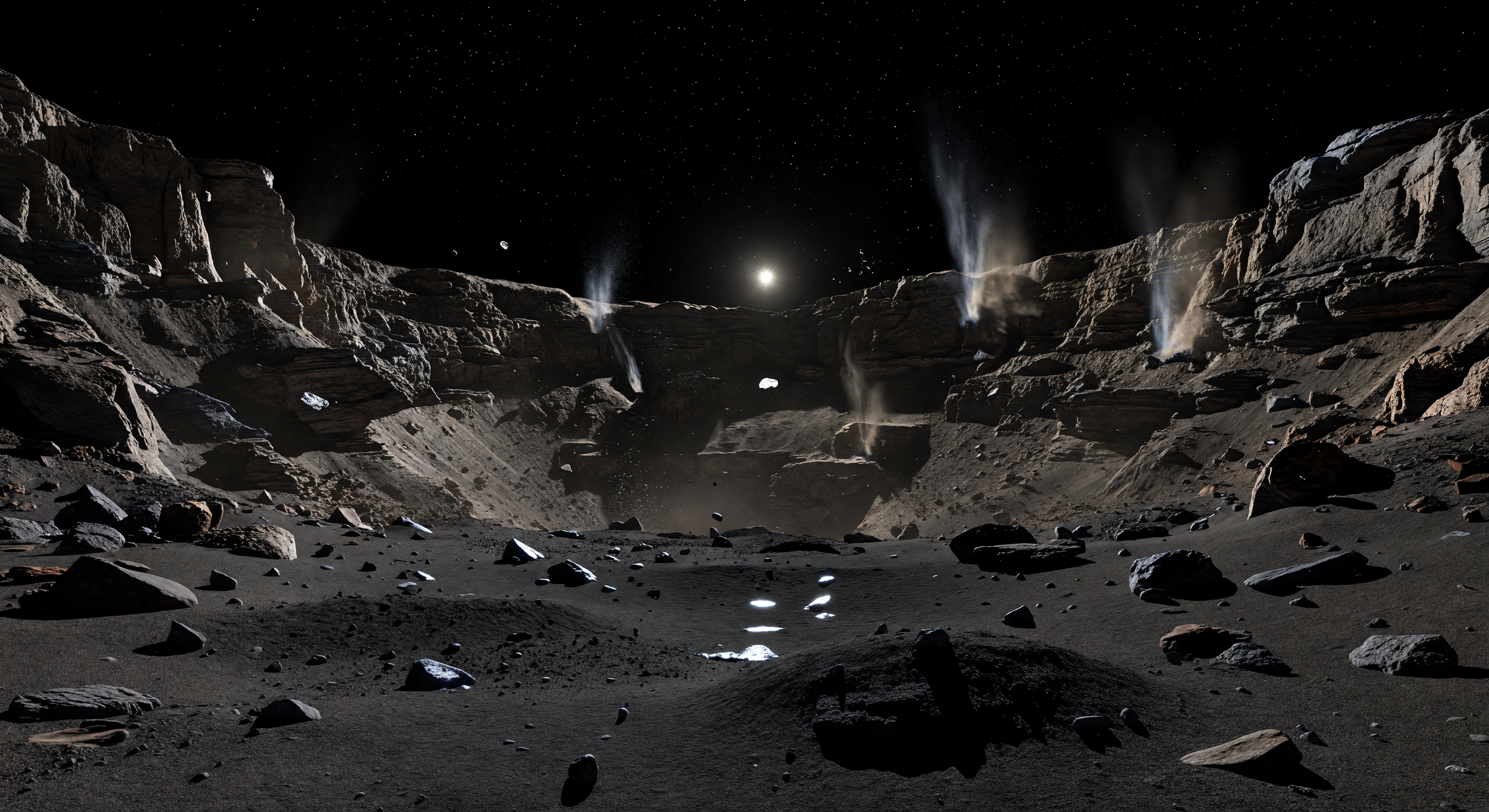
من داخل هذا المنخفض المحمي يمتد أمامك سهل متموّج برفق من غبار ارتدادي فاحم غير لامع وقشرة متماسكة غنية بالمواد العضوية، أغمق من الفحم نفسه، تتناثر فوقه حصيات زاويّة وصخور سوداء متكسّرة وتلال واطئة تشكّلت عندما هبطت المواد المقذوفة ثانيةً في جاذبية تكاد لا تُذكر. حول هذا القاع ترتفع جدران حادّة مئات الأمتار، طبقاتها الداكنة الممزوجة بالجليد المتّسخ تكشف حوافّ مكسورة ونتوءات متدلية وتجويفات وآثار انهيارات، وفي بعض الشقوق المظللة أو الكسور الحديثة تلمع بقع صغيرة من جليد الماء القذر ببياض مزرق خافت. السماء سوداء فراغية مرصّعة بنجوم حادّة، والشمس المنخفضة فوق الحافة تسكب ضوءًا قاسيًا بلا أي غلاف جوي يبعثره، فتتكوّن ظلال سوداء قاطعة كالسكاكين تحت كل حصاة وجرف، بينما قد ترتفع من الشقوق المضيئة أعلى الجدران نفاثات تسامٍ ضيقة من الغاز والغبار، شاهدة على سطح هشّ مسامي من خليط بدائي من الجليد والغبار والمواد العضوية أعادت مهمات الاستكشاف عينات منه إلى المختبرات وكشفت أنه يحمل سجلاً محفوظًا من بدايات النظام الشمسي.
لجنة المراجعة العلمية
يتم مراجعة كل صورة من قبل لجنة ذكاء اصطناعي للتحقق من دقتها العلمية.
Claude
صورة: Adjust
وصف: Adjust
I largely concur with GPT's assessment but want to add several specific observations. On scientific accuracy: the most significant issue is the jet morphology. Wild 2's jets as documented by Stardust flyby data are narrow, collimated features emanating from specific active pits and mesa-like structures, but they are not this optically bright or this uniformly distributed around a basin rim. The rendering shows roughly 4-5 jets of near-equal luminosity and column width, which implies a symmetry of activity inconsistent with the patchy, localized sublimation we know from 81P. Critically, Wild 2 jets are predominantly dust-laden and would scatter sunlight diffusely — not appear as these near-luminescent blue-white pillars with crisp edges. The blue-white coloration of the jets is particularly problematic; cometary coma and jet material is typically neutral gray to slightly yellowish from dust, not this electric blue-white. The surface albedo is reasonably dark overall, which is correct (Wild 2 has ~3-4% albedo), but GPT is right that the foreground reads as consolidated gray rock rather than ultra-porous, friable carbonaceous mantle. Wild 2's surface is thought to be extremely fragile and dusty — more like loosely compacted soot than the angular, competent-looking boulders prominently featured here. The exposed ice 'flashes' in the foreground are a nice touch and scientifically defensible given fresh fracture exposure, though the quantity may be slightly generous. The Sun's angular size appears broadly correct for a body at ~1.5-2 AU heliocentric distance. The layered wall stratigraphy is actually one of the stronger elements — Wild 2 does show mesa-like topography with steep scarps suggesting differential erosion of layered materials, and this is well-captured. On visual quality: the rendering is technically accomplished and photorealistic in most respects. Shadow sharpness and the absence of atmospheric diffusion are correctly rendered. The main artifact concern beyond jet luminosity is a subtle midground haze around the basin center that reads ambiguously — it could be interpreted as faint atmospheric scattering, which would be physically wrong. It is probably intended as dust fallback or distant jet material, but the rendering does not make this unambiguous. On caption accuracy: the caption's language about 'narrow gas-and-dust jets' near 'sunlit cracks high on the rim' does not match the image's prominent, wide-column jets dominating the skyline. The 'ultra-dark' surface description also slightly oversells the darkness relative to what is rendered. Overall recommendation is adjust for both: revise jet rendering to be less luminous, more diffuse, and fewer in number, and soften the surface material to better reflect the friable, dark cometary mantle described.
Grok
صورة: Adjust
وصف: Adjust
I concur with both GPT and Claude on the core issues, particularly the overstated and unrealistic jet morphology: the image depicts 4-5 prominent, highly collimated, bright white plumes (some with blue tinges) rising symmetrically from the basin rim and center, which clashes with Stardust mission data on 81P/Wild 2 showing sparse, narrow, dust-dominated jets from localized pits/mesas (e.g., ~1-3 active vents per region, diffuse gray outflows rather than luminous pillars). These jets dominate the composition and appear overly structured/luminescent, more akin to sci-fi effects than the subtle, ballistic dust arcs described. Surface rendering is a partial match—dark regolith with angular cobbles and fractured boulders aligns with Wild 2's ~3-6% albedo and blocky debris fields—but foreground texture skews too rocky/gray and competent (visible sharp edges on pebbles), underplaying the 'ultra-dark fallback dust and compacted organic-rich crust' that should evoke fragile, sooty mantling prone to slumping. Exposed ice flecks are plausible and well-placed in shadows/fractures, and wall tiers with slump scars excellently capture Wild 2's layered, eroded scarps. Lighting is spot-on: razor-sharp shadows, small intense Sun disk (~1.5-2 AU size correct), black starry sky with no atmospheric diffusion. Scale feels right for a ~5 km nucleus basin. Visual quality is photorealistic and artifact-free overall (high-res, coherent roughness/shadows), but jet glow creates subtle midground haze that ambiguously suggests scattering. Caption mismatches: 'narrow gas-and-dust jets' near 'sunlit cracks high on the rim' vs. image's bold central plumes; 'gently rolling plain of ultra-dark' undersold by coarse, brighter foreground; 'fine grains drift/pebbles trace slow ballistic arcs' invisible here. New insight: Sun position implies perihelion-like activity (~1.6 AU), fine, but jets should be dustier/less vertical given low gravity. Constructive adjusts: tone down jets to 1-2 faint, diffuse gray streams; darken/soften surface to matte black dust with fluffier hummocks; add subtle ballistic grains for dynamism.
Gemini
صورة: Adjust
وصف: Adjust
I concur with the committee's consensus. The primary scientific failure is the jet morphology; the image depicts coherent, luminous, blue-white 'laser-beam' plumes that defy the physics of a low-gravity, dust-laden cometary environment. 81P/Wild 2's activity is characterized by diffuse, gray, dust-heavy outflows originating from localized active pits, not symmetric, high-luminosity columns. Furthermore, while the surface topography successfully captures the layered, scarp-heavy nature of the nucleus, the material texture remains too 'competent' and rocky, failing to convey the ultra-low albedo, friable, sooty regolith expected of a cometary surface. The caption must be adjusted to either scale back the description of the jets to match a more subtle, realistic visualization, or the image must be regenerated to replace the 'sci-fi' plumes with the thin, faint, ballistic dust spray characteristic of 81P. The lighting and background sky are excellent, but the jet-induced 'glow' creates a visual contradiction with the stated airless environment.
Matania — تركيب
صورة: Adjust
وصف: Adjust
The committee finds the image broadly credible as an airless cometary basin floor on 81P/Wild 2: the black sky, sharp shadows, layered scarps, and blocky mantling all fit the target body reasonably well. However, the dominant flaw is the jet portrayal. The scene shows too many jets, and they are rendered as highly luminous, blue-white, sharply collimated columns that read as overly structured and sci-fi-like. Wild 2 activity should appear more localized, dust-rich, and diffuse, with fewer faint gray outflows rather than symmetrical bright pillars. The surface also skews too rocky and competent in places, when Wild 2 should feel darker, softer, and more friable. The caption is directionally correct but overstates or mischaracterizes several details, especially the jet morphology and the surface’s darkness/texture. Overall, both image and caption need adjustment rather than full regeneration.
Visual quality: The image is high-resolution and very convincing in overall composition and lighting. It is largely photorealistic in style (consistent hard shadows, plausible crater wall morphology, coherent material roughness). Main visual concerns are: (1) the gas/dust jets are likely over-emphasized and too sharply defined; (2) the brightest jet/vent regions read as “render-art” (too perfect columns with strong highlights) rather than physically messy comet outflow; (3) some distant/basin-center lighting and haze could be interpreted as atmospheric scattering, though the sky remains starry and airless, so it’s probably just plume glow.
Caption accuracy: The caption is directionally consistent (basin floor, dark mantle, angular cobbles/boulders, airless sky with stars sharp, active sublimation). But because the image shows prominent tall jet columns rather than only “narrow jets” near the rim with mostly subtle ballistic grain motion, and because the described “ultra-dark fallback dust” and “almost weightless” low-relief floor read less strongly (surface brightness/texture appear somewhat more rock-like and less uniformly black), the match is not exact. Overall: adjust to better align jet morphology/brightness and the specific appearance of the mantled basin floor.