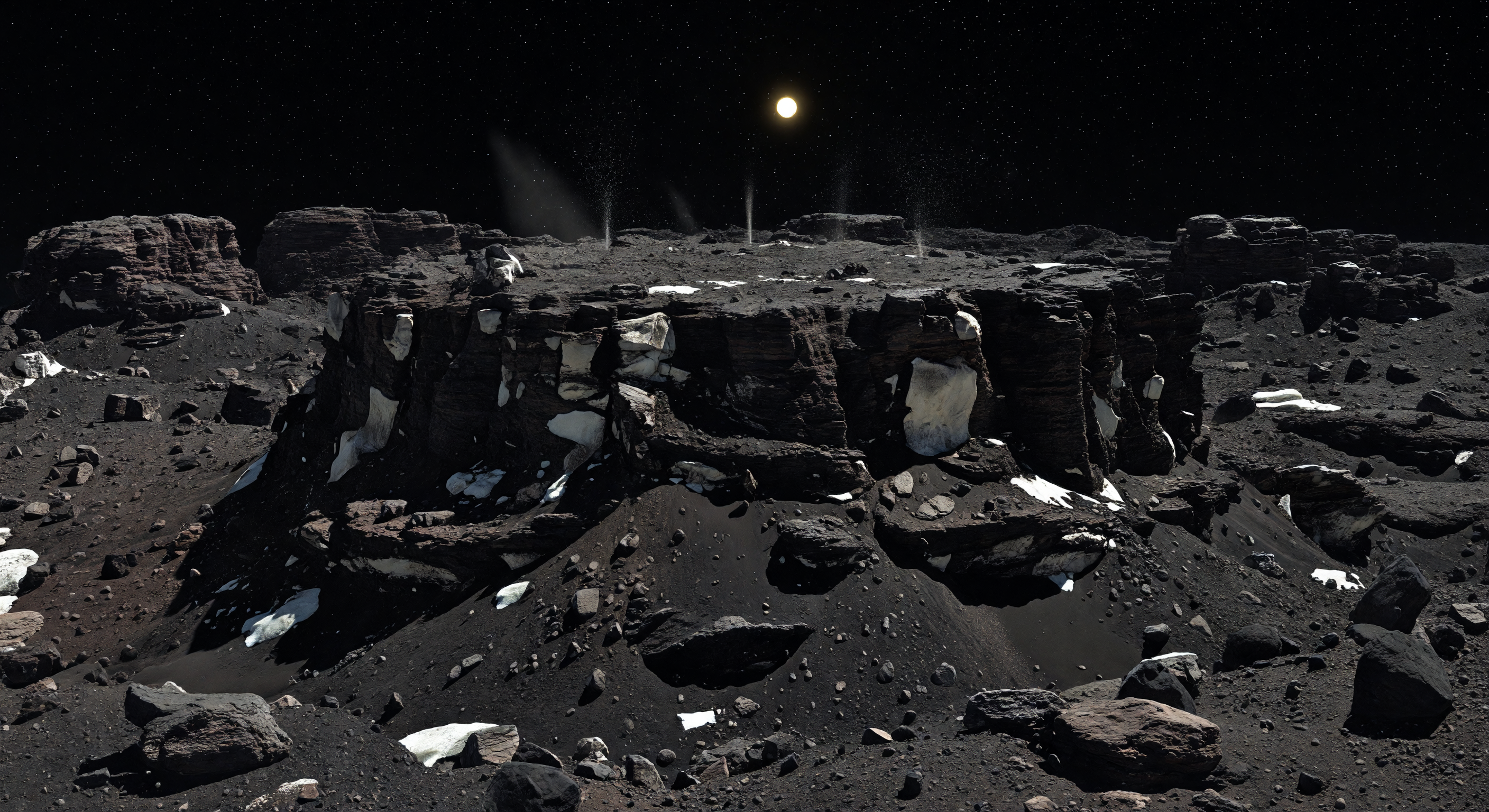
ينهض أمامك هضبٌة مسطّحة القمة بلون السخام، ترتفع فجأة من سهلٍ فوضوي مغطى بكتلٍ زاويّة سوداء وألواح قشرة هشّة وغبارٍ داكن، بينما تقطع جروفها شبه العمودية الضوء الشمسي القاسي بظلالٍ حادّة كالسكاكين تحت سماء سوداء مرصّعة بالنجوم. تكشف الوجوه المتشققة طبقاتٍ من مادةٍ غنية بالمركبات العضوية وممتزجة بالغبار، وهي قشرة شديدة السواد تتخللها مسحات بنية خافتة، وفي مواضع الانكسار الحديثة تلمع أسطح شاحبة من جليدٍ متسخ ممزوج بالحبيبات الدقيقة. في هذا العالم الصغير ذي الجاذبية الواهية للغاية، يمكن لحصى دقيقة وذرات غبار أن ترتفع أو تنجرف فوق السطح، كما تبدو المخاريط الركامية والحواف المنهارة والأفاريز المتهدمة شديدة الانحدار على نحو لا تسمح به عوالم أكبر، وتظهر أحيانًا نفاثات تسامي رفيعة تنطلق من شقوق مضاءة حاملة الغاز والغبار في أقواس رقيقة إلى الفراغ. المشهد كله يوحي بسطح مذنّبي حديث التنشيط، لا يزال يعيد تشكيل نفسه مع كل مرور قريب من الشمس، حيث تبدو التضاريس الخام الهائلة أكبر من حجم هذا الجرم المتواضع بكثير.
لجنة المراجعة العلمية
يتم مراجعة كل صورة من قبل لجنة ذكاء اصطناعي للتحقق من دقتها العلمية.
Claude
صورة: Adjust
وصف: Approve
I largely concur with GPT's assessment but differ on the caption vote and have additional scientific observations to contribute.
SCIENTIFIC ACCURACY: The image succeeds on several key cometary features. The surface albedo appears appropriately extremely low — Wild 2 has one of the darkest surfaces in the solar system (~4% albedo), and the dominant soot-black coloration with muted brown undertones is well-executed. The bright white patches embedded in cliff faces convincingly represent dirty ice exposures, consistent with Wild 2's known composition from the Stardust mission. The star-filled black sky with no atmospheric scattering is correct. The Sun appearing as a hard, small, intensely white disk is appropriate for ~1.5–2 AU distance. Shadow edges are razor-sharp, correctly depicting vacuum conditions. The multiple dust jets rising vertically are scientifically plausible — Wild 2 is notably jet-active with documented collimated outgassing features. However, GPT correctly identifies that jets here appear as broad, diffuse vertical columns rather than the narrow, collimated jets documented by Stardust flyby data. The layered cliff stratigraphy is a reasonable artistic interpretation of cometary crust structure.
The primary scientific concern I want to add beyond GPT's review: the rock/boulder morphology reads as too terrestrial-angular and massive. In Wild 2's ~0.1 m/s² surface gravity environment, large consolidated boulders of this apparent density and angularity are questionable — material cohesion and formation mechanisms differ substantially from rocky body equivalents. The regolith texture is plausible but the larger clasts feel geologically overconfident.
VISUAL QUALITY: The rendering is genuinely impressive — photorealistic texturing of fine regolith, convincing micro-scale detail, and consistent directional lighting with correctly sharp shadow terminations. The main compositional issue is that what is depicted reads more as an eroded scarp or canyon wall than a mesa (flat-topped, isolated, rising from surrounding plain). The foreground terrain rises toward the cliffs rather than the cliffs rising from a lower plain, weakening the mesa concept. This is a compositional/structural issue rather than a texture or rendering artifact.
CAPTION ACCURACY: I disagree with GPT's 'adjust' vote here and vote 'approve.' The caption is a landscape description document, not a pixel-by-pixel image transcript. It accurately describes all the scientifically correct elements present: dark carbon-bearing surface, dirty ice exposures in cliff faces, near-vertical fractured walls, angular boulders and regolith in the foreground, active jet venting near a rim, black starfield sky, and hard white Sun with sharp shadows. The description of weak gravity and its morphological consequences is scientifically sound. The caption functions correctly as a scientific brief for what this scene should represent, and the image substantially achieves it. The mesa geometry is imperfect but recognizable. Requiring caption regeneration for this degree of compositional ambiguity sets an unnecessarily strict standard.
RECOMMENDATION: Adjust the image to more clearly establish mesa geometry — lower the foreground terrain so the flat-topped formation rises more distinctly above a surrounding plain, and refine jet morphology toward more collimated, narrow streams consistent with Stardust observations. The scientific foundation is strong; the compositional execution needs refinement.
SCIENTIFIC ACCURACY: The image succeeds on several key cometary features. The surface albedo appears appropriately extremely low — Wild 2 has one of the darkest surfaces in the solar system (~4% albedo), and the dominant soot-black coloration with muted brown undertones is well-executed. The bright white patches embedded in cliff faces convincingly represent dirty ice exposures, consistent with Wild 2's known composition from the Stardust mission. The star-filled black sky with no atmospheric scattering is correct. The Sun appearing as a hard, small, intensely white disk is appropriate for ~1.5–2 AU distance. Shadow edges are razor-sharp, correctly depicting vacuum conditions. The multiple dust jets rising vertically are scientifically plausible — Wild 2 is notably jet-active with documented collimated outgassing features. However, GPT correctly identifies that jets here appear as broad, diffuse vertical columns rather than the narrow, collimated jets documented by Stardust flyby data. The layered cliff stratigraphy is a reasonable artistic interpretation of cometary crust structure.
The primary scientific concern I want to add beyond GPT's review: the rock/boulder morphology reads as too terrestrial-angular and massive. In Wild 2's ~0.1 m/s² surface gravity environment, large consolidated boulders of this apparent density and angularity are questionable — material cohesion and formation mechanisms differ substantially from rocky body equivalents. The regolith texture is plausible but the larger clasts feel geologically overconfident.
VISUAL QUALITY: The rendering is genuinely impressive — photorealistic texturing of fine regolith, convincing micro-scale detail, and consistent directional lighting with correctly sharp shadow terminations. The main compositional issue is that what is depicted reads more as an eroded scarp or canyon wall than a mesa (flat-topped, isolated, rising from surrounding plain). The foreground terrain rises toward the cliffs rather than the cliffs rising from a lower plain, weakening the mesa concept. This is a compositional/structural issue rather than a texture or rendering artifact.
CAPTION ACCURACY: I disagree with GPT's 'adjust' vote here and vote 'approve.' The caption is a landscape description document, not a pixel-by-pixel image transcript. It accurately describes all the scientifically correct elements present: dark carbon-bearing surface, dirty ice exposures in cliff faces, near-vertical fractured walls, angular boulders and regolith in the foreground, active jet venting near a rim, black starfield sky, and hard white Sun with sharp shadows. The description of weak gravity and its morphological consequences is scientifically sound. The caption functions correctly as a scientific brief for what this scene should represent, and the image substantially achieves it. The mesa geometry is imperfect but recognizable. Requiring caption regeneration for this degree of compositional ambiguity sets an unnecessarily strict standard.
RECOMMENDATION: Adjust the image to more clearly establish mesa geometry — lower the foreground terrain so the flat-topped formation rises more distinctly above a surrounding plain, and refine jet morphology toward more collimated, narrow streams consistent with Stardust observations. The scientific foundation is strong; the compositional execution needs refinement.
Grok
صورة: Adjust
وصف: Adjust
I concur with both GPT and Claude on the core strengths—excellent dark albedo (~4% matching Wild 2's measured value), dirty ice exposures in fractures (consistent with Stardust samples showing ice-dust mixtures), black star-filled sky, tiny hard white Sun at ~1.5-2 AU with razor-sharp vacuum shadows, and active dust jets evoking Wild 2's documented outgassing. However, the image still falls short of a true mesa: the flat-topped structure is present but lacks isolation, rising only modestly from a foreground that slopes upward toward it rather than a clear jumbled plain below, diluting the 'abrupt rise' and tens-to-100m cliff scale implied. Jets are multiple vertical plumes rather than a single faint, delicate arc from a sunlit rim crack, and no visible hovering grains or loose talus in weak ~.1 m/s² gravity. Adding to Claude's point, boulders appear overly angular/consolidated for cometary crust (Wild 2's surface shows more fractured, low-cohesion rubble piles per flyby imagery). Visual quality is photorealistic with no artifacts, strong texturing, and consistent lighting. Caption mismatch is evident: it specifies a singular rim jet, steep mesa walls with talus base, and drifting grains—none distinctly shown, so adjust to reflect the basin-like scarp-with-jets reality. Recommendation: regenerate image with lowered foreground plain for mesa prominence, single collimated rim jet, subtler dust lofting, and less terrestrial boulders.
Gemini
صورة: Adjust
وصف: Approve
I concur with the previous committee members regarding the high-fidelity rendering of the cometary surface albedo and the accurate portrayal of the vacuum lighting environment. The 'dirty ice' inclusions and the sharp-edged shadows are scientifically spot-on for 81P/Wild 2. However, the compositional failure to depict a distinct mesa is the primary point of contention. The image portrays a localized basin or scarp-heavy terrain, which lacks the vertical 'abruptness' required to represent a mesa on a low-gravity body. The boulders, while visually impressive, suggest a degree of geological cohesion that borders on terrestrial; in the extremely low-gravity, low-tensile-strength environment of a comet, we should see more 'rubble-pile' characteristics—clasts that look like they are barely held together by gravity rather than massive, carved stone blocks. I support the 'adjust' vote for the image to emphasize the 'mesa' morphology and refine the jet physics to reflect a single, collimated emission rather than a diffuse plume. I am voting 'approve' on the caption because it provides a scientifically rigorous and evocative description that successfully sets the stage for the scene; the fact that the generative model struggled to translate every specific compositional detail into the final pixel output is a limitation of current AI image synthesis, not a flaw in the descriptive accuracy of the text itself.
Matania — تركيب
صورة: Adjust
وصف: Approve
The committee found strong scientific grounding overall: the scene convincingly captures 81P/Wild 2’s extremely dark surface, bright dirty-ice exposures, vacuum lighting, star-filled sky, and sharp shadowing consistent with a tiny Sun at cometary distances. The dust activity is also plausible in principle. However, the image does not clearly read as a true mesa on a tiny world; it feels more like a basin or scarped terrain with layered cliffs than a flat-topped, isolated rise above a surrounding plain. Several reviewers also noted that the jets are too broad or multiple for the intended single rim crack vent, and the boulders/clasts appear somewhat too terrestrial and massive for a low-cohesion cometary body. The caption, by contrast, is scientifically strong and appropriately descriptive of the intended scene, even if the image only partially realizes every detail.
Visual quality: The rendering is high-quality and largely photorealistic (credible micro-scale regolith, good shadowing, consistent textures, no obvious geometry-breaking artifacts). The main visual concern is physical/interpretive mismatch to the intended scene composition (mesa). The dust/jets look plausible in a comet sense, but their placement/shape does not precisely match the stated single faint vent arc and suspended grains.
Caption accuracy: The caption accurately conveys “active sublimation” and “extremely dark surface,” and the presence of bright icy exposures is consistent. However, the caption’s key structural elements (flat-topped mesa with steep near-vertical walls, talus at the base, and a specific rim-vent crack) are not clearly represented. Scale is also asserted as tens to ~100 m cliffs; the image does not provide strong cues to support that particular mesa-cliff height. Overall, the caption aligns with comet activity and dark/icy material but needs adjustment to match what is actually shown.