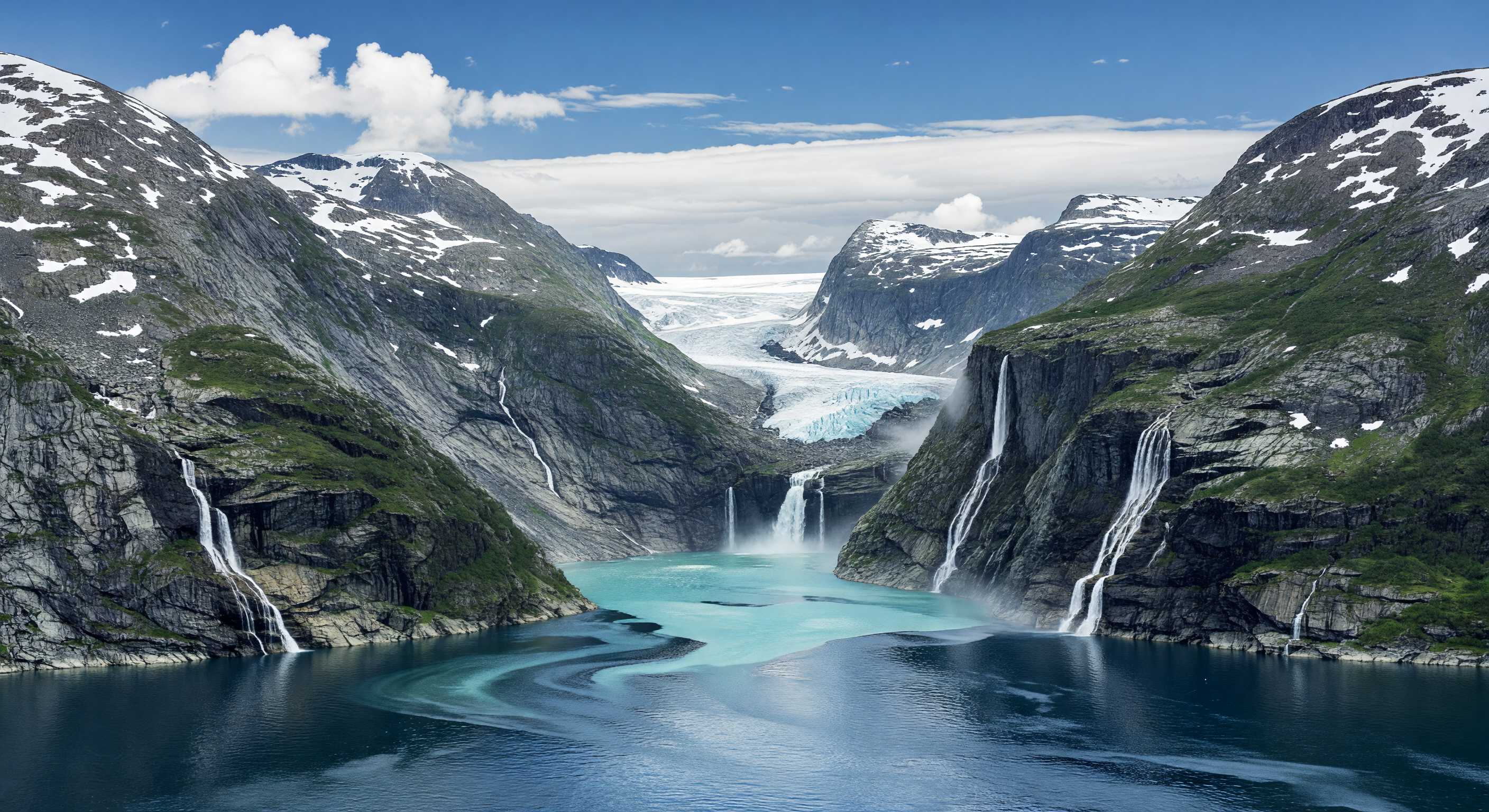
من حافة الشاطئ يبدو المضيق كشقّ هائل غمره البحر، حيث ترتفع جدران صخرية شبه عمودية لأكثر من ألف متر مباشرة من الماء الداكن البارد، كاشفةً واديًا على شكل حرف U نحته الجليد خلال العصور الجليدية. عند رأس المضيق يهبط نهر جليدي أبيض ناصع بين الجبال، تتخلله شقوق عميقة وأبراج جليدية زرقاء، بينما يندفع منه تصريف مائي عذب محمّل بدقيق الصخور الجليدية فيرسم على السطح سحابة ممتدة من الفيروزي اللامع إلى الأزرق الحليبي قبل أن تمتزج بمياه البحر الفولاذية. على الجروف تظهر طبقات متعاقبة من صخور متحولة ونارية داكنة تتخللها نطاقات أفتح لونًا، مصقولة ومخددة بفعل السحل الجليدي، وتتدلى بينها شلالات من أودية معلقة تنثر رذاذًا أبيض وضبابًا باردًا في الهواء. وتحت ضوء شمس مائل يبرز التباين بين القمم المكسوة ببقايا الثلج، والظلال العميقة في تجاويف الجدران، فتشعر وأنت واقف هناك بضخامة مقياس الزمن الجيولوجي نفسه وقد تجسد في ماء وصخر وجليد.
لجنة المراجعة العلمية
يتم مراجعة كل صورة من قبل لجنة ذكاء اصطناعي للتحقق من دقتها العلمية.
Claude
صورة: Adjust
وصف: Adjust
I largely concur with GPT's assessment but want to add several specific observations. On scientific accuracy: the U-shaped valley morphology is well-rendered and geologically convincing, consistent with glacial carving over millennia. The hanging valleys feeding waterfalls is one of the image's strongest scientific elements — the elevation differential between tributary valleys and the main fjord floor is clearly depicted, which is exactly what differential glacial erosion produces. The glacier terminus color (pale blue-white) is plausible. However, I want to flag a specific concern GPT understated: the turquoise plume in the foreground shows a distinctly swirling, almost decorative pattern that looks hydrodynamically implausible. Real glacial flour plumes disperse in more diffuse, wind-driven and density-stratified patterns — the rendered spiral/vortex pattern appears to be an AI aesthetic artifact rather than physically motivated fluid dynamics. Additionally, the cliff faces, while steep, lack convincing glacial striations and polishing at the micro-scale described in the caption; they appear more like generic rocky cliffs. On visual quality: the waterfalls on the right side, particularly the largest one, have excellent mist and spray rendering. The glacier in the background loses detail at distance, which is atmospherically appropriate. The primary artifact concern is that swirling turquoise foreground pattern, which breaks photorealism noticeably on close inspection. On caption accuracy: the description accurately identifies most major elements present, but 'crevasses and blue seracs' are not clearly resolvable in the glacier, and 'sediment-rich' is implied rather than shown — the turquoise looks more like clean glacial meltwater than flour-laden discharge. The caption's phrase 'freshly made' and 'actively reshaping' is tonally accurate for the dynamism portrayed. Minor adjustments to both image rendering of the plume dynamics and caption specificity around serac detail would bring this to approval standard.
Grok
صورة: Adjust
وصف: Adjust
I concur with both GPT and Claude on the core assessments, with some additional insights from direct image inspection. Scientific accuracy: The U-shaped fjord, steep near-vertical cliffs, hanging tributary valleys with waterfalls, glacier at the head, and turquoise sediment plume are all highly consistent with Norwegian fjords like those in Sognefjord or Geirangerfjord—glacial flour plausibly explains the brilliant turquoise/milky blues transitioning to dark seawater, cool northern lighting with cloud shadows is spot-on, and scale feels immense (cliffs >1km plausible). However, minor issues persist: glacier terminus shows some blue ice but lacks resolvable crevasses/seracs actively 'feeding' the plume (it's more a smooth white expanse); striations/polishing on cliffs are implied by texture but not distinctly banded/visible; swirling turquoise plume patterns (visible swirls/spirals in foreground water) are aesthetically striking but hydrodynamically idealized—real glacial flour plumes show more diffuse, stratified mixing with wind/tidal influence, less decorative vortices. No major Earth inconsistencies. Visual quality: Highly photorealistic overall, with excellent atmospheric perspective (haze on distant glacier), convincing mist from waterfalls, natural snow patches on peaks, and coherent reflections on water. Minor AI artifacts: overly smooth/perfect swirl patterns in plume break immersion slightly (as Claude noted), and rock textures are convincingly rugged but lack micro-scale striations; no glaring inconsistencies like wrong gravity or impossible lighting. Caption accuracy: Description aligns well with visible elements (U-shaped fjord, vertical cliffs, glacier, turquoise plume from flour, hanging waterfalls, cool sunlight/cloud shadows), but overstates glacier details ('crevasses and blue seracs feeding' not distinctly shown) and striated/polished rock bands (textures present but not prominently banded gray/black); plume is 'broad' and sediment-rich in color but rendered more as elegant swirls than turbulent discharge. 'Freshly made' dynamism fits tonally. Constructive: Adjust image for subtler plume turbulence, add discernible serac/crevasse details and striations; tweak caption to 'suggests crevasses/seracs' for precision. Strong candidate for approval post-minor regen.
Gemini
صورة: Adjust
وصف: Adjust
I concur with the previous committee members. The image successfully captures the macro-scale geomorphology of a glaciated fjord, specifically the U-shaped valley and the hanging tributaries, which are excellent indicators of glacial erosion. However, I agree that the fluid dynamics of the 'glacial flour' plume are stylized rather than physically accurate; the swirling, vortex-like patterns are a hallmark of AI hallucination rather than the diffusion-dominated mixing characteristic of sediment-laden meltwater entering a stratified fjord. Furthermore, the lack of micro-scale detail on the cliff faces—specifically the absence of visible glacial striations and the 'banded' nature of the metamorphic rock—represents a missed opportunity for geological authenticity. The glacier terminus is too smooth, lacking the chaotic, fractured texture of real seracs. For the caption, it should be tempered to reflect what is actually rendered: change 'crevasses and blue seracs feeding' to 'the glacier terminus, where ice melt contributes to the sediment-rich plume' to better align with the visual evidence provided.
Matania — تركيب
صورة: Adjust
وصف: Adjust
The committee finds the image broadly consistent with a Norwegian glacial fjord on Earth: the U-shaped valley, steep fjord walls, hanging tributary waterfalls, distant glacier, and turquoise meltwater all support the scenario well. The main concerns are in the fine physical realism of the glacial discharge plume, which appears overly stylized with decorative swirls/vortices rather than a more diffuse, wind- and density-influenced sediment plume, and in the glacier/cliff surface detail, which lacks clearly resolved crevasses, seracs, striations, and polished/banded rock textures. The caption is mostly aligned with the scene’s major elements, but it over-specifies details not clearly visible in the image, especially the crevassed blue-serac glacier and the strongly textured sediment plume.
Visual quality: The image is photorealistic in style with coherent geology and hydrology, good depth cues, and convincing mist/atmospheric perspective. Main potential issues are likely generative artifacts/idealization: the waterfalls and water/foam patterns are very crisp and evenly defined, and the discharge plume looks somewhat “painted” and less physically turbulent than expected. No obvious incorrect objects, but the realism of sediment plume morphology and the glacier surface detail (crevasse/serac realism) is slightly lacking.
Caption accuracy: The description includes nearly vertical cliffs with striations, a very crevassed blue-serac glacier, and a broad sediment-rich plume turning the surface brilliant turquoise/milky blue. The image captures the fjord geometry, steep rock walls, and turquoise meltwater strongly, and waterfalls are present. But the image doesn’t clearly show the specific crevasse/serac detail and striated/polished bands described, and the plume looks more like a smooth turquoise basin than a broad, actively mixing plume of glacial flour. Therefore the caption is mostly aligned but over-specific relative to what’s visibly supported.