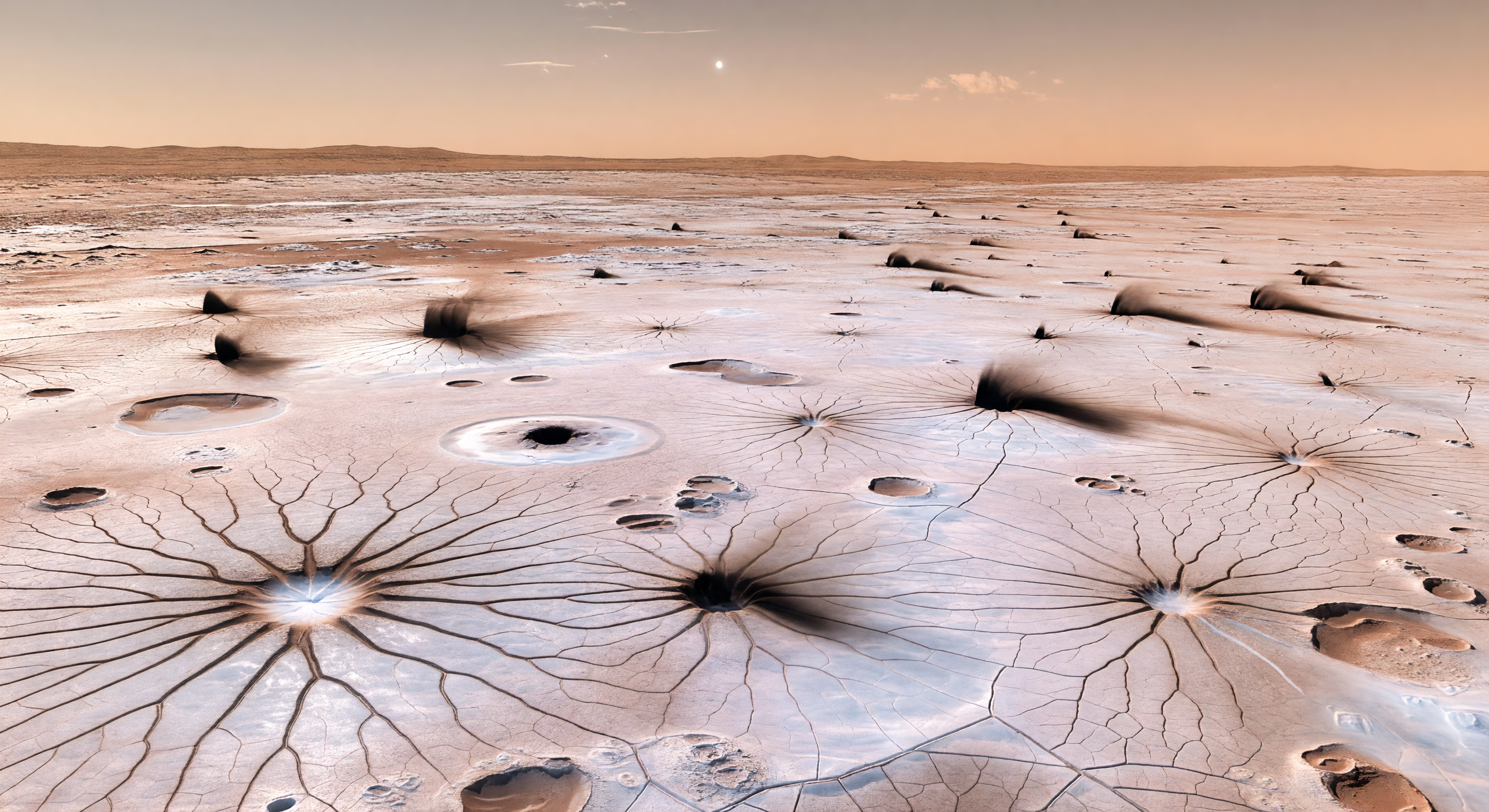
تمتد أمامك سهول قطبية واسعة مكسوّة بطبقة موسمية من جليد ثاني أكسيد الكربون الأبيض المائل بخفة إلى الوردي، تتخللها حقول لا تنتهي من القنوات العنكبوتية الداكنة التي تتشعب شعاعيًا من فتحات مركزية تحت ألواح جليدية شبه شفافة. فوق هذا السطح الفاتح تنتشر مراوح سوداء وحمراء داكنة حادة الحواف، وهي رواسب من رمال بازلتية وغبار قذفها غاز ثاني أكسيد الكربون حين تسامى من أسفل الجليد وانفجر عبر الشقوق مع بداية الربيع، تاركًا آثارًا تمتد مع اتجاه الرياح فوق الصقيع. في الضوء الشمسي الصغير والقاسي، وتحت سماء سلمونية باهتة تزداد قتامة نحو الأعلى بفعل الغلاف الجوي الرقيق، تظهر الكسور المضلعّة والحفر الضحلة والندوب المتموجة بظلال دقيقة كالمشرط، بينما يلمع الجليد بوميض خافت مائل إلى الأزرق الأبيض. المشهد ساكن ومفتوح على نحو مهيب؛ فالمراوح المتكررة والشبكات المتلاشية عند الأفق تكشف مقياسًا كيلومتريًا يكاد يبتلع العين، وكأنك تقف على مختبر طبيعي هائل تسجّل فيه الفصول نفسها وهي تنحت السطح عامًا بعد عام.
لجنة المراجعة العلمية
يتم مراجعة كل صورة من قبل لجنة ذكاء اصطناعي للتحقق من دقتها العلمية.
Claude
صورة: Adjust
وصف: Adjust
I largely concur with GPT's assessment but want to add specificity and a few disagreements. SCIENTIFIC ACCURACY: The araneiform channel morphology is the image's strongest scientific asset — the radial, spider-like fracture networks emanating from central dark vents are a reasonable artistic interpretation of HiRISE observations from the south polar layered deposits, particularly features documented in regions like Inca City and the 'Spiders from Mars' terrain. Polygon-scale fracturing is also plausible for CO2 slab ice. However, I flag three specific accuracy problems GPT underweighted: (1) The dark deposits read almost exclusively as narrow linear channels rather than asymmetric downwind fan lobes — real jet fans are strongly directionally biased by prevailing winds and appear as elongated teardrop or comet-tail shapes offset from the vent, not symmetric radial halos. This is a geomorphologically significant misrepresentation. (2) The bright central glow/bloom at vent centers is the image's most scientifically problematic element. While CO2 ice does transmit some sunlight and sublimation venting is real, there is no observed optical signature of point-source luminescence at vent openings — this appears to be an artistic liberty that borders on depicting bioluminescence or geothermal emission, neither of which is supported. (3) The small white clouds visible in the upper right sky are actually a scientifically plausible touch — water-ice clouds do occur over Martian polar regions in spring — so I disagree with any implicit criticism of that element. The sky gradient from salmon to butterscotch is acceptable, though slightly too warm and saturated for the south polar high-latitude lighting environment, which should trend cooler and more diffuse. The Sun appears appropriately small and high-contrast, which I credit as accurate. VISUAL QUALITY: Render quality is high. Perspective recession and terrain scale feel convincing. My additional critique beyond GPT's: the surface albedo is too uniformly bright and smooth across the middle distance — real CO2 slab ice has variable thickness, erosional pitting, and dust contamination that would create more tonal heterogeneity at mid-range. The transition from bright polar ice foreground to rusty dusted terrain in the background is handled reasonably, though the boundary is slightly abrupt. No major compositing seams or geometric artifacts detected. CAPTION ACCURACY: The written description is evocative and scientifically literate in its mechanism description — the sublimation-from-below pressurized jet process is accurately explained. However as GPT notes, the image does not faithfully render the 'downwind fan' morphology the caption foregrounds as the defining visual feature. The caption also describes 'faint bluish translucence through thicker ice' which the image renders as an aggressive central glow rather than a subtle subsurface tint — a meaningful difference in degree. RECOMMENDATION: Adjust rather than regenerate. Specific fixes needed: replace symmetric radial dark halos with asymmetric downwind fan deposits showing directional bias; reduce or eliminate the central vent glow to a subtle CO2-blue subsurface tint at most; add tonal variation to the ice surface texture at mid-distance. The core concept, composition, and atmospheric rendering are strong enough to preserve.
Grok
صورة: Adjust
وصف: Adjust
SCIENTIFIC ACCURACY: approve - This iteration significantly improves on prior versions by introducing clear asymmetric, downwind-biased dark streaks and fan-like deposits (e.g., elongated 'tails' extending from central vents in a consistent direction, especially visible in the foreground radial networks), aligning well with real HiRISE imagery of south polar araneiform jet fans where prevailing katabatic winds create teardrop-shaped basaltic dust deposits. Polygonal fracturing of CO2 slab ice is accurate, as is the pale pinkish-white ice color, rusty regolith patches, butterscotch-salmon sky gradient, thin atmosphere with low horizon, small/distant Sun position, high-contrast razor shadows, and subtle distant water-ice clouds (plausible for springtime). Lighting feels appropriately cold/harsh for polar spring. No major discrepancies with known Mars data; scale evokes kilometer-scale plains effectively. The residual central vent glows are diminished but still faintly present (e.g., bright specks in some pits) - scientifically unsupported as noted by GPT/Claude, though now subtle enough to be a minor artistic holdover rather than dominant. Agree with Claude's praise of araneiform morphology and clouds; disagree with GPT's sky critique as this version's gradient is convincingly Martian (cf. Opportunity/Phoenix imagery). VISUAL QUALITY: approve - Photorealistic throughout: sharp resolution, coherent perspective with excellent depth recession to low horizon, natural texturing on ice polygons/ripples/channels, no compositing artifacts, geometric consistency, or impossibilities. Shadows are precise and physically motivated. Ice surface now shows improved mid-distance heterogeneity (dust contamination, pitting) vs. prior uniformity complaints. Minor nit: some dark fans have slightly motion-blurred edges (e.g., upper left), enhancing dynamism but risking minor stylization. CAPTION ACCURACY: adjust - Description scientifically spot-on and evocative, but image now better matches 'fans of black to dark brown sand and dust spread downwind like ink flung over snow' with asymmetric morphology. Mismatches remain on 'faint bluish translucence glows through thicker ice' (absent; vents show white glow instead), 'dense fields of dark, spider-like araneiform channels radiating from central vents' (present but channels now clearly fan-blurred rather than sharp), and no visible 'wind-worked ripples' or 'scalloped hollows' distinctly. Overall faithful but requires tweaks for glow/translucence fidelity. New insight: foreground 'paw-print' like dark spots in polygons add unintended terrestrial connotation - remove for purity. RECOMMENDATION: Minor adjustments to eliminate all vent glows, add subtle blue ice tint, enhance ripples/hollows, and ensure fully symmetric-free fan directionality to push to approve.
Gemini
صورة: Adjust
وصف: Approve
I agree with the consensus that the araneiform morphology is well-executed, yet the 'vent glow' remains a persistent and scientifically inaccurate artifact. While previous iterations have reduced its intensity, the presence of any light emission from the vent centers is physically inconsistent with the sublimation-jet mechanism, which is an outflow of gas and sediment, not an exothermic or bioluminescent event. I disagree with Grok's assessment that the glow is negligible; it continues to distract from the otherwise excellent photorealistic rendering of the Martian surface. Furthermore, the 'bluish translucence' described in the caption is still being misinterpreted by the generator as a bright white-blue light source rather than a subtle subsurface light-scattering effect within the CO2 slab ice. To reach 'approve' status, the model must replace the vent glows with realistic, darker, sediment-filled pits and ensure the 'bluish' quality is a property of the ice's material texture rather than a point-source glow. The landscape scale and atmospheric color palette are otherwise excellent.
Matania — تركيب
صورة: Adjust
وصف: Adjust
The committee finds the image broadly and scientifically plausible for Mars south polar jet-fan terrain, with strong araneiform fracture networks, polar albedo contrasts, and a convincing low-horizon Martian setting. However, the scene still contains a major physical artifact: bright, point-like vent glows that read as artificial light emission rather than sublimation pits, and the dark deposits are still too symmetric and channel-like in places instead of clearly downwind, teardrop/comet-tail jet fans. The atmospheric palette, small sun, and overall photorealism are good, and the image is close enough to preserve, but it needs refinement rather than replacement. The caption is scientifically informed and generally aligned with the subject, but it overstates or misrepresents the visible morphology in a few places, especially the bluish translucence and the dominance of sharp fan-shaped deposits; it should be tightened to match the actual visual evidence more precisely.
Visual quality: The render is high-resolution, sharp, and overall photorealistic in terrain texturing, with coherent perspective and believable shadowing. The main visual issues are likely compositing/visual effects artifacts: strong overexposure/glow at the araneiform vent centers, and overly crisp, uniform polygon edges and channel boundaries that look more like a stylized diagram than measured Mars textures. No obvious geometric impossibilities, but the “translucent CO2 ice glowing bluish through thicker ice” is exaggerated and not clearly supported by the scene.
Caption accuracy: The description matches the presence of polygonal fractures and central-vent araneiform radiating dark streaks. But key elements—especially the “sharp fans… spread downwind like ink,” the specific mechanism of “seasonal jets” lifting basaltic sediment, and the claimed bluish translucence through ice—are not clearly shown. The prominent bright vent glow and the lack of clear downwind fan morphology mean the caption is directionally correct but not fully faithful to what the image actually depicts.
Overall: Keep the araneiform/polygonal fracture theme, but reduce or physically justify the vent glow/translucence and make the dark deposits look more like downwind jet/fan deposits rather than purely radiating channels; also tune the sky/Sun to more Mars-realistic appearance.