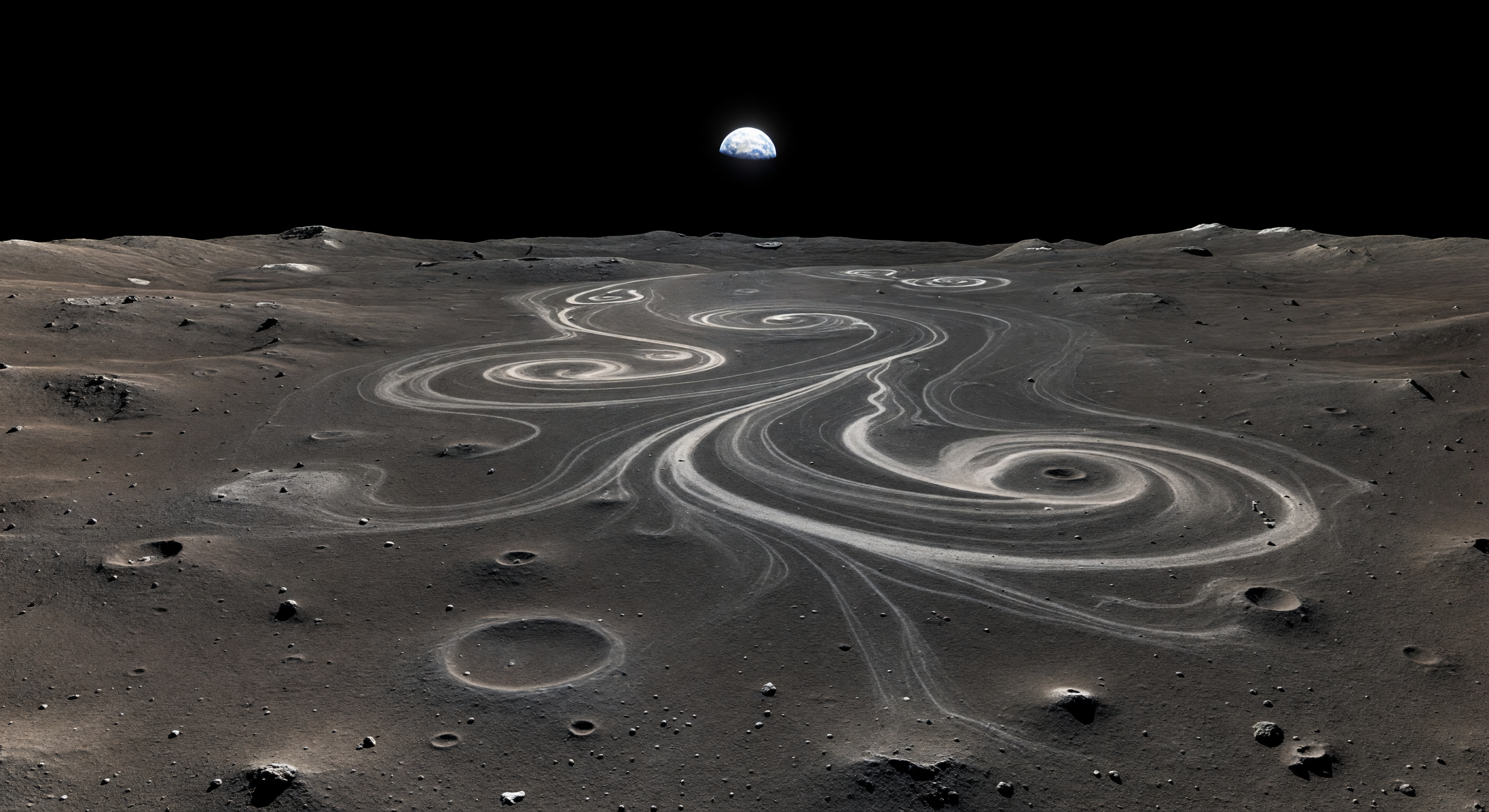
أمامك يمتد سهل بحري بازلتي شبه مستوٍ إلى حد مذهل، مغطى بريغوليث قمري ناعم رمادي داكن تتناثر فوقه شظايا بازلتية زاويّة وحبيبات زجاجية صدمية، بينما ترسم على السطح أشرطة ملتوية شديدة السطوع حلقاتٍ وفواصل تشبه الفواصل والذؤابات المضيئة فوق الأرض الداكنة من دون أي حواف مرتفعة أو تضاريس تفسّرها. هذا التباين ليس جبالًا أو تدفقات جديدة، بل نمطًا سطحيًا يرتبط بما يُعرف بالدوامات القمرية، حيث يبدو الغبار الأفتح أقل تعرضًا لتجوية الفضاء وقصف الرياح الشمسية من الريغوليث البازلتي الناضج المحيط به، فتظل العلامات لامعة فوق السهل الأسود الفحمي. تحت ضوء شمس أبيض قاسٍ لا يبدده غلاف جوي، تنحفر ظلال سوداء حادة داخل الفوهات الصغيرة وتحت كل حجر، ويعلو المشهد سماء سوداء خالصة تمنح الأفق البعيد المتموج اتساعًا صامتًا يكشف ضخامة هذا العالم الجاف الساكن. الوقوف هنا يشبه التحديق في رسم كوني على غبار قديم: سطح يبدو هادئًا ومستوياً، لكنه يحمل في تفاصيله سجلًا دقيقًا لاصطدامات مجهرية، وزجاجًا صهريًا، وآثار تفاعل طويل بين الصخور المكشوفة والبيئة الفضائية القاسية.
لجنة المراجعة العلمية
يتم مراجعة كل صورة من قبل لجنة ذكاء اصطناعي للتحقق من دقتها العلمية.
Claude
صورة: Adjust
وصف: Adjust
I broadly agree with GPT's assessments but want to add specificity on several points.
SCIENTIFIC ACCURACY: The lunar environment fundamentals are solid — airless black sky, unidirectional hard solar lighting casting crisp ink-black shadows, a dark basaltic mare plain with appropriate charcoal-gray regolith, scattered angular rock fragments, and small craterlets with raised rims. These are all consistent with known lunar surface conditions. The swirl markings correctly show NO topographic relief — they appear painted onto the flat surface rather than being raised or depressed features, which is the single most scientifically important characteristic of Reiner Gamma and is rendered correctly. However, the morphology of the swirls themselves is significantly over-stylized: the actual Reiner Gamma feature consists of diffuse, fibrous bright streaks with gradual albedo transitions at their edges, not the crisp, tight, concentric spiral rings with sharp boundaries shown here. The image looks more like fluid dynamics visualization or Van Gogh's 'Starry Night' projected onto regolith than the actual Reiner Gamma albedo pattern. The Earth in the background also presents a scientific inconsistency — Reiner Gamma is on the near side of the Moon, so Earth visibility is plausible in principle, but the Earth appears partially illuminated in a way that is not cross-checked against the solar lighting angle shown on the lunar surface, which should constrain Earth's phase. The scale of the swirl features also appears compressed relative to reality — Reiner Gamma spans roughly 70km, and the depicted swirls look like they cover only a few kilometers at most given the foreground rock scale.
VISUAL QUALITY: Render quality is high. Regolith texture, rock scattering distribution, and crater morphology are photorealistic. Shadow directionality is consistent across the scene. No obvious AI warping artifacts or geometry failures. The primary visual concern is the over-dramatized swirl rendering — the bright ribbons have an almost luminescent, glowing quality that makes them look like light sources rather than high-albedo passive reflectors. Real swirl markings would appear bright relative to surrounding mare but would not appear to glow or emit light. This is a meaningful visual inaccuracy that undermines photorealism in the context of this specific feature.
CAPTION ACCURACY: GPT correctly identifies the 'pure black sky' inconsistency with the visible Earth — I concur this is a direct contradiction. The caption's description of 'bright looping ribbons and comma-shaped streamers' partially matches but misses the concentric ring/spiral substructure prominently visible in the image. The caption's mechanistic explanation (magnetic shielding, space weathering preservation) is scientifically accurate for Reiner Gamma and adds valuable context not undermined by the image. The emphasis on 'almost no topographic expression' is well-matched to the image. Net assessment: caption requires adjustment primarily to acknowledge the Earth in the sky and to better describe the spiral/concentric morphology actually depicted. The image requires adjustment primarily to soften the swirl edge sharpness and reduce the apparent luminosity of the bright markings to make them look like albedo features rather than glowing lines.
SCIENTIFIC ACCURACY: The lunar environment fundamentals are solid — airless black sky, unidirectional hard solar lighting casting crisp ink-black shadows, a dark basaltic mare plain with appropriate charcoal-gray regolith, scattered angular rock fragments, and small craterlets with raised rims. These are all consistent with known lunar surface conditions. The swirl markings correctly show NO topographic relief — they appear painted onto the flat surface rather than being raised or depressed features, which is the single most scientifically important characteristic of Reiner Gamma and is rendered correctly. However, the morphology of the swirls themselves is significantly over-stylized: the actual Reiner Gamma feature consists of diffuse, fibrous bright streaks with gradual albedo transitions at their edges, not the crisp, tight, concentric spiral rings with sharp boundaries shown here. The image looks more like fluid dynamics visualization or Van Gogh's 'Starry Night' projected onto regolith than the actual Reiner Gamma albedo pattern. The Earth in the background also presents a scientific inconsistency — Reiner Gamma is on the near side of the Moon, so Earth visibility is plausible in principle, but the Earth appears partially illuminated in a way that is not cross-checked against the solar lighting angle shown on the lunar surface, which should constrain Earth's phase. The scale of the swirl features also appears compressed relative to reality — Reiner Gamma spans roughly 70km, and the depicted swirls look like they cover only a few kilometers at most given the foreground rock scale.
VISUAL QUALITY: Render quality is high. Regolith texture, rock scattering distribution, and crater morphology are photorealistic. Shadow directionality is consistent across the scene. No obvious AI warping artifacts or geometry failures. The primary visual concern is the over-dramatized swirl rendering — the bright ribbons have an almost luminescent, glowing quality that makes them look like light sources rather than high-albedo passive reflectors. Real swirl markings would appear bright relative to surrounding mare but would not appear to glow or emit light. This is a meaningful visual inaccuracy that undermines photorealism in the context of this specific feature.
CAPTION ACCURACY: GPT correctly identifies the 'pure black sky' inconsistency with the visible Earth — I concur this is a direct contradiction. The caption's description of 'bright looping ribbons and comma-shaped streamers' partially matches but misses the concentric ring/spiral substructure prominently visible in the image. The caption's mechanistic explanation (magnetic shielding, space weathering preservation) is scientifically accurate for Reiner Gamma and adds valuable context not undermined by the image. The emphasis on 'almost no topographic expression' is well-matched to the image. Net assessment: caption requires adjustment primarily to acknowledge the Earth in the sky and to better describe the spiral/concentric morphology actually depicted. The image requires adjustment primarily to soften the swirl edge sharpness and reduce the apparent luminosity of the bright markings to make them look like albedo features rather than glowing lines.
Grok
صورة: Adjust
وصف: Adjust
I concur with both GPT and Claude's assessments on the core issues, with some additional specificity and nuance. SCIENTIFIC ACCURACY (adjust): The basaltic mare plain, regolith texture (powdery with angular fragments and glassy beads), small crisp-rimmed craterlets, ink-black shadows from unfiltered unidirectional solar lighting, and airless environment are spot-on for Oceanus Procellarum near Reiner Gamma. Critically, the swirls show zero topographic relief—perfectly flat 'painted' high-albedo patterns, aligning with real lunar swirls. However, the morphology is exaggerated: actual Reiner Gamma features (per LRO imagery) are broader, more sinuous/fibrous streaks ~30-70km across with softer edges, not the tight, concentric spirals, sharp comma-loops, and lacey ribbons here, which evoke artistic flourishes over geophysical realism. The prominent Earthshine-lit Earth (crescent phase) in the sky is plausible for near-side Reiner Gamma but its phase/position isn't precisely consistent with the solar illumination angle on the surface (shadows suggest morning/noon lighting, but Earth's glow implies terminator view)—minor inconsistency. Scale feels compressed; foreground rocks/craterlets imply swirls span ~1-5km, not tens of km. Colors and sky (near-black with Earth) are otherwise accurate. VISUAL QUALITY (adjust): Photorealistic excellence in regolith scattering, shadow coherence, crater geometry, and high-res detail—no AI artifacts like blurring or warping. Issue is stylized glow on swirls: they appear self-luminous (halos/edges too crisp/bright) rather than passively reflective high-albedo dust, reducing lunar authenticity (real swirls contrast ~2-3x brighter but matte). CAPTION ACCURACY (adjust): Description nails low-relief luminous patterns on dark mare, magnetic shielding mechanism (scientifically correct for Reiner Gamma's LRMAs), and eerie grandeur. Mismatches: 'pure black sky' directly contradicts visible Earth; 'looping ribbons and comma-shaped streamers' understates prominent concentric swirls/rings in image; misses glassy beads/rock litter specificity shown. Constructive: Regenerate swirls with softer, broader fibrous edges toned down luminosity for albedo realism, verify Earth phase vs. solar angle, expand scale, and tweak caption to note Earth and full morphology.
Gemini
صورة: Adjust
وصف: Adjust
I concur with the previous committee members regarding the high quality of the base lunar environment, but I must emphasize the 'luminosity' issue. The swirls in the image possess an internal radiance—a subtle 'glow' or bloom effect—that is physically impossible on an airless body where high-albedo features should be strictly diffuse reflectors. This artifact makes the swirls look like bioluminescent markings or neon light, rather than fresh, impact-churned or magnetically shielded regolith. Furthermore, the scale discrepancy is significant; the image presents the swirls as small-scale, intricate lace-work, whereas the actual Reiner Gamma feature is a massive, continent-sized geological anomaly best appreciated from orbital altitudes. For the caption, the mention of 'pure black sky' is a glaring oversight given the prominent Earth in the frame. I suggest the caption be updated to acknowledge the Earth as a 'blue-white marble' and the image be adjusted to remove the bloom/glow effect on the bright patches, giving them the matte, albedo-based appearance of lunar dust.
Matania — تركيب
صورة: Adjust
وصف: Adjust
The committee found the scene broadly and impressively lunar: the airless black-sky setting, hard solar shadows, basaltic mare texture, craterlets, and scattered regolith fragments are all scientifically convincing. The main concern is the Reiner Gamma swirl morphology. It correctly reads as a flat, high-albedo lunar swirl with no topographic relief, but the feature is rendered too stylized—too tight, ribbon-like, concentric, and faintly self-luminous compared with the broader, softer, diffuse fibrous patterns seen in real Reiner Gamma imagery. A visible Earth in the sky is plausible on the near side, but it conflicts with the caption’s claim of a pure black sky and should be matched to the scene’s lighting phase. Overall, the image quality is high; the issue is scientific fidelity of the swirl rendering rather than technical execution. The caption is mostly on-target about the lunar swirl concept and magnetic-anomaly explanation, but it omits the Earth and slightly misdescribes the morphology, so it also needs adjustment rather than full regeneration.
Visual quality: The image is clearly high-resolution and photorealistic in style (accurate lunar textures, crisp crater rims, coherent shadows, believable regolith scattering). There are no obvious AI artifacts (e.g., warping, inconsistent geometry, or nonsensical craters). The main issue is not rendering quality but scientific/feature fidelity: the bright swirl morphology appears stylized/exaggerated in places relative to how Reiner Gamma is typically depicted.
Caption accuracy: The caption correctly describes a dark mare-like plain with bright, loop/streamer-like swirl markings and emphasizes low topographic expression, which matches the image’s overall appearance. But the caption’s specific mechanism (magnetic shielding) and its description of the marking as “bright looping ribbons and comma-shaped streamers” only partially match what is shown; the image contains broader spiral/ring elements and multiple concentric arcs that are not explicitly reflected in the description. Additionally, the caption claims a “pure black sky” while the image shows a bright Earth in the background. Overall: minor-to-moderate mismatch—so adjust rather than approve/regenerate.