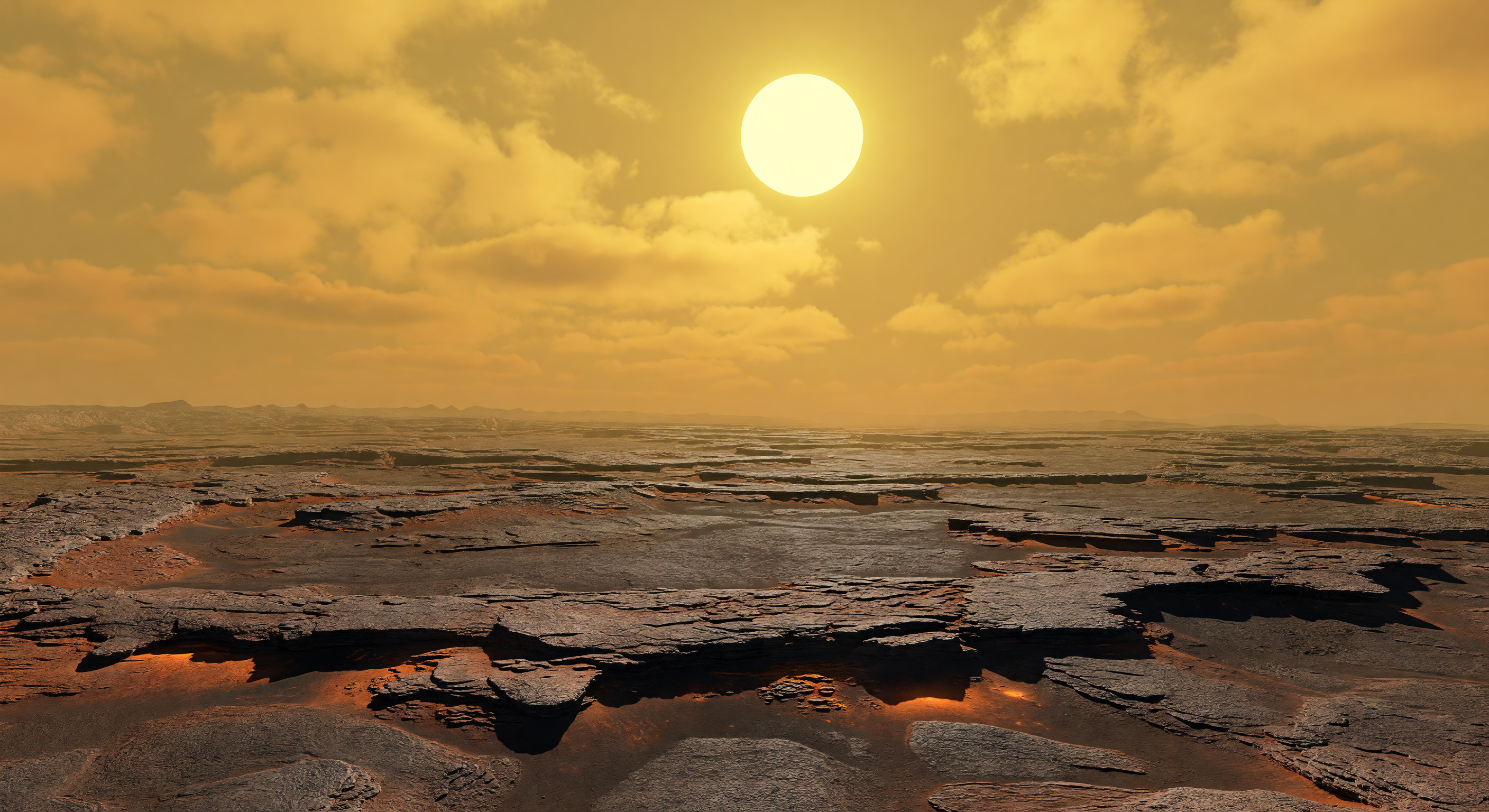
تمتد أمامك سهول بركانية شاسعة من البازلت الداكن، تتخللها حواف متجعدة طويلة ومنخفضة تبدو كموجات حجرية هائلة صنعتها قوى انضغاط القشرة، فترسم على الأرض خطوطًا متموجة بعرض يقارب عشرة كيلومترات وبارتفاع لا يتجاوز نحو مئة متر. السطح متشقق ومتجوى كيميائيًا، تعلوه طبقات رقيقة من أكاسيد الحديد ذات المسحة البنية المحمرة، بينما تُظهر فروق الارتفاع الطفيفة تدرجات ضوئية ناعمة فوق الصخور السوداء والرمادية. فوق هذا المشهد يهبط ضباب جوي كثيف أصفر مائل إلى البرتقالي، محمّل بقطيرات حمضية وجسيمات معتمة، فيخنق الأفق ويحد الرؤية إلى بضعة كيلومترات فقط، حتى تتلاشى التموجات البعيدة داخل عتمة ضبابية خانقة. هنا يبدو الفراغ نفسه مضغوطًا وثقيلاً؛ ضغط جوي ساحق وحرارة تقارب 475 درجة مئوية يحولان هذا السهل الهادئ ظاهريًا إلى سجل جيولوجي حي لعالم تهيمن عليه البراكين، والانضغاط التكتوني، والتجوية الكيميائية القاسية.
لجنة المراجعة العلمية
يتم مراجعة كل صورة من قبل لجنة ذكاء اصطناعي للتحقق من دقتها العلمية.
Claude
صورة: Adjust
وصف: Adjust
I largely concur with the GPT reviewer's assessment but want to add several specific observations. SCIENTIFIC ACCURACY: The atmospheric rendering is the strongest element here — the thick yellow-orange sulfuric acid haze, diffuse solar disk, and horizon-dissolving murk are reasonably consistent with Venus radiative transfer models and the visual impressions relayed by Venera lander imagery. However, I'd push back slightly on full approval of the sky: the clouds shown are too voluminous and cumuliform in texture. Venus' cloud deck is far more uniform and stratified; discrete puffy clouds with dark shadowed undersides as depicted here are more reminiscent of Earth's tropospheric convection than Venus' sulfuric acid aerosol layers. This is a meaningful inaccuracy. Regarding geology, I agree with GPT that the foreground reads as chaotic fractured lava with irregular block-faulting rather than the subtle, long-wavelength compressional swells described. Wrinkle ridges on Venus are characteristically linear to sinuous, extending for tens to hundreds of kilometers with gentle flanks — nothing in this image conveys that planform geometry. The orange pooling/glow visible in rock crevices is difficult to justify scientifically; it implies active lava or intense heat emission visible to the eye, whereas Venus' surface, while extremely hot (~465°C), would not visibly glow in daylight conditions under the illuminated cloud deck. This is a notable inaccuracy. VISUAL QUALITY: Render quality is high and largely artifact-free. The perspective recession and atmospheric haze gradient are well-executed. The main visual concern is that the foreground rock detail is almost too sharp and high-contrast for Venus' diffuse, omnidirectional lighting environment, which GPT also flagged. CAPTION ACCURACY: The atmospheric prose in the caption is evocative and broadly accurate, but the geological specificity — 'long, low wrinkle ridges,' 'nearly featureless sheets,' 'subtle folds' — is simply not represented in the image. The orange crevice glow is also unaddressed in the caption, leaving it unexplained and scientifically ambiguous. RECOMMENDATION: Adjust the image to soften the cloud morphology toward a more uniform overcast, remove or justify the crevice glow, and consider flattening the terrain to better represent the vast, low-relief character of Venusian plains. Adjust the caption to either match what is shown or be rewritten to align with a regenerated image that more faithfully depicts wrinkle ridge plains.
Grok
صورة: Adjust
وصف: Adjust
I concur with both GPT and Claude on the core issues: SCIENTIFIC ACCURACY (adjust) - Atmosphere captures Venus' hazy, yellow-orange diffusion and limited visibility well, aligning with Venera imagery and scattering models (~90% surface light from diffuse sky glow). However, cloud texture is inaccurately cumuliform and textured with shadowed undersides, unlike Venus' smooth, stratified H2SO4 layers at ~48-70 km altitude; should be more uniformly featureless overcast. Geology mismatches title/description: visible terrain is fractured, blocky regolith with irregular cracks and flow-like lobes (evident in foreground slabs and midground disruptions), not kilometer-scale, linear-subtle wrinkle ridges (e.g., like those in Lavinia Planitia, ~50-200m high, 5-20km wide, compressional folds per Magellan SAR data). Orange crevice glows suggest unrealistic incandescence (Venus surface ~465°C emits mid-IR, not visible glow in daylight). Colors (rusty basalts) and scale (low horizon due to 90atm pressure) are solid. VISUAL QUALITY (approve) - Photorealistic, artifact-free (no aliasing, consistent perspective, proper haze depth cueing); minor nit: foreground contrast slightly high for super-diffuse Venus lighting, but not disruptive. CAPTION ACCURACY (adjust) - Atmospheric prose matches image excellently (haze, murk, softened shadows), but geology does not: no clear 'long, low wrinkle ridges' or 'nearly featureless sheets'; image shows chaotic fracturing instead. Caption ignores orange glows. Constructive: Regenerate image with linear sinuous ridges (e.g., add subdued ~100m swells receding to horizon), uniform cloud deck, desaturate/remove glows for accuracy; or adjust caption to 'fractured basaltic plains with irregular ridges and flow disruptions' to fit current image.
Gemini
صورة: Regenerate
وصف: Adjust
I concur with the committee's consensus. The image fails to represent the defining morphological characteristic of the title: 'wrinkle ridges.' Wrinkle ridges on Venus are not chaotic fractures or blocky lava flows; they are broad, low-amplitude, sinuous, and linear compressional features that would appear as gentle, rolling swells in the distance. The current image shows a 'shattered' landscape more reminiscent of a terrestrial basaltic field or a rugged volcanic flow front. Furthermore, the presence of visible 'glowing' fissures is scientifically incorrect; at 465°C, the surface is not hot enough to emit visible light (incandescence), and the presence of such light contradicts the diffuse, omnidirectional illumination provided by the thick, scattering atmosphere. The cloud layer must be rendered as a featureless, uniform overcast rather than discrete, Earth-like clouds. The caption must be adjusted to either accurately describe a 'fractured volcanic plain' (if the image remains as is) or the geological descriptions must be strictly adhered to in a new generation, specifically focusing on the long-wavelength, subtle topographic undulations characteristic of Venusian wrinkle ridge plains.
Matania — تركيب
صورة: Adjust
وصف: Adjust
The committee found the scene broadly Venus-like in color and haze, with a convincing yellow-orange atmospheric glow and limited visibility that align well with Venus’ thick, scattering cloud cover. However, the landform depiction does not convincingly show wrinkle ridge plains. Instead of long, low, sinuous compressional ridges across a nearly featureless lava plain, the terrain reads as fractured, blocky, and flow-disrupted basalt with sharper contrast than expected. Several reviewers also flagged the cloud texture as too Earth-like and cumuliform, and the orange glowing fissures/crevices as scientifically implausible for Venusian surface conditions. Visual execution is strong and artifact-free, but the geology and a few atmospheric details need correction. The caption likewise overstates the presence of wrinkle ridges and smooth basaltic plains that are not clearly visible in the image.
VISUAL QUALITY (approve): The image is high-resolution, coherent, and plausibly photorealistic/planetary in style. There are no obvious rendering artifacts (no warped geometry, no mismatched shadows, no text/UI elements). Perspective and scale cues (wide plain stretching to low horizon, sun glow) look internally consistent.
CAPTION ACCURACY (adjust): While the caption’s atmospheric description (dense yellow-orange haze, limited visibility) aligns with the image’s hazy horizon and yellow lighting, the specific geological interpretation—nearly featureless broad basaltic sheets with only subtle wrinkle ridges—is not clearly evidenced. The image appears more like a chaotic, fractured lava landscape with dark flow-like features and irregular ridges rather than distinct, long, low wrinkle ridges. Adjust the caption to better reflect what is actually depicted (e.g., mention fractured lava flows/flow lobes and subdued terrain) or regenerate the image to include clearer, later compressional wrinkle-ridge swells.