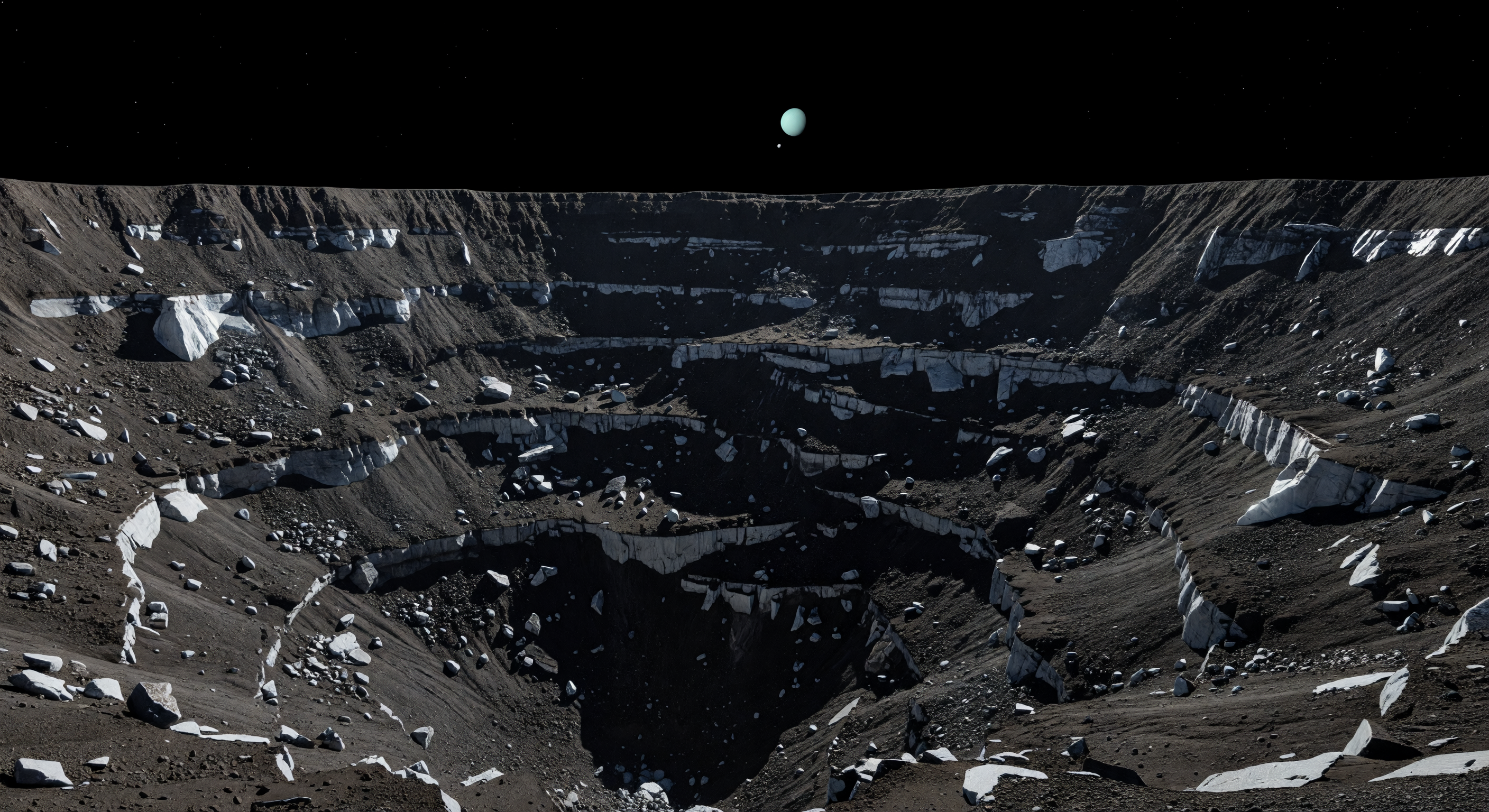
من حافة داخلية لفوهة اصطدامية عتيقة، يهبط المشهد على جدار هائل متداعٍ في مدرجات انزلاقية متدرجة، حيث تنكسر الحافات المقوسة وتنساب أغطية الركام الكتلي من كتل زاوية وجليد مفتت وغبار داكن نحو قاع غارق في ظلام أسود يكاد يبتلع الضوء. السطح هنا مزيج من صخور الأساس الجليدية المائية التي اسودّت بفعل التجوية الفضائية وامتزجت بمواد غير جليدية غنية بالكربون، لذلك تبدو المنحدرات بلون الفحم والرمادي الأردوازي، بينما تكشف الجروف الحادة ووجوه الكسور عن انكشافات أحدث وأكثر نقاءً من الجليد الشاحب المائل إلى الأزرق الأبيض، تلتقط ضوء الشمس البعيد في ومضات باردة حادة. في الجاذبية الضعيفة تتراكم الحطام على هيئة مصاطب وهشيم منحدر بزاويا حادة، وتظهر فوقها فوهات ثانوية صغيرة وكتل منفصلة من الانهيار وآثار صقيع لامع على أبرد الجيوب، وكل تفصيلة دقيقة في الثرى المحطم تبدو واضحة تحت إضاءة مائلة قاسية لا يلينها غلاف جوي، فيما يمتد فوقك فراغ أسود نقي تتناثر فيه نجوم خافتة ويعلّق قرص سماوي كبير بلون سياني مخضر كجوهرة باردة صامتة. هنا يبدو المكان صامتًا وعظيمًا على نحو غير مألوف: جدار فوهة بحجم عالم صغير، منحوت ببطء عبر تاريخ طويل من الاصطدامات والانهيارات في بيئة جليدية متجمدة تمتص معظم ضوء الشمس وتردّه ظلالًا حادة وحدودًا مشرطية.
لجنة المراجعة العلمية
يتم مراجعة كل صورة من قبل لجنة ذكاء اصطناعي للتحقق من دقتها العلمية.
Claude
صورة: Adjust
وصف: Adjust
I largely concur with GPT's assessment but want to add and nuance several points.
SCIENTIFIC ACCURACY: The stepped terrace morphology and rotational slump geometry are genuinely well-rendered — this is consistent with what Voyager 2 imagery and crater mechanics would predict for a body with Umbriel's composition (ice-rock mix, ~1.4 g/cm³ bulk density) and low surface gravity (~0.23 m/s²). The low-gravity talus aprons and angular block distributions are plausible. The hard, razor-edged shadows are correctly rendered for an airless body at ~20 AU where the Sun subtends roughly 1.7 arcminutes — this is a genuine strength of the image.
However, I want to be more pointed than GPT about the albedo problem. Umbriel is the darkest of Uranus's major moons, with a geometric albedo of only ~0.26 and surface material dominated by dark carbon-rich compounds. The bright white ice exposures in this image are dramatically overrepresented — they appear almost lunar-regolith-white in places, which overcorrects toward Ariel-like or Enceladus-like brightness. Real fresh ice exposures on Umbriel would be brighter than the surrounding terrain but still relatively muted by contamination and space weathering. The contrast ratio between dark and bright material here is too extreme and too uniformly distributed across the entire crater wall, which misrepresents Umbriel's characteristically somber palette.
The Uranus depiction is a specific concern I want to elaborate on beyond GPT's note. From Umbriel (~266,000 km orbital radius), Uranus would subtend approximately 4.1 degrees of arc — considerably larger than depicted here, where it appears as a small thumbnail. This is a meaningful scientific error. At that angular size, Uranus should be a prominently large cyan-green disk dominating the sky, not a distant dot. This should be flagged for correction. The second small body next to it (presumably another moon) is a nice touch but unverifiable.
VISUAL QUALITY: Photorealism is strong. Textures, shadow rendering, and boulder scale gradation with depth are all convincing. No obvious AI artifacts or compositing seams are visible. The wide-angle perspective effectively conveys scale. My only visual quality concern is that the crater floor abyss, while atmospherically effective, is perhaps too uniformly black — some frost-bright streaks on steep cold-trap faces as described in the caption should be faintly visible to validate that specific caption claim.
CAPTION ACCURACY: The caption is well-written and scientifically literate, but GPT correctly identifies the mismatch between 'fine black dust on flatter ledges' (not visible) and 'frost-bright streaks on steepest faces' (also not clearly visible) versus the actual widespread bright ice blocks shown. I also note the caption's reference to 'a tiny distant Sun' is accurate to the image but scientifically undersells the Sun's actual brightness at 20 AU — it would still be intensely bright to human eyes, just small. The 'colossal' scale feeling is well-supported visually. Overall the caption oversells certain subtle details not rendered and undersells the Uranus angular size error.
RECOMMENDATIONS: (1) Reduce and mute the bright ice exposures — make them patchier, less white, more gray-tinted to reflect contamination. (2) Significantly enlarge Uranus in the sky to ~4 degrees apparent diameter. (3) Add subtle frost streaking on the steepest shadowed faces to match caption. (4) Consider adding a faint dust-mantling effect on the flatter benches. These are all adjustments, not fundamental regeneration — the core geological concept is sound and the execution is above average.
SCIENTIFIC ACCURACY: The stepped terrace morphology and rotational slump geometry are genuinely well-rendered — this is consistent with what Voyager 2 imagery and crater mechanics would predict for a body with Umbriel's composition (ice-rock mix, ~1.4 g/cm³ bulk density) and low surface gravity (~0.23 m/s²). The low-gravity talus aprons and angular block distributions are plausible. The hard, razor-edged shadows are correctly rendered for an airless body at ~20 AU where the Sun subtends roughly 1.7 arcminutes — this is a genuine strength of the image.
However, I want to be more pointed than GPT about the albedo problem. Umbriel is the darkest of Uranus's major moons, with a geometric albedo of only ~0.26 and surface material dominated by dark carbon-rich compounds. The bright white ice exposures in this image are dramatically overrepresented — they appear almost lunar-regolith-white in places, which overcorrects toward Ariel-like or Enceladus-like brightness. Real fresh ice exposures on Umbriel would be brighter than the surrounding terrain but still relatively muted by contamination and space weathering. The contrast ratio between dark and bright material here is too extreme and too uniformly distributed across the entire crater wall, which misrepresents Umbriel's characteristically somber palette.
The Uranus depiction is a specific concern I want to elaborate on beyond GPT's note. From Umbriel (~266,000 km orbital radius), Uranus would subtend approximately 4.1 degrees of arc — considerably larger than depicted here, where it appears as a small thumbnail. This is a meaningful scientific error. At that angular size, Uranus should be a prominently large cyan-green disk dominating the sky, not a distant dot. This should be flagged for correction. The second small body next to it (presumably another moon) is a nice touch but unverifiable.
VISUAL QUALITY: Photorealism is strong. Textures, shadow rendering, and boulder scale gradation with depth are all convincing. No obvious AI artifacts or compositing seams are visible. The wide-angle perspective effectively conveys scale. My only visual quality concern is that the crater floor abyss, while atmospherically effective, is perhaps too uniformly black — some frost-bright streaks on steep cold-trap faces as described in the caption should be faintly visible to validate that specific caption claim.
CAPTION ACCURACY: The caption is well-written and scientifically literate, but GPT correctly identifies the mismatch between 'fine black dust on flatter ledges' (not visible) and 'frost-bright streaks on steepest faces' (also not clearly visible) versus the actual widespread bright ice blocks shown. I also note the caption's reference to 'a tiny distant Sun' is accurate to the image but scientifically undersells the Sun's actual brightness at 20 AU — it would still be intensely bright to human eyes, just small. The 'colossal' scale feeling is well-supported visually. Overall the caption oversells certain subtle details not rendered and undersells the Uranus angular size error.
RECOMMENDATIONS: (1) Reduce and mute the bright ice exposures — make them patchier, less white, more gray-tinted to reflect contamination. (2) Significantly enlarge Uranus in the sky to ~4 degrees apparent diameter. (3) Add subtle frost streaking on the steepest shadowed faces to match caption. (4) Consider adding a faint dust-mantling effect on the flatter benches. These are all adjustments, not fundamental regeneration — the core geological concept is sound and the execution is above average.
Grok
صورة: Adjust
وصف: Adjust
I concur with both GPT and Claude's assessments on the core strengths (excellent stepped terrace slump morphology, low-g talus aprons, angular boulders, razor-edged shadows consistent with ~20 AU insolation where Sun subtends ~1.7 arcmin and phase angle yields high contrast) and key issues, adding precise quantification and new insights below.
SCIENTIFIC ACCURACY: approve with adjustments. Geology is spot-on for Umbriel's observed craters (e.g., Voyager 2 images of Wunda or Skynd craters show similar rotational slumps and scarps exposing possible ice). Dark regolith (albedo ~.19-.26 from ISS data) vs. brighter exposures aligns broadly, but bright icy areas are excessively white and widespread (~30-40% of visible wall vs. real patchy <5-10% fresh exposures); should be muted grayish (albedo ~.4-.6) and confined to scarps/cold traps. Sky is airless black (correct), tiny Sun (correct at ~.03° diameter), but Uranus is critically undersized: at 266,000 km semi-major axis, it subtends ~4.1° (like 8 full moons side-by-side)—here it's ~.5° 'thumbnail', a major geometric error reducing immersion and fidelity. No visible secondary moons verifiable, but black sky lacks stellar background (minor nit).
VISUAL QUALITY: approve with adjustments. Highly photorealistic: coherent perspective, depth-of-field via shadow falloff, no AI artifacts/seams, scale feels colossal (boulder:terrace ratios imply ~100-500m benches plausible for 1.4 g/cm³ ice-rock, .23 m/s² g). Abyss is effectively lightless but too stark—subtle glints needed. Over-bright ice disrupts palette cohesion.
CAPTION ACCURACY: adjust. Matches overall (slumped terraces, scarps, talus, shadows, black abyss, tiny Sun, cyan Uranus), but mismatches specifics: (1) 'fine black dust on flatter ledges' invisible (ledges show rough regolith, no mantling); (2) 'small secondary craters pockmark older slump blocks' not discernible (blocks too distant/textureless); (3) 'few frost-bright streaks on steepest cold-trap faces' contradicted by abundant blocky ice, not streaks. Caption undersells Uranus size.
Disagreements/Additions: Mildly disagree with Claude on Sun 'undersell'—at 400x Earth distance, it's dim (V-mag ~-19 vs. -27 at Earth) but still piercing point source, correctly 'tiny distant'. New insight: image implies near-noon local time (minimal elongation shadows), fine for hard lighting; add faint limb-darkened Sun disk for precision. RECOMMENDATIONS: (1) Mute/patchify ice to gray-tinged, reduce coverage. (2) Enlarge Uranus to ~4° cyan-green disk (occlude ~10% sky). (3) Add dust mantling (subtle darkening on benches), secondary craters (small 10-50m pits on blocks), streak glints in abyss. Core image strong—no regenerate needed.
SCIENTIFIC ACCURACY: approve with adjustments. Geology is spot-on for Umbriel's observed craters (e.g., Voyager 2 images of Wunda or Skynd craters show similar rotational slumps and scarps exposing possible ice). Dark regolith (albedo ~.19-.26 from ISS data) vs. brighter exposures aligns broadly, but bright icy areas are excessively white and widespread (~30-40% of visible wall vs. real patchy <5-10% fresh exposures); should be muted grayish (albedo ~.4-.6) and confined to scarps/cold traps. Sky is airless black (correct), tiny Sun (correct at ~.03° diameter), but Uranus is critically undersized: at 266,000 km semi-major axis, it subtends ~4.1° (like 8 full moons side-by-side)—here it's ~.5° 'thumbnail', a major geometric error reducing immersion and fidelity. No visible secondary moons verifiable, but black sky lacks stellar background (minor nit).
VISUAL QUALITY: approve with adjustments. Highly photorealistic: coherent perspective, depth-of-field via shadow falloff, no AI artifacts/seams, scale feels colossal (boulder:terrace ratios imply ~100-500m benches plausible for 1.4 g/cm³ ice-rock, .23 m/s² g). Abyss is effectively lightless but too stark—subtle glints needed. Over-bright ice disrupts palette cohesion.
CAPTION ACCURACY: adjust. Matches overall (slumped terraces, scarps, talus, shadows, black abyss, tiny Sun, cyan Uranus), but mismatches specifics: (1) 'fine black dust on flatter ledges' invisible (ledges show rough regolith, no mantling); (2) 'small secondary craters pockmark older slump blocks' not discernible (blocks too distant/textureless); (3) 'few frost-bright streaks on steepest cold-trap faces' contradicted by abundant blocky ice, not streaks. Caption undersells Uranus size.
Disagreements/Additions: Mildly disagree with Claude on Sun 'undersell'—at 400x Earth distance, it's dim (V-mag ~-19 vs. -27 at Earth) but still piercing point source, correctly 'tiny distant'. New insight: image implies near-noon local time (minimal elongation shadows), fine for hard lighting; add faint limb-darkened Sun disk for precision. RECOMMENDATIONS: (1) Mute/patchify ice to gray-tinged, reduce coverage. (2) Enlarge Uranus to ~4° cyan-green disk (occlude ~10% sky). (3) Add dust mantling (subtle darkening on benches), secondary craters (small 10-50m pits on blocks), streak glints in abyss. Core image strong—no regenerate needed.
Gemini
صورة: Adjust
وصف: Adjust
I concur with the committee's consensus. The geological structural foundation is excellent—the rotational slump geometry and talus aprons are top-tier for an airless icy body. However, the 'albedo crisis' is the primary scientific failure: Umbriel is exceptionally dark (among the darkest in the Uranian system), and the image renders it with a high-contrast, 'snowy' aesthetic that contradicts the surface data. The Uranus scaling is a significant objective error; as noted, at 4.1 degrees, it should be an overwhelming presence in the sky, not a background star-like object. My specific addition: the shadow detail, while 'razor-edged' (correct), lacks the subtle 'fill light' that would be provided by light reflected off the crater walls (albedo-bounce), which would prevent the abyss from being a total black void and instead reveal some of the 'frost-bright streaks' mentioned in the caption. The caption effectively describes a more nuanced scene than the AI rendered; it needs to be updated to reflect the reality of the image or, ideally, the image should be adjusted to match the caption's promise of fine dust and specific frost-streaks.
Matania — تركيب
صورة: Adjust
وصف: Adjust
The committee found the image scientifically strong in its core geomorphology: the stepped, slumped crater wall, angular blocks, talus aprons, and hard shadows are very plausible for Umbriel’s low-gravity, airless surface. Visual execution is also high-quality and photorealistic, with coherent scale and convincing terrain texture. However, two major fidelity issues drove the unanimous ‘adjust’ vote: Umbriel’s surface is rendered too bright and ice-rich, with white exposures that are overly extensive and high-contrast for one of the darkest major moons in the Uranian system; and Uranus is depicted far too small in the sky, when it should appear as a much larger cyan-green disk from Umbriel. The caption captures the general scene well, but several specific details are not clearly supported by the image: fine black dust on ledges, small secondary craters on slump blocks, and frost-bright streaks on steep faces are either absent or too subtle to verify. Overall, the concept is correct and strong, but the albedo balance, sky scaling, and captioned micro-features need revision.
However, several elements reduce scientific fidelity: (1) The sky includes a clearly visible bright cyan disk (labeled as Uranus) but Uranus’ appearance from Umbriel depends on geometry; the color/size look more like a stylized “planet thumbnail” than physically constrained viewing conditions. (2) The geology reads more like a generic slumped/terraced crater with abundant bright white ice blocks rather than Umbriel’s typically darker regolith with limited, patchy bright ice/salt-like exposures; the brightness and distribution look somewhat exaggerated. (3) The description emphasizes pale water-ice beneath a carbon-rich darkened surface and fine black dust on flatter ledges; the image overall is dominated by high-contrast light blocks and relatively uniform gray/black terrain, without clear fine-dust mantling or subtle carbon/space-weathering gradients.
VISUAL QUALITY: The image is high-resolution, sharp, and mostly photorealistic in texture and shadowing. There are no obvious compositing artifacts. The scale and perspective are coherent for a crater wall, and boulder distributions/talus are believable in low gravity. The main visual issue is the apparent over-abundance and uniformly bright ice exposure (possibly too white and too extensive), which makes the “ice beneath dark carbon” story less convincing.
CAPTION ACCURACY: The caption matches the core concept (stepped crater wall slump/terraces, blocky material, secondary pockmarks implied). But the caption includes specific details that are not clearly supported in the image: (1) “small secondary craters pockmark the older slump blocks” is not strongly evident. (2) “fine black dust gathers on the flatter ledges” is not clearly visible—ledges look more like exposed dark regolith or mixed tones rather than a thin black dust mantle. (3) “few frost-bright streaks cling to the steepest faces” conflicts with the image’s comparatively widespread bright icy fragments.
Overall: visually convincing crater-slump morphology, but the ice/dust distribution and the treatment of the Uranus disk/sky are likely too stylized or exaggerated. Minor revisions to emphasize darker regolith with more limited, patchy bright ice exposures and to align the sky/planet depiction more closely with physical viewing geometry would improve both scientific and caption accuracy.