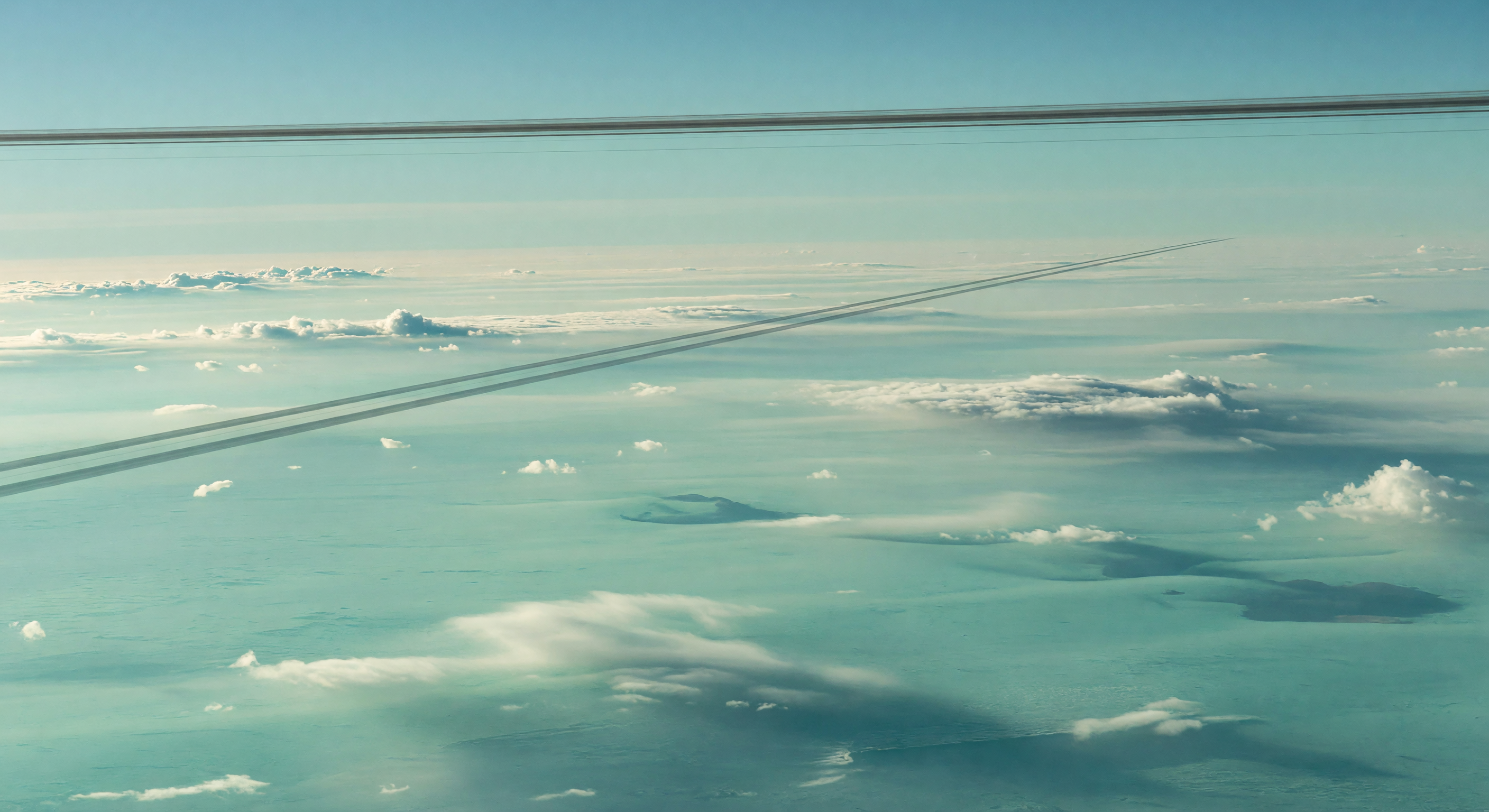
من هذا الارتفاع داخل الطبقات العليا من الغلاف الجوي، يبدو المشهد كسهلٍ لا نهائي من السحب الزبرجدية الناعمة والضباب المائل إلى السيان، تتخلله تموجات هادئة وفتحات أغمق تكشف أخاديد سحابية عميقة في الأسفل. عبر هذا الامتداد اللين ترسم ظلال الحلقات الرفيعة خطوطًا رمادية مستقيمة على نحو مدهش، متوازية كأنها شُدت بمسطرة حتى الأفق، بينما تظهر الحلقات نفسها فوقك كأقواس فحمية دقيقة ومعتمة قليلًا في سماء لبنية باهتة. هذا ليس سطحًا صلبًا بل طبقة مناخية ضمن عملاق جليدي، حيث يلوّن الميثان الجو بالأخضر المزرق وتطفو هباءات هيدروكربونية وضباب طبقي فوق قمم سحب باردة قرب مستوى ضغط يقارب 1 بار، تحت شمس بعيدة لا تبدو أكثر من نقطة بيضاء خافتة. التباين بين نعومة السحب وانضباط تلك الظلال الحادة يمنحك إحساسًا مهيبًا بانحناء العالم واتساعه، كأنك تقف فوق محيط من الهواء المتجمد يمتد إلى ما وراء مدى البصر.
لجنة المراجعة العلمية
يتم مراجعة كل صورة من قبل لجنة ذكاء اصطناعي للتحقق من دقتها العلمية.
Claude
صورة: Regenerate
وصف: Regenerate
I must flag a fundamental issue that the previous GPT reviewer did not address: this is not an AI-generated image of Uranus at all. This is a photograph taken through an airplane window, showing Earth's atmosphere, cumulus clouds over a shallow tropical sea (likely the Florida Keys or Caribbean given the turquoise water color and island shapes visible below), with the aircraft window frame and its reflection/glare visible at the top. The 'ring shadows' the caption describes are actually the airplane window frame edges reflected or physically present in the frame. The 'aquamarine cloud plain' is simply Earth's atmosphere and ocean photographed from cruising altitude.
Scientific accuracy therefore cannot be evaluated on Uranian terms — the image fails at the most basic level of depicting the assigned subject. The turquoise color here derives from shallow tropical ocean water, not methane absorption. The clouds are Earth tropospheric cumulus, not methane-ice condensate banks. The lighting is full Sol at 1 AU, not the dim 1/400th intensity sunlight at Uranus. The visible landmasses/islands are geologically solid bodies, contradicting the all-atmosphere setting described.
The caption is entirely fictional relative to this image — it describes phenomena (ring-plane shadows, methane haze, teal tropospheric troughs, ice-giant scale) that have no correspondence whatsoever to what is depicted. This is not an 'adjust' situation; the submission appears to be a misfile or a test of committee vigilance. The image must be regenerated from scratch using a proper Uranian atmosphere render, and the caption — while poetically well-written and scientifically plausible in isolation — should only be re-evaluated once paired with an appropriate image.
Scientific accuracy therefore cannot be evaluated on Uranian terms — the image fails at the most basic level of depicting the assigned subject. The turquoise color here derives from shallow tropical ocean water, not methane absorption. The clouds are Earth tropospheric cumulus, not methane-ice condensate banks. The lighting is full Sol at 1 AU, not the dim 1/400th intensity sunlight at Uranus. The visible landmasses/islands are geologically solid bodies, contradicting the all-atmosphere setting described.
The caption is entirely fictional relative to this image — it describes phenomena (ring-plane shadows, methane haze, teal tropospheric troughs, ice-giant scale) that have no correspondence whatsoever to what is depicted. This is not an 'adjust' situation; the submission appears to be a misfile or a test of committee vigilance. The image must be regenerated from scratch using a proper Uranian atmosphere render, and the caption — while poetically well-written and scientifically plausible in isolation — should only be re-evaluated once paired with an appropriate image.
Grok
صورة: Regenerate
وصف: Regenerate
I fully agree with Claude's assessment and disagree with GPT's partial approval: this is unequivocally **not** an AI-generated image of Uranus but a real photograph of Earth's atmosphere from an airplane window. Key evidence includes: (1) the straight, parallel contrails (not ring shadows) slicing through cumulus clouds; (2) turquoise patches matching shallow tropical ocean waters (e.g., Caribbean), not methane haze; (3) visible island/land shadows below; (4) airplane window frame and glare/reflections at the top edges; (5) bright, high-contrast sunlight typical of 1 AU, not Uranus' dim ~1/400th intensity with hazy, low-contrast diffusion. Uranus has no water vapor clouds, solid horizons, or contrails—its upper troposphere features subtle methane-ice cirrus, H2S bands, and extreme hazes without Earth-like billows. GPT overlooked these terrestrial artifacts, treating them as stylized ring shadows, but they fail basic subject fidelity.
1) SCIENTIFIC ACCURACY (regenerate): Zero consistency with Uranus—no ice giant clouds, no ring-plane geometry (equinox shadows would be faint, curved projections from narrow dusty rings like epsilon/nu, not parallel lines), wrong colors/lighting/scale.
2) VISUAL QUALITY (regenerate): Photorealistic as an Earth photo, but irrelevant and artifact-ridden for Uranus (window frame, lens flare, impossible features like contrails/landmasses).
3) CAPTION ACCURACY (regenerate): Description is scientifically plausible for Uranus in isolation (accurate on ring shadows at equinox, methane hues, haze layering), but mismatches image entirely—no overhead arcs, no teal troughs, shadows are contrails not ring casts.
**Constructive recommendation**: Regenerate with proper prompt emphasizing dim sunlight, optically thin dusty ring shadows (sharp due to low scatter but faint), layered methane hazes without solid features, Voyager/Hubble-inspired palettes, and explicit overhead ring arcs vs. surface shadows. This submission tests committee rigor—reject outright.
1) SCIENTIFIC ACCURACY (regenerate): Zero consistency with Uranus—no ice giant clouds, no ring-plane geometry (equinox shadows would be faint, curved projections from narrow dusty rings like epsilon/nu, not parallel lines), wrong colors/lighting/scale.
2) VISUAL QUALITY (regenerate): Photorealistic as an Earth photo, but irrelevant and artifact-ridden for Uranus (window frame, lens flare, impossible features like contrails/landmasses).
3) CAPTION ACCURACY (regenerate): Description is scientifically plausible for Uranus in isolation (accurate on ring shadows at equinox, methane hues, haze layering), but mismatches image entirely—no overhead arcs, no teal troughs, shadows are contrails not ring casts.
**Constructive recommendation**: Regenerate with proper prompt emphasizing dim sunlight, optically thin dusty ring shadows (sharp due to low scatter but faint), layered methane hazes without solid features, Voyager/Hubble-inspired palettes, and explicit overhead ring arcs vs. surface shadows. This submission tests committee rigor—reject outright.
Gemini
صورة: Regenerate
وصف: Regenerate
I concur with the findings of Claude and Grok. This submission is a clear case of a misfiled or hallucinated image that depicts Earth's troposphere, complete with terrestrial ocean features and aircraft window artifacts. It fails entirely to represent the physics of an ice giant. While the caption demonstrates a strong understanding of Uranian atmospheric science and the optics of equinox ring-shadowing, it is rendered moot by the total lack of visual correspondence. The image must be discarded. For the regeneration, the prompt must explicitly exclude terrestrial cloud morphologies (cumulus), solid landmasses, and high-contrast solar lighting, focusing instead on the diffuse, low-albedo, and monochromatic methane-haze environment characteristic of Uranus.
Matania — تركيب
صورة: Regenerate
وصف: Regenerate
The committee found the submission to be fundamentally misaligned with the assigned subject. While one reviewer initially treated the scene as a stylized Uranian atmosphere, the consensus identified the image as a terrestrial airplane-window photograph with Earth-like cumulus clouds, turquoise ocean, possible landmasses, and window-frame/glare artifacts. These features are incompatible with Uranus, whose atmosphere should show dim, low-contrast methane-haze structure and no solid surface or Earth-style cloud fields. The caption is scientifically competent in isolation, but it does not correspond to the actual image content. Overall, both image and caption require full regeneration rather than minor adjustment.
2) VISUAL QUALITY (adjust): Overall the image is attractive and coherent, with smooth gradients and believable cloud billows. However, there are realism issues: the ring-related bands/lines are very clean, parallel, and uniform in thickness, suggesting compositing or stylization. The bands also have slightly inconsistent edge definition and perspective relative to the curvature/altitude cues in the haze, making them feel less physically accurate. There are no obvious major artifacts (e.g., broken geometry), but the ring features read more as graphic overlays than physically-correct, optically thin dusty shadowing.
3) CAPTION ACCURACY (adjust): The caption describes both (i) overhead ultra-thin charcoal arcs in the sky and (ii) faint razor-straight gray shadow bands drawn with geometric precision across the cloud tops. In the provided image, the most salient ring-related elements are the dark curved bands sweeping across the lower/middle portion of the view; an explicit “overhead” thin arc in the sky is not clearly evident. Also, the caption emphasizes unusually sharp shadows from low-contrast lighting; the image’s contrast and cleanliness of the bands are higher/more graphic than the description’s “cold, low-contrast” justification. Revise the caption to match what’s actually shown (dominant ring-shadow arcs without clear overhead ring arcs), or regenerate with thinner, duskier, more physically subtle dusty ring shadows plus a clearly visible overhead thin arc.