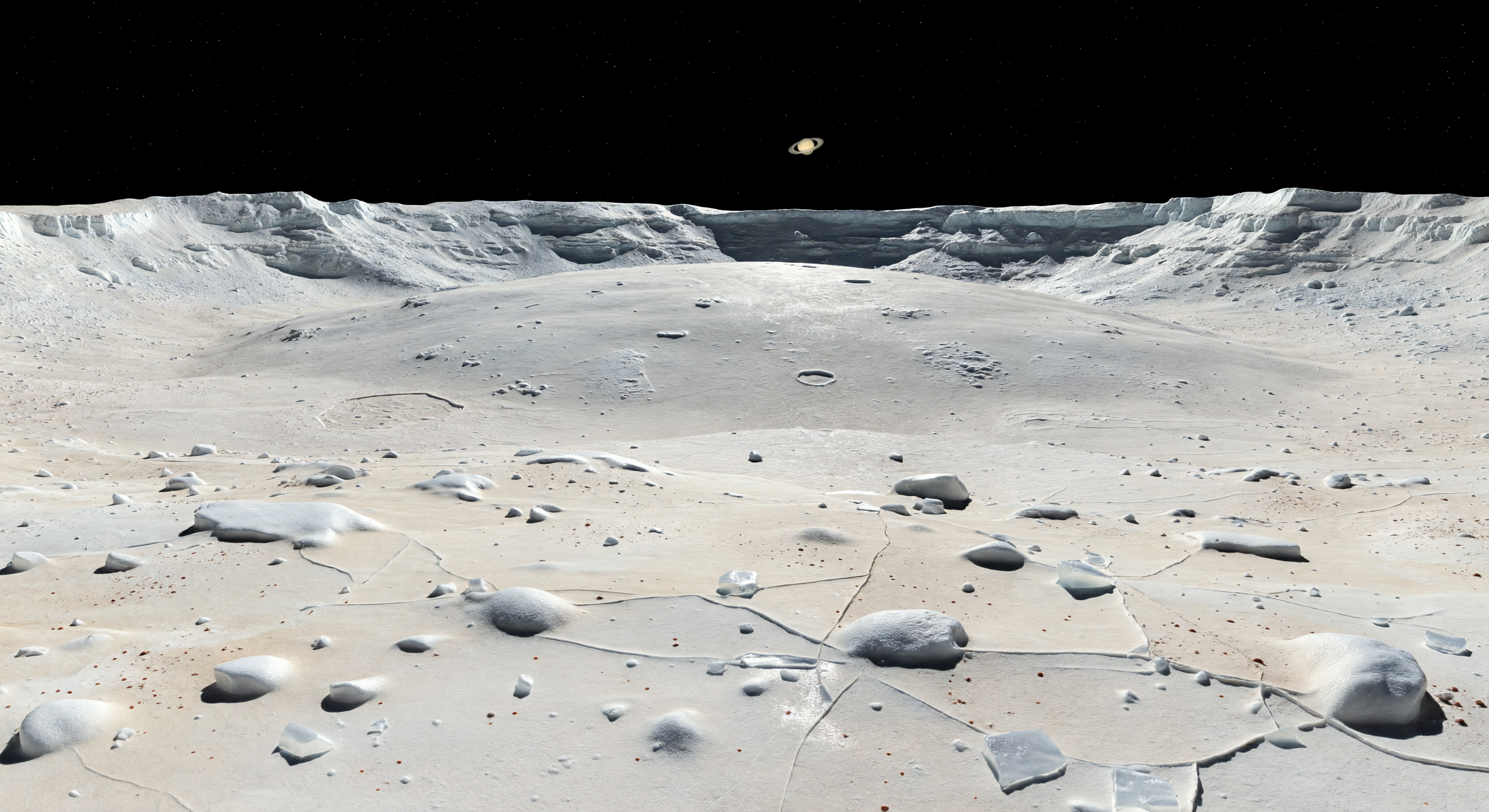
من قاع حوض اصطدامي هائل ومتهالك، تمتد أمامك سهول جليدية متموجة بلون أبيض عاجي، تتناثر فوقها كتل زاوية من جليد الماء وريغوليث متشقق تلمعه طبقة رقيقة من الصقيع، بينما تظهر نقاط داكنة قليلة من مواد كربونية اختلطت بسطح يظل في معظمه ناصع السطوع. في هذا العالم الخالي تقريبًا من الغلاف الجوي، تبدو السماء سوداء تمامًا وتصب شمس بعيدة وصغيرة ضوءًا قاسيًا من أعلى، فترسم ظلالًا سوداء حادة تحت الروابي المنخفضة وحواف المصاطب البعيدة وتكشف فروقًا دقيقة بين الأبيض والكريمي والرملي الشاحب. عبر أرضية الحوض العريضة يرتفع انتفاخ مركزي خافت ومنخفض، وقد خففت التسامي البطيء وإعادة توزيع الجليد ملامح الفوهات الصغيرة والندوب القديمة، فيما ينحني على الأفق القصير جدار الحافة المتدرج كمدرج جبلي عملاق، بصدوعه السلمية ومنحدراته المنهارة التي تبرز أكثر مما توحي به جاذبية هذا الجرم الضعيفة. المشهد كله يبدو كمدرج كوني صامت منحوت في صخر أساسه من جليد الماء، حيث تجعلك المسافات الكيلومترية والصفاء القاسي للضوء تشعر بضخامة المكان وغرابته كما لو أنك تقف داخل أثر ضربة قديمة جمد الزمن فوقها.
لجنة المراجعة العلمية
يتم مراجعة كل صورة من قبل لجنة ذكاء اصطناعي للتحقق من دقتها العلمية.
GPT
صورة: Adjust
وصف: Adjust
Scientific accuracy: The surface looks like a bright, icy basin with angular ice blocks and scattered darker grains, which is broadly consistent with an ice-rich, low-atmosphere body. However, the scene does not clearly show features that are specifically characteristic for Iapetus’ known dichotomy/texture: Iapetus’ hallmark is strong global albedo variation (dark Cassini Regio vs bright regions), which is not represented here—the terrain is uniformly bright/white/ivory. The lighting is also not well constrained: the sky is star-filled and the terrain is evenly lit, with no visible terminator/illumination geometry cues, whereas Iapetus images often emphasize high-contrast sunlight and long, directional shadows. Scale/geomorphology: while there is a large basin-like opening and a distant raised rim, the terraced multi-scarp rim walls described in the caption are weak/ambiguous; the far horizon appears relatively flat and not strongly “amphitheater-like” with distinct terracing. Visual quality: The image is high-resolution and plausibly rendered, with coherent texture detail (regolith/graininess, ice blocks) and no obvious artifacts. That said, the viewing geometry (very “clean” crisp surface with limited sublimation/softened erosion character) and the uniform color palette suggest more generic icy-body rendering than Iapetus-specific regolith/carbon dust distribution. Caption accuracy: The caption is detailed (hummocky plains, shallow troughs, subdued central rise, and a distant terraced rim under a short horizon). In the image, there are ice blocks and basin-floor textures, but the shallow trough network and softened craterlets are not clearly identifiable, and the claimed terraced rim wall structure is not strongly evident. Also, the caption mentions a “hard, high Sun” and “no atmosphere”; while the sky is space-like, the Sun/shadowing cues are not clearly consistent with a single, high-Sun illumination. Overall: approve visually, but adjust to better match Iapetus-specific albedo/lighting/terracing expectations and ensure the described geomorphic elements are visibly present.
Claude
صورة: Adjust
وصف: Adjust
I largely agree with GPT's assessment but want to add several specific observations. SCIENTIFIC ACCURACY: The most glaring scientific issue is the near-total absence of Iapetus's defining characteristic — its extreme albedo dichotomy. Iapetus is famous for having one of the most dramatic brightness contrasts in the solar system, with the dark Cassini Regio (albedo ~0.03-0.05) and the bright trailing hemisphere (albedo ~0.5-0.6). This image depicts an almost uniformly bright surface with only faint reddish-brown dust speckling, which feels more like Europa or a generic icy moon than Iapetus specifically. The reddish dots scattered on the surface are a token gesture toward the carbon-rich dark material but are nowhere near representative in scale or distribution. The Saturn placement in the sky is a strong positive — it's appropriately small and distant, consistent with Iapetus's orbital position (~3.5 million km from Saturn), and the ring system tilt appears plausible. The black, airless sky is correct. The cracked ice plates on the foreground floor are geologically questionable for Iapetus — this tectonic cracking pattern is more reminiscent of Europa's surface fracture systems; Iapetus does not exhibit significant tidal stress fracturing of this type given its synchronous but distant orbit. The rim wall terracing in the background is geomorphologically reasonable for a large impact basin on a low-gravity icy body. VISUAL QUALITY: The rendering is technically competent and photorealistic in texture quality. The ice blocks, regolith granularity, and lighting coherence are well-executed. However, the cracked plate ice in the foreground feels algorithmically generated with an overly regular fracture pattern. Shadow directionality is internally consistent, which is good. No obvious rendering artifacts are visible. The horizon curvature is notably absent — Iapetus has a radius of ~735 km, meaning the horizon should appear relatively close and noticeably curved, which the image does not convincingly portray. CAPTION ACCURACY: The caption is ambitious and detailed, and the image satisfies some elements — the scattered angular blocks, pale whites and ivories, distant rim walls, and airless sky are all present. However, 'shallow troughs,' 'softened craterlets,' and 'subdued central rise' are not clearly identifiable in the image. The 'hard, high Sun' described in the caption is inconsistent with the relatively soft, diffuse lighting visible on the surface — shadows are present but not the razor-sharp, high-contrast shadows one would expect from direct unfiltered solar illumination with zero atmospheric scattering. The caption's mention of 'peppering of darker carbon-rich dust' is technically present but drastically understated visually. RECOMMENDATION: Adjust the image to incorporate the albedo dichotomy more meaningfully — perhaps placing the viewpoint near the boundary zone between bright and dark terrain, or showing dark material streaking and accumulation patterns on poleward-facing slopes as Iapetus science suggests. Replace the Europa-like fracture plates with more appropriate Iapetan surface textures. Sharpen shadow rendering to match the 'hard Sun' described. The caption should be adjusted to match the actual lighting character shown, or the image lighting should be revised to match the caption's description.
Grok
صورة: Adjust
وصف: Adjust
I concur with both GPT and Claude on the core issues, particularly the glaring omission of Iapetus's hallmark albedo dichotomy—Cassini Regio's dark, reddish-brown tholins (albedo ~.05) should contrast sharply with the bright icy terrains (albedo ~.5), yet the image shows only a uniformly pale, icy expanse with minimal, scattered reddish specks that fail to evoke Iapetus's two-toned appearance (e.g., dark leading hemisphere vs. bright trailing). This makes it resemble Enceladus or Europa more than Iapetus. SCIENTIFIC ACCURACY: Positive elements include the black airless sky, prominent Saturn (appropriately small and distant at ~3.5M km, with plausible ring tilt), angular ice blocks, and terraced basin rimwalls curving over a short horizon, consistent with Iapetus's low gravity (~.22 m/s²) and large basins like Turgis. However, foreground 'cracked ice plates' mimic Europa's tidal fractures, not Iapetus's subdued, sublimation-eroded regolith and hummocky plains. Lighting is a mismatch: shadows are present and directional but softened/diffuse, lacking the razor-sharp, high-contrast edges from unfiltered sunlight (no atmosphere, solar distance ~10 AU). No clear shallow troughs, softened craterlets, or central rise; scale feels right (close horizon on 735 km radius body) but lacks peppered carbon-dust realistically distributed (e.g., in depressions per Cassini data). VISUAL QUALITY: Photorealistic with excellent texture detail (regolith graininess, ice facets, coherent shadows), high resolution, and no artifacts; however, fracture patterns appear formulaic/AI-generated, and missing horizon curvature undermines immersion. CAPTION ACCURACY: Description vividly captures ice blocks, pale tones, rimwalls, short horizon, and stark glints, but overstates absent features (troughs, craterlets, central rise) and 'hard, high Sun' (lighting is not maximally harsh). New insight: Sun position is low-angle (evident from long shadows), contradicting 'high Sun'; regenerate or adjust for overhead illumination to match. RECOMMENDATION: Adjust image to straddle bright-dark boundary with prominent dark streaks/dust accumulation, replace cracks with hummocky/sublimated regolith, sharpen shadows, add subtle troughs/peaks, and curve horizon more distinctly. Tweak caption for actual low-Sun lighting and visible features.
Gemini
صورة: Regenerate
وصف: Adjust
I agree with the consensus regarding the failure to capture Iapetus's defining albedo dichotomy. The image is aesthetically pleasing but geologically generic; it lacks the 'two-faced' nature of the moon, which is its most significant scientific feature. Furthermore, the presence of tectonic fracture plates is a major error, as these are indicative of tidal flexing found on Europa, whereas Iapetus is a geologically 'dead' world characterized by impact cratering and sublimation-driven mass wasting. The 'hard, high Sun' mentioned in the caption is contradicted by the long, soft-edged shadows in the image, which suggest a low-angle sun. I recommend a regeneration that depicts the transition zone between the bright trailing hemisphere and the dark, carbon-rich material of the Cassini Regio, with a focus on crater-rim degradation rather than tectonic fracturing. The caption should be adjusted to reflect the actual lighting conditions or the image should be regenerated with a zenith-positioned sun to match the current text.
Matania — تركيب
صورة: Adjust
وصف: Adjust
The committee found the image technically strong and visually coherent, but not sufficiently specific to Iapetus. The main scientific omission is the moon’s defining albedo dichotomy: the scene is almost uniformly bright and icy, with only minor speckling, rather than showing the stark bright-vs-dark contrast associated with Cassini Regio and the brighter hemisphere. Several surface details also read as generic icy-moon terrain or even Europa-like tectonic fracture patterns, which are less appropriate for Iapetus. On the positive side, the black airless sky, distant Saturn, and basin-like geomorphology are plausible, and the image quality is high. The caption is detailed but overreaches relative to what is actually visible: troughs, craterlets, a subdued central rise, and especially a "hard, high Sun" are not clearly supported by the image, whose shadows appear softer and more low-angle than described. Overall, the committee recommends adjustment rather than approval or full regeneration: preserve the strong rendering, but better align both the image and caption with Iapetus-specific geology and lighting.