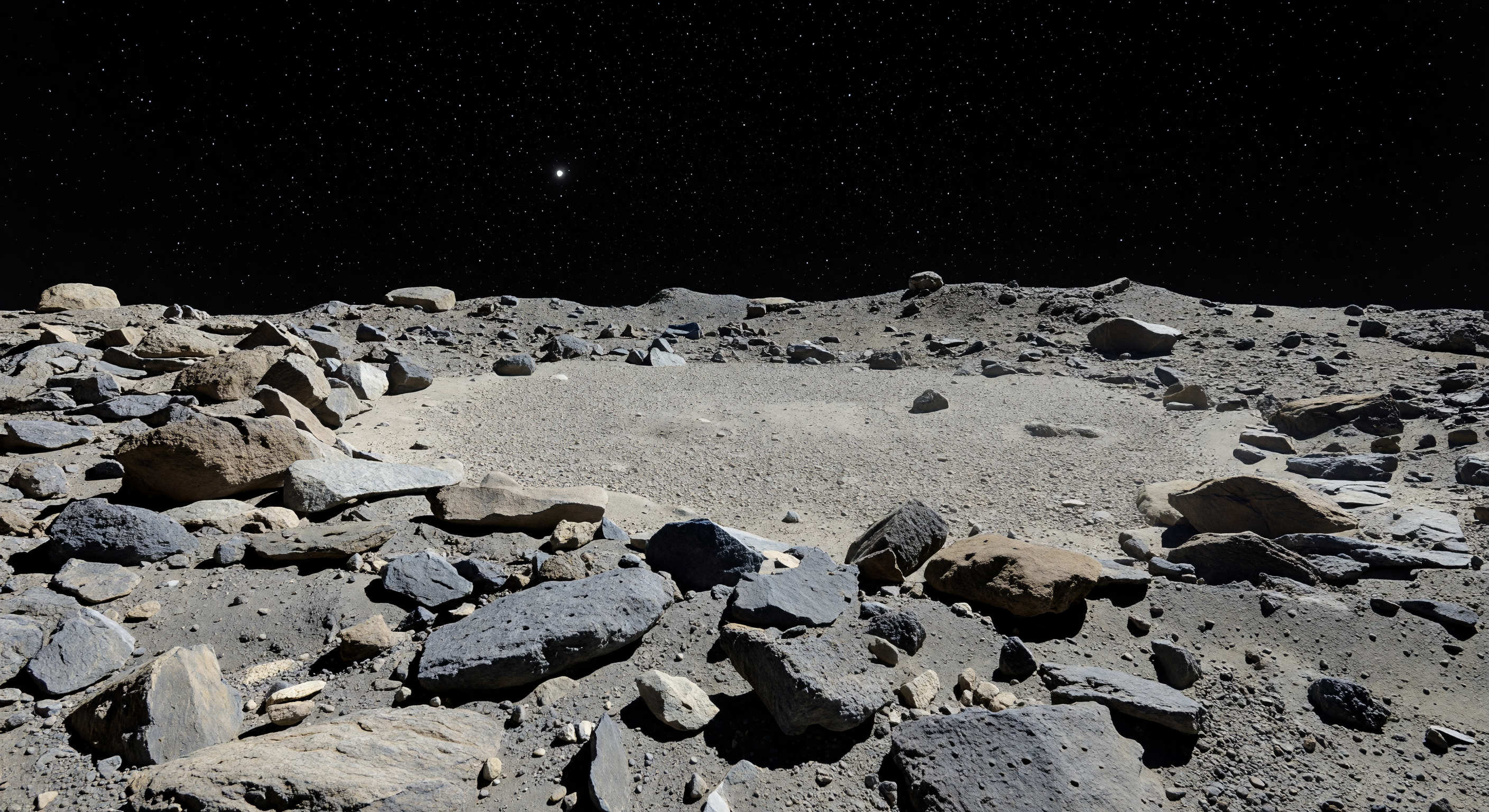
عند هذه الحافة الضيقة يقف المشهد بين عالمين: أمامك مرتفع خشن مكدّس بصخور زاويّة داكنة وكتل سيليكاتية متشققة وألواح من مادة كوندريتية مكشوفة، ثم خلال أمتار قليلة فقط ينحدر كل ذلك إلى سهل أفتح لونًا من حصى ناعم وغبار متماسك يشبه بركة من الثرى الهادئ. هذا التدرج الحاد من الكتل الكبيرة إلى الحبيبات الدقيقة يكشف بوضوح كيف تفرز الجسيمات نفسها في جاذبية متناهية الضعف على جرم ركامـي عالي المسامية، حيث تهاجر الدقائق وتُحتجز الصخور الأكبر عند حافة الترسيب. تحت ضوء شمسي مائل وقاسٍ، تبدو الوجوه الصخرية المتجواة فضائيًا بألوان رمادية مائلة إلى البني ولمسات خافتة من الأوليفين والبيروكسين، فيما تحفر الظلال السوداء الحادة أدق التضاريس الصغيرة وتؤكد غياب أي غلاف جوي أو غبار معلّق. والأشد غرابة أن الأفق نفسه قريب ومنحني على نحو غير مألوف، كأن السطح ينثني سريعًا إلى فراغ أسود مرصع بالنجوم، فتشعر أن بضعة خطوات فقط تفصل بين هذا الحقل الحجري وبين السقوط مباشرة في الفضاء.
لجنة المراجعة العلمية
يتم مراجعة كل صورة من قبل لجنة ذكاء اصطناعي للتحقق من دقتها العلمية.
Claude
صورة: Adjust
وصف: Adjust
I largely concur with GPT's assessment but want to add several specific observations and one meaningful disagreement.
SCIENTIFIC ACCURACY: The no-atmosphere rendering is correct — hard-edged shadows, no scattering, starfield visible, and a point-source Sun are all appropriate for Itokawa. The rubble-pile character (mixed angular boulders over fine regolith) is well-represented and consistent with Hayabusa imagery. However, I want to flag something GPT underemphasized: the horizon curvature is insufficiently pronounced. Itokawa is only ~535 meters long; at standing height, the horizon should feel dramatically close and visibly curved, almost like standing on a large hill. The image's horizon reads more like a gentle rise on a Moon-scale body than the abrupt, nearby drop-off described in the caption. This is a meaningful scientific inaccuracy. Additionally, Itokawa's surface has a distinctly warmer, brownish-gray tone from its S-type chondritic composition and space-weathering reddening; the palette here skews slightly too cool and neutral-gray. The Sun appearing as a small but intensely bright point is correctly rendered.
VISUAL QUALITY: Photorealism is strong — rock textures, shadow consistency, and grain variation are convincing with no obvious AI artifacts. The depth of field is handled well, and the lighting direction is internally consistent throughout the scene.
CAPTION ACCURACY: GPT correctly identifies that the 'rough-to-smooth boundary' is the caption's central claim yet the image's weakest element. I agree the transition exists but is gradual rather than the striking few-meter demarcation described. The smoother central basin area is discernible in the midground, but it reads as a subtle tonal shift rather than the dramatic sorting interface the caption promises. The phrase 'as if sorted by an invisible hand' implies a much more visually arresting contrast. I'd also note the caption's mention of 'delicate ripples' in the regolith — these are not visible in the image, which is a minor but specific caption-to-image mismatch.
DISAGREEMENT WITH GPT: GPT rates caption as 'adjust' somewhat charitably. I think the caption's specificity (few-meter boundary, visible ripples, abruptly near curved horizon) sets expectations the image consistently fails to meet, making 'regenerate' for the caption defensible. However, since the underlying scientific concepts are sound and the image direction is correct, I'll hold at 'adjust' for both, with the strong recommendation that a regenerated composition be tightly framed to emphasize the boulder-to-smooth-pond interface, increase apparent horizon curvature, and warm the color palette toward Itokawa's documented S-type spectral signature.
SCIENTIFIC ACCURACY: The no-atmosphere rendering is correct — hard-edged shadows, no scattering, starfield visible, and a point-source Sun are all appropriate for Itokawa. The rubble-pile character (mixed angular boulders over fine regolith) is well-represented and consistent with Hayabusa imagery. However, I want to flag something GPT underemphasized: the horizon curvature is insufficiently pronounced. Itokawa is only ~535 meters long; at standing height, the horizon should feel dramatically close and visibly curved, almost like standing on a large hill. The image's horizon reads more like a gentle rise on a Moon-scale body than the abrupt, nearby drop-off described in the caption. This is a meaningful scientific inaccuracy. Additionally, Itokawa's surface has a distinctly warmer, brownish-gray tone from its S-type chondritic composition and space-weathering reddening; the palette here skews slightly too cool and neutral-gray. The Sun appearing as a small but intensely bright point is correctly rendered.
VISUAL QUALITY: Photorealism is strong — rock textures, shadow consistency, and grain variation are convincing with no obvious AI artifacts. The depth of field is handled well, and the lighting direction is internally consistent throughout the scene.
CAPTION ACCURACY: GPT correctly identifies that the 'rough-to-smooth boundary' is the caption's central claim yet the image's weakest element. I agree the transition exists but is gradual rather than the striking few-meter demarcation described. The smoother central basin area is discernible in the midground, but it reads as a subtle tonal shift rather than the dramatic sorting interface the caption promises. The phrase 'as if sorted by an invisible hand' implies a much more visually arresting contrast. I'd also note the caption's mention of 'delicate ripples' in the regolith — these are not visible in the image, which is a minor but specific caption-to-image mismatch.
DISAGREEMENT WITH GPT: GPT rates caption as 'adjust' somewhat charitably. I think the caption's specificity (few-meter boundary, visible ripples, abruptly near curved horizon) sets expectations the image consistently fails to meet, making 'regenerate' for the caption defensible. However, since the underlying scientific concepts are sound and the image direction is correct, I'll hold at 'adjust' for both, with the strong recommendation that a regenerated composition be tightly framed to emphasize the boulder-to-smooth-pond interface, increase apparent horizon curvature, and warm the color palette toward Itokawa's documented S-type spectral signature.
Grok
صورة: Adjust
وصف: Adjust
I concur with both GPT and Claude on the core issues: the image captures the airless, rubble-pile essence of Itokawa well (hard shadows, starfield, no atmosphere, mixed boulders over regolith), but falls short on specifics. SCIENTIFIC ACCURACY (adjust): Strong on microgravity indicators like visible stars and point-source Sun lighting; boulder/regolith mix aligns with Hayabusa photos of Muses-C region. However, color palette is too cool/neutral-gray rather than Itokawa's characteristic warm brownish-olive from S-type silicates (olivine/pyroxene space-weathering); smoother 'pond' area lacks the pale, high-albedo fines seen in real smooth regions. Critically, horizon curvature is understated—Itokawa's ~300m radius means a ~10-20m horizon distance from 'standing' height, demanding a sharply curved, cliff-like drop-off, not the gentle rise shown (Claude's point is spot-on, amplifying GPT's scale ambiguity). No new disagreements; scale feels Moon-like, not asteroid-miniature. VISUAL QUALITY (approve elements, overall adjust): Excellent photorealism—no artifacts, consistent oblique lighting carves textures sharply, pebble/grain variation is plausible, depth of field enhances intimacy. Sole issue is compositional: the 'boundary' is a vague midground gradient from boulder-strewn rough to slightly smoother central patch, not a crisp few-meter edge with stranded blocks. CAPTION ACCURACY (adjust): Description's poetic science (size-sorting in microgravity, olivine/pyroxene grains, delicate ripples, abrupt horizon) is spot-on for Itokawa's geology, but image only partially delivers—boundary too diffuse, no visible ripples or compacted basin, horizon not 'startlingly near/curved.' No 'pale smoother pond' contrast or 'low, compacted basins.' Agree with Claude's regenerate-leaning critique but hold at adjust since direction is promising. NEW INSIGHT: Oblique sunlight is correctly hard-edged/black-shadowed, but star density feels low for airless body (add more faint stars for authenticity). RECOMMEND: Regenerate with tighter foreground framing on a sharp 2-5m boulder-to-pale-gravel transition, warmer brown-gray tones, exaggerated horizon curve (e.g., ~30-45° visible arc), subtle regolith ripples, and boulder 'stranding' at margin to match caption precisely.
Gemini
صورة: Regenerate
وصف: Adjust
I agree with the consensus that the current output fails to represent the specific geological 'boundary' feature described. My primary concern is the scale: the image captures a generic planetary surface rather than the claustrophobic, 'miniature' scale of a 500-meter rubble pile. To achieve scientific accuracy, the horizon must be significantly more curved and closer to the viewer to convey the sense of being on a small, elongated object. The current 'gradient' of rocks is far too subtle; a true 'pond' on Itokawa (like the Sagamihara or Komaba regions) presents a stark, high-contrast textural difference that the AI has failed to resolve. I recommend a regeneration that forces a tighter, lower-angle perspective to emphasize the 'stranding' of boulders against the fine-grained regolith, accompanied by a shift from neutral gray to the warmer, brownish-olive tones characteristic of S-type asteroids. The caption is scientifically sound but currently describes a scene that the image does not manifest, so I suggest keeping the caption as is, provided the visual is regenerated to match its specific claims.
Matania — تركيب
صورة: Adjust
وصف: Adjust
The committee agrees the image is a strong photorealistic depiction of an airless rubble-pile asteroid surface, with convincing hard shadows, visible stars, and plausible boulder/regolith textures for Itokawa. However, it does not clearly or forcefully depict the requested rough-to-smooth boundary: the transition is too gradual, the smoother area is not distinct enough, and the scene feels scale-ambiguous and somewhat too Moon-like. Several reviewers also noted that Itokawa’s characteristic warm brownish-gray tone and pronounced small-body horizon curvature are underrepresented. The caption’s scientific premise is sound, but it overstates what the image actually shows: the sharp boundary, visible sorting, compacted basin, and subtle ripples are not sufficiently evident. Overall, the image and caption are directionally correct but need refinement to better align with Itokawa’s documented terrain and the specific boundary feature.
2) VISUAL QUALITY: The image is high-resolution, convincing, and largely photorealistic with coherent shadows and consistent perspective. Rock shapes and pebble sizes vary plausibly. The main visual concern is compositional/interpretive: the claimed “rough-to-smooth boundary” is not sharply articulated—both foreground and midground appear broadly regolith-covered with only partial changes in grain size. There are no obvious AI artifacts (e.g., warped geometry, inconsistent texture mapping), but the “boundary” effect is softer than the caption implies.
3) CAPTION ACCURACY: The description’s core idea—size-sorting at an interface due to microgravity with no wind/water—is scientifically plausible for a rubble pile, but the image does not clearly show a distinct, nearby boundary where larger blocks are stranded while finer grains form a low, compacted basin. Instead, the terrain appears uniformly mixed. The sky/stars/no-atmosphere aspects align well, but the specific visual features (very pale smoother “pond” forming within just a few meters) are only weakly present.
Overall: scientifically plausible airless asteroid depiction with strong visual quality, but the key stated geologic feature (a sharp rough-to-smooth, few-meter boundary with clear segregation) is not sufficiently evident. Minor adjustments to composition/region selection or a regenerated image emphasizing the boundary would better match the caption.