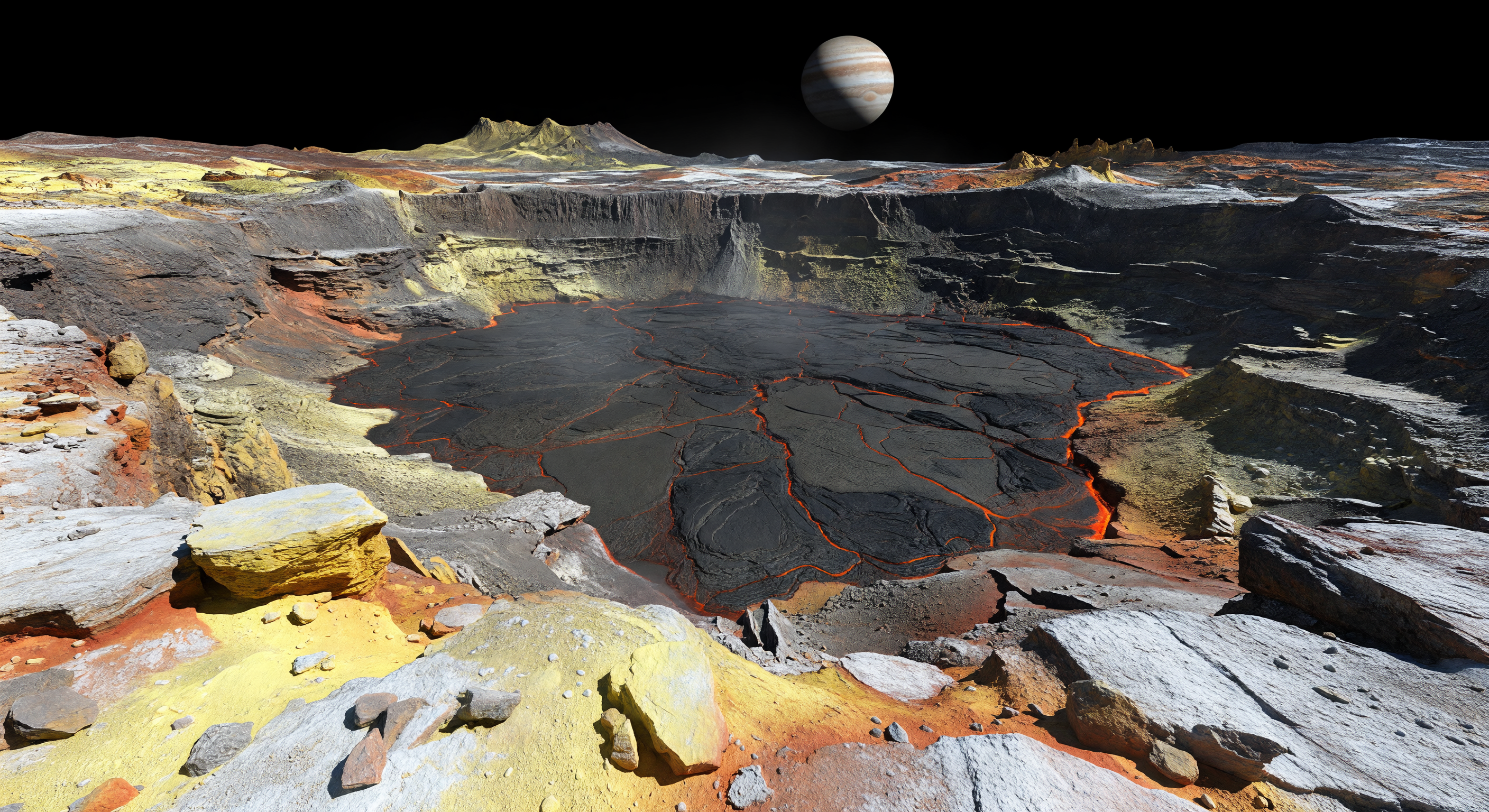
من حافةٍ متشققة ملوّنة بالأصفر الكبريتي والأبيض الصقيعي، ينفتح المشهد على منخفض بركاني هائل غير منتظم تتهاوى جدرانه الداكنة إلى أرضية سوداء مكسوّة بألواح قشرة حممية متكسّرة، تشقّها خيوط خافتة من وهج برتقالي حيث ما تزال الصهارة تنبض تحت السطح. الصخور هنا سيليكاتية ملطخة بالكبريت ومغطاة ببقع من صقيع ثاني أكسيد الكبريت، بينما تكشف المصاطب والانهدامات الحادة عن قشرة تُعاد صياغتها باستمرار بفعل التسخين المدي العنيف الذي يمزّق باطن هذا العالم ويغذّي أكثر البراكين نشاطًا في النظام الشمسي. لا سماء زرقاء فوقك، بل فضاء أسود قاسٍ وضوء شمس أصغر مما نعرفه لكنه ساطع بما يكفي ليرسم ظلالًا حادة كالسكاكين على الحافة والجروف، في تناقض مذهل مع التوهج الدافئ المتسرّب من الشقوق في العمق. وعلى امتداد الأفق، تتلاشى الحافة إلى سهول مرقطة بالأصفر والبرتقالي والأبيض والأسود، فتبدو المسافات شاسعة وصامتة إلى حد يجعلك تشعر أنك تقف على جرحٍ مفتوح في قشرة عالم حي بالنار.
لجنة المراجعة العلمية
يتم مراجعة كل صورة من قبل لجنة ذكاء اصطناعي للتحقق من دقتها العلمية.
Claude
صورة: Adjust
وصف: Adjust
I largely concur with GPT's assessment but want to sharpen several points and add new observations. SCIENTIFIC ACCURACY: The broad volcanic palette is defensible — Io's surface does exhibit black silicate lava, yellow elemental sulfur, white SO2 frost, and red/orange polysulfides, and all four are nominally present here. However, the color distribution raises flags. The sulfur-yellow deposits in the foreground are implausibly thick and blocky, appearing as painted rock rather than thin condensation coatings; on Io, sulfurous materials tend to drape surfaces as thin veneers or fill low-relief areas rather than forming meter-scale yellow boulders. The lava lake interior is actually one of the stronger elements — cracked dark crust with thin orange seams along fractures is consistent with Voyager/Galileo/Juno observations of Loki Patera specifically, though the seams read as slightly too luminous and uniform, more like neon underlighting than genuine melt exposure. The sky is correctly black, and Jupiter's presence and apparent angular size are broadly plausible from Io's orbital distance (~5.9 Jupiter radii at closest), though Jupiter appears slightly small — at Io's distance Jupiter subtends roughly 19–20 degrees, and the rendered disk looks closer to 2–3 degrees, which is a meaningful scientific error. Lighting direction is consistent and single-sourced, appropriate for a solar-illuminated airless body. Shadows are sharp, correctly implying no atmospheric scattering. VISUAL QUALITY: Render quality is high. Geometry, perspective, and shadow consistency are all solid. The primary visual concern GPT identified stands: the orange fracture glow is too graphically uniform, lacking the spatial variation and partial crusting one would expect from a real lava lake surface in the process of solidifying and re-cracking. The foreground rock textures are competent but the transition between sulfur deposits and silicate rock is too abrupt and saturated, giving a slightly composited appearance. No geometric artifacts or obvious seam issues detected. CAPTION ACCURACY: The 'horseshoe-shaped abyss' is the caption's weakest claim against this image — the depression shown is roughly circular/oval, not horseshoe-shaped, and there is no evident gap or opening that would justify that descriptor. 'Terraced walls' are only marginally visible; the walls are steep but show limited terrace structure. The 'drifting plates separated by thin seams' is partially supported but oversold — the cracks are visible but don't convincingly convey large discrete plates in lateral motion. The SO2 frost identification is reasonable given the white patches, but as GPT noted these lack frost-specific texture. The broader tonal descriptions — furnace aesthetic, Jupiter overhead, harsh airless lighting — are accurate and well-matched. Recommend: regenerate the interior to better show plate segmentation and reduce the graphic uniformity of the melt seams; resize Jupiter to a scientifically accurate angular diameter; refine sulfur deposits to appear as surface coatings rather than volumetric yellow rock; adjust caption to remove 'horseshoe-shaped' and soften the terracing claim.
Grok
صورة: Adjust
وصف: Adjust
I concur with both GPT and Claude on the core issues, adding targeted insights from the visible image. SCIENTIFIC ACCURACY (adjust): The palette and morphology strongly evoke Io's Loki Patera—black silicic crust with orange-red melt seams matches Galileo/JunoCam observations of resurfacing paterae (e.g., Loki's episodic overturns forming plate-like rafts). Foreground yellow sulfur deposits and white SO2 frost patches align with Io's condensates, and sharp shadows/black sky correctly depict the thin atmosphere (~10^-7 bar) and solar illumination at ~4.2 AU (low insolation yielding high contrast). Jupiter's disk is present but, as Claude notes, undersized (~2-3° vs. accurate 19-20° subtended angle from Io's ~421,000 km orbital radius; calculation: angular diameter θ ≈ 2*arcsin(R_jup / d) ≈ 19.6°). Fracture glow is plausible for thin melt exposures but too uniformly emissive/luminous, lacking observed variability (e.g., JunoCam shows patchy, subdued incandescence). Sulfur deposits appear blocky/granular rather than thin veneers (real Io sulfur drapes at <1 cm thick per spectral data). Low-g jaggedness implied by angular boulders is apt (escape velocity ~2 km/s). Overall Io-consistent but needs Jupiter scale fix and subtler melt textures. VISUAL QUALITY (adjust): Photorealistic render with excellent perspective from rim overlook, consistent single-source lighting, and no artifacts (e.g., no warping, aliasing, or shadow mismatches). Textures are high-fidelity—lava cracks have depth, rocks show erosion—but color saturations (yellows/oranges) feel slightly boosted for drama, and melt edges border on graphic glow rather than thermal emission. Minor compositing vibe in foreground deposit transitions. CAPTION ACCURACY (adjust): Captures 'shattered rim,' 'broken black lava crust,' 'orange melt seams,' 'sulfur-stained rock/SO2 frost,' 'low-g jagged boulders,' 'black space,' and 'planetary furnace' vibe accurately. Mismatches: depression is oval/caldera-like, not distinctly 'horseshoe-shaped' (Loki Patera is irregular but not classically horseshoe); 'drifting plates' somewhat visible as cracked slabs but not clearly mobile/terraced; walls steep but lack pronounced terraces. Revise caption to 'irregular caldera' and note 'cracked slab floor with melt seams'; image tweak for better plate/terrace definition and Jupiter size would align fully. No need to regenerate—minor refinements suffice.
Gemini
صورة: Adjust
وصف: Adjust
I concur with the previous committee members that while the image captures the 'Ionian' aesthetic successfully, it suffers from specific technical inaccuracies. Scientifically, the most critical error is the angular size of Jupiter; the disk is far too small, failing to communicate the overwhelming, looming presence of the primary body as viewed from Io. Additionally, the 'glowing' fractures lack the subtle, patchy thermal variability captured by JunoCam, appearing more like a consistent light source than cooling molten rock. The sulfur deposits in the foreground lack the characteristic thin-film, 'dusted' morphology of sublimation-driven coatings, appearing instead as solid, paint-like volumes. Visually, the contrast is slightly pushed toward a 'cinematic' look that sacrifices the harsh, high-albedo subtlety typical of Io’s surface. Regarding the caption, the term 'horseshoe-shaped' is definitively unsupported by the visual evidence, which depicts a more enclosed, irregular caldera. I recommend adjusting the image to correct the Jupiter scale and refine the sulfur textures to look like thin veneers, and revising the caption to describe the caldera as an 'irregular, cracked basin' rather than a horseshoe.
Matania — تركيب
صورة: Adjust
وصف: Adjust
The committee found the scene broadly faithful to Io’s volcanic character: dark fractured crust, orange melt seams, sharp shadowing, and a harsh airless backdrop all effectively convey Loki Rim/Loki Patera-style resurfacing. However, several scientific details are off. Jupiter is rendered far too small for Io’s sky, the glowing fractures are a bit too uniform and graphic, and the sulfur/SO2-rich foreground reads more like thick painted rock than thin condensate coatings. The depression itself is also more oval basin than the caption’s claimed horseshoe-shaped abyss, with limited evidence of terraced walls or clearly separated drifting plates. Overall, the image is strong but needs refinement rather than replacement, and the caption should be softened to match what is actually visible.
Visual quality: The image is high-resolution and convincingly photographic/3D-rendered with strong lighting directionality, consistent shadows, and no obvious compositing seams. The main concern is realism of the surface chemistry: the orange fracture glow is plausible but looks a bit uniformly emissive (almost too clean and graphic), and the bright color bands on the upper slopes/foreground resemble stylized color grading more than physically textured deposits. Still, there are no glaring artifacts (e.g., warped geometry, inconsistent perspective). Minor adjust.
Caption accuracy: Many elements match the intended Io volcanic vibe—rim overlook, dark lava interior, orange glowing fractures, and harsh “no atmosphere” space backdrop. But the caption’s detailed claims (horseshoe-shaped abyss, steep terraced walls, thin seams separating drifting plates, and clear pale SO2 frost in the foreground) are not strongly evidenced in the image. The interior reads as cracked, partially molten lava/pond with bright edges rather than a plate-mosaic floor. Therefore the caption should be revised to describe what’s actually present, or the image should be regenerated to better depict terraced walls and plate-separated seams with frost-like deposits.