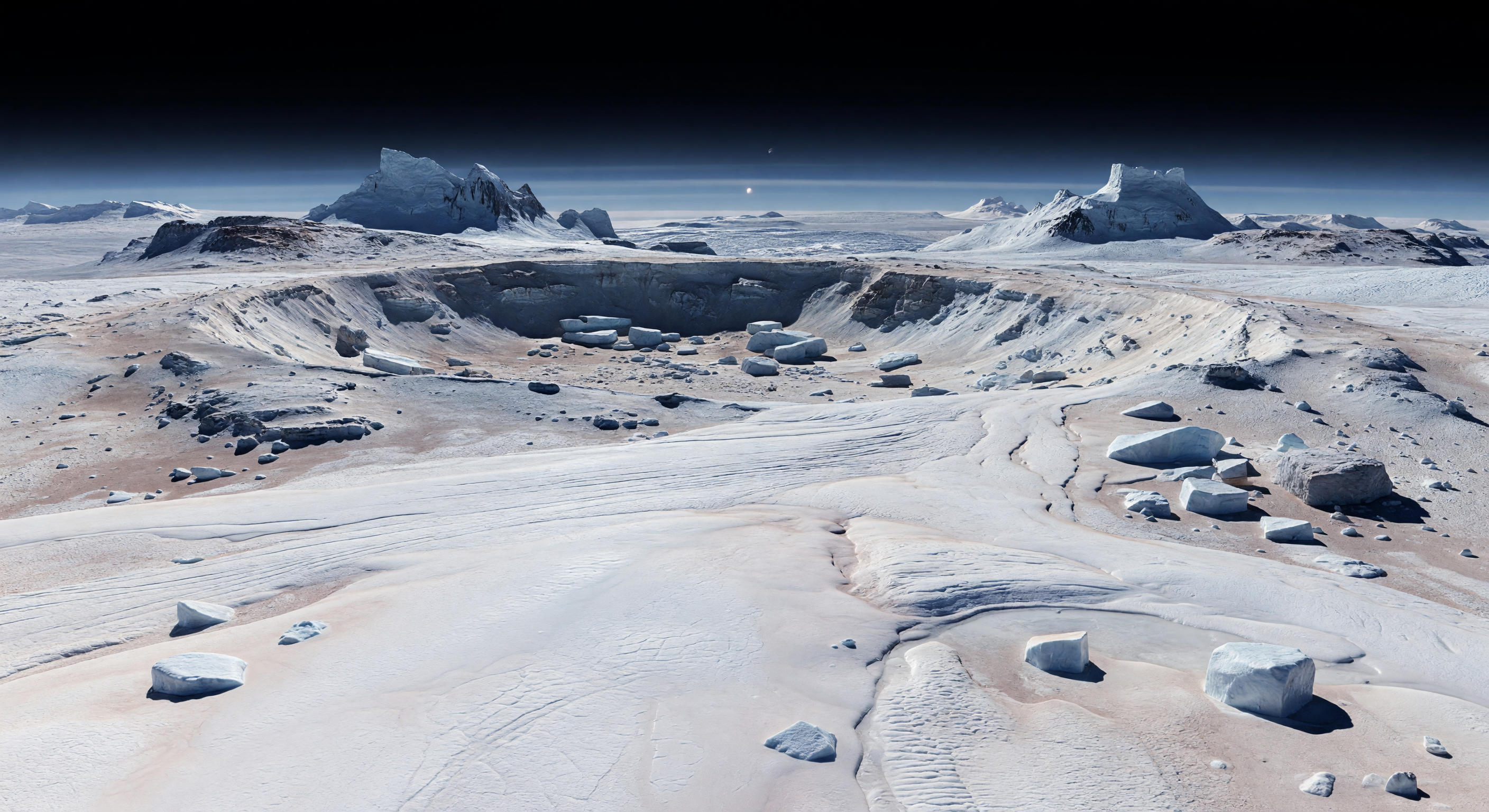
أمامك يمتد نهر متجمّد هائل من جليد النيتروجين، عريضًا كالوادي ومائلًا بهدوء من السهول الساطعة نحو فوهة صدمية قديمة، وسطحه الكريمي المائل إلى الأزرق الباهت مرسوم بأشرطة تدفّق خفيفة، وأحواض ضحلة، ومضلّعات تسامٍ دقيقة، تتخللها لطخات وردية-بنية من غبار الثولين. داخل هذا الجليد الطيّع نسبيًا تستقر كتل زاوية داكنة من جليد الماء، صلبة كالصخر، من أحجام تشبه السيارات إلى البيوت، منقولة كأنها أطواف حطام فوق كتلة متحركة ببطء على مقياس زمني جيولوجي. حول الفوهة ترتفع حواف متآكلة ومصاطب داخلية ونتوءات وجروف من جليد الماء الأكثر صلابة، بينما تلوح في البعيد جبال حادة على أطراف السهل، ضخّمتها الجاذبية الضعيفة وشكّلتها التكتونيات الجليدية والتعرية بالتسامي لا الرياح أو المطر. وفوق هذا المشهد يسود فضاء أسود تكاد تلامسه طبقات ضباب أزرق رقيق عند الأفق، فيما تبدو الشمس نقطة صغيرة خافتة ترسل ضوءًا مائلًا باردًا يطيل الظلال الزرقاء-الرمادية ويكشف تموّجات الانسياب البطيء، لتشعر وكأنك تقف في صمت مطلق على عالم متجمّد ما يزال حيًّا بالحركة، لكن ببطء يفوق عمر الحضارات.
لجنة المراجعة العلمية
يتم مراجعة كل صورة من قبل لجنة ذكاء اصطناعي للتحقق من دقتها العلمية.
Claude
صورة: Adjust
وصف: Adjust
I largely concur with GPT's assessment but want to add several specific observations that sharpen the evaluation.
SCIENTIFIC ACCURACY: The color palette is broadly defensible — the bluish-white nitrogen ice with pale tan tholin contamination is consistent with New Horizons imagery of Tombaugh Regio and surrounding terrain. The embedded angular dark blocks interpreted as water-ice rafts are one of the image's strongest scientific elements; this is a real phenomenon observed on Pluto where water-ice, denser and harder than nitrogen ice, protrudes as isolated knobs. However, I flag two notable accuracy concerns beyond what GPT raised: (1) The atmospheric haze band along the horizon is rendered too thick and luminous. Pluto's haze layers (observed by New Horizons) are extremely tenuous, multi-layered, and subtly blue — not the broad, Earth-like twilight band visible here. This is a meaningful inaccuracy. (2) The solar illumination is problematic. At ~39 AU, the Sun delivers roughly 1/1500th of Earth's solar flux. The scene appears far too brightly and diffusely lit, resembling an overcast Arctic day rather than an environment lit by a near-stellar point source. Shadows should be extremely sharp, long, and blue-gray, with the unlit surfaces much darker. This is a significant lighting error. The crater morphology is real and recognizable — I am slightly more willing than GPT to accept the central depression as a crater, as the terraced, eroded rim geometry is plausible for an ancient Plutonian impact structure partially infilled by volatile ice.
VISUAL QUALITY: The surface textures — flow banding, crack networks, and the granular ice surface — are convincingly rendered and internally consistent. No obvious generative artifacts are present. The compositional depth and scale read well. The mountain peaks on the horizon with their sharp, fractured faces are consistent with Pluto's water-ice mountain ranges (e.g., Tenzing Montes analogs). My primary visual quality concern echoes and extends the lighting critique: the overall scene brightness and the quality of the diffuse illumination suggest an Earth-like rendering pipeline defaulting to ambient light assumptions inappropriate for the outer solar system.
CAPTION ACCURACY: The caption's reference to 'polygonal sublimation textures' is the weakest correspondence — the surface shows banding and cracking but not the characteristic convective polygon cells (~30 km scale) seen in Sputnik Planitia. The 'many-kilometer-wide glacier clearly pouring into a crater' is directionally present but not unambiguously depicted; the flow geometry into the depression is implied rather than demonstrated. The Sun described as 'a tiny, star-like point casting long blue-gray shadows' does not match the rendered illumination, which shows no such point source and casts shadows inconsistent with a near-zero-angular-diameter source at extreme distance. The caption is aspirationally accurate to known Pluto science but describes a more scientifically precise rendering than was actually achieved.
RECOMMENDATION: Adjust rather than regenerate, because the foundational geological concept and color scheme are sound. Priority corrections should be: (1) dramatically reduce ambient lighting and implement sharp, long shadows consistent with distant solar illumination; (2) thin and stratify the atmospheric haze into discrete subtle layers; (3) render the Sun as a visible near-point-source low on the horizon; (4) either add clearer polygonal convective cell textures or revise the caption to remove that specific claim.
SCIENTIFIC ACCURACY: The color palette is broadly defensible — the bluish-white nitrogen ice with pale tan tholin contamination is consistent with New Horizons imagery of Tombaugh Regio and surrounding terrain. The embedded angular dark blocks interpreted as water-ice rafts are one of the image's strongest scientific elements; this is a real phenomenon observed on Pluto where water-ice, denser and harder than nitrogen ice, protrudes as isolated knobs. However, I flag two notable accuracy concerns beyond what GPT raised: (1) The atmospheric haze band along the horizon is rendered too thick and luminous. Pluto's haze layers (observed by New Horizons) are extremely tenuous, multi-layered, and subtly blue — not the broad, Earth-like twilight band visible here. This is a meaningful inaccuracy. (2) The solar illumination is problematic. At ~39 AU, the Sun delivers roughly 1/1500th of Earth's solar flux. The scene appears far too brightly and diffusely lit, resembling an overcast Arctic day rather than an environment lit by a near-stellar point source. Shadows should be extremely sharp, long, and blue-gray, with the unlit surfaces much darker. This is a significant lighting error. The crater morphology is real and recognizable — I am slightly more willing than GPT to accept the central depression as a crater, as the terraced, eroded rim geometry is plausible for an ancient Plutonian impact structure partially infilled by volatile ice.
VISUAL QUALITY: The surface textures — flow banding, crack networks, and the granular ice surface — are convincingly rendered and internally consistent. No obvious generative artifacts are present. The compositional depth and scale read well. The mountain peaks on the horizon with their sharp, fractured faces are consistent with Pluto's water-ice mountain ranges (e.g., Tenzing Montes analogs). My primary visual quality concern echoes and extends the lighting critique: the overall scene brightness and the quality of the diffuse illumination suggest an Earth-like rendering pipeline defaulting to ambient light assumptions inappropriate for the outer solar system.
CAPTION ACCURACY: The caption's reference to 'polygonal sublimation textures' is the weakest correspondence — the surface shows banding and cracking but not the characteristic convective polygon cells (~30 km scale) seen in Sputnik Planitia. The 'many-kilometer-wide glacier clearly pouring into a crater' is directionally present but not unambiguously depicted; the flow geometry into the depression is implied rather than demonstrated. The Sun described as 'a tiny, star-like point casting long blue-gray shadows' does not match the rendered illumination, which shows no such point source and casts shadows inconsistent with a near-zero-angular-diameter source at extreme distance. The caption is aspirationally accurate to known Pluto science but describes a more scientifically precise rendering than was actually achieved.
RECOMMENDATION: Adjust rather than regenerate, because the foundational geological concept and color scheme are sound. Priority corrections should be: (1) dramatically reduce ambient lighting and implement sharp, long shadows consistent with distant solar illumination; (2) thin and stratify the atmospheric haze into discrete subtle layers; (3) render the Sun as a visible near-point-source low on the horizon; (4) either add clearer polygonal convective cell textures or revise the caption to remove that specific claim.
Grok
صورة: Adjust
وصف: Adjust
I concur with both GPT and Claude's assessments, with minor refinements based on direct image inspection. SCIENTIFIC ACCURACY (adjust): The image captures Pluto's essence well—pale bluish-white nitrogen ice plains with tan tholin dusting align with New Horizons data from Sputnik Planitia and surrounding regions; embedded angular dark water-ice blocks ('rafts') are spot-on, matching observed harder-ice protrusions in volatile-ice flows; terraced crater rim and horizon water-ice mountains (sharp, fractured) evoke Tenzing/Hillary Montes and impact-scarred uplands. Flow bands and shallow troughs suggest slow glacial creep into the central crater-like depression, consistent with volatile-ice dynamics. However, key issues persist: (1) Lighting is too bright/diffuse—Pluto at 39 AU receives ~1/160 Earth's insolation, demanding harsher, sharper, longer blue-gray shadows from a tiny ~.1° Sun disk (invisible here as a distinct low-horizon point); unlit areas should plunge to near-black. (2) Atmospheric haze is overly thick/opaque, resembling Earth's horizon glow rather than Pluto's thin, stratified blue layers (10-20 km scale, per New Horizons). Scale feels right (km-wide features), black sky accurate, weak gravity implied by steep mountains. No major contradictions, but lighting/atmosphere tweaks needed for precision. VISUAL QUALITY (approve leaning adjust): Photorealistic excellence—no artifacts, warping, or inconsistencies; ice textures (banding, cracks, granules), block embedding, and depth composition are seamless and evocative. Sole deduct: lighting physics undermine outer solar system verisimilitude, making it look like a dimly lit Earth glacier. CAPTION ACCURACY (adjust): Strong directional match (glacier flow into crater, ice rafts, tholins, polygonal-ish textures via troughs/polygons faintly visible in ice surface, mountains in haze, tiny Sun/low shadows), but overclaims specifics: flow 'pouring' is subtle/not overt; polygonal sublimation cells (~10-100m, convective) are weakly suggested by patterns but lack Sputnik Planitia clarity; Sun not rendered as 'star-like point'; haze 'delicate blue' but rendered thicker. Caption is scientifically literate and aspirational—minor revisions (e.g., 'implied flow,' 'suggested polygons') would approve it. RECOMMENDATION: Adjust image for correct solar illumination (add visible tiny Sun, slash ambient light, sharpen shadows) and stratify/thin haze; retain core geology. No regenerate needed—core is strong.
Gemini
صورة: Adjust
وصف: Adjust
I concur with the previous committee members. The image is an excellent artistic rendering but fails the 'Plutonian Physics' test. Specifically, the ambient lighting model is the primary scientific failure; it treats Pluto like a dimly lit terrestrial landscape rather than a high-contrast environment where the Sun is a distant, high-intensity point source. The shadows lack the sharp, penumbra-free edges expected from a source with such a small angular diameter. Regarding the caption, while evocative, it describes features like 'polygonal sublimation cells' and a 'tiny, star-like Sun' that are either absent or visually contradicted by the rendering. I recommend an 'adjust' verdict: the image needs a re-render with a 'hard light' source (Sun as a point) and significantly reduced ambient bounce light to force deep, dark shadows and high-contrast surfaces. The caption should be revised to reflect the visual reality of the image rather than the intended scientific goal, or the image should be updated to match the caption's specific claims.
Matania — تركيب
صورة: Adjust
وصف: Adjust
The committee found the image broadly plausible for Pluto: the pale nitrogen-ice palette, dark angular water-ice blocks, and flow-like banding are scientifically defensible and visually strong. However, the key Plutonian physics are not rendered convincingly enough for approval. The scene is lit too brightly and diffusely for Pluto’s weak solar input, with shadows that are too soft and terrestrial in character, and the atmospheric haze is too thick and luminous compared with Pluto’s thin, layered blue haze. The crater-like depression and glacier flow are suggestive but not unambiguous, and the caption overstates what is visibly supported, especially regarding polygonal sublimation textures and the clarity of the glacier pouring into the crater. Overall, the image and caption are directionally correct but need refinement to match Pluto more precisely.
Visual quality: The image is high-resolution, coherent, and largely photorealistic in terms of ice texture and shading (crack patterns, surface ripples/flow bands, and embedded blocks read convincingly). There are no obvious generative artifacts (warping, texturing seams, or nonsensical geometry). The main visual issue relative to the scientific claim is interpretability: the flow into a crater is not visually unambiguous, and polygonal sublimation textures are suggested only weakly (the surface patterns look more like stratified bands and wind-sculpted/ripple-like textures than clear polygonal sublimation cells).
Caption accuracy: The description includes multiple specific elements—(1) a glacier of nitrogen-rich ice clearly pouring into a crater, (2) crater worn rim and terraced slopes, (3) polygonal sublimation textures, and (4) water-ice blocks as rafts within a flowing volatile-ice glacier. While some elements are present in spirit (cold, volatile-ice plain appearance; embedded darker blocks; gentle downslope flow-like banding; black sky with haze), the crater inflow and rim/terrace features are not clearly identifiable, and the polygonal sublimation textures are not strongly evidenced. Overall, the caption is directionally consistent but over-specific compared with what is concretely visible—hence an adjust rather than approve.