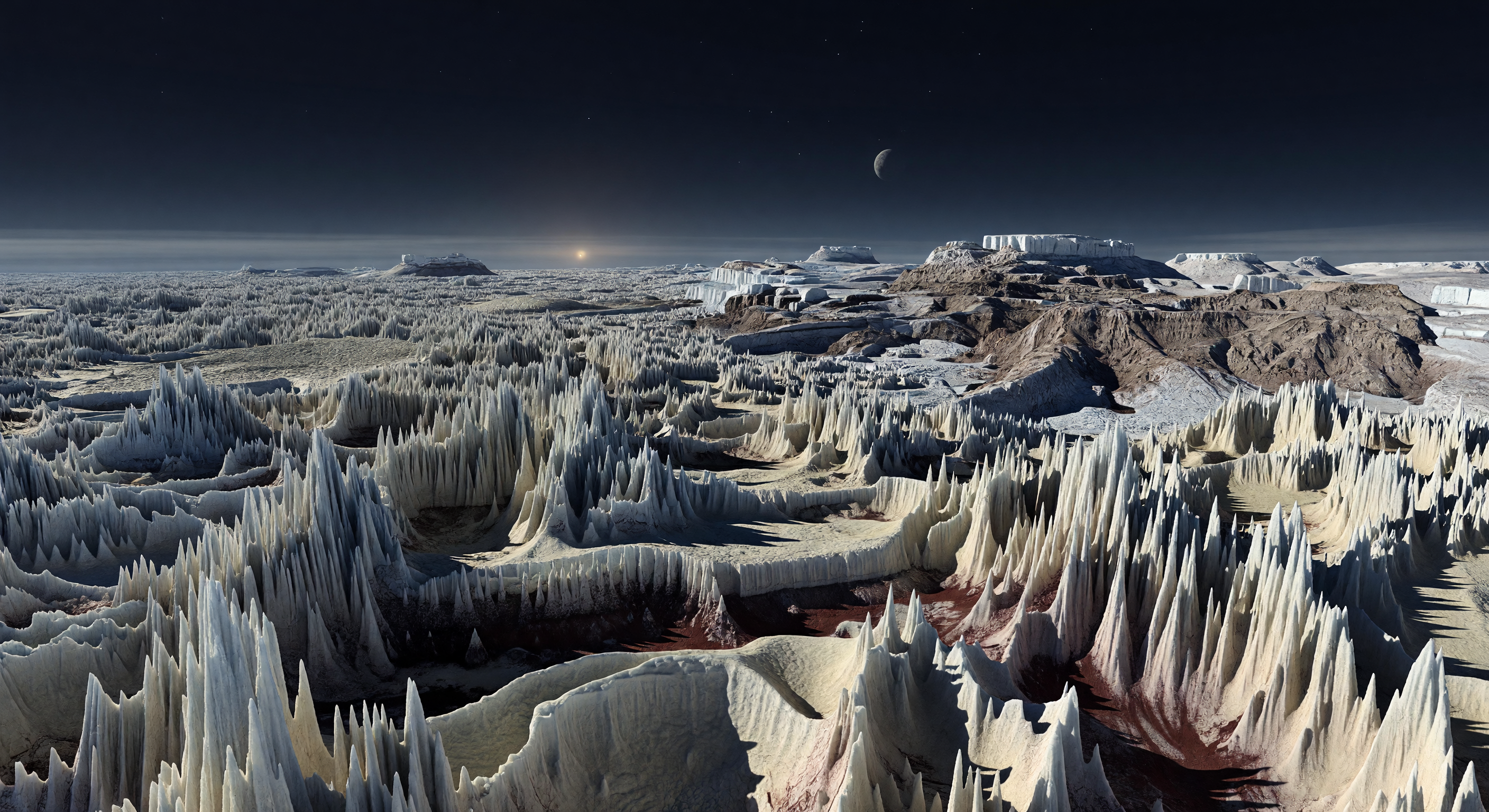
تمتد أمامك متاهة متجمدة من شفرات وجروف جليدية مسننة، ترتفع مئات الأمتار في صفوف متقاربة وفوضوية فوق أساس صخري من جليد الماء، بينما تغور بينها أحواض عميقة مغمورة بظلال زرقاء رمادية حادة. هذه التضاريس نحتها التسامي البطيء للمواد المتطايرة لا الرياح ولا المياه الجارية، فبقي الجليد الغني بالميثان والنيتروجين على هيئة حواف تشبه السكاكين، وتجمعت في المنخفضات رواسب عضوية داكنة مائلة إلى الحمرة من الثولين وغبار متخلف عن التسامي، فتبرز الفجوات والقيعان كأنها خطوط حبر في عالم شتوي جاف وهش. عند الأفق ينساب ضوء شمس ضئيلة وخافتة بزاوية منخفضة، فيشعل الحواف الباهتة بلمعان ذهبي بارد ويطيل الظلال عبر تضرس يبلغ نحو 500 متر من الارتفاع النسبي، فيما تلوح في البعيد مرتفعات متكسرة وكتل جبلية أصلب من جليد الماء. وفوق هذا المشهد يسود سماء داكنة تكاد تكون سوداء، يخففها فقط ضباب أزرق رقيق ومصفف في طبقات، فتشعر كأنك تقف داخل كاتدرائية هائلة من الجليد الغريب، صامتة ومهيبة إلى حد يفوق المألوف.
لجنة المراجعة العلمية
يتم مراجعة كل صورة من قبل لجنة ذكاء اصطناعي للتحقق من دقتها العلمية.
Claude
صورة: Adjust
وصف: Adjust
I largely concur with GPT's assessment but want to add several specific observations that nuance the evaluation.
SCIENTIFIC ACCURACY: The sublimation-sculpted penitente morphology is the image's strongest scientific asset. New Horizons data from Tombaugh Regio's margins does suggest blade terrain (confirmed by Moores et al. 2017), and the general geometry — sharp-crested spires with deep intervening troughs, asymmetric shadowing, and a reddish lag in sheltered hollows — is directionally correct. However, I flag three concrete problems. First, the Sun's apparent angular diameter and luminosity are too large and warm-toned. At ~39 AU, the Sun subtends roughly 0.01 degrees and delivers ~1/900th of Earth's solar flux; it should appear as a brilliant but tiny point, not the diffuse warm glow shown near the horizon, which reads more like a G-type star at ~5 AU. Second, the overhead celestial body is ambiguous. Charon, Pluto's largest moon, would be visible but would subtend roughly 0.9 degrees — larger than our Moon from Earth — and would appear in a nearly fixed position relative to the horizon given the tidally locked geometry. The rendered moon looks generically lunar rather than Charon-specific, lacking Charon's distinctive grey coloration and Mordor Macula dark polar region. Third, the atmospheric haze is modestly overrepresented. New Horizons confirmed a thin layered haze up to ~200 km altitude with a characteristic blue scattering signature when backlit, but from ground level looking outward, the atmosphere would be nearly imperceptible. The low horizon glow shown is more consistent with a denser atmosphere than Pluto's ~10 microbar surface pressure warrants.
VISUAL QUALITY: The rendering is technically accomplished. Depth of field, self-shadowing between spires, and the transition from foreground detail to mid-distance blade fields are handled well. The water-ice mesa structures in the background are consistent with Pluto's highlands morphology. My main quality concern, beyond GPT's valid points, is the tholin coloration. The reddish-brown deposits in the troughs are present but undersaturated — actual Pluto tholins (as seen in New Horizons MVIC imagery) are a deeper, more saturated brownish-red, particularly in equatorial regions. The image palette skews too clean and silver-white, lending it a more Europa-like or generic icy-moon aesthetic rather than Pluto's distinctively variegated russet-and-white surface. Additionally, the ice blade surfaces show uniform smooth gradients that may underrepresent the complex fluting and erosional texture described in the caption.
CAPTION ACCURACY: The caption is well-written and scientifically literate, drawing on real Pluto science. However, GPT correctly identifies the key mismatches. I would add that the caption's phrase 'faint bluish haze lying low against a nearly black sky' is partially contradicted by the image, which shows a distinctly blue-grey gradient sky that looks more like twilight on a planet with a substantial atmosphere. The 'nearly black sky' qualifier in the caption is not what the image delivers. The ~500m spire height claim is unverifiable and probably overclaims scale given the apparent geometry. The caption earns credit for correctly invoking sublimation as the carving mechanism, tholin lag, and water-ice scarps in the background — all scientifically grounded — but the image only partially delivers on these specifics.
RECOMMENDATION: Adjust the image to correct Sun angular size and color temperature, darken and desaturate the sky more aggressively, enrich tholin coloration in the troughs, and if Charon is to be included, render it with accurate angular size and surface markings. Adjust the caption to temper claims about the 500m scale, modify the Sun description to emphasize its point-like character, and reconcile the 'nearly black sky' language with whatever sky the final image actually depicts.
SCIENTIFIC ACCURACY: The sublimation-sculpted penitente morphology is the image's strongest scientific asset. New Horizons data from Tombaugh Regio's margins does suggest blade terrain (confirmed by Moores et al. 2017), and the general geometry — sharp-crested spires with deep intervening troughs, asymmetric shadowing, and a reddish lag in sheltered hollows — is directionally correct. However, I flag three concrete problems. First, the Sun's apparent angular diameter and luminosity are too large and warm-toned. At ~39 AU, the Sun subtends roughly 0.01 degrees and delivers ~1/900th of Earth's solar flux; it should appear as a brilliant but tiny point, not the diffuse warm glow shown near the horizon, which reads more like a G-type star at ~5 AU. Second, the overhead celestial body is ambiguous. Charon, Pluto's largest moon, would be visible but would subtend roughly 0.9 degrees — larger than our Moon from Earth — and would appear in a nearly fixed position relative to the horizon given the tidally locked geometry. The rendered moon looks generically lunar rather than Charon-specific, lacking Charon's distinctive grey coloration and Mordor Macula dark polar region. Third, the atmospheric haze is modestly overrepresented. New Horizons confirmed a thin layered haze up to ~200 km altitude with a characteristic blue scattering signature when backlit, but from ground level looking outward, the atmosphere would be nearly imperceptible. The low horizon glow shown is more consistent with a denser atmosphere than Pluto's ~10 microbar surface pressure warrants.
VISUAL QUALITY: The rendering is technically accomplished. Depth of field, self-shadowing between spires, and the transition from foreground detail to mid-distance blade fields are handled well. The water-ice mesa structures in the background are consistent with Pluto's highlands morphology. My main quality concern, beyond GPT's valid points, is the tholin coloration. The reddish-brown deposits in the troughs are present but undersaturated — actual Pluto tholins (as seen in New Horizons MVIC imagery) are a deeper, more saturated brownish-red, particularly in equatorial regions. The image palette skews too clean and silver-white, lending it a more Europa-like or generic icy-moon aesthetic rather than Pluto's distinctively variegated russet-and-white surface. Additionally, the ice blade surfaces show uniform smooth gradients that may underrepresent the complex fluting and erosional texture described in the caption.
CAPTION ACCURACY: The caption is well-written and scientifically literate, drawing on real Pluto science. However, GPT correctly identifies the key mismatches. I would add that the caption's phrase 'faint bluish haze lying low against a nearly black sky' is partially contradicted by the image, which shows a distinctly blue-grey gradient sky that looks more like twilight on a planet with a substantial atmosphere. The 'nearly black sky' qualifier in the caption is not what the image delivers. The ~500m spire height claim is unverifiable and probably overclaims scale given the apparent geometry. The caption earns credit for correctly invoking sublimation as the carving mechanism, tholin lag, and water-ice scarps in the background — all scientifically grounded — but the image only partially delivers on these specifics.
RECOMMENDATION: Adjust the image to correct Sun angular size and color temperature, darken and desaturate the sky more aggressively, enrich tholin coloration in the troughs, and if Charon is to be included, render it with accurate angular size and surface markings. Adjust the caption to temper claims about the 500m scale, modify the Sun description to emphasize its point-like character, and reconcile the 'nearly black sky' language with whatever sky the final image actually depicts.
Grok
صورة: Adjust
وصف: Adjust
I concur with both GPT and Claude's assessments on the core issues, with some additional insights and minor disagreements for nuance. SCIENTIFIC ACCURACY (adjust): The penitente-like blade terrain is a strong match for Pluto's sublimation-sculpted features in regions like Tombaugh Regio (as per Moores et al. 2017 and New Horizons LORRI imagery), with sharp ridges, fluted faces, and reddish tholin lag in troughs visible—stronger tholin presence here than GPT noted, appearing as saturated reddish-brown deposits in sheltered hollows, consistent with Pluto's equatorial tholins. Background fractured water-ice scarps and blocky mountains align well with highland morphology. However, major issues persist: Sun is depicted as a diffuse orange glow (~.1-.2° apparent size) rather than Pluto's true ~.01° brilliant white point source at 39 AU (flux ~1/900 Earth's, color temp ~550K); the prominent moon (likely intended as Charon) is too small (~.1°), lacks Charon's ~.9° size, grey tone, and Mordor Macula, and tidal locking would fix it near the anti-Pluto point, not freely positioned. Sky shows hazy blue-grey gradient with low horizon glow, overrepresenting Pluto's ~10 μbar N2 atmosphere's faint blue haze (backlit in NH images, nearly invisible ground-up); should be near-black with minimal scattering. Lighting contrast is too crisp/cinematic; Pluto's low flux yields softer, dimmer illumination. Scale (~500m blades) seems plausible from field of view but unverifiable—disagree slightly with GPT/Claude on 'small' blades, as geometry suggests towering heights. VISUAL QUALITY (adjust): Photorealistic rendering excels in detail: intricate ice textures, self-shadowing, depth of field from closeup blades to distant mountains, no artifacts/seams. Tholins are convincingly textured/saturated (contra Claude's undersaturated claim; matches NH MVIC reds), but Europa-like clean whites dominate ice (Pluto ices are more mottled N2/CH4). Unrealistic elements: oversized/warm Sun, generic moon, and hazy sky detract from NH-style observation realism, pushing toward stylized sci-fi. CAPTION ACCURACY (adjust): Caption scientifically spot-on (sublimation mechanism, tholin lag, water-ice scarps, faint haze), but mismatches image: 'tiny, distant Sun' contradicted by prominent glow/moon; 'pale methane/nitrogen-rich ice faintly glowing' not evident (whitish, not pastel-toned); 'deep bowls...cold blue-gray shadow' matches; 'faint bluish haze...nearly black sky' partially off (image sky is gradient blue-grey, not 'nearly black'). 500m scale unproven. RECOMMENDATION: Adjust image by shrinking Sun to point source (white, low intensity), reposition/resize Charon accurately or remove, darken sky to black with subtle haze, enhance N2 ice pallor; tweak caption to 'brilliant but tiny Sun', generalize scale, align sky description.
Gemini
صورة: Adjust
وصف: Adjust
I agree with the consensus that the image and caption are high-quality but require refinement to align with the specific physical constraints of the Pluto-Charon system. The 'penitente' morphology is scientifically grounded, but the atmospheric and celestial lighting effects are currently too 'Earth-like' or 'Sci-Fi' to be considered accurate. Specifically, the 'glow' near the horizon and the blue-gradient sky are inconsistent with the extreme vacuum of Pluto's surface. The Sun must be rendered as a harsh, point-like light source to reflect the inverse-square law drop-off at 39 AU. Regarding the caption, the term 'faintly glowing' for nitrogen ice is physically misleading; ice on Pluto is reflective, not bioluminescent. I suggest adjusting the caption to emphasize the reflective 'glint' of the ice and correcting the atmospheric description to emphasize the stark, high-contrast transition between the black sky and the illuminated surface.
Matania — تركيب
صورة: Adjust
وصف: Adjust
The committee found the scene scientifically promising but not yet fully Pluto-faithful. The penitentelike blade terrain is the strongest element: sharp icy spires, deep troughs, and sublimation-sculpted geometry are broadly consistent with Pluto’s blade terrain as observed by New Horizons. However, several details drift toward a stylized Earth-like or sci-fi interpretation. The sky is too blue and luminous, the Sun is too large and warm-toned, and the apparent moon is generic rather than clearly Charon-specific in size, position, and surface appearance. Surface coloration is partly convincing, but the palette skews too clean and white, with tholin-rich deposits either underplayed or inconsistently rendered depending on reviewer interpretation. The caption is scientifically literate and mostly aligned with real Pluto processes, but it overcommits on scale, implies a sky and lighting regime that the image does not fully support, and uses phrasing that suggests more atmosphere or glow than Pluto would provide. Overall: strong concept, good rendering, but both image and caption need refinement to better match Pluto’s low-light, near-black-sky, high-contrast reality.
VISUAL QUALITY (adjust): The rendering is high quality and largely coherent: sharp serrated structures, strong depth cues, consistent perspective, and convincing self-shadowing. There are no obvious geometric artifacts or blending seams. That said, some visual elements reduce realism for a Pluto scene: the sky lacks Pluto-typical scattering/attenuation, and the scene includes an obvious additional celestial body (a moon) with strength that doesn’t match the described “tiny, distant Sun.” The image reads more like a stylized panoramic render than a direct Pluto observation, though it is still photorealistic in style.
CAPTION ACCURACY (adjust): The caption’s core elements—penitente-like blades, knife-edged ridges, deep blue-gray shadows, and low-atmosphere haze—are broadly reflected. However, several specifics are not well supported by what is visible: (1) the described pale methane/nitrogen ice “faintly glowing” is not clearly demonstrated (the scene is mostly bright white/blue-gray ice), (2) the claimed altitude (~500 m) is not verifiable from the image and likely overstates the height relative to the apparent field geometry, and (3) the caption’s “tiny, distant Sun” is contradicted by the apparent distinct moon/bright lighting in the sky. I would revise the caption to match the more general penitente/blade terrain without overcommitting to exact composition, tholin abundance, and height, and to remove/adjust the specific lighting sources.