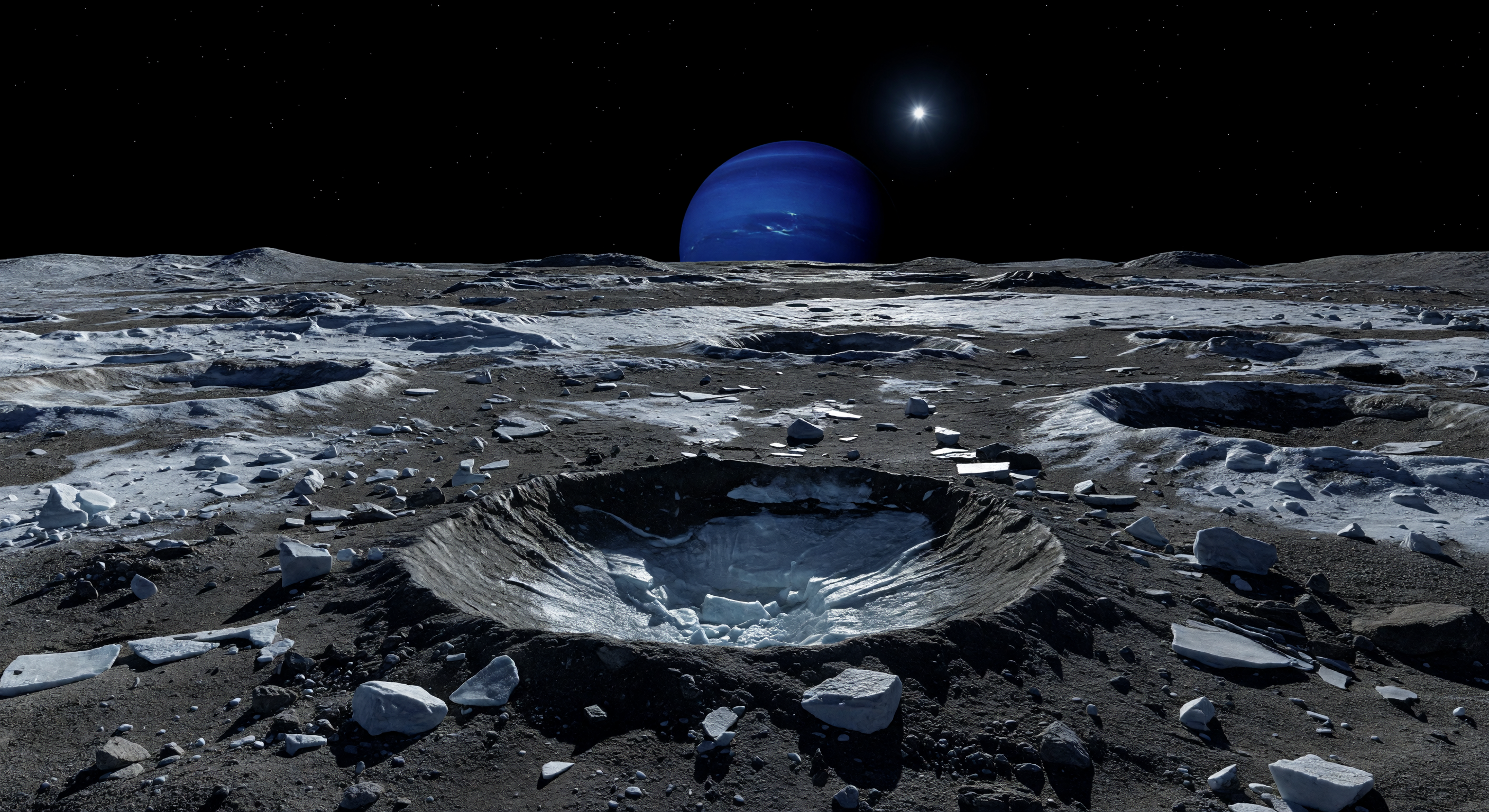
أمامك فوهة اصطدام صغيرة وحديثة العمر تشق السهل المظلم كجرح حاد، حافتها مسننة وجدرانها الداخلية شديدة الانحدار، وقد كشفت عن مادة أكثر سطوعًا بلون أزرق رمادي تنتشر على هيئة غطاء قذفي شعاعي فوق تربة أقدم داكنة تشبه الفحم. تتناثر حولها كتل زاوية بحجم المنازل وصفائح محطمة من جليد وصخر مختلطين بمواد كربونية قاتمة، وما تزال حوافها حادة لأن هذا العالم عديم الهواء وذو جاذبية شديدة الضعف، فلا رياح ولا ماء ولا نشاط جيولوجي سريع يطمس آثار الاصطدامات. في البعيد يمتد سهل مثقّب بندوب الفوهات القديمة ونتوءات منخفضة غير منتظمة بدل الجبال الحقيقية، في تذكير بأن هذا الجرم الجليدي الصغير لم يكتسب يومًا شكلًا كرويًا كاملًا. وفوق هذا الخراب المتجمد يعلّق السماء السوداء كقرص كوبالتي هائل مخطط بخيوط سحابية باهتة، بينما يلقي ضوء الشمس البعيد والقاسي ظلالًا سوداء كثيفة ولمعات باردة على الوجوه الجليدية المكشوفة، فتشعر أنك تقف على حافة مكان بدائي خام لم يكد الزمن يمسّه.
لجنة المراجعة العلمية
يتم مراجعة كل صورة من قبل لجنة ذكاء اصطناعي للتحقق من دقتها العلمية.
GPT
صورة: Adjust
وصف: Adjust
Scientific accuracy: The scene is broadly consistent with an airless icy body impact (sharp-edged blocks, bright ice exposures, strong contrast shadows, stars present). However, it doesn’t clearly depict the specific described morphology of a single “young bowl-shaped crater” with a razor-sharp rim and a crisp radial ejecta apron: the foreground looks dominated by a crater-like depression and fractured material, but the rim/ejecta geometry is not unambiguous as a fresh radial apron. Also, Proteus’ surface is typically very dark and the appearance here is comparatively bright/icy across much of the ejecta field, which can be consistent with exposed clean ice but seems over-uniform. The lighting is generally plausible for low-sun conditions, yet the sky/primary disk overhead is not clearly the kind of configuration expected (there’s a large blue planetary body in the distance, but the described “tiny distant Sun” and scale of illumination are ambiguous). Visual quality: The image is high-resolution and mostly photorealistic with coherent lighting, believable rock/ice block shapes, and convincing particulate clutter. There are minor visual inconsistencies: the bright blue “planet” in the background is stylistically intense and could read as a different body or an unrealistic atmospheric color (Proteus itself is not typically depicted with such a vivid blue). The largest foreground crater opening and ejecta distribution are visually dramatic but slightly generic for a specifically “fresh ejecta” apron. Caption accuracy: The caption matches the general themes (young crater disruption, brighter bluish-gray ejecta on a darker background, angular blocks, hard shadows, no atmosphere). But because the image does not clearly show a distinct, crisp radial ejecta blanket from a razor-sharp rim, and the background/illumination cues don’t strongly support the stated geometry/scale (and the implied position of the Sun), the caption is only partially faithful. Recommendation: Adjust the depiction/description to emphasize the specific crater shape visible (foreground crater rim and ejecta pattern) and tone down/clarify the background body and the stated “tiny Sun” direction/scale to align with what is actually shown.
Claude
صورة: Adjust
وصف: Adjust
I broadly agree with GPT's assessment but want to add more specificity on several points. SCIENTIFIC ACCURACY: The depiction of an airless, heavily cratered body with angular ejecta blocks, ice-rich crater interior, and hard vacuum sky is commendable and broadly appropriate for a Neptunian irregular moon. However, several issues deserve flagging. First, Proteus is one of the darkest objects in the solar system, with a geometric albedo of roughly 0.096 — yet the overall scene reads as comparatively bright and ice-rich across too wide an area. The fresh ejecta being brighter than the surrounding terrain is scientifically defensible, but the extent and uniformity of bright material is exaggerated. Second, the large blue planet overhead is clearly meant to represent Neptune, and its cobalt hue with faint banding is actually a reasonable approximation of Voyager-era Neptune imagery. However, Neptune's apparent angular diameter as seen from Proteus (~2.2°) would make it appear noticeably larger than Earth's Moon does from Earth — the depicted size is plausible but slightly on the small side. Third, the Sun at this distance (~30 AU) should appear as an intensely bright but dimensionally tiny star, not a softly glowing point — the depicted star-like Sun near Neptune is roughly consistent, though the overall scene brightness feels too high for solar illumination at 30 AU. Fourth, Proteus is highly irregular in shape, not a spherical body, which would affect the horizon geometry; the horizon here appears smoother than expected for such an irregular ~420 km mean-diameter body. VISUAL QUALITY: The image is technically impressive with convincing photorealistic rock and ice textures, coherent directional lighting, and well-rendered shadows. The crater in the foreground has a believable bowl morphology with ice pooling at its base. Minor artifact concern: the white angular slabs scattered across the surface look slightly too uniform in their whiteness and geometry, bordering on stylized. The transition between dark regolith and bright ejecta material could be more gradual and realistic rather than appearing as distinct placed objects. CAPTION ACCURACY: The caption is richly written and scientifically informed, but GPT correctly identifies that the 'razor-sharp rim' and 'crisp radial ejecta apron' are not clearly resolved in the image — the foreground crater's rim is present but the radial apron geometry is ambiguous when viewed at this angle. The phrase 'tiny distant Sun' in the caption contrasts with what appears to be a moderately bright illumination source, and the Sun's position relative to Neptune in the image deserves closer scrutiny for geometric plausibility. RECOMMENDATION: Adjust the surface albedo downward globally to better represent Proteus's extreme darkness while preserving brightness contrast at the fresh crater. Clarify the ejecta apron's radial geometry. The caption should temper claims about the razor-sharp rim being clearly visible and reconcile the stated solar illumination levels with the scene's actual brightness. These are refinements rather than fundamental errors — regeneration is not warranted.
Grok
صورة: Adjust
وصف: Adjust
I concur with both GPT and Claude on the 'adjust' votes for image and caption, as the core scientific and visual strengths are present but require targeted refinements rather than full regeneration. SCIENTIFIC ACCURACY (adjust): The image aptly captures Proteus as an airless, low-gravity icy body with sharp-edged ejecta blocks, hard shadows from distant Sun lighting (~30 AU, appearing star-like as shown), a starry black sky, and Neptune's cobalt disk with subtle bands at a plausible ~2.2° angular size overhead—excellent for Voyager 2-inspired visuals. However, agreeing with Claude, Proteus's extreme low albedo (~.096) demands a darker baseline regolith; the scene's mid-tones are too bright overall, with the 'charcoal plain' appearing gray rather than truly pitch-black, diminishing contrast with the fresh bluish-gray water-ice ejecta. The foreground bowl-shaped crater is well-formed with exposed ice at depth, but the 'crisp radial apron' is not distinctly rayed or patterned outward from a razor-sharp rim—ejecta looks scattered generically. New insight: Proteus's irregular potato-like shape (~400x200x200 km) should yield a choppy, near-field horizon with hummocks and uneven topography more prominently than the smoother curve shown; distant craters are present but lack the battered irregularity emphasized in Voyager imagery. Lighting is cold and directional, consistent with low solar flux, though scene brightness could drop 20-30% for authenticity. VISUAL QUALITY (adjust): Photorealistic excellence in ice/rock textures, coherent shadows, and block fragmentation—no major artifacts, blurriness, or inconsistencies. Minor issues: ejecta slabs are convincingly jagged but slightly too pristine/white and uniformly placed, lacking subtle regolith dusting expected even in 'fresh' craters; Neptune's glow risks lens-flare stylization. CAPTION ACCURACY (adjust): Description poetically matches themes (young crater, brighter ejecta on dark plain, angular blocks, feeble Sun, Neptune overhead, scale dwarfing), but overstates visibility of 'razor-sharp rim' and 'crisp radial apron' given the ambiguous foreground geometry and viewing angle. 'Feasible gravity' sharpness is shown, but 'inky black shadows' are present yet softened by overall brightness. Recommendation: Darken regolith globally, enhance radial ejecta rays and irregular horizon hummocks, add subtle erosion hints on distant features; tweak caption to 'evident sharp rim' and note scene brightness for solar distance.
Gemini
صورة: Adjust
وصف: Adjust
I concur with the committee's consensus. The image succeeds in capturing the 'feel' of an outer solar system body, but the scientific fidelity falls short on two primary metrics: albedo and topography. Proteus is remarkably dark—among the least reflective objects in the solar system—and the current render presents a 'gray' surface that lacks the necessary charcoal-like, near-black depth to make the fresh ice ejecta truly 'pop.' Furthermore, the horizon is too smooth; a successful revision must incorporate the characteristic 'potato-shaped' irregularity of Proteus, which should manifest as a disjointed, hummocky horizon line rather than the gentle curve currently displayed. Regarding the caption, the term 'razor-sharp' is an exaggeration for a geological feature that, even in low gravity, would show some degree of impact-induced rounding or regolith accumulation. I recommend adjusting the image to darken the global albedo, introducing more rugged, irregular horizon geometry, and updating the caption to reflect the reality that fresh ejecta is a high-contrast exception to an otherwise extremely dark, ancient surface.
Matania — تركيب
صورة: Adjust
وصف: Adjust
The committee found the scene broadly scientifically plausible for Proteus: an airless, icy outer-solar-system body with hard shadows, exposed bright fresh ejecta, and Neptune visible in the background. The render is strong in texture, lighting coherence, and cratered terrain, but it underrepresents Proteus’s extreme darkness and irregular, potato-like topography. The surface reads too bright and uniform overall, and the fresh ejecta is not organized convincingly enough into a clearly radial apron from a distinct young crater rim. The caption is similarly close in spirit but slightly overstates the certainty of features such as a razor-sharp rim, crisp ejecta geometry, and the illumination/Sun setup, which are not all clearly supported by the image.