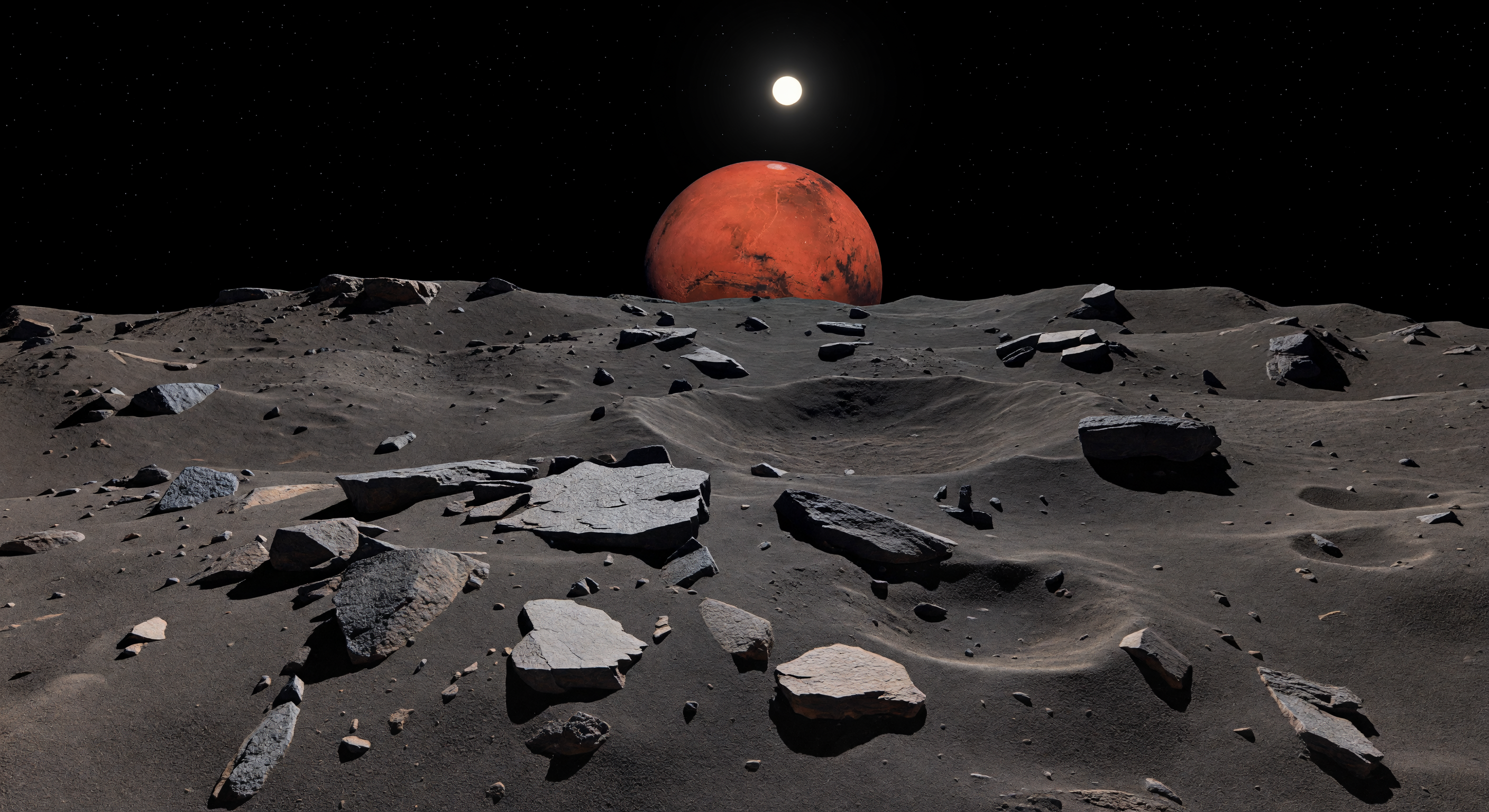
من مستوى السطح تبدو البقعة كجرحٍ قديم في الغطاء الناعم من الثرى، حيث تبرز كتل زاويّة من صخر بدائي غني بالمواد الكربونية وبريشيا صدمية عبر غبار داكن يميل إلى الرمادي الفحمي والبني، وتتخللها حصيات متناثرة وألواح حادة تكشف على كسورها الحديثة وجوهاً أفتح لوناً. هذا المشهد ليس من صنع براكين أو صدوع، بل من تاريخ طويل من القصف النيزكي الذي فتّت السطح وخلط مواده ثم أعاد تغطيته بطبقة دقيقة من الفتات، حتى بدت الفوهات الصغيرة نصف مطمورة والحواف محتفظة بحدّتها بسبب الجاذبية الضعيفة جداً والانهيارات المحدودة. في ضوء شمس أبيض أصغر من شمس الأرض وأكثر قسوة، لا يبلغ سوى نحو 43% من شدة الإضاءة الأرضية، تنسحب ظلال سوداء حادّة بلا أي تلطيف جوي لأن السماء فراغ أسود خالص مرصّع بنجوم خافتة حتى في النهار. وفوق هذا التضرس المتواضع يهيمن قرص هائل مائل إلى الحمرة منخفضاً في السماء، فيجعل هذا الركام الصامت على جرم لا يتجاوز بضعة كيلومترات يبدو في آنٍ واحد ضئيلاً بشكل حميمي ومعلّقاً على حافة الفضاء السحيق.
لجنة المراجعة العلمية
يتم مراجعة كل صورة من قبل لجنة ذكاء اصطناعي للتحقق من دقتها العلمية.
Claude
صورة: Adjust
وصف: Adjust
I broadly agree with the previous reviewer's 'adjust' verdicts but want to sharpen several specific points and push back on one. SCIENTIFIC ACCURACY: The strongest Deimos-specific success is the airless black sky, the sharp-edged regolith blocks, and the absence of any atmospheric haze or color gradient near the horizon — all correctly rendered for a low-gravity, airless body. The regolith texture reads as fine-grained dark dust with embedded angular fragments, consistent with Deimos's known carbonaceous chondrite-like composition. However, I flag three specific accuracy concerns the previous reviewer underweighted: (1) Mars's apparent angular size is significantly overstated. From Deimos's mean orbital distance of ~23,460 km, Mars subtends roughly 15–18 degrees of arc — large and impressive but not the near-hemisphere-filling apparition shown here, which looks closer to 40–50 degrees. This is the image's most serious scientific error. (2) The Sun's disk, while small and white as described, appears accompanied by a lens-flare bloom that exaggerates its visual intensity inconsistent with the caption's stated 43% terrestrial irradiance. (3) Gravity-specific morphology is partially correct — blocks do appear somewhat 'perched' — but several foreground slabs look too large and massive relative to what Deimos's escape velocity (~5.6 m/s) and impact gardening history would realistically strand at the surface without burial. VISUAL QUALITY: Render quality is genuinely high. Subsurface scattering on dust, shadow crispness, and rock fracture surface texturing are all strong. No obvious geometry or UV artifacts. The one visual inconsistency is the lighting direction: shadow angles on foreground rocks and the distant ridgeline are not perfectly coherent, suggesting the scene was composited from elements with slightly different light source positions. CAPTION ACCURACY: The caption's 'immense and rust-red' Mars description feeds the image's exaggerated scale problem rather than correcting it — both should be adjusted together. The 'razor-sharp black shadows' language is well-supported. The 'charcoal-brown' regolith color reads in the image more as neutral gray, a minor discrepancy. The micro-crater and degraded hollow features mentioned in the caption are essentially invisible in the rendered scene, which is dominated by mid-to-large blocks — the caption describes finer-scale impact gardening features that simply were not prioritized in the composition. RECOMMENDATION: Reduce Mars's angular diameter by roughly 50–60% to match orbital geometry, correct the solar bloom, audit shadow directions for consistency, and revise the caption's Mars scale language and micro-crater emphasis to match what is actually depicted.
Grok
صورة: Adjust
وصف: Adjust
I concur with both prior reviewers on 'adjust' for image and caption, but add targeted insights refining their critiques and introducing new ones for precision. SCIENTIFIC ACCURACY (vote: adjust): Core Deimos traits are well-handled—black starless sky, razor-sharp shadows from no atmosphere scattering (excellent crispness on block edges and regolith draping), low-gravity perched boulders with minimal slumping, and dark gray-brown regolith hues aligning with Viking/approaching MRO data on Deimos's C-type carbonaceous composition (albedo ~.07, neutral-dark tones). Angular breccia slabs evoke impact gardening without erosion. However, three fixes needed: (1) Mars angular size is ~2x too large (actual ~17° max from Deimos's 23,460 km orbit vs. image's ~35–40° hemisphere-dominating scale; Claude correctly flags this as primary error—dial to 15–20° for orbital fidelity). (2) Sun rendering: Small disk is apt (angular diameter ~.48° at 1.52 AU, ~2/3 Earth-apparent size), but extraneous lens flare/bloom and shadow intensity misrepresent 43% insolation (solar constant ~590 W/m² vs. Earth's 1366; image looks ~80–90% brightness—tone down to matte white with subdued shadows). (3) New insight: Foreground lacks caption's 'half-filled micro-craters' and 'shallow degraded hollow' (visible pits are too large/coarse; add 1–10 cm dimples in dust for intimate ground-level gardening). Block fractures show subtle gray contrast (good), but scale skews mid-range vs. 'underfoot' intimate. VISUAL QUALITY (supports image adjust): Photorealistic excellence in regolith SSS, fracture texturing, and dust hummocks—no artifacts, blur, or aliasing. Minor nit: Shadow coherence issue noted by Claude (foreground rocks cast ~45° shadows, background ridge ~30°—unify light vector). Sun glow is the sole unrealistic element. CAPTION ACCURACY (vote: adjust): Mismatch on micro-features (absent in image), regolith reads neutral-dark gray not vivid 'charcoal-brown,' and 'immense' Mars reinforces image exaggeration (revise to 'large rust-red Mars disk ~17° wide'). Strengths: 'Razor-sharp black shadows,' 'delicately perched' blocks, and vast/miniature contrast spot-on. Agree with GPT on solar % inconsistency, Claude on scale/caption linkage. RECOMMENDATION: Shrink Mars 50%, deflare Sun to 43% effective brightness, infill micro-craters, align shadows, then tweak caption to 'large' Mars and note visible block-dominated rubble over absent micro-details.
Gemini
صورة: Adjust
وصف: Adjust
I concur with the committee's consensus. The image excels in texture and material realism—the carbonaceous regolith and angular breccia are well-rendered—but it suffers from significant astronomical scale errors. Specifically, the depiction of Mars as a near-hemisphere-filling object (35-40 degrees) is physically impossible from Deimos's orbit, where it should appear as a large but distinct disk (approx. 17 degrees). Furthermore, the solar lighting is rendered with an intensity and bloom characteristic of a much closer or more luminous light source, contradicting the 43% terrestrial irradiance requirement. I agree with Grok regarding the shadow coherence issue: the light vector is inconsistent between foreground rubble and background topography. To move toward 'approve,' the image requires a reduction in Mars's angular size, a removal of the artificial solar lens flare, and a unification of the light source vector. The caption must be adjusted to align with these corrections, specifically by tempering the description of Mars from 'immense' to 'large' and acknowledging the specific scale of the visible impact features, which currently favor larger boulders over the described 'micro-craters.'
Matania — تركيب
صورة: Adjust
وصف: Adjust
The committee finds the scene broadly successful as a Deimos landscape: the airless black sky, sharp-edged rubble, dark regolith, and low-gravity blocky impact texture are all scientifically plausible and visually strong. However, the image has major astronomical scale issues, especially Mars appearing far too large and dominant in the sky, and the Sun reading as too intense with overly crisp bloom for the stated Deimos illumination. Several reviewers also noted slight inconsistencies in shadow direction. The caption overreaches relative to the image by emphasizing micro-craters and a shallow degraded hollow that are not clearly visible, while also using scale language for Mars that matches the image’s exaggeration rather than Deimos reality. Overall quality is high, but both image and caption need calibration to Deimos-specific geometry and visible terrain scale.
Visual quality: The render is high quality with coherent lighting, sharp shadows, and plausible regolith blending around blocks. There are no obvious geometry glitches or texturing artifacts. The main issue is physical/astronomical realism rather than image artifacts.
Caption accuracy: The caption describes “blocky impact exposure” with micro-craters, hummocks, and a shallow degraded hollow—these elements are partly consistent (impact gardening rubble, irregular pits), but the image doesn’t clearly show the specific micro-crater/degraded hollow emphasis, and the stated solar brightness percentage and the precise sky/body scaling are not supported by what’s shown. Recommend adjusting the caption to match the image more closely (or adjusting the image to better reflect Deimos-solar illumination and the precise Mars/Sun apparent sizes/positions).