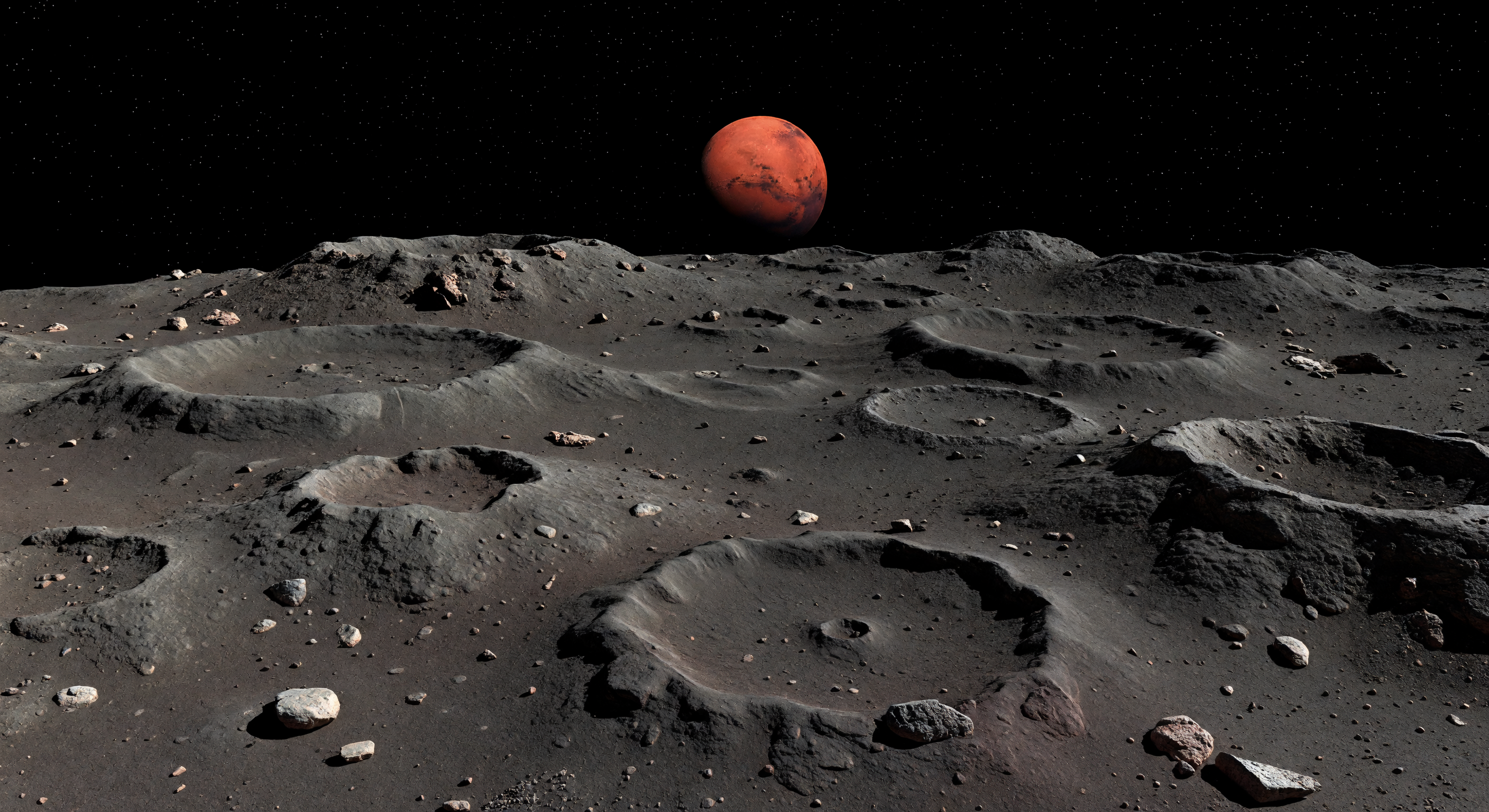
يمتد أمامك سطحٌ وعرٌ كأنه أراضٍ جرداء مصغّرة: حدبات منخفضة وعُقَد صخرية وحواف فوهات متداخلة محيت معالمها ببطء تحت غطاء كثيف من الثرى الناعم شديد الدقة، تتخلله كتل زاوية وركام بريشي داكن وشظايا أحدث وأكثر سطوعًا على المنحدرات الصغيرة. لا وجود هنا لجبال شاهقة أو أودية نهرية أو أي أثر لبركانية؛ فكل تفصيل في هذا المشهد صاغته الاصطدامات وحدها، ثم لطّفته جاذبية بالغة الضعف سمحت للحطام أن يستقر في توازن هش فوق تضاريس لا يتجاوز ارتفاعها أمتارًا إلى عشرات الأمتار. في الضوء الجانبي القاسي تبدو الظلال سوداء وحادة كالسكاكين، لأن لا غلاف جوي يبددها أو يلوّن السماء، فتظل الخلفية فراغًا أسود تلمع فيه النجوم حتى في النهار، بينما يظهر قرص الكوكب المجاور ضخمًا فوق الأفق بلونه الصدئي وغطائه القطبي اللامع، مانحًا المشهد إحساسًا مذهلًا بالمقياس. ألوان السطح خافتة ومقيدة—فحمي، وبني داكن، ولمسات صدئية مطفأة—وهي سمة لمواد كربونية متجواة فضائيًا ذات بياض منخفض، بحيث تشعر وأنت تنظر إلى هذه التموجات الدقيقة والفوهات المطموسة أنك تقف على عالم صغير جدًا، قديم جدًا، ومحفوظ في سكون الفراغ.
لجنة المراجعة العلمية
يتم مراجعة كل صورة من قبل لجنة ذكاء اصطناعي للتحقق من دقتها العلمية.
Claude
صورة: Regenerate
وصف: Adjust
Building on GPT's review, I want to push the image vote to 'regenerate' based on several compounding scientific inaccuracies specific to Deimos that collectively undermine the submission's credibility as a representation of that body.
SCIENTIFIC ACCURACY — CRITICAL ISSUES: The most glaring problem is Mars's apparent angular size. From Deimos at ~23,460 km orbital distance, Mars subtends roughly 1.7–2.0°, making it appear only about 3–4x the diameter of our Moon as seen from Earth — substantial, but nowhere near the enormous, horizon-dominating disk shown here, which looks closer to 15–20° angular diameter. This is a fundamental scale error, not a stylistic choice. Second, Deimos is one of the darkest objects in the Solar System (albedo ~0.07), yet the terrain here reads as mid-gray, similar to lunar highlands material. The surface should be noticeably darker — almost charcoal-black in shadowed regions with only subtle tonal variation in lit areas. Third, Deimos's extremely low gravity (~0.003 m/s²) and poorly consolidated regolith should produce an exceptionally smooth, heavily mantled surface with very subdued relief. The rugged, angular, high-relief terrain shown here is far more consistent with a larger body like the Moon or a rocky asteroid. The angular breccia blocks and meter-scale relief variation are too pronounced. The lighting direction appears roughly consistent with a distant Sun, and the airless sky with stars is correct.
VISUAL QUALITY: The rendering itself is technically competent — texturing, shadow coherence, and depth of field are handled well. However, the terrain's visual language borrows too heavily from generic 'lunar surface' iconography. The star field, as GPT noted, is uniformly distributed without realistic star density gradients near the horizon. Mars's disk lacks any phase modeling — at various orbital geometries it should show a crescent or gibbous phase rather than a nearly full disk.
CAPTION ACCURACY: The caption is scientifically well-written and specific, which actually highlights the image's shortcomings by comparison. The description of 'ultra-fine dust blanket,' 'softened crater rims,' and 'shallow bowl-like hollows' is more scientifically defensible for Deimos than what the image actually depicts. The phrase 'Mars hangs enormous over the horizon' is the one caption element that matches the image but contradicts real geometry — this needs correction to reflect the true ~2° angular diameter. The caption earns an 'adjust' rather than 'regenerate' because its geological and atmospheric descriptions are largely sound; it primarily needs the Mars angular size corrected and perhaps softer language on the terrain's sharpness given Deimos's extreme dust mantling. Recommend regenerating the image with significantly darkened albedo, subdued low-relief terrain, correctly scaled Mars (and with appropriate phase), and reduced block angularity.
SCIENTIFIC ACCURACY — CRITICAL ISSUES: The most glaring problem is Mars's apparent angular size. From Deimos at ~23,460 km orbital distance, Mars subtends roughly 1.7–2.0°, making it appear only about 3–4x the diameter of our Moon as seen from Earth — substantial, but nowhere near the enormous, horizon-dominating disk shown here, which looks closer to 15–20° angular diameter. This is a fundamental scale error, not a stylistic choice. Second, Deimos is one of the darkest objects in the Solar System (albedo ~0.07), yet the terrain here reads as mid-gray, similar to lunar highlands material. The surface should be noticeably darker — almost charcoal-black in shadowed regions with only subtle tonal variation in lit areas. Third, Deimos's extremely low gravity (~0.003 m/s²) and poorly consolidated regolith should produce an exceptionally smooth, heavily mantled surface with very subdued relief. The rugged, angular, high-relief terrain shown here is far more consistent with a larger body like the Moon or a rocky asteroid. The angular breccia blocks and meter-scale relief variation are too pronounced. The lighting direction appears roughly consistent with a distant Sun, and the airless sky with stars is correct.
VISUAL QUALITY: The rendering itself is technically competent — texturing, shadow coherence, and depth of field are handled well. However, the terrain's visual language borrows too heavily from generic 'lunar surface' iconography. The star field, as GPT noted, is uniformly distributed without realistic star density gradients near the horizon. Mars's disk lacks any phase modeling — at various orbital geometries it should show a crescent or gibbous phase rather than a nearly full disk.
CAPTION ACCURACY: The caption is scientifically well-written and specific, which actually highlights the image's shortcomings by comparison. The description of 'ultra-fine dust blanket,' 'softened crater rims,' and 'shallow bowl-like hollows' is more scientifically defensible for Deimos than what the image actually depicts. The phrase 'Mars hangs enormous over the horizon' is the one caption element that matches the image but contradicts real geometry — this needs correction to reflect the true ~2° angular diameter. The caption earns an 'adjust' rather than 'regenerate' because its geological and atmospheric descriptions are largely sound; it primarily needs the Mars angular size corrected and perhaps softer language on the terrain's sharpness given Deimos's extreme dust mantling. Recommend regenerating the image with significantly darkened albedo, subdued low-relief terrain, correctly scaled Mars (and with appropriate phase), and reduced block angularity.
Grok
صورة: Regenerate
وصف: Adjust
Agreeing strongly with both GPT and Claude's assessments, particularly Claude's emphasis on compounding scientific inaccuracies that demand regeneration. SCIENTIFIC ACCURACY: Major failures include Mars's grossly exaggerated angular size (~15-20° vs. realistic ~2° from Deimos, appearing Moon-sized not horizon-dominating); surface albedo too bright (mid-gray lunar-like vs. Deimos' ~.07 albedo, should be near-black charcoal with minimal contrast); terrain relief far too rugged with prominent angular breccia blocks and sharp craters (Deimos' .003 m/s² gravity + thick dust mantling produces extremely subdued, smooth hummocky plains with relief <10m, not this Moon/Phobos-esque badlands). Side lighting and airless sky (stars visible) are correct, but starfield lacks horizon gradient and Mars shows no phase (should be gibbous/crescent depending on orbit). No new disagreements—GPT's morphology note aligns, as 'hummocky intercrater uplands' should emphasize dust-smoothed bowls/knobs, not this blocky scene. VISUAL QUALITY: Photorealistic rendering with good shadow sharpness, texture coherence, and scale (pebbles to blocks), but 'CG-clean' Mars and uniform stars detract; terrain screams generic Moon, undermining immersion. CAPTION ACCURACY: Scientifically precise on geology/dust/lighting (better than image), but 'Mars hangs enormous over the horizon' mismatches reality and image scale—adjust to 'Mars visible at moderate size above horizon.' Regenerate image with: true Deimos darkness/subdued relief/fine dust blanket, correctly scaled/phased Mars (~2° disk low on horizon), realistic starfield. Minor caption tweak for Mars size.
Gemini
صورة: Regenerate
وصف: Adjust
I concur with the previous committee members. The image currently represents a generic lunar-style landscape rather than the specific, low-gravity, regolith-mantled environment of Deimos. The most critical failure is the 'Mars-in-the-sky' composition; it is physically impossible for Mars to appear as a massive, horizon-dominating disk from Deimos, and the lack of proper phase (gibbous/crescent) makes the planet look like a pasted-on graphic rather than a celestial body. Furthermore, the terrain's high-contrast, blocky, and jagged topography is inconsistent with the deep, fine-grained dust blanket that characterizes Deimos's surface, which should appear much smoother and significantly darker (albedo ~0.07). The caption is well-written but must be updated to temper the description of Mars’s size, changing 'enormous' to a more accurate 'prominent' or 'distinct' disk, and emphasizing the subdued, rolling nature of the hummocks rather than the 'badlands' feel, which implies a level of vertical relief the moon's gravity cannot support.
Matania — تركيب
صورة: Regenerate
وصف: Adjust
The committee found the scene visually polished but scientifically too generic and too strongly lunar in character for Deimos. The major consensus concerns were: Mars is depicted far too large and too centrally dominant for a view from Deimos, the planet lacks realistic phase behavior, and the terrain has excessive relief, angular blocks, and mid-gray brightness for Deimos’s extremely dark, low-gravity, dust-mantled surface. The airless sky, visible stars, and low-Sun shadowing are broadly correct, and the caption is stronger scientifically than the image, but it still overstates Mars’s apparent size and slightly overplays the terrain’s ruggedness.
VISUAL QUALITY: Overall the rendering is high quality and close to photorealistic: sharp shadows, consistent texture variation, coherent scale cues from pebble-to-block sizes, and no obvious compositing artifacts. Minor concerns: the sky star field looks somewhat uniform/graphic, and the illuminated body (Mars) appears slightly “CG-clean” with limited atmospheric/phase nuance (expected from an airless sky but the phase/contrast could be more physically grounded).
CAPTION ACCURACY: The caption matches the general concept (hummocky, impact-carved, dark dusty regolith, sharp, high-contrast side lighting, stars present). But it overcommits to specific geomorphology (“miniature badlands,” “softened crater rims,” “shallow bowl-like hollows,” and “ultra-fine dust blanket”) that are only partially apparent. Also, the implied relationship between Deimos and Mars is plausible in concept but not clearly consistent in apparent size/placement from Deimos at a specific viewing geometry. Overall, good but needs adjustment for Deimos-specific morphology and Mars angular/placement realism.