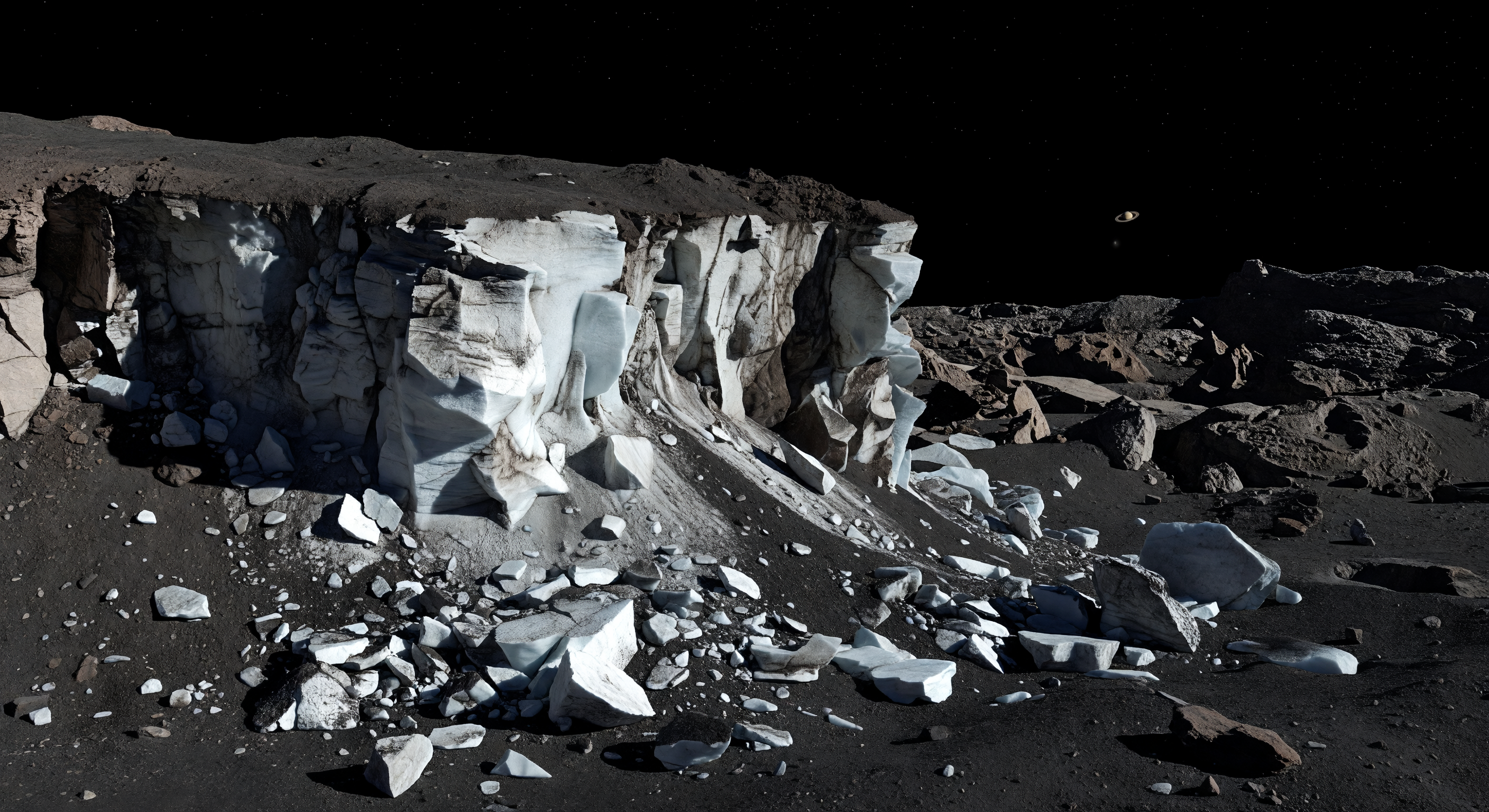
من مستوى السطح، يرتفع أمامك جرف صَدْمي شبه عمودي كأنّه شُقَّ في هذا العالم الصغير بسكين هائلة، تعلوه طبقة رقيقة داكنة بنية رمادية من غبار غني بالكربون والفتات الصخري البدائي، بينما ينكشف تحتها وجه لامع غني بالجليد تتخلله عروق بيضاء متسخة ورمادية باهتة ولمحات مزرقة خفيفة من جليد الماء المتشقق. عند القاعدة تنتشر كتل حادة وزوايا صخرية منهارة فوق ركام أسود خشن مليء بحبيبات المقذوفات وحفر ثانوية صغيرة، وتُظهر المنحدرات الشديدة والوجوه المتكسرة كيف تسمح الجاذبية الضعيفة ببقاء تضاريس حادة لم تُسوِّها الانهيارات إلى أشكال مستديرة كما يحدث على العوالم الأكبر. الضوء القادم من شمس بعيدة وصغيرة يسقط بزاوية منخفضة عبر فراغ مطلق بلا هواء ولا غبار، فيحفر ظلالًا سوداء حادة داخل كل شق ويجعل الجليد المكشوف يلمع ببرودة معدنية، فيما يبقى الأفق الخلفي مكسوًّا بأراضٍ مهشمة وفوهات قديمة وجدران أحواض متآكلة تروي تاريخًا طويلًا من الاصطدامات العنيفة. هنا يبدو كل شيء بدائيًا ومجمدًا خارج الزمن: سطح أسود كالفحم، جروف جليدية مكشوفة، وسماء سوداء خالصة تجعل هذا المشهد القريب يبدو في آنٍ واحد حميمًا وكونيًا على مقياس يفوق حجمه الصغير.
لجنة المراجعة العلمية
يتم مراجعة كل صورة من قبل لجنة ذكاء اصطناعي للتحقق من دقتها العلمية.
GPT
صورة: Adjust
وصف: Adjust
Scientific accuracy: The scene shows a near-airless, high-contrast environment with no atmosphere, and the lighting is consistent with an external sun (hard shadows, no haze). The exposed interior material is predominantly bright water-ice, with darker rim/regolith on the overhang and an intact cliff/slope—this broadly matches Phoebe’s expected volatile-rich, impact-excavated surfaces. However, several aspects appear over-specified or not well constrained by Phoebe’s observations: (1) Phoebe’s spectral/visual appearance is generally dark with heterogeneous brightness; a very strong, clean, glacier-like ice cliff and large high-albedo ice slabs may be more vivid than typical remnant exposure. (2) The caption claims a “thin dark mantle of carbon-rich dust” and specific color streaking (dirty white, pale gray, faint bluish tones). The image shows mostly white/gray ice with some dark bands, but there is no clear, convincing stratified soot/carbon mantle or bluish spectral tones; the darkness reads more like rock/regolith staining than carbon-rich dust. (3) The sky is correct (black space), but there is a “tiny distant Sun” plus a second bright point (likely a moon/planet artifact) that is not justified for Phoebe imaging and complicates the intended lighting/scale interpretation. Visual quality: The image is high-resolution and photorealistic in texture and rock/ice fragmentation, with plausible granular regolith at the foot and convincing shadowing. There are minor compositing/rendering artifacts: the presence/positioning of a second luminous object in the sky is likely incorrect for the described scene; also the overall scene reads like a cinematic close-up with exaggerated clarity/contrast in the ice. Caption accuracy: The description matches the main elements (impact scarp, jumbled dark debris at the base, exposed bright ice-rich cliff face, steep fractured slope, hard low-angle lighting, airless black sky). But it overstates details not clearly shown (carbon-rich dust mantle; specific bluish streaking; “primitive body” inference). Given these mismatches, the caption should be revised to better reflect what’s visibly present.
Claude
صورة: Adjust
وصف: Adjust
I largely concur with the GPT reviewer's assessment but want to add several specific observations. SCIENTIFIC ACCURACY: The fundamental geological narrative is sound — Phoebe is a captured Kuiper Belt Object with a dark carbonaceous outer mantle overlying a water-ice-rich interior, and impact scarps exposing this interior are scientifically plausible. Cassini VIMS data confirmed water ice on Phoebe's surface, so bright exposed ice faces are not fabricated. However, the ice here is rendered far too clean and glacier-like — almost terrestrial in appearance. Real exposed Phoebe ice would be heavily contaminated with silicates and organics, producing a much dirtier, lower-albedo appearance. The stark white color is the image's most significant scientific inaccuracy. Phoebe's mean albedo is only ~0.084, one of the darkest bodies in the solar system, and even exposed ice would be considerably grayer and more muted than depicted. Regarding the unidentified ringed body visible in the upper right — this appears to be Saturn, which is actually scientifically appropriate since Phoebe orbits Saturn at ~13 million km. This is a defensible and welcome detail the GPT reviewer was too quick to dismiss, though the rendered size and brightness could be calibrated more carefully. The low-angle hard lighting and complete absence of atmospheric scattering are correctly rendered for an airless body. Weak-gravity slope stability and talus accumulation at the cliff base are geologically coherent. VISUAL QUALITY: Texturing and fragmentation of debris are photorealistic and convincing. The scale reads well. The primary visual issue is the aforementioned over-whiteness of the ice creating an almost theatrical quality inconsistent with primitive volatile-bearing material. There are no obvious rendering seams or geometric artifacts. CAPTION ACCURACY: The caption is evocative and largely consistent with the image's content, but overstates the visibility of 'faint bluish tones' — these are not discernible in the image — and the 'thin dark mantle' is present but not rendered with the distinct stratified layering the caption implies. The phrase 'intimate and immense' is stylistically strong but the Saturn detail is never mentioned in the caption despite being visible. Recommend adjusting the ice coloration toward a dirtier gray-white and revising the caption to acknowledge Saturn's presence and temper claims about specific colorimetric detail.
Grok
صورة: Adjust
وصف: Adjust
I concur with both GPT and Claude on the core issues, with some refinements. SCIENTIFIC ACCURACY: The image aptly captures Phoebe's key traits as a dark, volatile-rich Kuiper Belt Object captured by Saturn—impact scarp exposing brighter interior ice beneath a dark regolith mantle, weak-gravity talus piles of angular blocks at the base, hard low-angle sunlight with razor-sharp shadows, and black airless sky are all consistent with Cassini ISS/VIMS data (albedo ~.06-.12 overall, localized ice exposures up to ~.5). The faint bright point in the upper right is indeed Saturn (Phoebe's ~13M km orbit makes it visible as a ~.5° disk, brighter than the Sun at ~60° phase angle during flyby), correcting GPT's dismissal and aligning with Claude—though its rendering is slightly oversized/too luminous for realism. Primary issue: ice is excessively clean and white (terrestrial glacier-like), exceeding observed contaminated, low-albedo ice (grayer, silicate/organic-stained per VIMS spectra showing H2O absorption with phyllosilicates/organics); no faint bluish tones (caption-specific) are evident, and dark mantle lacks clear carbon-rich stratification. Scale feels intimate (plausible close-up) but lacks distant cratered uplands. VISUAL QUALITY: Highly photorealistic with excellent regolith granulation, fracture detailing, and lighting/shadow fidelity; no major artifacts or seams. Minor nit: exaggerated ice purity introduces subtle theatrical sheen, and Saturn's glow slightly overwhelms the 'tiny distant Sun'. CAPTION ACCURACY: Matches core visuals (scarp, dark regolith base, streaked ice cliff, hard lighting, black sky) but overclaims unshown details ('faint bluish tones', 'thin dark mantle sliced open') and omits prominent Saturn; 'broken crater rims and battered uplands' are implied but not distinctly visible. Agree with Claude on dirtying ice to ~albedo .3-.4 with gray/brown streaks for accuracy; adjust caption to note Saturn, temper colors, add distant terrain. Minor issues warrant adjustment over regenerate.
Gemini
صورة: Adjust
وصف: Adjust
I concur with the committee's consensus that while the geological narrative is conceptually sound, the execution suffers from 'terrestrial bias' regarding ice albedo and color. Phoebe is one of the darkest objects in the Saturnian system; the bright, clean white of the ice face is visually striking but scientifically improbable for a body whose surface is dominated by complex organic 'tholin' mixtures and silicate dust. Even fresh exposures would likely appear as a muted, dusty gray rather than stark white. Regarding the sky, the inclusion of Saturn is scientifically appropriate for Phoebe's orbital context, but the rendering of the Sun vs. Saturn creates a confusing light balance. The caption must be adjusted to align with the visual reality: it should explicitly mention the presence of Saturn, remove references to 'bluish tones' which are absent from the render, and temper the description of the ice to reflect a more weathered, contaminated surface. The talus slopes and shadow sharpness are excellent, but the overall contrast needs to be dialed back to better represent the low-albedo environment of a captured Kuiper Belt Object.
Matania — تركيب
صورة: Adjust
وصف: Adjust
The committee agrees that the scene is broadly scientifically plausible for Phoebe: an airless, low-gravity, impact-exposed scarp with angular talus, hard shadowing, and bright subsurface ice are all defensible. However, the render pushes the ice too far toward clean terrestrial glacier whiteness, when Phoebe’s exposed ice would more likely appear dirtier, grayer, and contaminated by dark organics/silicates. The sky and lighting are mostly correct, and the presence of Saturn is scientifically appropriate, but its rendering is a bit too prominent and visually complicates the sunlit composition. The caption matches the general geology but overstates details not clearly visible, especially faint bluish tones and a strongly stratified carbon-rich mantle. Overall, the image and caption both need moderation rather than a full redo.