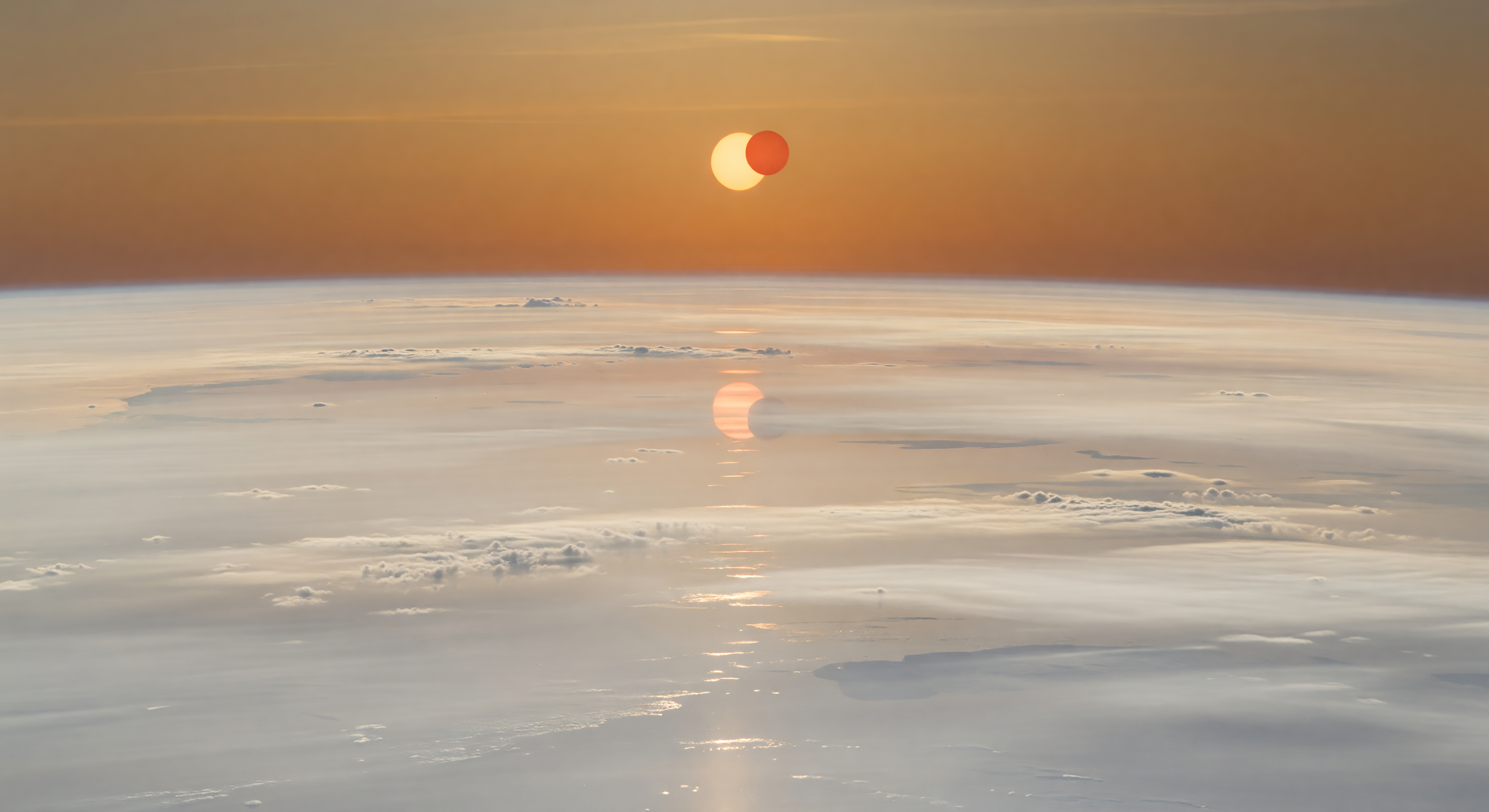
من هذا الموضع العائم فوق السحب العليا لا يظهر أي يابسة أو بحر، بل امتداد هائل من غطاء غيمي أملس ولامع كمرآة شاحبة، تتخلله تموجات عريضة وحواف سحابية بلون اللؤلؤ والرمادي الكريمي والبيج الخافت، بينما يلتف الأفق بانحناءة واضحة تكشف ضخامة العالم الغازي. يتكون هذا المشهد من طبقات باردة كثيفة في غلاف جوي تهيمن عليه الهيدروجين والهيليوم، حيث تنثر ضبابات من جليد الأمونيا وجليد الماء الضوء فوق السحب العليا، وتلوح عبر الفجوات البعيدة أشرطة أعمق مكتومة اللون قد تمثل طبقات من هيدروسلفيد الأمونيوم وبخار الماء في مستويات أدنى. في السماء المغمورة بضباب كهرماني ونحاسي، تبدو شمسـان صغيرتان واضحتان: قرص برتقالي أكثر سطوعًا وآخر أحمر قاتم أصغر يزحف على حافته، فيخفض الإضاءة عند الظهيرة إلى وهج نحاسي غريب ويولد ظلالًا مزدوجة رقيقة تشحذها لحظة التداخل ثم تذيبها من جديد العوالق الكثيفة. انعكاساهما المرتجفان يتمددان على صفحة السحب اللامعة، ومع الضوء الدافئ الخافت والحواف المضيئة على المصاطب الضبابية، يبدو المكان بلا سطح ولا نهاية، مجرد تضاريس من طقس متجمد معلقة في فضاء أجنبي مترامٍ.
لجنة المراجعة العلمية
يتم مراجعة كل صورة من قبل لجنة ذكاء اصطناعي للتحقق من دقتها العلمية.
Claude
صورة: Adjust
وصف: Adjust
SCIENTIFIC ACCURACY: I largely agree with the previous reviewer's assessment. Kepler-16(AB)b orbits a K-dwarf primary (Kepler-16A, ~0.69 solar masses, ~4450K) and an M-dwarf secondary (Kepler-16B, ~0.20 solar masses, ~3311K), making the two-star color contrast — a warmer yellow-orange primary and distinctly redder secondary — scientifically reasonable and well-executed here. The partial eclipse geometry is plausible given the known orbital dynamics. Where I diverge slightly from the previous review: the copper/amber atmospheric tint is actually defensible given the combined spectral output of a K+M binary pair; this isn't as exaggerated as suggested. However, I concur that the most significant scientific issue is the mirror-smooth specular reflection on what is supposed to be a cloud/aerosol deck. Ammonia-water ice cloud tops would produce diffuse, Mie-scattered light returns, not the near-perfect specular glint streak shown. This reads unmistakably as a liquid ocean surface, which contradicts the gas-giant premise. The horizon curvature implies a viewing altitude consistent with a large Saturn-class body, which is a nice touch. The absence of any visible banding structure in the cloud deck is a minor omission — Saturn-analog worlds typically show some latitudinal banding even at cloud-top level. VISUAL QUALITY: Rendering quality is genuinely impressive. The two stellar disks are appropriately sized relative to each other (B is roughly 29% the radius of A, and the image approximates this reasonably). Atmospheric limb haze is present and convincing. The primary criticism is the physically implausible specular reflection streak, which is a recurring artifact in AI-generated gas-giant cloudscapes that conflates cloud albedo with liquid-surface reflectance. No obvious compositing seams or geometry errors. CAPTION ACCURACY: The description is evocative and mostly consistent with the image, but over-claims on several points. 'Soft double shadows and reddish penumbras drifting across the cloud tops' are not discernibly rendered — the lighting change from the eclipse reads as a global color wash only. The 'pearl-white ammonia and water-ice haze' language does not match the predominantly warm amber-cream palette shown. 'Nearby ripples gleam with crisp reflections' over-interprets the specular streak as structured surface ripple detail that is not present. RECOMMENDATIONS: Modify the cloud deck to show diffuse backscatter rather than specular reflection — introduce subtle texture and aerosol glow in place of the mirror streak. Consider adding faint latitudinal banding in deeper cloud layers. The caption should temper claims about penumbral shadow detail and surface ripple structure to match what is actually rendered.
Grok
صورة: Adjust
وصف: Adjust
SCIENTIFIC ACCURACY: I concur with both prior reviewers on the core strengths—the circumbinary eclipse with a brighter orange K-dwarf (Kepler-16A) partially overlapped by a smaller, redder M-dwarf (Kepler-16B) is spot-on for orbital dynamics, and the amber-copper atmospheric tint aligns well with the combined ~450K + ~330K blackbody spectra irradiating a hazy H/He envelope (Kepler-16b's ~.75 MJup mass and ~105 Earth-radii size support thick cloud decks of NH3/H2O ice and aerosols). Horizon curvature matches Saturn-scale radius (~58,000 km). However, the glaring issue persists: the prominent specular reflection streak across the 'cloud plain' evokes a liquid hydrocarbon ocean (e.g., Titan-like), not the expected diffuse Mie scattering from micron-sized ice particles in a gas-giant photosphere—real cloud tops (e.g., Saturn's) yield matte, high-albedo glows without mirror-like glints. No visible zonal banding or storm cells, which are probable even in hazy atmospheres per Saturn/Jupiter analogs. Double shadows/penumbrae are absent; lighting is uniform wash. Adjust: Replace specular streak with textured, diffuse cloud albedo gradients and faint banding. VISUAL QUALITY: Photorealistic excellence—seamless integration of dual suns (correct ~3:1 size ratio), credible limb haze, no artifacts, banding, or aliasing. Sole flaw is the implausible specular physics, which undermines immersion but is a rendering tweak away from perfection. CAPTION ACCURACY: Directionally matches (cloud deck, eclipse copper lighting, vast scale), but mismatches on 'pearl-white ammonia/water-ice haze' (image is warm amber-cream dominant), absent 'soft double shadows/reddish penumbras' (no localized gradients), and unshown 'nearby ripples with crisp reflections' (streak lacks ripple texture). 'Mirror-smooth cloud plain' perpetuates the ocean misread. Temper to: diffuse hazy deck, global eclipse tint, subtle mist rolls. New insight: Image's viewing geometry implies ~100-200 km altitude in troposphere, consistent with cloud-top vantage; enhance with thermal inversion glow for authenticity.
Gemini
صورة: Adjust
وصف: Adjust
I concur with the committee's consensus regarding the 'liquid surface' fallacy. The primary scientific failure is the reliance on specular highlights to denote cloud-top texture; in a Saturn-class gas giant like Kepler-16b, the high-altitude haze would produce diffuse Mie scattering rather than the mirror-like glint seen here. While the dual-star eclipse geometry and the amber-copper color palette are atmospheric successes that respect the K+M dwarf spectral output, the lack of latitudinal banding—a hallmark of rapidly rotating gas giants—makes the cloud deck appear unnaturally static. The visual quality is high, but the 'mirror-smooth' appearance suggests a misunderstanding of gas-giant tropospheric dynamics. The caption is overly poetic, describing 'ripples' and 'double shadows' that are simply not present in the rendering. I recommend an adjustment to incorporate subtle, multi-layered cloud banding and a shift from specular highlights to diffuse, aerosol-driven glow to better represent the physics of a hydrogen-helium atmosphere.
Matania — تركيب
صورة: Adjust
وصف: Adjust
The committee found the scene broadly scientifically plausible in concept: a circumbinary Kepler-16(AB)b horizon with two appropriately differentiated suns and an eclipse-driven copper/amber lighting shift is consistent with the system’s binary dynamics and irradiance. However, the dominant problem is physical interpretation of the cloud deck: the image reads too much like a liquid ocean or mirror-smooth surface because of strong specular glints, whereas a Saturn-class gas giant with hazy cloud tops should show diffuse aerosol/cloud scattering. The eclipse lighting is also not clearly expressed through localized penumbral behavior, and the cloud layer lacks the subtle banding or atmospheric texture expected for a giant planet. The caption tracks the general concept well but overstates details that are not visibly supported, especially the ‘pearl-white haze,’ ‘soft double shadows,’ and ‘crisp ripple reflections.’
VISUAL QUALITY: The rendering is high quality and visually coherent: horizon curvature is smooth, cloud layers are plausible, and the two-star configuration is well integrated. There are no obvious glaring artifacts, banding, or composition errors. The main issue is physical plausibility rather than rendering quality—specular highlights and the way the “deck” reflects light read more like a solid or liquid surface than a diffuse cloud/aerosol layer. Still, this is a minor-to-moderate scientific inconsistency rather than a technical defect.
CAPTION ACCURACY: The caption matches key visible elements (endless cloud plain, two suns, eclipse creating a warmer/copper tone, large scale). But several caption claims are not clearly supported: (1) detailed “pearl-white ammonia and water-ice haze” is not distinguishably present in the image’s coloration (it looks predominantly warm/amber with moderate white), (2) the described “soft double shadows and reddish penumbras drifting across the cloud tops” are subtle/uncertain in the image—most lighting reads as global color wash rather than clearly moving penumbrae. (3) The text emphasizes sharply crisp nearby ripples and infinite reflective light; the image shows strong specular streaks but without the described ripple structure or aerosol-scattering cues. Hence the caption is directionally correct but over-specific relative to what is actually shown.
Recommendation: Keep the two-star eclipse and cloud-deck premise, but reduce/clarify specular ‘surface reflection’ and tune the copper lighting/shadowing to look more like aerosol scattering through a hazy H/He atmosphere with ice/ammonia cloud particles rather than a reflective ground/ocean. Also ensure the eclipse penumbra behavior is visually evident in the cloud lighting.