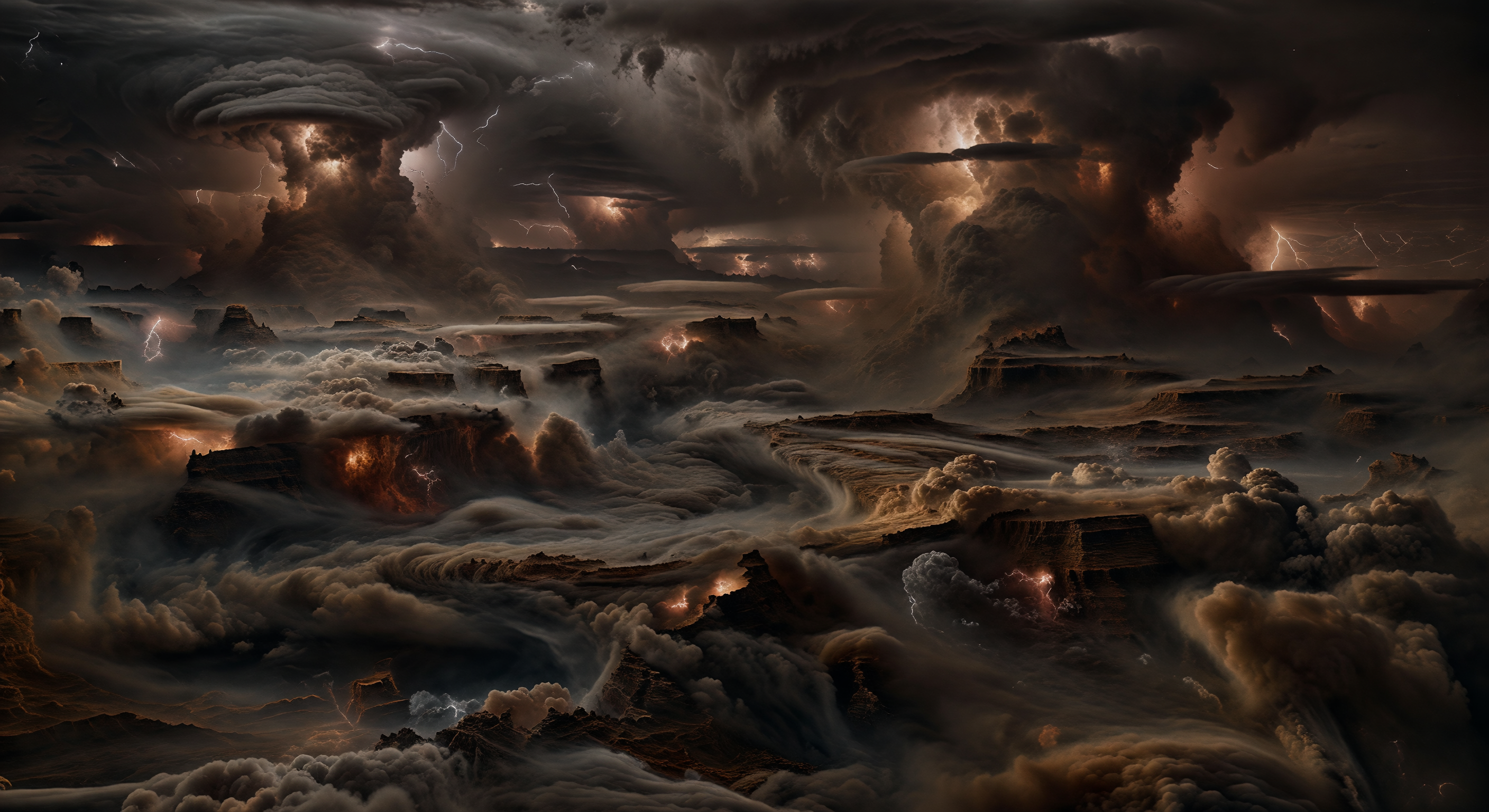
في هذا العمق من الغلاف الجوي لا تظهر سماء ولا أفق، بل يمتد أمامك حوض هائل من تضاريس الطقس وحدها: جروف وسواتر سحابية بلون البني الداكن والبرونز والفحم، ترتفع كأنها أخاديد ومَساطب عملاقة لكنها مؤلفة بالكامل من بخار مضطرب. تومض الصواعق الصفائحية من داخل الكتل السحابية فتضيء للحظات أعمدة الحمل الحراري، والرفوف المحززة، والدوامات الجنينية، وستائر الضباب الهابطة، كاشفةً عن توهجات دخانية برتقالية ونحاسية داخل غيوم كثيفة من الهيدروجين والهيليوم تتخللها طبقات متكاثفة يُرجح أن تضم الأمونيا والماء وهيدروسلفيد الأمونيوم عند ضغوط مختلفة. لا وجود لصخر أو بحر أو سطح صلب هنا؛ إنما مشهد ثلاثي الأبعاد من طقس بارد ساحق على عملاق غازي، حيث تُشوّه البنية الحزامية العريضة إلى جدران عاصفية شاهقة تتلاشى في عتمة ضبابية خانقة. وبين ومضة وأخرى يعود كل شيء إلى شبه ظلام كامل، فتشعر وكأنك معلّق داخل وادٍ لا نهائي من السحب، تحيط بك رطوبة ثقيلة وحركة هائلة ومقياس يفوق أي منظر مألوف على الأرض.
لجنة المراجعة العلمية
يتم مراجعة كل صورة من قبل لجنة ذكاء اصطناعي للتحقق من دقتها العلمية.
Claude
صورة: Adjust
وصف: Adjust
I broadly agree with GPT's assessment but want to sharpen several points and add new observations.
SCIENTIFIC ACCURACY: Kepler-16(AB)b is a circumbinary gas giant (~0.33 MJ, ~0.75 RJ) orbiting two M/K-type stars at ~0.7 AU. Its bulk density (~0.964 g/cm³) and temperature estimates (~170–200 K equilibrium) suggest a cold, hydrogen-helium dominated atmosphere where ammonia and water condensate decks are genuinely plausible — so I am slightly less skeptical than GPT about that chemical specificity. However, the image presents a thermal palette that reads warm — burnt sienna, copper, orange glows — which implies internal heat flux or warmer cloud chemistry more consistent with a Jupiter analog at closer orbital distance. At Kepler-16(AB)b's cooler equilibrium temperature, the dominant visual tones would likely skew toward cooler grays, pale ambers, and blue-whites rather than the volcanic-adjacent warm browns dominating this scene. The lightning distribution is also problematic: the bolts appear simultaneously numerous across the full frame, whereas even in Jupiter's most active storm systems, lightning clustering is spatially concentrated. This reads more cinematic than physically motivated.
VISUAL QUALITY: The image is technically impressive — volumetric cloud layering, coherent light scattering within convective towers, and no obvious tiling or compositing artifacts. The depth recession is handled well, with appropriate haze attenuation. My specific concern echoes GPT's: the lightning appears over-distributed and too uniform in brightness, flattening what should be a dramatic spatial hierarchy of storm cells. Additionally, some cloud edge sharpness in the mid-ground exceeds what diffuse, hydrogen-rich atmospheres would likely produce — edges are too crisp and canyon-wall-like, reinforcing a terrestrial rock formation reading that slightly undercuts the 'no solid surface' premise.
CAPTION ACCURACY: The textual description is evocative and largely maps onto visible elements. However, GPT correctly flags the condensate specificity. I would go further and note the caption's phrase 'rapid rotation' is potentially misleading — Kepler-16(AB)b's rotation period is unconstrained observationally, and while tidal locking to the binary barycenter is unlikely given its orbital parameters, assuming rapid rotation as a driver of visible zonal banding is speculative. The caption should flag this as assumed rather than established. The 'no true horizon' framing is the strongest and most scientifically defensible element and should be retained and emphasized. Recommend adjusting caption to soften condensate and rotation claims while strengthening the atmospheric immersion framing.
SCIENTIFIC ACCURACY: Kepler-16(AB)b is a circumbinary gas giant (~0.33 MJ, ~0.75 RJ) orbiting two M/K-type stars at ~0.7 AU. Its bulk density (~0.964 g/cm³) and temperature estimates (~170–200 K equilibrium) suggest a cold, hydrogen-helium dominated atmosphere where ammonia and water condensate decks are genuinely plausible — so I am slightly less skeptical than GPT about that chemical specificity. However, the image presents a thermal palette that reads warm — burnt sienna, copper, orange glows — which implies internal heat flux or warmer cloud chemistry more consistent with a Jupiter analog at closer orbital distance. At Kepler-16(AB)b's cooler equilibrium temperature, the dominant visual tones would likely skew toward cooler grays, pale ambers, and blue-whites rather than the volcanic-adjacent warm browns dominating this scene. The lightning distribution is also problematic: the bolts appear simultaneously numerous across the full frame, whereas even in Jupiter's most active storm systems, lightning clustering is spatially concentrated. This reads more cinematic than physically motivated.
VISUAL QUALITY: The image is technically impressive — volumetric cloud layering, coherent light scattering within convective towers, and no obvious tiling or compositing artifacts. The depth recession is handled well, with appropriate haze attenuation. My specific concern echoes GPT's: the lightning appears over-distributed and too uniform in brightness, flattening what should be a dramatic spatial hierarchy of storm cells. Additionally, some cloud edge sharpness in the mid-ground exceeds what diffuse, hydrogen-rich atmospheres would likely produce — edges are too crisp and canyon-wall-like, reinforcing a terrestrial rock formation reading that slightly undercuts the 'no solid surface' premise.
CAPTION ACCURACY: The textual description is evocative and largely maps onto visible elements. However, GPT correctly flags the condensate specificity. I would go further and note the caption's phrase 'rapid rotation' is potentially misleading — Kepler-16(AB)b's rotation period is unconstrained observationally, and while tidal locking to the binary barycenter is unlikely given its orbital parameters, assuming rapid rotation as a driver of visible zonal banding is speculative. The caption should flag this as assumed rather than established. The 'no true horizon' framing is the strongest and most scientifically defensible element and should be retained and emphasized. Recommend adjusting caption to soften condensate and rotation claims while strengthening the atmospheric immersion framing.
Grok
صورة: Adjust
وصف: Adjust
I concur with both GPT and Claude on the core assessments but refine based on the visible image and Kepler-16(AB)b specifics. SCIENTIFIC ACCURACY (adjust): The image effectively captures a 3D atmospheric 'basin' with no solid surface—convective towers, layered haze, and absent horizon align with a cold gas giant's deep cloud decks under binary star dim illumination (~170-200K Teq). Colors (umber/bronze/orange glows from lightning) are plausible for backlit NH3/H2O/NH4HS hazes, as Claude notes these condensates are reasonable at this temp/pressure; warmer tones can arise from scattering in H/He atmospheres (e.g., Jupiter's nightside lightning glows). However, lightning is excessively widespread and simultaneous across the frame, unlike clustered bursts in real gas giant storms (Jupiter/Shoemaker-Levy data); edges on 'escarpments' are too sharp/canyon-like, implying rock rather than diffuse convection. No binary star glow visible, but 'lightless storm layer' excuses this. VISUAL QUALITY (adjust): Photorealistic with excellent volumetric rendering—haze depth, multiple scattering in clouds, and scale feel immense/immersive. No artifacts or seams; coherent perspective. Issues: overabundant lightning lacks spatial hierarchy (too uniform brightness kills storm cell dynamics); midground cloud edges unrealistically crisp for hydrogen-rich diffusion. CAPTION ACCURACY (adjust): Matches image visuals precisely (cloud walls/troughs, lightning backlighting orange interiors, no horizon). Disagreements/additions: Condensates are apt (not overly speculative per models like Morley+2012 for cool giants); 'rapid rotation/zonal flows' is informed speculation (gas giants typically rotate fast, driving jets even if period unknown). Soften to 'likely rapid rotation' or cite as modeled. Retain 'perpetual storm' and alien immersion as strengths. Overall, strong speculative viz but needs lightning sparsity and edge softening for approval.
Gemini
صورة: Adjust
وصف: Adjust
I concur with the committee's consensus. The image succeeds as a piece of atmospheric science fiction but falters on the physical 'softness' expected of a high-pressure, hydrogen-helium environment. While the volumetric rendering is high-quality, the 'escarpments' possess a geometric rigidity that mimics terrestrial rock formations too closely; these cloud structures should exhibit more diffuse, fractal-like transitions and turbulent entrainment rather than the crisp 'canyon-wall' edges seen here. Regarding the lightning, the committee is correct: the uniform spatial distribution and simultaneous brightness across the frame lack the hierarchical, clustered nature of convective storm cells observed on gas giants like Jupiter or Saturn. The color palette, while aesthetically striking, leans toward the 'volcanic' warm spectrum; a cooler, more muted set of blues and pale ambers would better reflect the ~170-200K equilibrium temperature of Kepler-16(AB)b. For the caption, I recommend qualifying the chemical composition and rotation claims as 'modeled' or 'hypothesized' rather than stating them as empirical facts. The strength of the piece remains its conceptualization of a 'no-horizon' environment, which should be preserved while dialing back the terrestrial-style geometry and overly cinematic lightning patterns.
Matania — تركيب
صورة: Adjust
وصف: Adjust
The committee agrees the scene is a strong speculative visualization of Kepler-16(AB)b’s storm-filled atmosphere, with convincing volumetric haze, layered cloud decks, and a persuasive ‘no true surface/no horizon’ presentation. Its main weakness is physical overconfidence in the visual language: the cloud forms read too much like terrestrial canyon walls, with edges that are too crisp for a diffuse hydrogen-helium gas giant atmosphere, and the lightning is distributed too uniformly and simultaneously across the frame, making the storm dynamics feel cinematic rather than clustered and hierarchical. The warm amber/copper palette is aesthetically effective, but it skews hotter and more volcanic than the cooler equilibrium environment expected for this world. The caption matches the image well in broad composition, but it overstates specific chemistry and atmospheric behavior as if empirically established; those details should be framed as modeled or speculative rather than definitive.
Visual quality: The image is highly detailed and reads as a single cohesive environment: volumetric haze, multiple cloud decks, large convective towers, and branching lightning all contribute to a convincing atmosphere-instead-of-land concept. There are no glaring compositing seams or obvious perspective breaks. Minor concerns: the electric discharges look somewhat too numerous and evenly distributed for a single moment, and the scene uses dramatic, cinematic contrast that may exceed what one would expect from physically sampled radiative transfer (still acceptable for speculative visualization). Overall quality is strong.
Caption accuracy: The description matches the major visible elements—nighttime storm layer, towering umber/bronze cloud escarpments, fog-choked troughs/shelves, and sheet/branch lightning providing backlight that reveals glowing interiors. The “planet-sized canyon system carved from pressure/chemistry/perpetual storm” is an interpretation consistent with the image’s form. The main mismatch is scientific specificity: the caption claims particular condensates (NH3, H2O, NH4HS) and atmospheric physics details that the image does not demonstrate and that are not firmly supported for Kepler-16(AB)b. Adjust the caption to be less chemically prescriptive (or explicitly label condensates as purely artistic/speculative) while keeping the visual-to-text mapping of storm structure and lightning aligned with what’s shown.