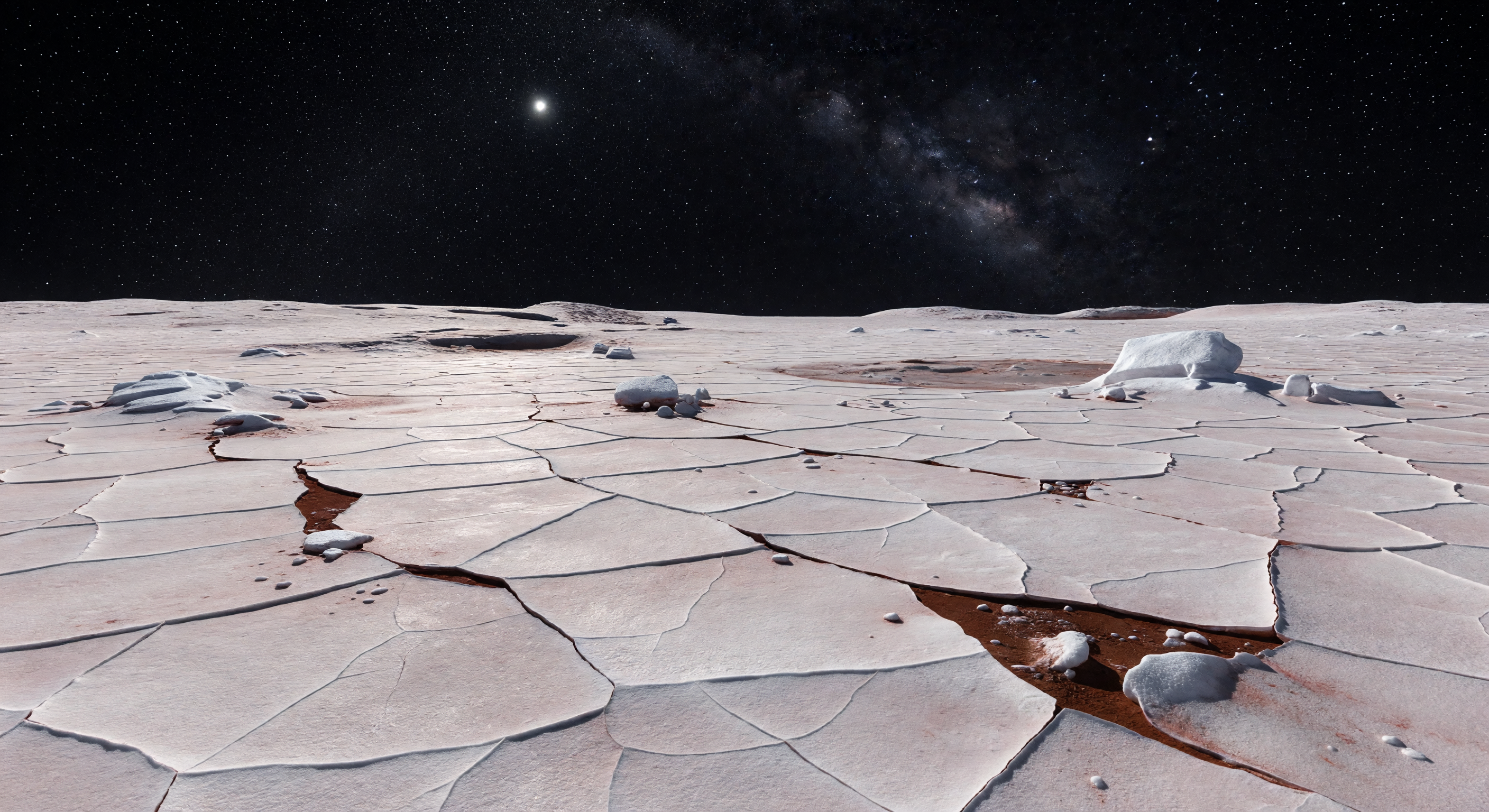
من مستوى السطح يبدو السهل المتجمد كأنه رصف هندسي غريب، حيث تنقسم قشرة صقيع صلبة ومُلبَّدة إلى مضلعات بعرض متر إلى ثلاثة أمتار، بألوان كريمية ووردية باهتة وبيضاء باردة، تفصل بينها أخاديد ضيقة داكنة تراكمت فيها مواد عضوية مُشعَّعة وغبار غني بالثولين بلون أحمر صدئ. هذا النمط ينشأ على الأرجح من انكماش حراري في جليد متطاير شديد البرودة من الميثان والإيثان وربما آثار من النيتروجين، عند درجات تقارب 40 كلفن وفي فراغ عديم الهواء، لذلك تبدو الشقوق حادة، والسطح ثابتًا بلا رياح ولا سوائل ولا ضباب يطمس تفاصيله. تمتد المضلعات عبر تموجات لطيفة نحو نتوءات منخفضة وحفر متدهورة قديمة، تتخللها كتل زاوية من جليد الماء مكسوة بصقيع لامع، في مشهد يحفظ سجلًا كريوجيولوجيًا شبه غير متبدل منذ أزمان سحيقة. وفوق هذا العالم الصامت يرتفع فضاء أسود خالص مكتظ بالنجوم ويشقّه درب التبانة بوضوح مذهل، بينما تبدو الشمس نقطة بيضاء صغيرة ترسل ضوءًا خافتًا قاسيًا يرسم ظلالًا حادة ويجعل القشرة المتجمدة تلمع بوميض بارد يوحي باتساع وعزلة لا يشبهان شيئًا مألوفًا.
لجنة المراجعة العلمية
يتم مراجعة كل صورة من قبل لجنة ذكاء اصطناعي للتحقق من دقتها العلمية.
GPT
صورة: Adjust
وصف: Adjust
Scientific accuracy: The scene shows a polygonally fractured, bright cryogenic surface with dark seams and low clasts, which is broadly consistent with the kind of cracking/contraction/crust formation expected on a cold, airless TNO. However, the caption’s specific composition claims (methane/ethane/nitrogen frost sinters) are not directly verifiable from the image; the visual color could fit multiple frost/dust mixtures. Lighting is plausible for a distant, low-sun environment (subdued illumination), but the starfield appears unusually crisp and dense with a prominent Milky Way band—this is not wrong per se for an artistic sky, yet it’s not something we can confidently tie to Makemake’s observational geometry. Scale is also ambiguous: the polygons appear very regular and meter-wide as claimed, but without a reference object their actual size relative to the distant hummocks is speculative. Visual quality: The image is high-resolution, photorealistic in rendering (good texture detail, consistent perspective, convincing shadows along cracks). There are minor issues: the sharpness/contrast of the sky and the very uniform polygon plate geometry can read as slightly too perfect/synthetic, and the dark seams look like liquid-like trenches rather than thin radiation-dust stains in a frost crust. Caption accuracy: The description matches the core visible features (polygon frost pavement, raised plates, dark filled troughs/seams, dark airless sky). But it overcommits to specific chemistry/processes (methane-, ethane-, and nitrogen-rich sintering; radiation-processed tholins forming seams) and mentions a "Sun reduced to a brilliant star" with a specific spectral/gleam behavior; in the image the illumination is not clearly characterized that way and no sun-like source is shown. Net: good alignment with the intended geologic motif, but the caption’s specific Makemake composition/formation specifics and some sky/lighting particulars are not sufficiently supported by what’s shown.
Claude
صورة: Adjust
وصف: Adjust
I largely concur with GPT's assessment but want to add several specific observations. SCIENTIFIC ACCURACY: The polygonal fracture network is the image's strongest scientifically grounded feature. Thermal contraction polygons are well-documented on icy bodies and are consistent with the kind of volatile-rich crust expected on Makemake, which spectroscopy confirms is dominated by methane ice with tholins. The reddish-brown material in the seams is visually appropriate for tholin accumulation — radiation-processed organics do appear dark reddish-brown, matching Makemake's observed moderately red coloration. The surface albedo appears high and consistent with Makemake's known very high albedo (~0.81). However, the surface texture looks too smooth and planar between cracks — a real methane frost crust would likely show sublimation pitting, micro-roughness, and more irregular topography. The hummocks are plausible but feel geometrically too clean. Critically, GPT correctly identifies the sun: it IS visible in the image as a brilliant star-like point near the top center, which is actually scientifically accurate for Makemake at ~52 AU. This is a point where I disagree with GPT's claim that 'no sun-like source is shown' — it is there and it is correct. The Milky Way is visible and while not wrong for an airless body, its prominence feels slightly over-rendered aesthetically. The absence of any atmospheric haze is correct for an essentially airless body (Makemake has at most a thin, transient atmosphere). VISUAL QUALITY: Rendering quality is high with convincing photorealism in the foreground textures. The primary artifact concern is the uncanny regularity of the polygon geometry — natural thermal contraction polygons show more variation in size, shape, and crack width. The liquid-like appearance of the dark seam material GPT flagged is valid: the fills look slightly too fluid/pooled rather than as accumulated dust-tholin powder in narrow crevices. Ice clasts are well-rendered. CAPTION ACCURACY: The description is scientifically literate and matches the visual content at a high level. The core claim — polygon frost pavement with tholin-filled seams under a star-like sun — is well-supported by the image. The specific geochemical process claims (sintering of methane/ethane/nitrogen frost) are reasonable extrapolations from Makemake's known composition but go beyond what is visually verifiable. The phrase 'airless world' is accurate. The description of 'razor-sharp shadows' is consistent with what is rendered. Overall: a scientifically thoughtful image with minor geometric idealization issues; caption is accurate in spirit but overspecifies unverifiable chemical mechanisms.
Grok
صورة: Adjust
وصف: Adjust
I concur with both GPT and Claude on the core strengths and issues, adding targeted insights from the visible image. SCIENTIFIC ACCURACY (adjust): The polygonal frost pavement with raised, bright plates (cream/white/pinkish hues) and dark red-brown tholin-like seams in troughs is highly consistent with Makemake's methane-dominated icy surface (albedo ~.8-.85), thermal contraction cracking, and reddish tholin contamination observed spectroscopically. Low hummocks, ice clasts, and subdued ridges evoke the ancient, static TNO terrain accurately. Lighting from the tiny, brilliant Sun-point (visible top-center, ~52 AU dimming correct) casts razor-sharp shadows in the airless void—spot-on for no atmosphere scattering. Starry black sky with Milky Way is plausible (Makemake's orbital geometry allows good galactic plane visibility). Minor issues: Polygons are too uniformly meter-scale and geometrically perfect (natural ones vary .5-2m with irregular edges/junctions); seams appear slightly pooled/fluid rather than dry dust accumulations; lacks subtle sublimation roughness/pitting on plates expected from methane volatility cycles. Scale feels right but no reference (e.g., probe shadow) confirms meter-width precisely. VISUAL QUALITY (adjust): Photorealistic excellence in texture (frosty gleam, sharp cracks), depth-of-field, and shadow integration; high-res no artifacts. Unrealistic elements: Excessive polygon regularity borders on synthetic (like a CG grid); seam material has minor glossy sheen implying moisture over powder; sky stars/Milky Way slightly oversharpened for vacuum clarity. CAPTION ACCURACY (adjust): Matches image closely—polygon plates, trough residues, shadows, hummocks, black starry sky, cryogenic stasis all visible. However, specific chemistry (methane/ethane/nitrogen sintering; radiation tholins) and process (contraction cracking) are scientifically sound extrapolations from Makemake data but not visually confirmed (e.g., no color gradients proving ethane). 'Subdued crystalline gleam' and 'Sun as brilliant star' align with the rendered Sun-point and lighting, but 'faintest pink' tint is subtle at best in image. Constructive: Approve with tweaks for polygon irregularity, drier seams, micro-texture; trim caption chemistry to 'volatile ices' for verifiability.
Gemini
صورة: Adjust
وصف: Approve
I concur with the previous committee members. The image is an impressive rendering of a TNO surface, successfully capturing the high-albedo, volatile-rich aesthetic associated with Makemake. The decision to render the Sun as a brilliant, non-diffuse point source is scientifically astute, correctly reflecting the lack of atmospheric scattering at ~52 AU. However, I must emphasize the need for 'geological entropy.' Natural thermal contraction polygons in cryogenic ices are subject to decades of sublimation-driven erosion and mass wasting, which creates a more chaotic, asymmetric, and pitted surface than the current 'tiled' aesthetic. The 'liquid-like' appearance of the tholin seams is the primary visual flaw; in an airless environment, these should appear as dry, granular, or powdery deposits accumulating in the troughs, not as a pooled, semi-glossy material. Adding micro-topography (sublimation pits or 'pancaking' of frost plates) would significantly enhance the realism. The caption is well-written and scientifically grounded; while it references specific chemical processes, these are reasonable, high-quality extrapolations that add necessary context to the visual data. The caption is acceptable as is, but the image requires a final pass to break up the geometric uniformity of the polygons.
Matania — تركيب
صورة: Adjust
وصف: Adjust
The committee found the image broadly scientifically plausible for Makemake’s polygon frost pavement: bright volatile-ice plates, dark seam infill, sharp solar shadows, and an airless black sky all fit the intended TNO setting. The main concern is visual/geologic over-regularity: the polygons are too uniform and grid-like, the seam material reads a bit too liquid or glossy, and the surface lacks the micro-roughness, pitting, and sublimation wear expected on a real cryogenic crust. For the caption, the core description matches what is visible, but it overstates several unverifiable details, especially the specific methane/ethane/nitrogen sintering chemistry and some process wording that cannot be confirmed from the image alone. Overall: strong concept and execution, but both image and caption would benefit from slightly more natural surface irregularity and less specific compositional certainty.