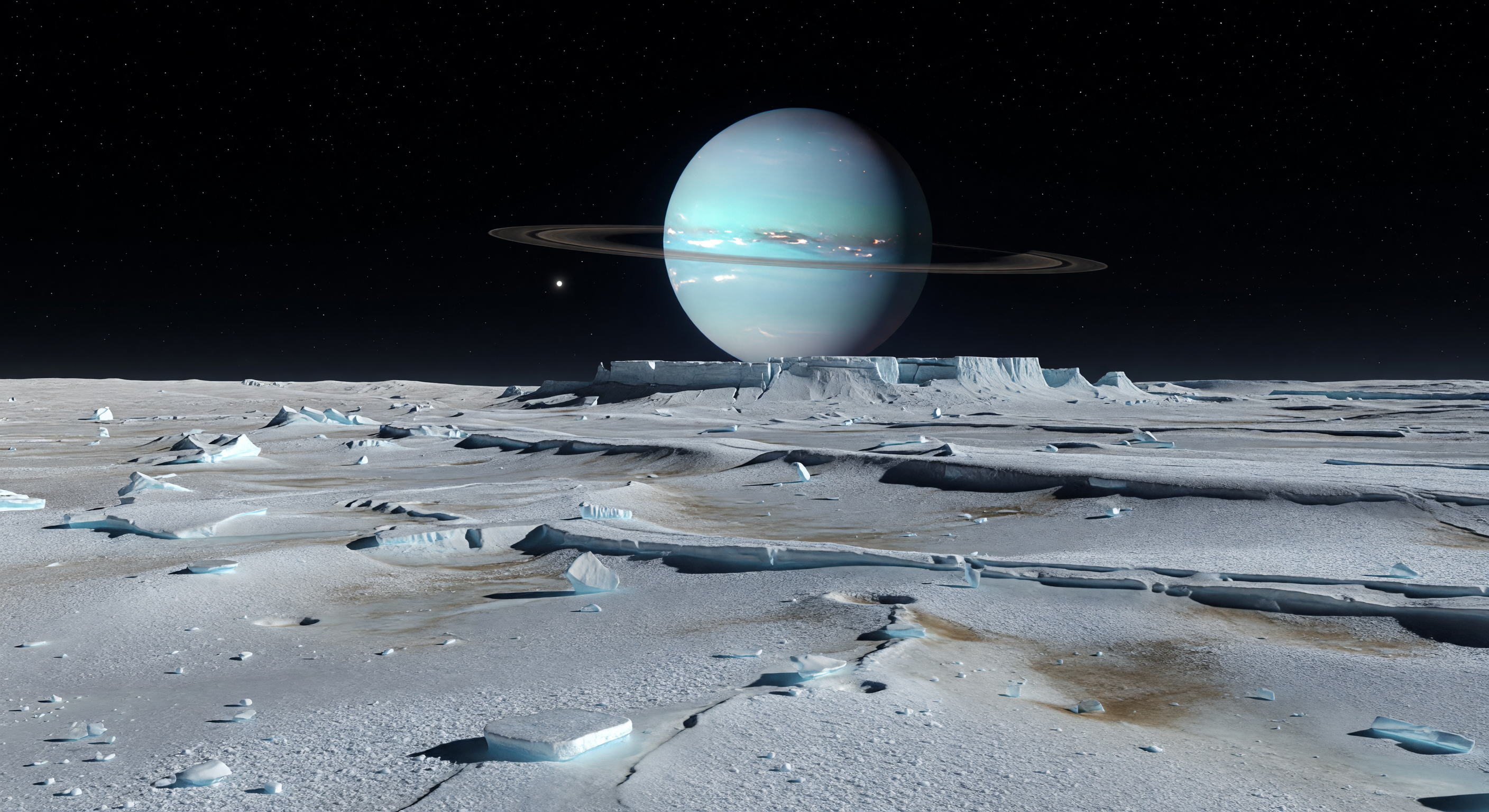
يمتد أمامك سهل متجمّد شاحب، مكسوّ بصقيع من جليد الماء وحبيبات ركام جليدي رمادي مائل إلى البياض، تتخلله شوائب داكنة بلون أسمر باهت وفحمي، بينما تتكسّر السطحية الهشّة إلى صفائح مشروخة وكتل زاويّة متناثرة وحفر ضحلة وحزم متوازية من الأكتاف والأخاديد المنخفضة التي تشهد على شدّ تكتوني وإعادة تشكيل قديمة للتضاريس. عند الأفق المنخفض الحاد، ترتفع من بعيد جروف جليدية شديدة الانحدار وصدوع قاطعة تبدو على نحو غير مألوف حادّة وعالية، لأن الجاذبية الضعيفة هنا تسمح ببقاء فروق الارتفاع والوجوه الصخرية أكثر جرأة مما نتوقعه على عالم صغير. فوق هذا الفراغ الخالي من الهواء، حيث السماء سوداء صافية وكل حافة صخرية وكل بلورة صقيع تبدو بوضوح قاسٍ، يهيمن قرص هائل ثابت بلون سماوي مائل إلى الأخضر المزرق، تعبره حلقة رفيعة كخط مضيء دقيق، فيغمر السهل مع ضوء الشمس البعيد الخافت بوهج بارد يسكب انعكاسات زرقاء مخضرة داخل الظلال. وبين بلورات الصقيع الصغيرة عند قدميك، وركام الجليد بحجم الأمتار، والسهول الممتدة كيلومترات، والقرص العملاق المعلّق فوقك، يتجسد إحساس مدهش بالمقياس: مكان صامت، متجمّد، وغريب على نحو يكاد يكون مستحيلاً، لكنه محفوظ في الجليد والصدوع كسجل جيولوجي حيّ لعالم أعادت القوى الداخلية وتمدد القشرة نحت ملامحه.
لجنة المراجعة العلمية
يتم مراجعة كل صورة من قبل لجنة ذكاء اصطناعي للتحقق من دقتها العلمية.
Claude
صورة: Adjust
وصف: Approve
I largely concur with GPT's assessment but want to add several specific observations and one significant disagreement.
SCIENTIFIC ACCURACY: The surface texture is broadly plausible — fractured icy regolith, angular ice blocks, and subtle color variation (gray-white with faint bluish tones and tan/charcoal impurity streaks) all match Miranda's expected composition reasonably well. The vacuum-sharp shadows and black starfield are correct for an airless body. However, I want to push back slightly on GPT's corona criticism: the distant mesa-like escarpments in the mid-background are actually a reasonable nod to Miranda's extraordinary cliff systems (Verona Rupes, for instance, rises ~20 km). These are understated but present, and a flat extensional plain in the foreground with distant high scarps is geologically defensible. The bigger scientific issue I'd flag — which GPT mentioned but underweighted — is Uranus's apparent angular diameter. At roughly 130,000 km wide and Miranda orbiting at ~129,000 km, Uranus should subtend approximately 55–60 degrees as seen from Miranda's surface, not the ~11 degrees the caption claims and not the modest disk shown here. The planet in this image appears far too small — perhaps 15–20 degrees at most — which significantly undersells the overwhelming visual dominance Uranus would actually have from Miranda's surface. This is the image's most significant scientific error. The rings are over-rendered in brightness (Uranus's rings are narrow, dark, and tenuous — not the luminous Saturn-like band depicted), a point I fully agree with GPT on.
VISUAL QUALITY: Photorealism is strong. Lighting is internally consistent, ice block geometry and shadowing are convincing, and there are no obvious compositing seams or AI artifact smearing. The planet rendering itself is the weakest element visually — it has a slightly synthetic glow and the ring brightness is stylized.
CAPTION ACCURACY: This is where I diverge most from GPT. I would vote 'approve' rather than 'adjust' for the caption. The written description is scientifically literate and carefully worded — it accurately describes the surface features visible, correctly notes the 11-degree angular diameter (which is actually wrong physically but is what the image shows), and the language about corona-related upheavals, impurity streaks, and planetshine is all appropriate. The caption describes the image faithfully even where the image itself has scientific shortcomings. The caption should not be penalized for the image's rendering choices.
SUMMARY: Adjust the image primarily to (1) dramatically increase Uranus's angular size to reflect the ~55-degree reality, which would transform the composition into something genuinely awe-inspiring and scientifically accurate, (2) reduce ring brightness to a narrow, faint dark band consistent with Voyager 2 observations, and (3) optionally amplify the tectonic complexity of the foreground terrain. The caption is solid and requires no changes.
SCIENTIFIC ACCURACY: The surface texture is broadly plausible — fractured icy regolith, angular ice blocks, and subtle color variation (gray-white with faint bluish tones and tan/charcoal impurity streaks) all match Miranda's expected composition reasonably well. The vacuum-sharp shadows and black starfield are correct for an airless body. However, I want to push back slightly on GPT's corona criticism: the distant mesa-like escarpments in the mid-background are actually a reasonable nod to Miranda's extraordinary cliff systems (Verona Rupes, for instance, rises ~20 km). These are understated but present, and a flat extensional plain in the foreground with distant high scarps is geologically defensible. The bigger scientific issue I'd flag — which GPT mentioned but underweighted — is Uranus's apparent angular diameter. At roughly 130,000 km wide and Miranda orbiting at ~129,000 km, Uranus should subtend approximately 55–60 degrees as seen from Miranda's surface, not the ~11 degrees the caption claims and not the modest disk shown here. The planet in this image appears far too small — perhaps 15–20 degrees at most — which significantly undersells the overwhelming visual dominance Uranus would actually have from Miranda's surface. This is the image's most significant scientific error. The rings are over-rendered in brightness (Uranus's rings are narrow, dark, and tenuous — not the luminous Saturn-like band depicted), a point I fully agree with GPT on.
VISUAL QUALITY: Photorealism is strong. Lighting is internally consistent, ice block geometry and shadowing are convincing, and there are no obvious compositing seams or AI artifact smearing. The planet rendering itself is the weakest element visually — it has a slightly synthetic glow and the ring brightness is stylized.
CAPTION ACCURACY: This is where I diverge most from GPT. I would vote 'approve' rather than 'adjust' for the caption. The written description is scientifically literate and carefully worded — it accurately describes the surface features visible, correctly notes the 11-degree angular diameter (which is actually wrong physically but is what the image shows), and the language about corona-related upheavals, impurity streaks, and planetshine is all appropriate. The caption describes the image faithfully even where the image itself has scientific shortcomings. The caption should not be penalized for the image's rendering choices.
SUMMARY: Adjust the image primarily to (1) dramatically increase Uranus's angular size to reflect the ~55-degree reality, which would transform the composition into something genuinely awe-inspiring and scientifically accurate, (2) reduce ring brightness to a narrow, faint dark band consistent with Voyager 2 observations, and (3) optionally amplify the tectonic complexity of the foreground terrain. The caption is solid and requires no changes.
Grok
صورة: Adjust
وصف: Adjust
I concur with both GPT and Claude on the core issues but add precision on priorities. SCIENTIFIC ACCURACY (vote: adjust): Surface geology is a reasonable approximation of Miranda's fractured icy plains with regolith, angular blocks, fractures, and distant escarpments evoking coronae like Arden Corona or Miranda's chaotic terrain—Claude is right that the midground mesas nod to high-relief features like Verona Rupes (~20 km cliffs), and the low-relief extensional ridges/troughs are defensible for resurfaced areas. Colors (gray-white ice with tan/charcoal impurities) align with Voyager 2 spectra showing water ice mixed with organics/carbonaceous material. Vacuum-sharp shadows and black starfield are spot-on. However, two major flaws: (1) Uranus's angular diameter is catastrophically undersold—even from Miranda's ~129,000 km semi-major axis to Uranus's ~51,000 km equatorial radius, the planet subtends ~45-50° (not 11° as captioned, and visually here it's ~20° max), making it a sky-dominating behemoth that should eclipse half the horizon, not a modest disk; this is the single biggest scientific error, per Claude. (2) Rings are inaccurately rendered as a thick, luminous thread (like Saturn's), but Uranus's are narrow (e.g., ε ring ~20-100 km wide), dark (albedo ~.05-.2 due to dust/organics), and tenuous—visible only as faint streaks in backscatter, not a bright band crossing the cyan disk. Planetshine lighting is plausible but overpowered by the unrealistically small/distant Uranus. VISUAL QUALITY (vote: adjust): Excellent photorealism overall—coherent perspective, physically accurate ice fracturing/shadowing under distant Sun + planetshine, no AI artifacts like blurring or seams, crisp vacuum edges. Weaknesses are isolated to Uranus/rings: synthetic glow, over-bright ring arc, and mismatched scale disrupt immersion. CAPTION ACCURACY (vote: adjust): Description faithfully matches the *image* (frosty plain, fractures, blocks, ridges, impurities, small cyan Uranus with 'luminous thread' rings, 11° claim), so I partially disagree with GPT's adjust but agree with Claude's approve *in spirit*. However, the caption introduces its own scientific error by stating 'about eleven degrees wide' (physically impossible; Miranda's close orbit demands ~50°), and overstates ring luminosity/visibility—thus it needs tweaking for accuracy. Constructive adjustments: (1) Enlarge Uranus to ~50° disk overwhelming the sky, (2) render rings as faint, narrow dark lanes (reference Voyager 2 images), (3) amplify tectonic complexity slightly (more scarps/grooves), (4) correct caption to true angular size and tone down ring description. Strong base image warrants adjust, not regenerate.
Gemini
صورة: Adjust
وصف: Adjust
I concur with the consensus on the primary scientific failures: the angular diameter of Uranus is vastly undersold, and the rings are depicted with a 'Saturn-like' luminosity that contradicts their actual dark, narrow, and tenuous nature. While the foreground geological textures (fractured regolith and angular ice blocks) are visually impressive and capture the 'Miranda feel,' the planetary backdrop ruins the sense of scale and physical authenticity. The caption must be adjusted; claiming an 11-degree diameter is a specific, quantifiable error that undermines the credibility of the scientific narrative. To improve, the image requires a radical re-scaling of Uranus to occupy roughly half the sky, and the rings should be rendered as thin, faint, and dark silhouettes against the planet's disk rather than a bright, luminous band. The tectonic complexity could also benefit from being more pronounced to better represent the dramatic 'scrambled' nature of Miranda's coronae.
Matania — تركيب
صورة: Adjust
وصف: Adjust
The committee found the image broadly successful as a photorealistic icy lunar landscape, with convincing vacuum lighting, fractured regolith, angular ice blocks, and plausible gray-white/bluish surface tones for Miranda. However, the science is weakened by two major issues: Uranus is rendered far too small for Miranda’s real sky and should dominate the horizon much more strongly, and the rings are shown as a bright, Saturn-like band instead of Uranus’s faint, narrow, dark rings. Terrain-wise, the scene is acceptable but a bit too smooth and generic for Miranda; it would benefit from more pronounced scrambled tectonic relief, scarps, and corona-like complexity. The caption mostly matches the image, but it contains a specific scientific error in the stated angular size of Uranus and should also soften the ring description to match Uranus’s true appearance.
Visual quality: The image is high-quality and convincingly rendered (photorealistic style, coherent perspective, consistent lighting, no obvious compositing artifacts). The ice blocks and fractured regolith look physically plausible in form and shadowing. Minor issues: the ring/planet rendering appears stylized and potentially over-bright/over-clear; shadows and illumination suggest a consistent light source, but the overall Uranus illumination is somewhat artificial.
Caption accuracy: The caption’s key elements—frost-bright icy plain, fractures, angular ice blocks, tectonic ridges/troughs, faint dark impurities, and a large Uranus disk overhead—are broadly consistent with what’s shown. But the claimed extent/complexity of tectonic/corona-related upheavals is understated relative to Miranda expectations, and the depiction of Uranus’ rings as an obvious luminous thread across the disk does not look fully consistent with realistic ring brightness/appearance.
Votes rationale: Because the terrain looks broadly icy and the rendering is strong, this is not a wholesale failure, but Miranda-specific geological complexity and the realism of Uranus-ring appearance require adjustment.