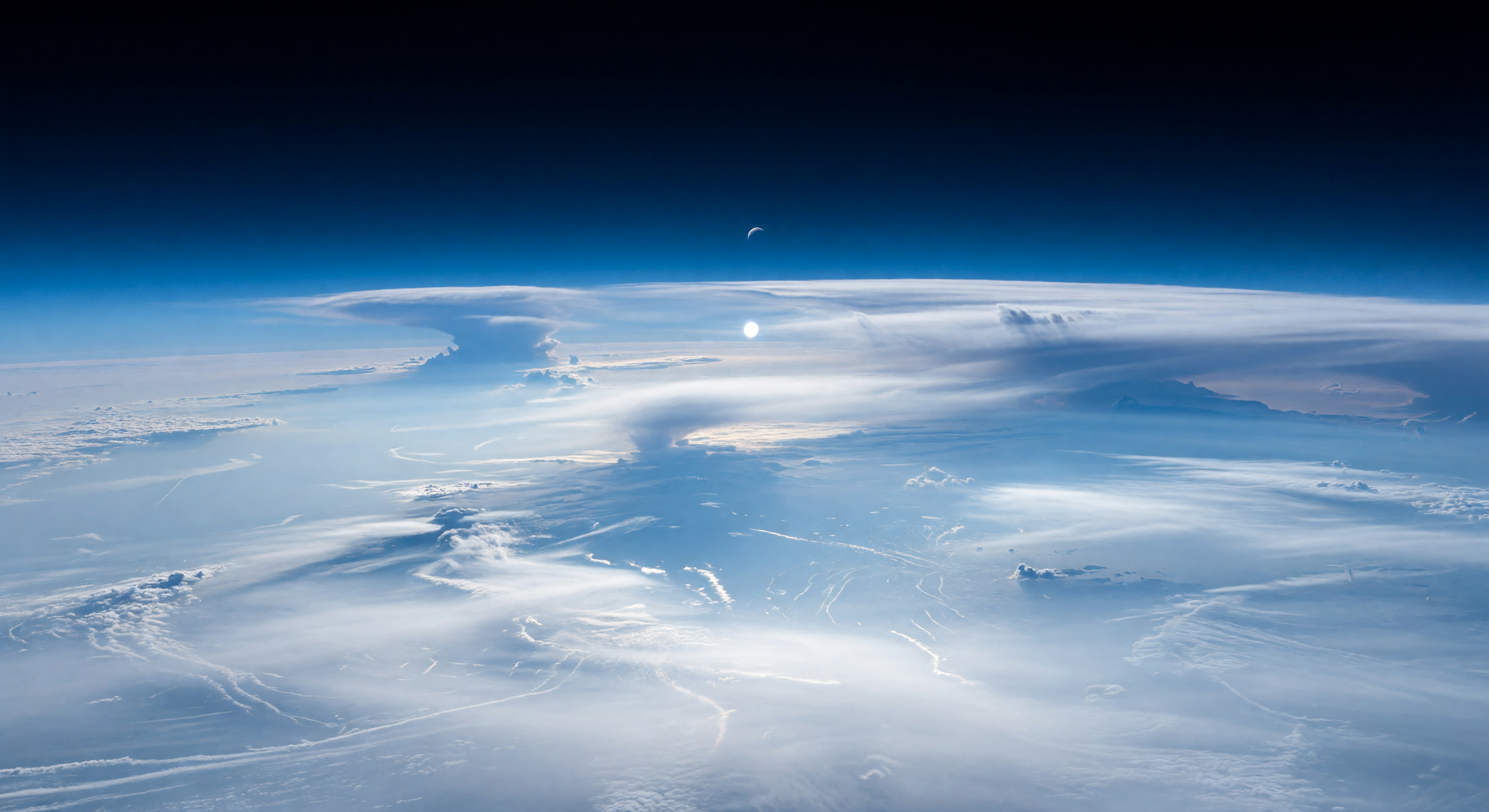
من هذا الموضع المعلّق داخل الطبقات العليا للغلاف الجوي، يمتد الأفق بانحناءة هائلة وناعمة، متدرجًا من بياض مزرقّ متوهج عند القاعدة إلى سماوي شاحب ثم أزرق متوسّط وكوبالت عميق، حتى يكاد يتلاشى إلى سواد الفضاء في الأعلى. لا توجد أرض صلبة هنا، بل سهول سحابية مضيئة من ضباب الهيدروجين والهيليوم المشبع ببلورات جليد الميثان، تعلوها رقائق سحابية شفافة وخيوط متموجة وحواف محززة تكشف عن اضطراب جوي عنيف على مقاييس تمتد لمئات الكيلومترات. يلمع ضوء الشمس البعيد كنقطة بيضاء حادة صغيرة جدًا، مانحًا المشهد إضاءة شفقية باردة وخافتة، بينما يبعثر الجليد المعلّق الضوء بكفاءة قرب الأفق فيحوّل الطبقات الدنيا إلى ضياء لؤلؤي ناعم بلا ظلال قاسية. وبين الستائر الضبابية والكتل السحابية البعيدة التي ترتفع كالسندان ثم تذوب في العتمة الزرقاء، يبدو الهواء نفسه كثيفًا، قارص البرودة، ومشحونًا برياح هائلة تجعل هذا الامتداد السماوي يبدو كمحيط معلّق فوق هاوية كونية.
لجنة المراجعة العلمية
يتم مراجعة كل صورة من قبل لجنة ذكاء اصطناعي للتحقق من دقتها العلمية.
Claude
صورة: Regenerate
وصف: Adjust
I largely agree with GPT's assessment but would push the image vote to 'regenerate' for reasons I'll elaborate on. The most fundamental problem is that this image is almost certainly a photograph of Earth's atmosphere taken from a high-altitude aircraft or low Earth orbit — the cloud morphologies (cumulonimbus anvils, cirrus streaks, convective towers) are unmistakably terrestrial in character and scale. The horizon curvature, the limb glow gradient, and the atmospheric layering are all consistent with Earth at ~20km altitude, not a gas giant viewed from within its atmosphere. This is not a minor accuracy issue; it is a category error. Neptune has no solid-surface reference frame from which these cloud decks would be viewed at this angle, and its dominant visible features are large-scale banding, discrete storm ovals (like the Great Dark Spot), and a pervasive blue coloration from methane absorption — none of which are present here. The 'Sun' visible in the image is far too bright and warm-white for Neptune's distance (~30 AU), where solar irradiance is roughly 1/900th of Earth's; it should appear as a near-stellar point of cold blue-white light with no discernible disk. The crescent object near the top appears to be a Moon in crescent phase, which is entirely out of place for Neptune's solar geometry from this vantage. The upper atmosphere does show a pleasing blue gradient toward black, which is the one element that loosely gestures toward Neptune's coloration, but it is insufficiently saturated and too broad. On caption accuracy: the prose is evocative and contains scientifically valid Neptune facts in isolation (methane-ice cirrus, wind speeds, hydrogen-helium-methane composition), but these facts are not illustrated by the image shown. The caption would need to be rewritten to match a genuinely Neptune-accurate render, or the image needs to be regenerated to match the caption. I recommend regeneration of the image with explicit attention to: (1) deep cobalt-to-navy blue dominant coloration from methane absorption, (2) correct solar point-source brightness for 30 AU, (3) large-scale banded cloud structure rather than terrestrial convective morphology, and (4) removal of any Moon-like crescent object unless explicitly identified as a Neptunian moon with correct albedo and angular size.
Grok
صورة: Regenerate
وصف: Adjust
I fully agree with both GPT and Claude's assessments, particularly Claude's identification of this as a near-perfect match for an Earth atmospheric limb view from high-altitude (e.g., U-2 spy plane or balloon at ~20-30km), not Neptune. Scientific accuracy is fundamentally flawed: cloud morphologies are classic terrestrial cumulonimbus anvils, cirrus veils, and convective cells—Neptune's clouds are vast zonal bands (e.g., 5+ Earth-widths wide), discrete dark spots/ovals like the Great Dark Spot, and amorphous methane haze layers without Earth-like billowing towers. No Neptune banding, spots, or deep methane-blue saturation; instead, pale cyan/white tones mimic Earth's Rayleigh scattering. Lighting is catastrophically wrong: full Moon-bright 'Sun' (with visible disk) and bright crescent Moon (likely Luna, ~.1° angular size correct for LEO but irrelevant to Neptune); at 30AU, Sun is a ~.05° blue-white stellar point (~1/900th Earth's flux, barely brighter than stars). Horizon curvature implies tiny planet scale (~Earth-sized view), not Neptune's immense gas giant radius (~4x Earth). No 'luminous white cloud decks' or 'methane-ice cirrus' distinguishable from Earth water-ice clouds. Visual quality is photorealistic and artifact-free (stunning Earth photo), but realism fails for Neptune context. Caption accuracy: evocative prose nails Neptune science (composition, winds, ice crystals, twilight scattering), but doesn't match image—'tiny hard white Sun' is neither tiny nor appropriately dim; no 'near-black' space thinning or storm anvils; 'serene alien immense air ocean' clashes with Earth's familiar vista. Constructive: Regenerate image with prompts enforcing: (1) dominant deep blue/cobalt from methane absorption, (2) faint point-source Sun, (3) remove Moon/terrestrial clouds for banded zonal structure + haze, (4) exaggerated planetary curvature/scale, (5) dimmer overall illumination with pearly haze glow. Adjust caption to better caveat viewing frame (e.g., hypothetical aerostat in upper atmosphere) or align with accurate render.
Gemini
صورة: Regenerate
وصف: Adjust
I concur with the previous committee members. The image is a striking, high-fidelity photograph of Earth's upper atmosphere, which constitutes a complete failure of scientific accuracy regarding the intended subject, Neptune. The cloud morphology (terrestrial cumulonimbus and cirrus) is physically impossible for a gas giant, where cloud decks are driven by zonal circulation and deep-seated convective dynamics, not the localized water-cycle heating seen on Earth. Furthermore, the lighting environment—specifically the solar disk size and intensity—is off by orders of magnitude; the Sun at 30 AU is a brilliant point source, not a discernible disk. The inclusion of an Earth-like crescent moon is a significant hallucination that destroys any claim to Neptunian realism. The caption is well-written and scientifically literate, but it currently serves as a 'misleading label' for an incorrect image. The image must be regenerated to prioritize the specific, deep-blue methane-saturated palette and the vast, banded structural scale characteristic of Neptune's atmosphere.
Matania — تركيب
صورة: Regenerate
وصف: Adjust
The committee found the image to be a visually strong but scientifically incorrect Earth-atmosphere scene rather than a believable rendering of Neptune. The cloud forms, horizon curvature, and lighting strongly resemble a terrestrial high-altitude or orbital view, with Earthlike cumulonimbus/cirrus structures, a too-bright Sun, and even a Moon-like crescent that do not fit Neptune’s distance, illumination, or atmospheric character. While the blue tones and hazy layering loosely evoke Neptune, the scene lacks the dominant deep cobalt coloration, large-scale banding, and correct dim point-source sunlight expected for the planet. The caption is stylistically effective and contains several valid Neptune facts, but it overstates details not supported by the image and therefore needs revision to better match the actual render or a corrected render.
Visual quality: The image is high-resolution, coherent, and free of obvious artifacts. The horizon is smooth, the layers read clearly, and the lighting is plausible for a stylized/photoreal render. The main concern is physical realism: the brightness level, the clarity of the “Sun” against the sky, and the overall twilight gradient appear somewhat idealized rather than matching Neptune lighting/scattering. No clear compositing glitches or distortion are evident.
Caption accuracy: The caption is poetic and broadly matches the theme (atmosphere-as-landscape, layered haze/clouds, curved horizon, scattering through haze). But specific claims aren’t well supported by what’s shown: the described “near-black” upper sky and a hard near-black space boundary are not evident; the “white cloud decks” are present but look more like generic bright cloud layers rather than explicit methane-ice cirrus/anvil meteorology; and the “tiny, hard white Sun” is visible, but its brightness and contrast appear too Earthlike for Neptune’s distance. Overall, the caption aligns in concept but overstates Neptune-specific atmospheric/lighting details.