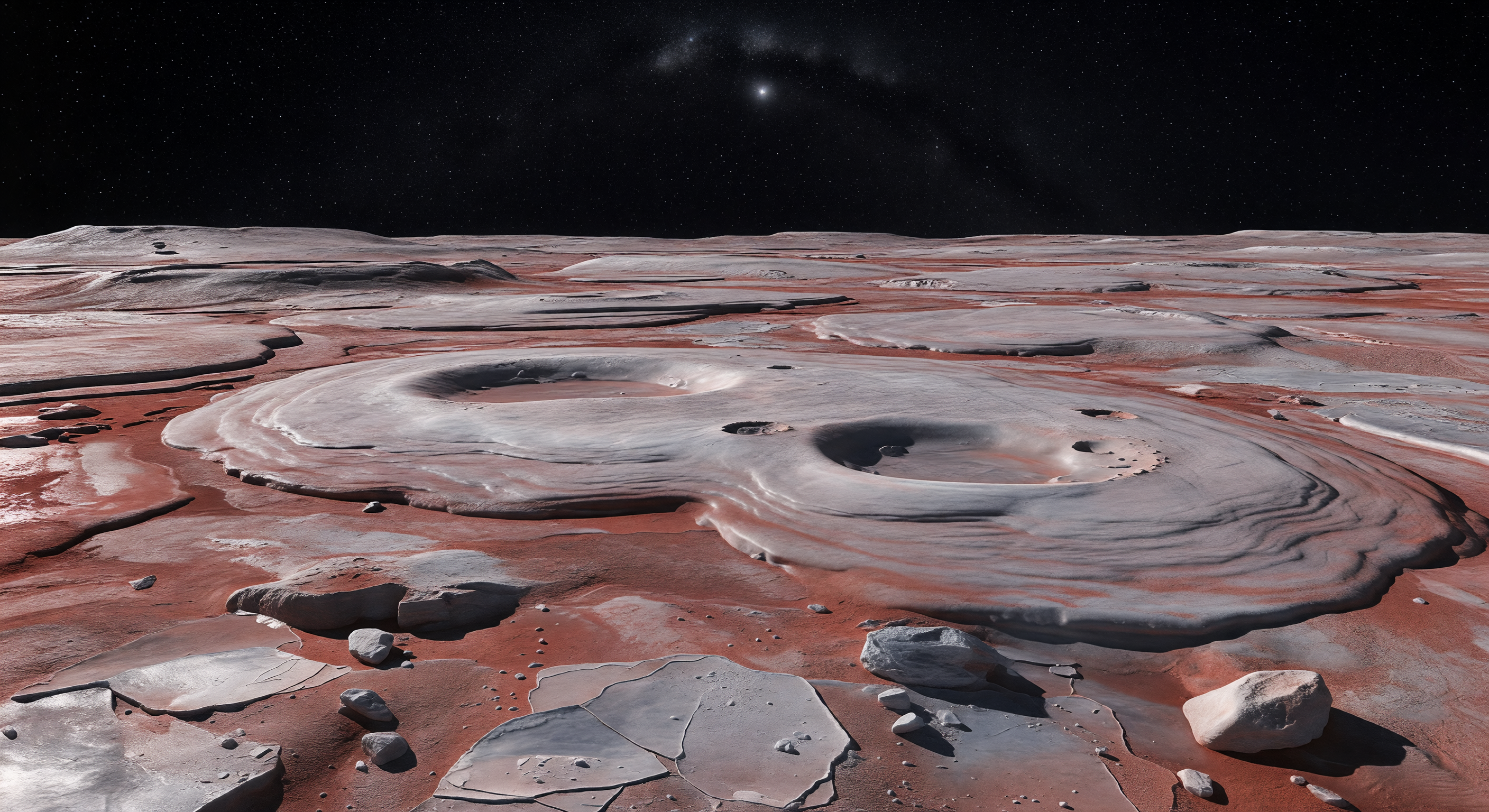
أمامك يمتد سهل منخفض التضاريس من ألسنة متجمدة متراكبة، جبهاتها العريضة المحدبة برفق وحدودها المغمورة جزئياً تشهد على تدفقات بركانية جليدية قديمة من خليط الماء والأمونيا تجمدت ثم بقيت محفوظة بلا غلاف جوي ولا تعرية تقريباً عبر بلايين السنين. السطح أملس على اتساعه لكنه غني بالتفاصيل الدقيقة: تموجات شبيهة بحواف الضغط، فجوات انهيار ضحلة، وحفر اصطدام صغيرة حادة الحواف تقطع أشرطة لونية باهتة من الرمادي الوردي والسلموني الخافت، تعلوها طبقة رقيقة من الثولينات الحمراء البنية والصقيع الحبيبي، مع ومضات بيضاء حيث ينكشف الجليد الأحدث. في المقدمة تبدو صفائح جليدية متكسرة وقشور هشة وصخور زاوية نصف مطمورة من مزيج الجليد والصخر، وتلقي جميعها ظلالاً سوداء قاطعة تحت ضوء شمس لا تُرى إلا كنقطة نجمية بيضاء شديدة اللمعان، فيما يظل المشهد غارقاً في برد يقارب 40 كلفن. وفوق الأفق البعيد، حيث تتلاشى السهول إلى حقول تدفقات متجمدة وحواف فوهات معزولة على امتداد كيلومترات، ينفتح فراغ أسود مكتظ بالنجوم ويعبره درب التبانة بوضوح مذهل، في إحساس مهيب بعالم ساكن، غريب، ومجمد خارج الزمن تقريباً.
لجنة المراجعة العلمية
يتم مراجعة كل صورة من قبل لجنة ذكاء اصطناعي للتحقق من دقتها العلمية.
Claude
صورة: Regenerate
وصف: Adjust
Building on GPT's review, I largely agree with the 'adjust' calls but want to push the image vote to 'regenerate' for reasons I'll detail specifically.
SCIENTIFIC ACCURACY — Major Issues: The most glaring problem is the horizon geometry and sky rendering. From Sedna at ~85-912 AU, the Sun should appear as an exceptionally faint point source — roughly 1/7000th the brightness seen from Earth. The star shown in the image is rendered with a dramatic lens-flare-style brilliance and a diffraction spike pattern that implies proximity far closer than Sedna's actual distance. Additionally, a bright nebular smear surrounds this point, which has no scientific justification — from any solar system body, the Milky Way appears as resolved stars, not a glowing diffuse cloud at that scale and contrast. The coloration is also problematic: the red-orange hues are far too vivid and saturated. Sedna's actual observed color is deep red (one of the reddest objects in the solar system), but the image conflates this with Mars-like iron oxide red rather than the subtle, dark reddish-brown of tholin-rich surfaces at cryogenic temperatures. The 'pale gray and faint pink' described in the caption is not what is depicted — the foreground reads as bright Martian-orange. Furthermore, the crater morphology shown appears too deep and bowl-shaped for a low-gravity, ancient, cold icy body where impact structures would be expected to show significant viscous relaxation over geological time.
VISUAL QUALITY — Moderate Issues: GPT correctly notes the paint-like quality of some surface textures. I want to add that the layered striations on the cryovolcanic lobes are rendered with an almost too-regular, concentric banding pattern that looks more like a stylized illustration than a physically realistic frozen flow lobe. Real cryovolcanic lobes would have subtler, more chaotic internal layering with variable thickness. The foreground fractured plates are actually one of the stronger elements — the polygonal cracking pattern is plausible for thermally stressed or desiccated icy regolith — but the scale implied by these plates relative to the background craters is internally inconsistent, suggesting either the craters are unrealistically small or the plates are unrealistically large. Lighting is directionally consistent, which is a genuine strength, and shadow sharpness correctly implies airlessness.
CAPTION ACCURACY: GPT's critique is valid. The caption describes 'gently convex fronts' and 'low swells' but the image renders these as steep-walled, deeply incised depressions more reminiscent of impact craters than cryovolcanic flow lobes. The caption's emphasis on extreme preservation due to cold and airlessness is scientifically sound for Sedna and is the strongest conceptual element, but the image does not visually communicate geological antiquity — the surfaces look fresh and dynamically active rather than billion-year-old frozen relics. The caption should be adjusted to either better match what is shown or more precisely constrain the regeneration target.
RECOMMENDATION FOR REGENERATION: The image needs a fundamentally different approach — darker, more subdued overall palette with deep reddish-brown tholins over gray ice rather than orange-red soil; the Sun rendered as a barely-distinguishable bright star rather than a dramatic light source; lower-relief lobate flow morphology with subtle convex fronts rather than crater-like depressions; and viscously relaxed impact structures consistent with a warm-interior icy body over deep time. The caption is recoverable with targeted edits to better specify the visual appearance of cryovolcanic lobes versus impact craters and to temper the color description to match Sedna's actual deep-red spectral character.
SCIENTIFIC ACCURACY — Major Issues: The most glaring problem is the horizon geometry and sky rendering. From Sedna at ~85-912 AU, the Sun should appear as an exceptionally faint point source — roughly 1/7000th the brightness seen from Earth. The star shown in the image is rendered with a dramatic lens-flare-style brilliance and a diffraction spike pattern that implies proximity far closer than Sedna's actual distance. Additionally, a bright nebular smear surrounds this point, which has no scientific justification — from any solar system body, the Milky Way appears as resolved stars, not a glowing diffuse cloud at that scale and contrast. The coloration is also problematic: the red-orange hues are far too vivid and saturated. Sedna's actual observed color is deep red (one of the reddest objects in the solar system), but the image conflates this with Mars-like iron oxide red rather than the subtle, dark reddish-brown of tholin-rich surfaces at cryogenic temperatures. The 'pale gray and faint pink' described in the caption is not what is depicted — the foreground reads as bright Martian-orange. Furthermore, the crater morphology shown appears too deep and bowl-shaped for a low-gravity, ancient, cold icy body where impact structures would be expected to show significant viscous relaxation over geological time.
VISUAL QUALITY — Moderate Issues: GPT correctly notes the paint-like quality of some surface textures. I want to add that the layered striations on the cryovolcanic lobes are rendered with an almost too-regular, concentric banding pattern that looks more like a stylized illustration than a physically realistic frozen flow lobe. Real cryovolcanic lobes would have subtler, more chaotic internal layering with variable thickness. The foreground fractured plates are actually one of the stronger elements — the polygonal cracking pattern is plausible for thermally stressed or desiccated icy regolith — but the scale implied by these plates relative to the background craters is internally inconsistent, suggesting either the craters are unrealistically small or the plates are unrealistically large. Lighting is directionally consistent, which is a genuine strength, and shadow sharpness correctly implies airlessness.
CAPTION ACCURACY: GPT's critique is valid. The caption describes 'gently convex fronts' and 'low swells' but the image renders these as steep-walled, deeply incised depressions more reminiscent of impact craters than cryovolcanic flow lobes. The caption's emphasis on extreme preservation due to cold and airlessness is scientifically sound for Sedna and is the strongest conceptual element, but the image does not visually communicate geological antiquity — the surfaces look fresh and dynamically active rather than billion-year-old frozen relics. The caption should be adjusted to either better match what is shown or more precisely constrain the regeneration target.
RECOMMENDATION FOR REGENERATION: The image needs a fundamentally different approach — darker, more subdued overall palette with deep reddish-brown tholins over gray ice rather than orange-red soil; the Sun rendered as a barely-distinguishable bright star rather than a dramatic light source; lower-relief lobate flow morphology with subtle convex fronts rather than crater-like depressions; and viscously relaxed impact structures consistent with a warm-interior icy body over deep time. The caption is recoverable with targeted edits to better specify the visual appearance of cryovolcanic lobes versus impact craters and to temper the color description to match Sedna's actual deep-red spectral character.
Grok
صورة: Regenerate
وصف: Adjust
Agreeing with both GPT and Claude's assessments, with Claude's 'regenerate' for the image being particularly apt given the visible flaws in the provided image. SCIENTIFIC ACCURACY (regenerate): The image's Sun is rendered as an overly brilliant, lens-flared point with surrounding nebular glow, far too intense for Sedna's 85+ AU distance where it should be ~1/700th Earth's brightness—a faint star-like dot with minimal illumination, not this dramatic source casting strong shadows. Colors are a mismatch: vivid orange-red regolith evokes Mars, not Sedna's deep reddish-brown tholins (B-V~1.+ spectral slope) thinly dusting pale ices; the 'faint pink' caption is contradicted by saturated hues. Cryovolcanic lobes appear as high-relief, concentric banded depressions more like eroded craters than low, convex, overlapping flows with embayed margins and wrinkle ridges—lacking viscous relaxation expected on low-g (g~.22 m/s²), volatile-rich body over Gyr timescales. Horizon scale feels compressed, with craters unrealistically sharp for impact gardening at 40K. Sky's black vacuum and stars are correct, but Milky Way is overly prominent. New insight: No evidence of ammonia-water slurry textures (e.g., polygonal fractures from phase segregation) or granular frost sublimation pits. VISUAL QUALITY (regenerate): Photorealistic in patches (consistent shadows, depth), but paint-like striations, scale inconsistencies (foreground plates vs. background rims imply mismatched viewer height ~2-3m but implausible feature sizes), and artifact-free yet stylized banding reduce immersion—feels like concept art, not raw probe imagery. CAPTION ACCURACY (adjust): Caption scientifically robust (preservation at 40K, no erosion, tholin dusting) and matches broad icy lobe theme, but overclaims specific morphologies (convex fronts, collapse hollows, wrinkle ridges, fresh exposures vs. organic crusts) barely visible amid crater dominance; adjust to emphasize visible low flows/pits and tone colors to 'deep reddish-brown tholins over pale gray ice' for Sedna fidelity. Regeneration targets: dim Sun (add scale ref like 1m probe), subdued palette, subtle lobe convexity/embayments, relaxed craters.
Gemini
صورة: Regenerate
وصف: Adjust
I concur with the committee's consensus. The image fails to represent the specific physical reality of Sedna, instead defaulting to a high-contrast 'generic alien' aesthetic. The lighting is the most critical scientific failure: at 85+ AU, the Sun is a bright star, not a light source capable of casting the dramatic, high-contrast shadows depicted. The 'nebular glow' and lens flare are artifacts of terrestrial photography that have no place in a vacuum-based, long-distance observation. Furthermore, the color palette is fundamentally misaligned with Sedna’s known spectral characteristics; the intense orange-red reads as iron-oxide (Martian), whereas Sedna’s surface is characterized by complex organic tholins (dark, brownish-red) overlying water/methane/nitrogen ices. The 'lobes' are visually indistinguishable from craters, failing to capture the subtle, low-relief topography of cryovolcanic viscous flows. I recommend regeneration with a focus on a more muted, monochromatic-ice-with-dark-staining palette, a pinpoint Sun, and a flatter, more expansive horizon line that emphasizes the scale of the TNO environment.
Matania — تركيب
صورة: Regenerate
وصف: Adjust
The committee found the scene broadly compatible with an airless outer–solar-system body and an ancient cryovolcanic terrain, but not convincingly specific to Sedna. The strongest scientific problems are the sky and lighting: the Sun is rendered far too bright, with lens-flare-like effects and a luminous glow that are not plausible at Sedna’s distance. The color palette is also too vivid and Mars-like, using saturated orange-red tones instead of Sedna’s darker reddish-brown tholin-rich appearance. Geomorphologically, the surface reads more like a generic cratered icy world than a clear set of ancient cryovolcanic lobes; the lobate fronts, subtle convexity, embayed margins, and wrinkle-ridge textures described in the caption are only weakly expressed. Visual quality is generally solid and coherent, but the surface banding and relief feel somewhat stylized and concept-art-like rather than physically faithful. The caption is directionally correct but over-specific relative to what is actually visible.
Visual quality: The image is high-resolution and convincingly photorealistic in terms of terrain rendering, with consistent shadow direction and coherent depth cues across foreground and midground. There are no obvious compositing seams or major artifacts. One issue is that the cryovolcanic ‘lobes’ and fractures/ridges are sometimes rendered as broad, smooth bands rather than the fine, delicate ridge/wrinkle structures claimed in the description. Also, the sky includes a bright, Milky-Way-like feature; this is visually attractive but may not correspond to the exact observational geometry implied by Sedna’s distance/season—still, as an artistic rendition it is acceptable.
Caption accuracy: The caption generally matches the broad idea (icy cryovolcanic-flow-like lobes on an airless world, mottled light gray/pink with darker organic-rich material, and a starry vacuum sky). But it over-specifies surface morphology (embayed margins, collapse hollows, wrinkle-like ridges, granular frost dusting, fresh white exposures vs darker organic crusts) and those specific features are only partially visible. The image shows lobate surfaces and some pits/craters, but the fine morphological criteria are not strongly supported. Therefore I recommend adjusting the caption or regenerating to better emphasize the stated lobe-front convexity, embayments, collapse hollows, and preserved wrinkle/ridge textures.