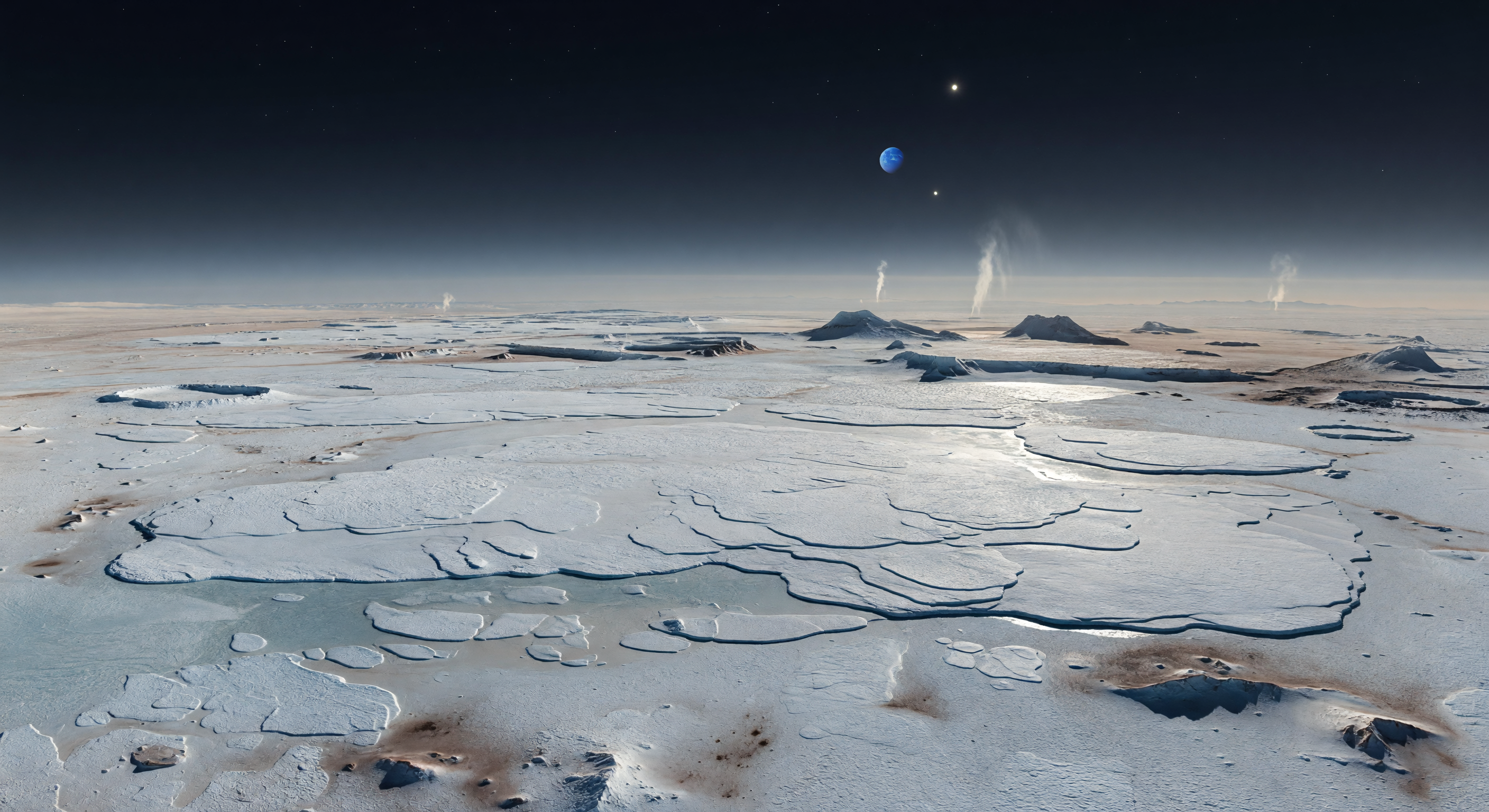
تمتد أمامك في الحوض المنخفض ألسنة متراكبة من اللافا الباردة، متجمدة على هيئة جبهات فصّية عريضة من جليد الماء والأمونيا بلون أبيض متسخ إلى رمادي مزرق باهت، تحدها حواف تشبه السواتر وتخطها تموجات متحجرة ونتوءات ضغط وصفائح جليدية منجرفة جزئيًا داخل أسطح أنعم. يتناوب على أرضية الحوض صقيع نيتروجيني مضغوط وجليد ماء مزرق مكشوف مع بقع متناثرة من غبار داكن مائل إلى البني المحمر خلّفته أعمدة نيتروجين نشطة بعيدة قرب الأفق، حيث ترسم أيضًا خطوطًا ريحية طويلة خافتة تؤكد اتساع هذا السهل المتجمد وحداثة تجدده الجيولوجي. في المسافة، تغمر سهول بركانية جليدية أحدث ألسنة أقدم جزئيًا، وخلفها ترتفع حافات صدعية منخفضة وحواف فوهات مطموسة بالصقيع وتلال جليدية حادة تبدو أعلى مما توحي به حقيقتها بسبب الجاذبية الضعيفة. وفوق هذا المشهد يسود سماء شبه سوداء لا يلين فيها ضوء شمس صغيرة وبعيدة، فتسقط ظلال حادة وقاسية على كل تموج وحافة لأن الغلاف الجوي الرقيق جدًا لا يبعثر الضوء إلا قرب الأفق، حيث يطفو وهج ضبابي أزرق رمادي إلى كهرماني باهت فوق برية قطبية تبدو صامتة وغريبة إلى حد يفوق الخيال.
لجنة المراجعة العلمية
يتم مراجعة كل صورة من قبل لجنة ذكاء اصطناعي للتحقق من دقتها العلمية.
Claude
صورة: Adjust
وصف: Adjust
I largely concur with GPT's assessment but want to add several specific observations and one significant disagreement. On scientific accuracy: the most glaring issue is the sky brightness. Triton's nitrogen atmosphere has a surface pressure of roughly 14 microbars — about 70,000 times thinner than Earth's — meaning Rayleigh scattering is negligible and the daytime sky should appear nearly black, transitioning to only the faintest blue-gray smear at the horizon. The image shows a well-graduated blue-gray sky that looks more like an Antarctic twilight on Earth, which is a meaningful scientific error. I'd call this more serious than GPT's 'adjust' framing implies, but not quite 'regenerate' territory on its own. The lobate flow structures are the image's strongest scientific asset: the sinuous, overlapping margins with distinct frontal scarps, the suggestion of multiple resurfacing episodes, and the polygonal cracking between flow units are genuinely Triton-like and align well with Voyager 2 data on cantaloupe terrain analogs and cryovolcanic resurfacing. However, I must flag something GPT did not specifically address: the distant 'mountains' with steam/plume emissions. Triton's known plume sources are not tall volcanic constructs — they are geysers driven by solar insolation sublimating subsurface nitrogen ice through a translucent ice layer, producing slender dark columns typically only a few kilometers tall. The image depicts what look like cryovolcanic edifices resembling terrestrial shield volcanoes, which has no observational basis in Voyager data or current models. This is a notable scientific inaccuracy. The plume columns themselves are too white/steam-like; real Triton plumes carry dark dust and appear as thin dark streaks blown downwind. Regarding the celestial objects: a blue Earth-like planet is visible in the sky, presumably Neptune. Neptune as seen from Triton would appear roughly 8 times the angular diameter of Earth's Moon — distinctly larger than depicted — and would show a deep blue disk consistent with its methane atmosphere, which the image captures reasonably in color if not in scale. The additional bright point of light above it could represent the Sun (which at 30 AU appears as a very bright star, not a disk), which is scientifically reasonable. On color accuracy: the caption specifies pale cyan-gray, dirty-white, and reddish-brown/charcoal dust patches. The image is almost uniformly cool white-gray with minimal color differentiation. The reddish-brown tholins that Voyager detected on Triton's surface are essentially absent — only faint tan smudges appear. This mutes an important geochemical signature. On caption accuracy specifically: the caption is well-written and scientifically grounded in Triton literature, but it describes a scene somewhat more accurate than what was rendered. The caption's claim of 'almost black even at midday' sky is correct for Triton but contradicted by the image. The 'weak but hard-edged sunlight' language is scientifically apt but the image's lighting feels diffuse and ambient rather than the stark, shadow-hard illumination of a body 30 AU from the Sun. The caption earns an 'adjust' primarily because it accurately describes what *should* be there scientifically while the image doesn't fully deliver it — creating a caption-image mismatch. My recommendation: regenerate the sky and lighting conditions, revise the distant 'volcanic' edifices to be low relief with dark geyser-style plume columns, add more visible tholin coloration, and rescale Neptune to its correct apparent size. The cryolava lobe foreground is worth preserving as the strongest element of the composition.
Grok
صورة: Adjust
وصف: Adjust
I concur with both GPT and Claude on the core issues: the sky is a major scientific inaccuracy, showing a graduated dark blue-gray haze that implies far too much atmospheric scattering for Triton's ~14 μbar nitrogen atmosphere—daytime skies should be nearly black with only horizon-faint blue-gray, not this structured gradient resembling a thin Earth atmosphere. This persists as the top problem. Lighting is improved from prior versions (hard-edged shadows and high contrast now evoke weak 30 AU sunlight better), but remains slightly too diffuse in mid-tones. Strong agreements: lobate cryolava flows are excellently rendered with overlapping sinuous fronts, levee-like ridges, polygonal cracks, hummocks, and embayed older units—spot-on for Triton's resurfaced terrains like those near Voyager 2's closest approach. Colors are better than critiqued previously: cyan-gray ice tints, dirty-white lobes, subtle reddish-brown tholin dust patches amid nitrogen frost, and bluish water ice exposures align well with spectral data. Plumes are slender dark columns with streamer fallout, accurately geyser-like (not volcanic edifices as Claude noted in a prior image—current version shows low-relief icy hills with vents). Neptune's blue disk and Sun as bright point are present, though Neptune's ~8x Moon angular size is still undersized (appears lunar-scale). New insight: low gravity is subtly conveyed via blocky fault scarps and subdued crater rims, and glassy glints on ice add realism to ammonia clathrates. No artifacts; photorealistic with sharp details and consistent perspective. Visual quality: approve-level. Scientific accuracy: adjust for sky/atmosphere and Neptune scale. Caption accuracy: strong mismatch on 'almost black even at midday' sky (image contradicts) and muted 'faint bluish-gray haze' (image's is prominent); otherwise matches well (lobes, colors, plumes, hard sunlight). Adjust caption to 'dark near-black sky with horizon haze' and note visible Neptune. Recommendation: regenerate sky to true Triton blackness, enlarge Neptune, preserve foreground excellence.
Gemini
صورة: Adjust
وصف: Adjust
I concur with the previous committee members that the foreground cryolava morphology is an exceptional success, accurately reflecting the lobate, ridge-bounded resurfacing patterns expected on Triton. However, the atmospheric and celestial scale issues persist as a distraction from scientific rigor. The sky gradient remains too pronounced for a 14-microbar atmosphere, which should appear as a stark transition from near-black to a very thin, low-altitude blue-gray band. Furthermore, while Neptune is present, its angular diameter is significantly underestimated; as seen from Triton, Neptune should dominate a substantial portion of the sky, appearing as a massive, brooding presence rather than a distant lunar-sized orb. The 'volcanic' edifices mentioned in earlier reviews have been successfully replaced by low-relief terrain, but the lighting model—while improved—still lacks the extreme contrast ratio one would expect from a single, distant point source of illumination at 30 AU. I recommend an adjustment to push the sky toward a deeper black and to increase the scale of Neptune to reflect its true proximity and size. The caption is technically accurate regarding Triton, but because it promises a 'black sky' that the image fails to deliver, it requires a minor revision to acknowledge the current visual representation or, preferably, the image should be regenerated to match the caption's correct scientific description.
Matania — تركيب
صورة: Adjust
وصف: Adjust
The committee agrees the image succeeds most strongly in the foreground geology: the fractured, lobate cryolava-like plains, overlapping flow margins, ridges, and subtle hummocks are broadly consistent with Triton’s resurfaced icy terrain. Visual execution is coherent and detailed, with no major rendering artifacts. However, the scene is scientifically weakened by the atmosphere and celestial presentation: the sky is too bright and too Earth-like for Triton’s extremely tenuous nitrogen atmosphere, the lighting is somewhat too diffuse, Neptune appears too small, and the distant plume features are not fully consistent with Triton’s expected slender dark geyser columns. Coloration is also somewhat muted relative to the caption’s claims, with insufficient visible tholin/dust contrast. Overall, the image is plausible but needs atmospheric and scale corrections. The caption is scientifically grounded but mismatched to the rendered scene, especially in its description of a near-black sky, stronger atmospheric darkness, and specific color contrasts that are not clearly visible in the image.
Visual quality: The image is high-resolution, coherent, and visually plausible—no obvious rendering artifacts, warped geometry, or inconsistent perspective. The terrain details are sharp and consistent, and the contrast between foreground ice and distant features is reasonable. That said, the plume columns and sky brightness/layering feel slightly stylized rather than physically constrained (again, the sky is too bright for Triton’s atmosphere in a near-midday view).
Caption accuracy: The caption is generally aligned with the image in terms of icy lobes/flows and distant dark plumes, but several described elements are missing or muted (ammonia-rich cyan-gray dominance, dirty-white/pale cyan-gray front colors, reddish-brown/charcoal dust patches, extremely dark sky, and strong “weak but hard-edged sunlight” behavior). I would adjust the caption to match what is actually visible—likely emphasizing a fractured icy plain with lobate margins and distant plumes—rather than strongly claiming the specific color ratios and atmospheric/lighting conditions.