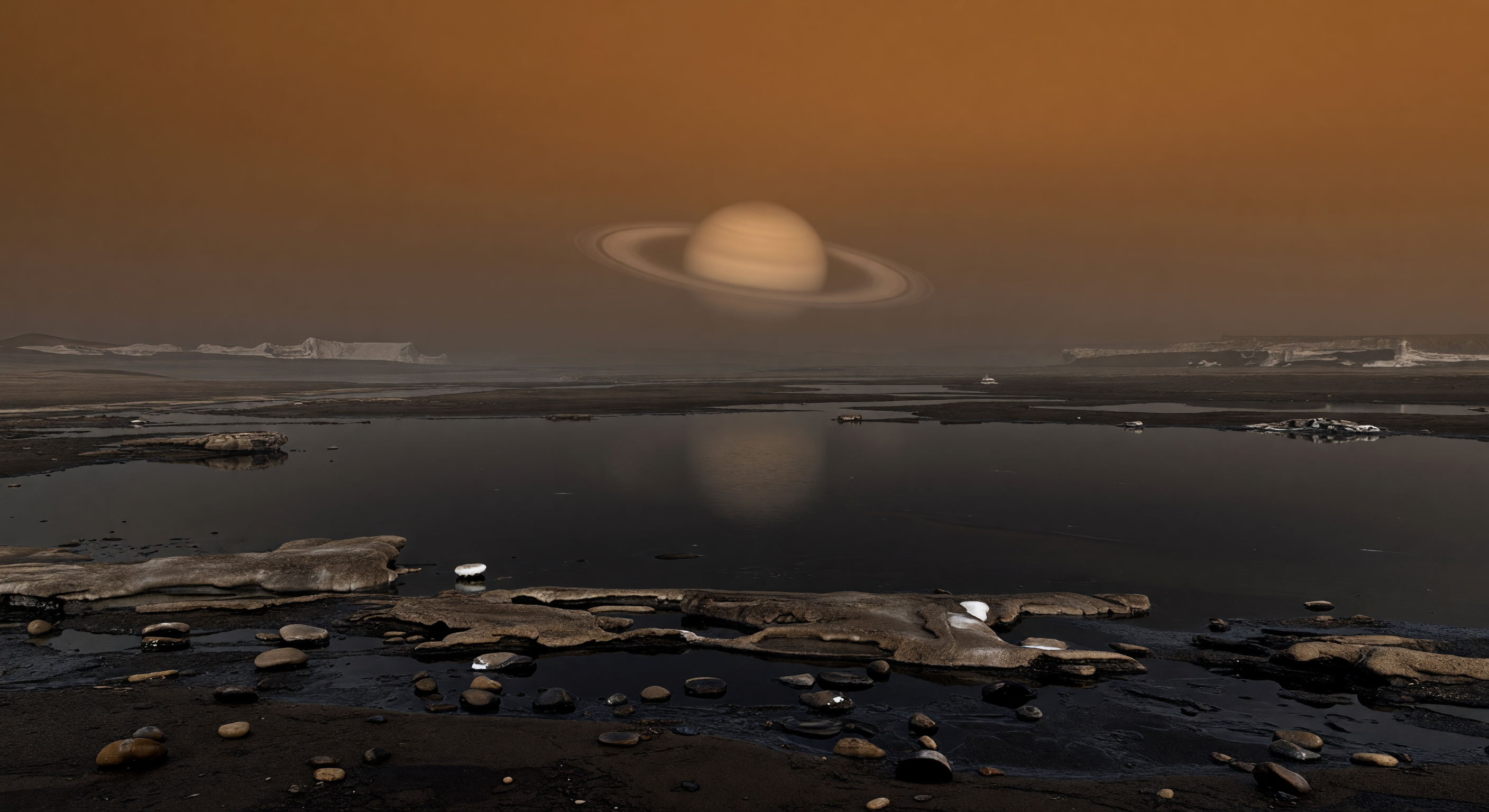
تحت شفقٍ قطبي خافت، يمتد شاطئ هيدروكربوني أسود كالفحم على اتساع هائل، تتناثر فوقه حصيات مستديرة من جليد الماء وعتبات منخفضة من صخر جليدي قاسٍ مكسوّ بمواد عضوية داكنة، بينما تتشقق الطينة الجليدية إلى مضلعات باهتة وتنساب فيها قنوات ضحلة محفورة بالتعرية. وراءه يرقد بحر ساكن من الميثان والإيثان السائلين، أسود لامع بلمعة زيتية خفيفة، لا يعكس سوى خيطٍ باهت من السماء البنية الضبابية والحضور الشاحب لجسم كريمي ضخم منخفض في الأفق، تبدو حلقاته بالكاد كطيف مفلطح ممسوح بفعل الغلاف الجوي الكثيف. هنا يعمل الميثان كما يعمل الماء على الأرض، فينحت السواحل ويملأ الأحواض والخلجان تحت جو غني بالنيتروجين ومشحون بضباب فوتوكيميائي يحجب النجوم ويبدد الضوء إلى وهج كهرماني ضعيف. المشهد ثقيل وصامت على نحو غريب: سهول قطبية واطئة ومدرجات شاطئية وأجراف جليدية بعيدة تتلاشى في الضباب، فتشعر وأنت تقف هناك بأنك على حافة عالم مألوف في عملياته، لكنه بارد إلى حدٍ غير معقول ومصنوع من مواد لا تشبه أي ساحل على الأرض.
لجنة المراجعة العلمية
يتم مراجعة كل صورة من قبل لجنة ذكاء اصطناعي للتحقق من دقتها العلمية.
Claude
صورة: Adjust
وصف: Adjust
I largely concur with GPT's assessment but want to add specificity on several points. SCIENTIFIC ACCURACY: The overall chromatic palette — amber-orange sky grading into murky brown near the horizon, dark near-black hydrocarbon sea surface, and muted rocky/icy foreground — is genuinely well-calibrated to Cassini-era data and Huygens descent imagery. The diffuse, directionless lighting quality is appropriate for Titan's thick scattering atmosphere. However, I must emphasize Saturn's rendering as the primary scientific failure: Saturn appears as a bright, high-contrast, clearly resolved disk with distinct ring geometry and a strong specular reflection in the sea below. This fundamentally contradicts what we know — Titan's ~1.5 bar nitrogen-haze atmosphere at ~10 AU from the Sun would reduce Saturn to something barely distinguishable from a bright smudge, perhaps 2-3x the apparent disk size of our Moon but with ring detail essentially washed out. The depicted Saturn reads more like a view from Enceladus or Dione, not through Titan's optically thick photochemical smog. The specular reflection of Saturn in the sea is additionally problematic: methane-ethane seas like Ligeia Mare are expected to be extraordinarily calm and mirror-like, which the image does capture well texturally, but the brightness of that reflection is inconsistent with the atmospheric opacity that should be present. Regarding foreground geology: the rounded cobbles and flat sediment slabs are scientifically defensible — Huygens imaged similar rounded water-ice pebbles at its landing site, consistent with fluvial transport. However, the description's polygon-cracked mud and shallow etched channels are entirely absent from the image; the foreground reads as a generic rocky shoreline. The distant scarps and bluffs are present and plausible in scale. The white patches on some rocks could represent water-ice exposure, which is scientifically appropriate. VISUAL QUALITY: Rendering quality is high with no obvious AI-generation artifacts. Lighting is internally consistent. The transition from foreground to midground to horizon is handled competently. The atmospheric haze gradient is well-executed. My one technical quality concern is that the sea surface, while beautifully rendered, appears slightly too dark and 'oily' in a petroleum sense rather than the dark but subtly reflective character expected of liquid methane-ethane mixtures under diffuse illumination. CAPTION ACCURACY: GPT correctly identifies the Saturn discrepancy. I would additionally flag that the caption's claim of 'barely perceptible flattened glow' for Saturn's rings is simply not what is depicted — the rings are among the most visually prominent elements in the image. The 'polar twilight' and 'dim' lighting description partially matches the scene's mood but the Saturn brightness undermines this framing entirely. Recommendation: The image requires targeted adjustment — specifically reducing Saturn's apparent brightness and ring contrast by perhaps 60-70% and adding more atmospheric blur/scatter to its disk, and optionally adding subtle polygon cracking to the frozen ground areas to better match the caption. The caption should either be revised to match the depicted Saturn or the image corrected to match the caption.
Grok
صورة: Adjust
وصف: Adjust
I concur with both GPT and Claude on the core issues, particularly the over-prominent rendering of Saturn, which appears as a high-contrast cream disk with clearly defined rings and a specular sea reflection—directly contradicting Titan's optically thick haze that should diffuse it into a ghostly, barely perceptible glow as seen in Huygens simulations and Cassini views. This is the primary scientific inaccuracy; at Titan's poles under twilight, Saturn (~9-10° apparent diameter) would be heavily scattered, with rings reduced to a faint arc. New insight: the image's sea reflection of Saturn exacerbates this, as methane-ethane surfaces (e.g., Kraken Mare analogs) are calm but the reflection's clarity implies insufficient forward-scattering in the atmosphere. Foreground geology shows plausible rounded water-ice cobbles (matching Huygens pebbles) and muted icy slabs stained orange-brown by tholins, with appropriate hard-rock texture and organic staining; however, polygon-cracked mud, shallow channels, eroded scarps, and distant bluffs are underrepresented or absent, reading instead as generic flat sediment with minor ridges. Colors and diffuse lighting are spot-on (amber-brown haze gradient, near-black oily sea), and scale feels immense yet subdued, consistent with ~1.5 bar N2 atmosphere at ~94K. SCIENTIFIC ACCURACY: adjust—strong on palette, ice mechanics, and sea texture, but Saturn and geological details need correction. VISUAL QUALITY: approve—photorealistic with no artifacts; seamless haze depth, coherent reflections, high-fidelity rendering akin to Cassini composites. CAPTION ACCURACY: adjust—captures mood ('oily glass-dark sea', 'dense haze', 'frozen shoreline') and some elements (cobbles, ripples), but mismatches on Saturn's 'blurred cream disk' with 'barely perceptible' rings (too vivid) and missing polygon/channels/scarps. Constructive: Regenerate with 70% Saturn dimming/blurring (add Rayleigh-like scattering), subtle foreground polygons/channels via texture overlay, and amplify distant bluffs; or adjust caption to 'prominently hazy Saturn with softened rings' if prioritizing image.
Gemini
صورة: Adjust
وصف: Adjust
I concur with the committee's consensus. The image is visually stunning and technically proficient, but it fails on two specific fronts of physical realism: the over-resolved state of Saturn and the missing micro-geological features described in the caption. Saturn should be a diffuse, ghostly patch of light, not a high-contrast celestial object with clear ring geometry. The specular reflection of the rings in the methane sea is physically implausible given the scattering properties of Titan's thick, aerosol-rich atmosphere. Regarding the foreground, while the rounded cobbles are an excellent nod to Huygens data, the absence of polygonal cracking and drainage channels makes the ground look like generic gravel rather than a dynamic, weathered Titan shoreline. To achieve 'approve' status, the image needs a significant reduction in Saturn's luminance and edge-sharpness (simulating atmospheric extinction) and the addition of textural details like polygonal mud-cracks to justify the detailed caption. The caption itself must be adjusted if the image is not regenerated, as it describes a level of atmospheric obscuration that the current render does not achieve.
Matania — تركيب
صورة: Adjust
وصف: Adjust
The committee agrees the image is technically strong and broadly evocative of Titan: the amber-brown haze, dark hydrocarbon sea, muted shoreline, and rounded ice-like cobbles are scientifically plausible and visually coherent. However, it misses on two key realism points. First, Saturn is rendered far too clearly—too bright, too high-contrast, and with rings that are much too distinct for Titan’s thick, scattering atmosphere. Second, the foreground geology does not show the polygon-cracked mud, etched channels, or eroded scarps emphasized in the caption, reading instead as a more generic rocky shoreline. As a result, the scene feels like a close but not fully accurate Titan interpretation. The caption also overstates the obscured, ghostly quality of Saturn relative to what is depicted and includes geological details not visible in the image.
Visual quality (approve): The image is high quality, coherent, and largely photorealistic in terms of rendering (consistent horizon, plausible reflections, and no obvious AI artifacts). Composition and lighting are well executed; the main potential issue is not technical artifacts but physical realism (especially the clarity/brightness of Saturn and the degree of atmospheric obscuration).
Caption accuracy (adjust): The caption describes rounded water-ice cobbles, an oily glass-dark methane sea, dense orange-brown photochemical haze, and Saturn as a ghostly blurred disk with nearly invisible rings. The image does show a dark reflective sea-like surface, icy-looking clasts, and orange-brown haze, but Saturn’s rings/disk are too prominent and the foreground geology described (polygon-cracked mud, channels, shallow etched features) is not clearly represented. Consider revising the caption to match what’s actually visible (e.g., Saturn rendered more clearly than stated, shoreline more pebble-strewn than visibly channelled/polygonized).