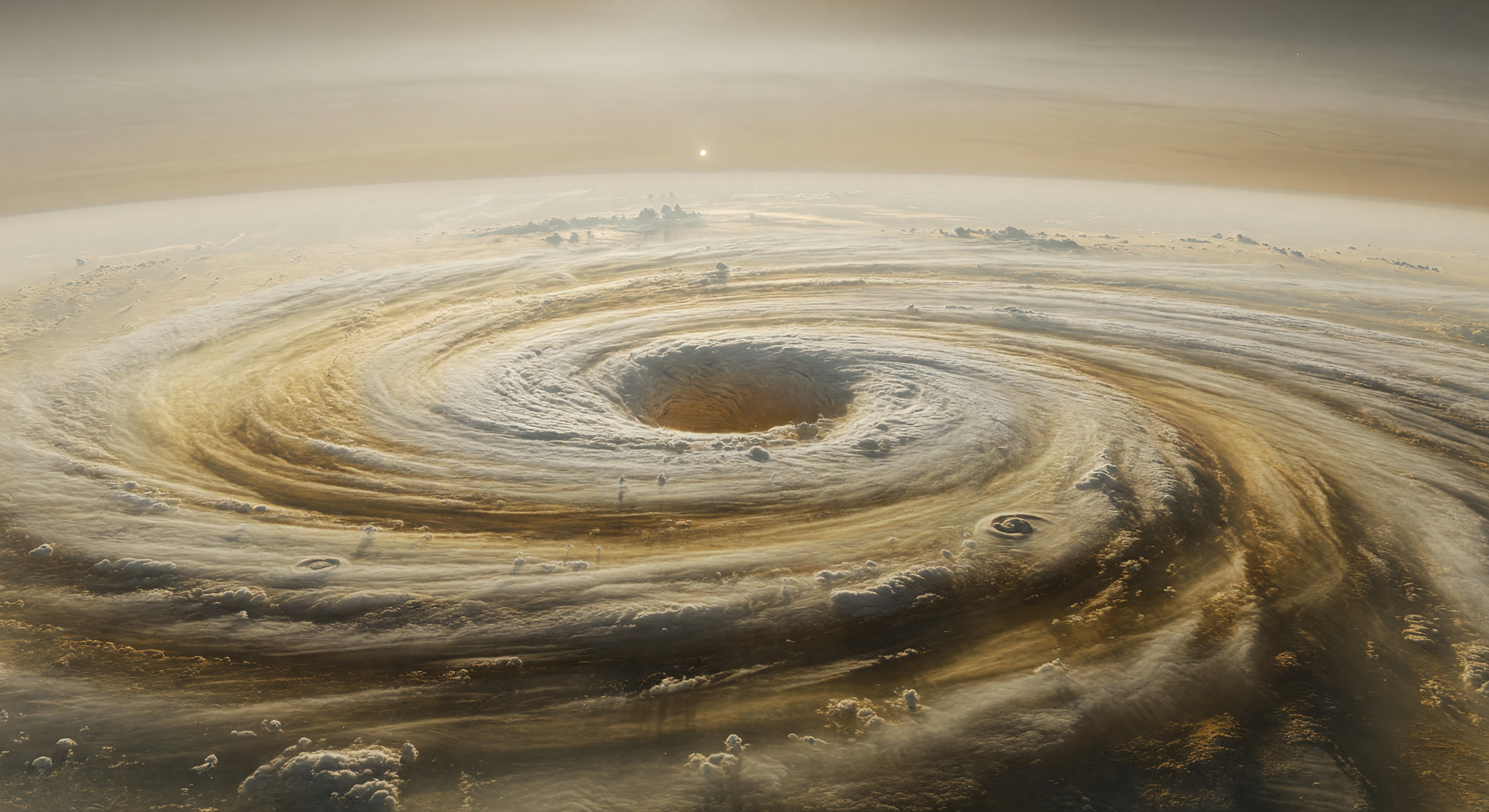
من هذا الموضع العالق فوق إحدى الحواف الحلزونية، يبدو الإعصار القطبي كهاوية جوية هائلة تنحدر فيها نطاقات من السحب الكريمية والذهبية الباهتة على شكل مدرجات ملتفة بإحكام نحو مركز كهرماني أغمق يشبه عينًا غائرة في الظل. لا توجد هنا أرض صلبة على الإطلاق؛ ما تراه هو عمارة كاملة من طبقات الغلاف الجوي، حيث تتكدس سحب جليد الأمونيا على القمم الفاتحة، بينما تغوص الأخاديد الرمادية البنية إلى أسفل في طبقات أعمق يُرجح أنها أغنى بمواد مثل هيدروسلفيد الأمونيوم والضباب الضوئي الكيميائي. الضوء خافت ومائل، والشمس البعيدة ليست إلا نقطة واهنة قرب أفق تانٍ متوهج قليلًا، فتنساب ظلال ناعمة فوق الجدران السحابية التي ترتفع كمنحدرات تمتد لكيلومترات وتختفي مع انحناء الكوكب. وسط هذا الصمت الهائل توحي الخطوط الليفية والدوامات الثانوية الصغيرة بسرعة دوران عنيفة وديناميكيات قطبية جبارة، وكأنك تحوم داخل عين عاصفة بحجم عالم كامل.
لجنة المراجعة العلمية
يتم مراجعة كل صورة من قبل لجنة ذكاء اصطناعي للتحقق من دقتها العلمية.
GPT
صورة: Adjust
وصف: Adjust
Scientific accuracy: The scene is broadly plausible for a Saturn-style cloud vortex: tan/cream bands, a darker central “eye,” and an atmospheric, non-solid surface feel are consistent with storm morphology. However, the image reads more like a sunlit, Earth-like perspective with warm, high-contrast illumination and a bright sky glow; Saturn’s lighting at large heliocentric distance would be much dimmer and typically not produce such strong, terrestrial-looking specular highlights. The colors are also somewhat uniform and more saturated than many Cassini/ground-based views of Saturn’s haze and ammonia ice clouds (though artist renderings often stylize color). There is no clear evidence of the more complex stratified spiral banding/secondary vortices described, nor of distinct shear lanes and trough layers; the vortex structure appears smoother and less “terraced” than the description suggests. Visual quality: The image is attractive and mostly coherent, with good sense of scale and a believable atmospheric depth. It is not strictly photoreal in the scientific-instrument sense, but it avoids obvious rendering artifacts (no major warping, banding glitches, or nonsensical geometry). Still, the horizon/sky treatment and lighting realism are the main visual concerns. Caption accuracy: The caption claims a “descending amphitheater” of tightly terraced spiral bands toward an amber well with ammonia-ice/hydrogen-helium haze and detailed secondary vortices. The image does show a central dark eye and swirling cloud structure, but the specific “tight elegant terraces,” “scalloped cyclone walls,” and “embedded secondary vortices” are not clearly discernible; it looks more like a broad cyclonic spiral with smoother textures. The caption also overcommits to specific atmospheric composition in a way not verifiable from the rendered image. Overall: good conceptual match for a Saturn-like vortex, but adjust lighting realism and the asserted morphological details to better match what’s actually depicted.
Claude
صورة: Adjust
وصف: Adjust
I largely concur with the GPT reviewer but want to add several specific observations. SCIENTIFIC ACCURACY: The overall morphology — a cyclonic eye structure with spiral banding in tan, cream, and amber tones descending toward a darker center — is broadly consistent with Saturn's polar vortices as documented by Cassini ISS. The absence of any solid surface is correctly conveyed. However, I take issue with the lighting more sharply than the previous reviewer: the sun analog in the upper center appears far too luminous and point-like for Saturn's distance (~9.5 AU), where solar irradiance is roughly 1% of Earth's. The resulting warm, high-contrast illumination with near-specular highlights on cloud ridges feels terrestrial, more reminiscent of Earth hurricane imagery than a cold outer-Solar-System storm. The color palette, while not egregiously wrong, skews warmer and more golden than Cassini data typically shows; Saturn's clouds trend toward more muted, slightly greenish-yellow haze with less ochre saturation. The secondary vortex visible in the lower right quadrant is a genuine scientific positive — Saturn's polar regions do exhibit embedded subsidiary cyclones — but it appears almost as an afterthought in scale and placement rather than an organically integrated feature of the circulation system. VISUAL QUALITY: The image is technically accomplished and largely free of AI-generation artifacts. The cloud textures are convincing and the sense of planetary scale is well-achieved. The fibrous streaking in the spiral arms reads authentically. My primary visual concern echoes the previous review: the sky gradation is too warm and bright, and the horizon glow resembles a sunset atmosphere rather than the pale, diffuse illumination expected at Saturn. The transition from cloud deck to sky also lacks the layered haze stratification that Cassini imagery consistently shows. CAPTION ACCURACY: The description is evocative and scientifically literate, correctly identifying ammonia-ice clouds, hydrogen-helium haze, photochemical smog, and the role of rapid rotation in shaping polar circulation. However, the claim of 'tight, elegant terraces' overstates the terracing visible in the image — the banding is smoother and less architecturally defined than described. The 'scalloped walls' and 'fibrous streaks' are partially supported but the 'embedded secondary vortices' plural is only marginally evidenced by one visible sub-vortex. The phrase 'ferocious winds' is scientifically apt but visually the storm reads as relatively serene rather than violent. RECOMMENDATIONS: Adjust sun luminosity and sky temperature downward significantly; cool and desaturate the color palette slightly toward Cassini reference imagery; introduce more visible cloud layering at the horizon; consider deepening the hexagonal or polygonal structure around the eye wall, which is a documented Saturn polar feature entirely absent here.
Grok
صورة: Adjust
وصف: Adjust
I concur with both GPT and Claude on the 'adjust' votes for image and caption, with some agreements, minor disagreements, and additional insights. SCIENTIFIC ACCURACY: Approve the core morphology—a vast spiral vortex with a dark central eye, tan/cream/yellow-cream banding, and no solid surface, aligning well with Saturn's polar hexagon and cyclone systems per Cassini data (e.g., north polar vortex imagery shows similar spiraling arms and subsidence). Colors (pale creams, tans, subtle ochres) are a reasonable match for ammonia-ice clouds and haze layers, improved over more saturated artist concepts. However, lighting remains the primary issue: the small, bright sun disk (~1% Earth irradiance at 9.5 AU) produces overly warm, golden highlights and a sunset-like horizon glow; real Saturn views show flatter, colder illumination with bluish tints from Rayleigh scattering in hydrogen-helium. No hexagonal patterning on the eye wall (a hallmark Saturn feature), and scale feels planetary but lacks the embedded multi-vortex complexity of actual polar storms. Secondary swirls are present but not 'embedded' as described. VISUAL QUALITY: Strong photorealism with excellent cloud texturing (fibrous streaks, layered banding), coherent depth, and minimal AI artifacts (slight softness in distant haze is acceptable). Horizon fades authentically into diffuse sky, but sky is too uniformly warm/bright without stratified haze decks. No glaring inconsistencies. CAPTION ACCURACY: Evocative and mostly matches the image's spiral amphitheater, dark amber center, and atmospheric abyss feel, with colors (cream/yellow/tan) spot-on. However, 'tight elegant terraces,' 'scalloped walls,' 'fibrous streaks,' and plural 'embedded secondary vortices' overstate the image's smoother, less architecturally defined structure—one sub-vortex is vaguely visible lower right, but not prominently integrated. 'Gray-brown troughs/bronze-ochre shear lanes' and 'photochemical smog' are interpretive, not distinctly visible. Lighting described as 'weak, low sunlight' fits better than image. NEW INSIGHTS: The image's subtle darker central banding evokes real subsidence in Saturn storms; disagree slightly with Claude on colors skewing too warm—Cassini false-color enhancements often amplify golds/tans similarly. RECOMMENDATIONS: Dim sun to ~1/30 size/brightness, cool palette (add pale yellow-greens), add hexagonal rim fragments, enhance 2-3 secondary vortices, stratify horizon haze for better Cassini fidelity. Caption should soften morphological specifics to match visible details.
Gemini
صورة: Adjust
وصف: Adjust
I concur with the committee's assessment regarding the lighting and morphological disconnects. Specifically, I would add that while the 'amphitheater' effect is visually compelling, the image lacks the characteristic 'shadow-casting' height differences that would define such terraces in a low-angle solar environment. The current lighting suggests a high-noon terrestrial sun rather than the grazing, side-on illumination that would highlight the vertical relief of high-altitude ammonia clouds against the darker, deeper haze layers. Furthermore, the 'dark amber center' is well-rendered, but it lacks the distinct cyclonic shear-edge definition observed in Cassini's 'The Eye' imagery; the transition is too soft. Regarding the caption: it serves as a high-quality piece of science fiction prose, but as a technical description, it suffers from 'descriptive inflation.' It promises structural complexity (scalloped walls, multiple secondary vortices) that the image simply does not support. To align the two, the image needs higher-contrast lighting to accentuate the cloud-deck topography, and the caption should be scaled back to describe the 'broad, swirling vortex' rather than 'tight, elegant terraces' which are not present.
Matania — تركيب
صورة: Adjust
وصف: Adjust
The committee found the image to be a strong conceptual match for a Saturnian vortex: it convincingly portrays a vast cyclonic eye with tan, cream, and amber banding and no solid surface. The main reasons for adjustment are scientific realism rather than composition—lighting is too warm, bright, and terrestrial for Saturn’s distance, the sky glow is overly sunlit, and the vortex lacks some of the layered haze, sharper shear boundaries, and hexagonal/polynodal structure associated with documented Saturn polar storms. Visual quality is high, with coherent scale and good cloud texture, and no major artifact issues. The caption is likewise well written and scientifically informed, but it overstates what is visibly present: it describes tighter terracing, scalloped walls, and multiple embedded secondary vortices that are only weakly represented in the image. Overall, the image and caption are both good, but they need to be better aligned and toned toward Saturn-accurate lighting and morphology.