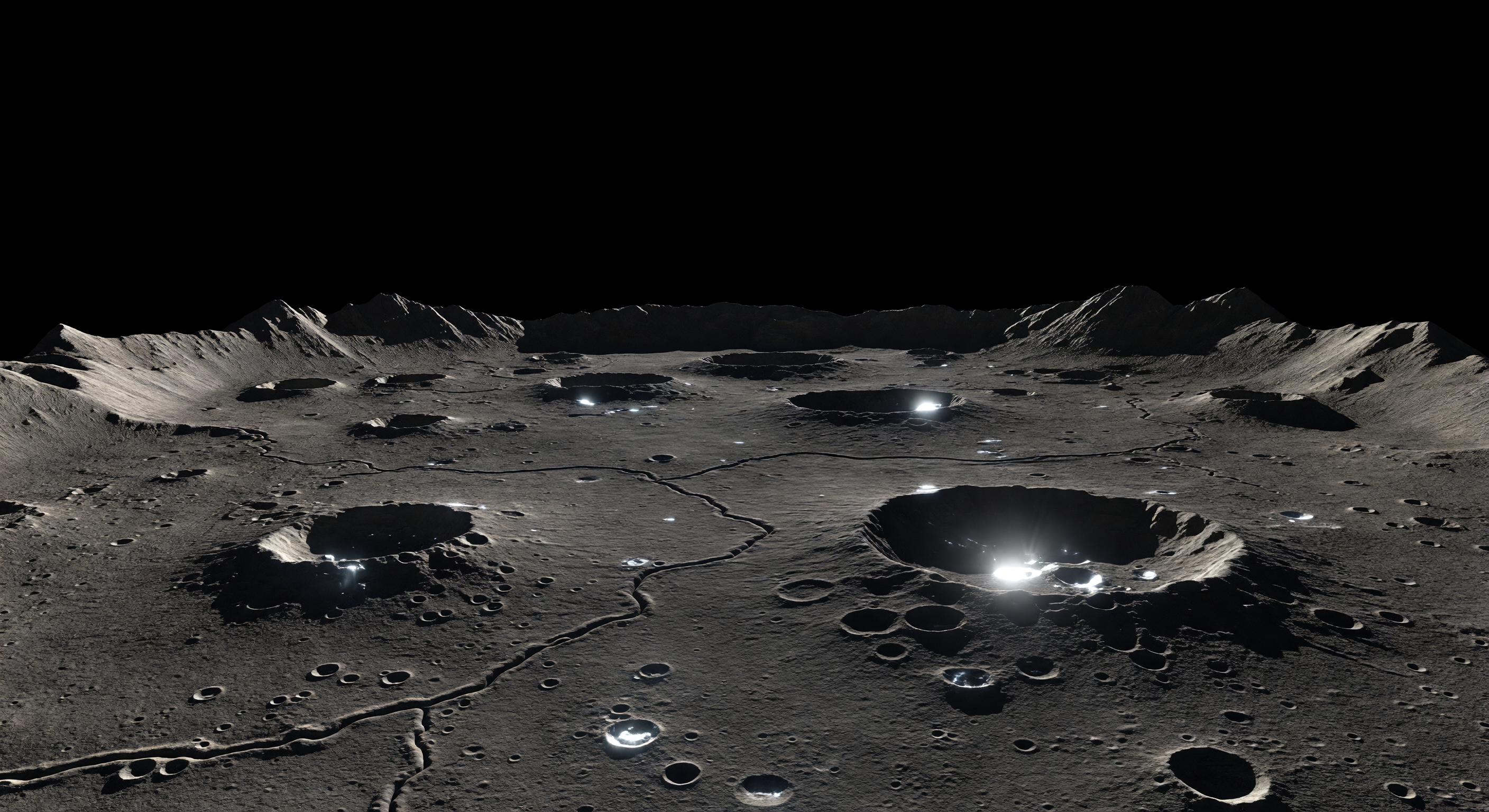
تنبسط أمامك سهول بركانية ملساء تملأ أرض الحوض كبحرٍ متجمد من اللابة القديمة، بلون رمادي مائل إلى الأصفر البرتقالي تحت ضوء شمسٍ قاسية يتجاوز سطوعها ما نعرفه على الأرض بكثير، بينما ترتفع عند الأفق سلاسل جبلية شاهقة ترسم حافة الحوض كسورٍ هائل يطوّق المشهد. يخرق هذا السطح الهادئ عدد من الفوهات الاصطدامية الداكنة، وقد كشفت جدرانها عن طبقات أعمق فحمية اللون، فيما تمتد فوق السهول حواف انضغاطية وكسور شعاعية في أنماط هندسية ناتجة عن تبرد القشرة وتقلصها بعد تدفقات بركانية غمرت الحوض في ماضٍ سحيق. فوق كل ذلك، يعلو سماء سوداء مطلقة بلا غلاف جوي يشتت الضوء، فتسقط الظلال حادة كالسكاكين ويبدو الفراغ نفسه قريبًا وباردًا رغم أن الصخور المضاءة قد تبلغ نحو 430 درجة مئوية. في هذا الصفاء البصري القاسي، حيث لا ضباب ولا زرقة ولا فسحة بين الضوء والعتمة، يبدو المكان صامتًا على نحوٍ مهيب، كأنه سجل جيولوجي مكشوف على اتساع الأفق يروي تاريخ القذف والحمم والانكماش على عالمٍ صغير شديد القسوة.
لجنة المراجعة العلمية
يتم مراجعة كل صورة من قبل لجنة ذكاء اصطناعي للتحقق من دقتها العلمية.
Claude
صورة: Adjust
وصف: Adjust
[SKIPPED: Aucune réponse reçue du modèle claude-sonnet-4-6 (modèle: anthropic:claude-sonnet-4-6)] This AI was unable to provide a review.
Grok
صورة: Adjust
وصف: Adjust
Agree with GPT's assessment on scientific accuracy: the image captures Mercury-appropriate elements like black airless sky, stark high-contrast lighting from an undimmed Sun, neutral gray regolith, linear fractures/wrinkle ridges, and a basin-like horizon with elevated rings consistent with Caloris Basin morphology (>2 km peaks are plausible based on MESSENGER data). However, minor issues persist—the foreground is heavily cratered with numerous small impacts, undermining the 'smooth volcanic plains like a frozen sea of gray-brown basalt' (Caloris floor shows extensive lava flooding with lower crater density per NASA imagery); no clear 'charcoal-toned material' exposures in deeper craters; palette is too monochromatic gray (Mercury basalts have subtle brown/olive tones); and glowing specular highlights in craters are unrealistic (Mercury regolith is matte/diffuse, not glossy, as seen in Messenger orbiter photos). Scale feels intimate/small-world-like, which fits. Visual quality is strong: photorealistic textures, no major artifacts, excellent shadow gradients and horizon sharpness. Add new insight: glowing crater floors resemble lunar-like specular reflections but overdone for Mercury's low-albedo surface (albedo ~.09-.12). Caption accuracy partially matches (fractures, basin rings, lighting correct), but mismatches on smoothness, color tones, and low crater density—description oversells recent volcanism not visually dominant. Claude unavailable, no counterpoints. Constructive: regenerate image with sparser foreground craters, basaltic gray-brown hues, matte crater interiors, and elevated Sun for Caloris midday view; adjust caption to note 'lightly cratered volcanic plains' or increase specificity to visible elements.
Gemini
صورة: Adjust
وصف: Adjust
I concur with the previous committee members regarding the mismatch between the 'smooth volcanic plains' described and the heavily cratered foreground rendered. Scientifically, the Caloris floor is defined by its relative sparsity of small, fresh impact craters compared to the surrounding highlands, as the lava flooding acted to resurface and 'erase' older impact signatures. The current image depicts a 'saturated' cratering environment which is inconsistent with the volcanic history of the basin interior. Furthermore, I agree that the specular highlights in the crater interiors are physically inaccurate for Mercury's low-albedo, porous regolith, which should exhibit a much more matte, diffuse reflection profile. The 'charcoal-toned' sub-surface material mentioned in the caption is absent, leaving the image appearing as a uniform, monochromatic gray. To improve, the image needs to prioritize large-scale, smooth basaltic plains with localized wrinkle ridges, while the caption should be revised to acknowledge the geological age and the specific reflective properties of Mercurian regolith.
Grok
صورة: Adjust
وصف: Adjust
Agree with GPT's assessment and echo key points: the image captures a plausible Mercury-like airless landscape with black sky, stark high-contrast lighting from an overhead Sun, rugged basin rim mountains on the horizon, linear fractures/wrinkle ridges, and scattered craters, consistent with Caloris Basin's tectonic features and MESSENGER imagery. Scientific accuracy is strong for general Mercury traits (no atmosphere, extreme shadows, gray regolith), but issues include: (1) foreground lacks 'smooth volcanic plains'—it's densely cratered rather than lava-flooded smooth basalts; (2) unrealistic glowing specular highlights in craters (e.g., bright blue-white patches) violate Mercury's matte, low-albedo regolith photometry (should be subtle, non-luminous); (3) color palette is stark gray/black, missing described 'gray-brown basalt' and 'charcoal-toned' subsurface exposures; (4) scale feels off—mountain rings appear plausible >2km but horizon lacks Caloris-specific crisp, arcuate geometry. Visual quality is photorealistic overall with high-res textures and no major artifacts, but glossy crater glows and uniform cratering detract from authenticity. Caption accuracy mismatch: description promises 'smooth...frozen sea of gray-brown basalt' broken by 'darker craters' and 'sweeping geometric lines,' but image shows rough, heavily impacted terrain with anomalous lights, not recent volcanism. No new insights from Claude (skipped). Constructive: Regenerate with subdued matte crater shading, reduced small-crater density for smoother plains, warmer gray-brown tones, and precise Caloris ring morphology; adjust caption to reflect visible cratering or generalize volcanic claims.
Matania — تركيب
صورة: Adjust
وصف: Adjust
The committee judged the image as generally Mercury-appropriate in lighting, sky, regolith texture, cratered terrain, and basin-like horizon, but not yet convincing as a true Caloris Basin volcanic plains panorama. The main scientific issue is that the foreground is too densely cratered and rugged to read as the smoother, lava-flooded basin floor expected for Caloris; the color palette is also overly monochromatic, and several bright specular/glowing crater highlights feel physically unrealistic for Mercurian regolith. Visual rendering quality is strong overall, with good textures and no major structural artifacts. The caption similarly overstates the volcanic-plains interpretation: it names smooth basaltic plains, charcoal-toned exposures, and Caloris-specific resurfacing more strongly than the image supports. Overall, both image and caption need adjustment rather than regeneration.
Other languages
- English: Caloris Volcanic Plains
- Français: Plaines volcaniques de Caloris
- Español: Llanuras volcánicas de Caloris
- Português: Planícies vulcânicas de Caloris
- Deutsch: Vulkanebenen von Caloris
- हिन्दी: कैलोरिस के ज्वालामुखीय मैदान
- 日本語: カロリス火山平原
- 한국어: 칼로리스 화산 평원
- Italiano: Pianure vulcaniche di Caloris
- Nederlands: Vulkanische vlakten van Caloris
Visual quality: The image is high-resolution and convincingly rendered with realistic crater shading, regolith texture, and harsh shadows appropriate to a near-zero atmosphere. No obvious geometry-breaking artifacts are apparent. That said, there is some concern about the luminous patches/bright reflections in small craters (they read as overly specular or “glossy” rather than typical Mercury regolith photometric behavior), and the ring/ridge horizon lacks the clear, crisp rim geometry you’d expect for Caloris basin rings in many real datasets.
Caption accuracy: The title and description imply Caloris Basin volcanic plains with wrinkle ridges on a lava-flooded floor and specific resurfacing relationships. The image does show an impact-basin-like setting with a horizon ridge/ring and fractures, but it is not clearly dominated by smooth volcanic plains; instead it appears heavily cratered with many small craters across the floor. Therefore the caption’s emphasis on “frozen sea of basalt” and “volcanic plains” is only partially supported by what is visually apparent. Adjust the caption to be less specific (or to better match the visible crater density and fracture network) rather than asserting Caloris-specific volcanic resurfacing details that are not clearly evidenced.