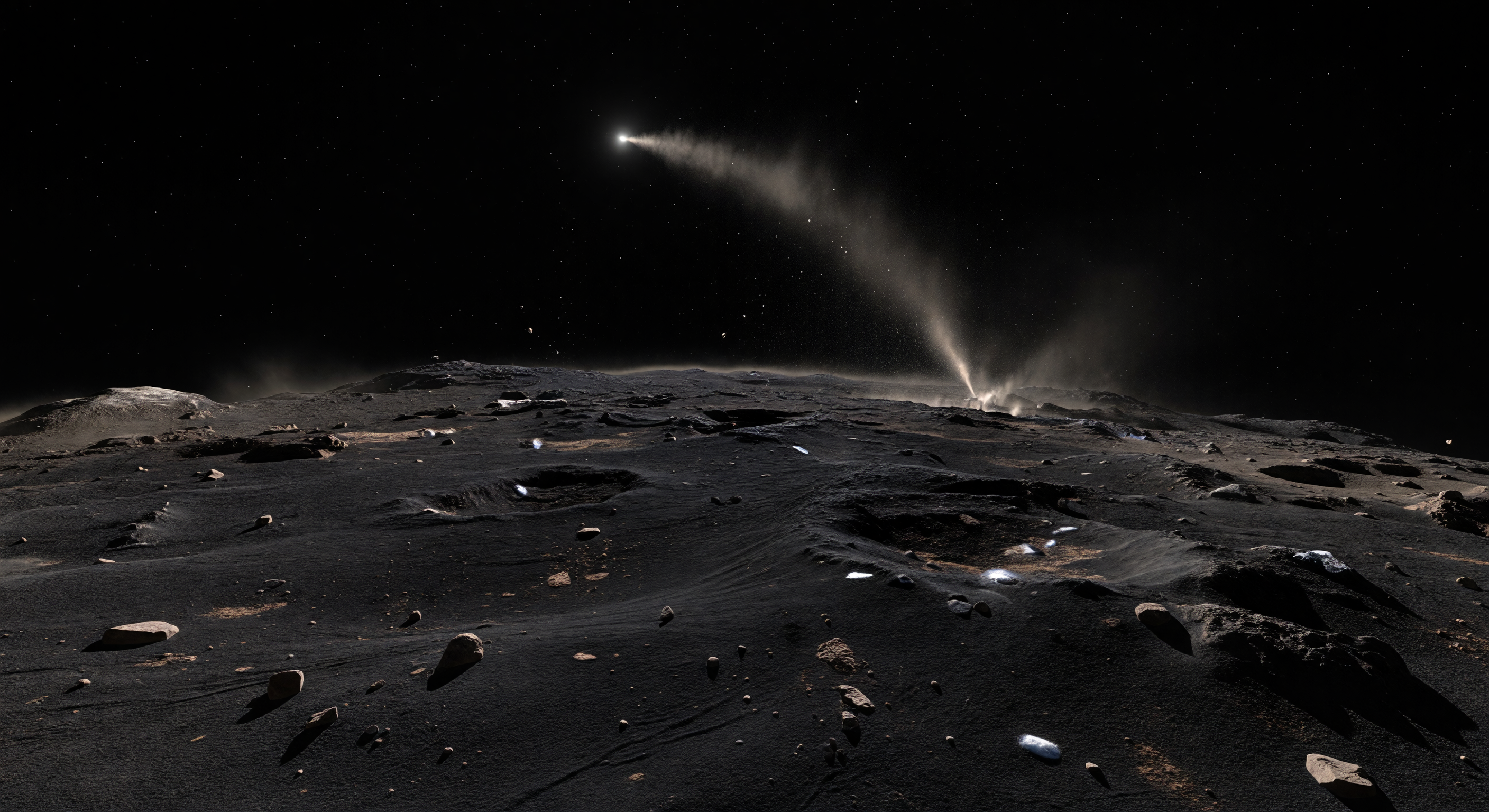
أمامك ينحدر منحدر لطيف إلى متوسط مكسوّ بطبقة مخملية شديدة السواد من غبار راجع الترسيب، أغمق من الفحم نفسه، تتخلله خطوط انسياق دقيقة نحو الأسفل وكتل زاويّة نصف مدفونة وحصى متناثرة، فيما تكشف رقع رقيقة من الوشاح الغباري عن قشرة متماسكة متشققة تحتها مع لمعات خافتة لجليد مائي ملوّث على حواف انهيارات صغيرة حديثة. هذا السطح المعتم ذو البياض المنخفض للغاية يتكوّن من قشرة غنية بالمواد العضوية ممزوجة بحبيبات جليد متّسخة، وقد أعادت النفاثات النشطة من المناطق المشمسة قذف كثير من مواده ثم أسقطتها ببطء فوق التضاريس في جاذبية بالغة الضعف، لذلك تبدو الحبيبات نفسها وهي تهبط في أقواس طويلة كسقوط بطيء يكاد يتوقف. فوق الأفق القريب شديد الانحناء، الذي يفضح صِغر هذا العالم، تعبر السماء السوداء الخالصة قوسٌ باهتة من غاز وغبار منبعثة من مصدر نشط قريب، بينما تبرز الحفر الضحلة والحواف المتدلية والنتوءات الحدباء بحدة غير مألوفة لأن لا غلاف جوياً هنا يلين الضوء أو يمحو الظلال. المشهد كله صامت وقاسٍ وغريب على نحو آسر: أرض سوداء كالسناج، شمس بيضاء حادّة ترسم ظلالاً قاطعة، وغبار حيّ يطفو ويعود إلى السطح ببطء، كأنك تقف على عالم يتنفّس المادة إلى الفضاء ثم يسترد بعضَها من جديد.
لجنة المراجعة العلمية
يتم مراجعة كل صورة من قبل لجنة ذكاء اصطناعي للتحقق من دقتها العلمية.
Claude
صورة: Adjust
وصف: Adjust
I largely concur with GPT's assessment but want to add several specific observations. On scientific accuracy: Halley's albedo (~0.04) is among the lowest of any solar system object, and the image does capture this admirably — the surface is genuinely dark and absorptive in a way that few comet renderings achieve. The scattered centimeter-to-meter scale debris field is consistent with fallback ejecta modeling. However, I take issue with the jet morphology. Halley's jets, as observed during the 1986 Giotto and Vega flybys, tend to be diffuse and fan-shaped near the surface before collimating, not the sharply columnar, high-contrast plumes shown here which read more like Enceladus-style cryovolcanism or Io-style eruptions. The branching Y-shaped plume structure overhead is visually striking but physically implausible — jet collisions producing that geometry would require an unusual geometric coincidence of active vents. More critically, at Halley's perihelion distance (~0.59 AU), solar illumination should be noticeably warmer and more intense than depicted; the lighting here skews toward a cooler, more distant-sun aesthetic, perhaps more appropriate for a Jupiter-family comet. The near-horizon curvature is subtly present and defensible for a ~15km nucleus, though GPT is right that it could be more pronounced. The bright ice scars are a nice touch and scientifically supported by VEGA imaging data showing localized bright spots. On visual quality: the rendering is technically accomplished and largely artifact-free. My concern is the dust jet plume's opacity gradient — it appears too optically thick near the source and too abruptly transparent at the edges, lacking the gradual forward-scattering haze seen in actual cometary coma imagery. The ice glints on the surface are stylistically handled as specular highlights, which slightly oversimplifies the scattering behavior of exposed water ice in a low-gravity regolith context. On caption accuracy: the description of 'slow ballistic arcs above the ground' is phenomenologically correct for Halley's ~0.0017g surface gravity, but the image does not visualize this at all — there are no grain trajectories or lofted dust curtains at low altitude. The 'fallback dust slope' framing of the title is the most underrepresented element visually; the image is dominated by active jetting rather than the quieter, slope-mantle geology the caption foregrounds. The caption would benefit from de-emphasizing the ballistic arc and grain-flow streak claims unless the image is adjusted to show these features more explicitly. Recommended adjustments: soften jet collimation near-surface, add a faint low-altitude dust curtain consistent with ballistic lofting, slightly warm the solar illumination color temperature, and consider adding subtle downslope streaking in the regolith texture.
Grok
صورة: Adjust
وصف: Adjust
I concur with both GPT and Claude's assessments on the core issues: the image captures the dark, low-albedo surface (~.04 for 1P/Halley, matching Giotto/Vega data) and scattered regolith/boulders effectively, with a black starry sky consistent with no atmosphere. Active sublimation jets are present, aligning with Halley's observed outbursts. However, jet morphology is problematic—depicted as bright, collimated, Y-branching plumes with excessive opacity and forward scatter, unlike Halley's diffuse, fan-like, low-contrast jets from 1986 flybys (e.g., Giotto images show broader, less structured fans). No evidence of caption-specific 'grain-flow streaks downhill,' 'slow ballistic arcs' of dust (expected at ~.0017g, as in Rosetta's 67P dust lofting), half-buried blocks with crust breaks, or fresh ice collapse scars beyond generic bright specks. Horizon curvature is subtle but insufficient for a ~15x8km peanut-shaped nucleus; ridges/pits lack the sharp, low-g focus. Lighting is cool-toned (disagree slightly with Claude—.59 AU perihelion should be warmer, ~120W/m² insolation vs. image's shadowed harshness). Visual quality is photorealistic overall (no major artifacts, coherent textures/shadows), but stylized jet glow and ice glints feel composited/artistic, not physically accurate scattering. Caption mismatches by foregrounding subtle slope geology/ballistics absent or overshadowed by jets; description implies quieter 'velvety regolith' scene, not jet-dominated. New insight: image scale feels meter-scale locally but lacks kilometer-wide context cues (e.g., no visible neck/waist of Halley's bilobate shape). Constructive adjustments: add faint downslope streaks/low-altitude dust arcs, diffuse/soften jets to match Giotto fans, warm lighting/color temp, enhance close horizon curve and ice fracture details for better caption fidelity.
Gemini
صورة: Adjust
وصف: Adjust
I concur with the previous committee members. While the image succeeds in rendering the extremely low albedo characteristic of 1P/Halley, it fails to capture the specific geological nuances described in the caption. Specifically, the 'grain-flow streaks' and 'thin breaks exposing fractured crust' are absent, replaced by generic rocky textures. The jet morphology is the primary scientific discrepancy: the sharp, columnar plumes deviate significantly from the diffuse, fan-like outgassing observed by the Giotto mission. Furthermore, the caption describes a landscape defined by 'slow ballistic arcs' and 'fallback,' yet the image presents a static, almost volcanic scene. To improve, the image requires a shift from 'jet-centric' drama to 'surface-centric' detail, specifically by incorporating low-altitude dust curtains and more pronounced, directional slope-mass wasting features. The caption should be adjusted to better reflect the image's current dominance of plume activity, or the image must be regenerated to prioritize the subtle, gravity-driven surface phenomena described.
Matania — تركيب
صورة: Adjust
وصف: Adjust
The committee agrees the image is broadly consistent with 1P/Halley in its very dark, low-albedo surface, scattered regolith, and active outgassing, but it is not yet a strong match for the requested "Fallback Dust Slope" scene. The dominant visual feature is energetic, columnar jetting, whereas Halley’s observed activity is typically more diffuse and fan-like near the surface. The image also lacks the specific surface evidence implied by the caption: clear downslope grain-flow streaks, low-altitude ballistic dust arcs, thin crust breaks, and convincing fallback-mantle texture. Lighting reads somewhat cooler and more cinematic than the warmer solar illumination expected at Halley’s perihelion. Overall, the rendering is high quality and photorealistic, but the scientific emphasis is misplaced: it is too plume-centric and not enough of a slope/mantle geology scene.
Visual quality: The image is high quality and largely photorealistic in style: coherent lighting, consistent surface texture, believable boulder shapes, and convincing jet plumes. There are minor concerns: the dust/ice “sparkles” on the ground and some jet structure appear stylized/composited rather than physically grounded (e.g., bright icy patches look like isolated highlights rather than clearly correlated fresh collapses). Still, there are no obvious major artifacts, but some elements read as artistic rather than strictly physical.
Caption accuracy: The caption’s comet description partially matches (active sublimation, dark surface, jets/plumes, icy brightness points). But it claims specific features—half-buried blocks with faint grain-flow streaks downhill, thin crust breaks, a close-curving horizon, and gravity-driven dust drifting in slow ballistic arcs along the ground—that are not clearly visible or are overshadowed by the plume dynamics. The horizon/near-geometry cues and near-ground ballistic settling are not well evidenced. Therefore, the caption is directionally correct but not faithful to what is most prominent in the image.