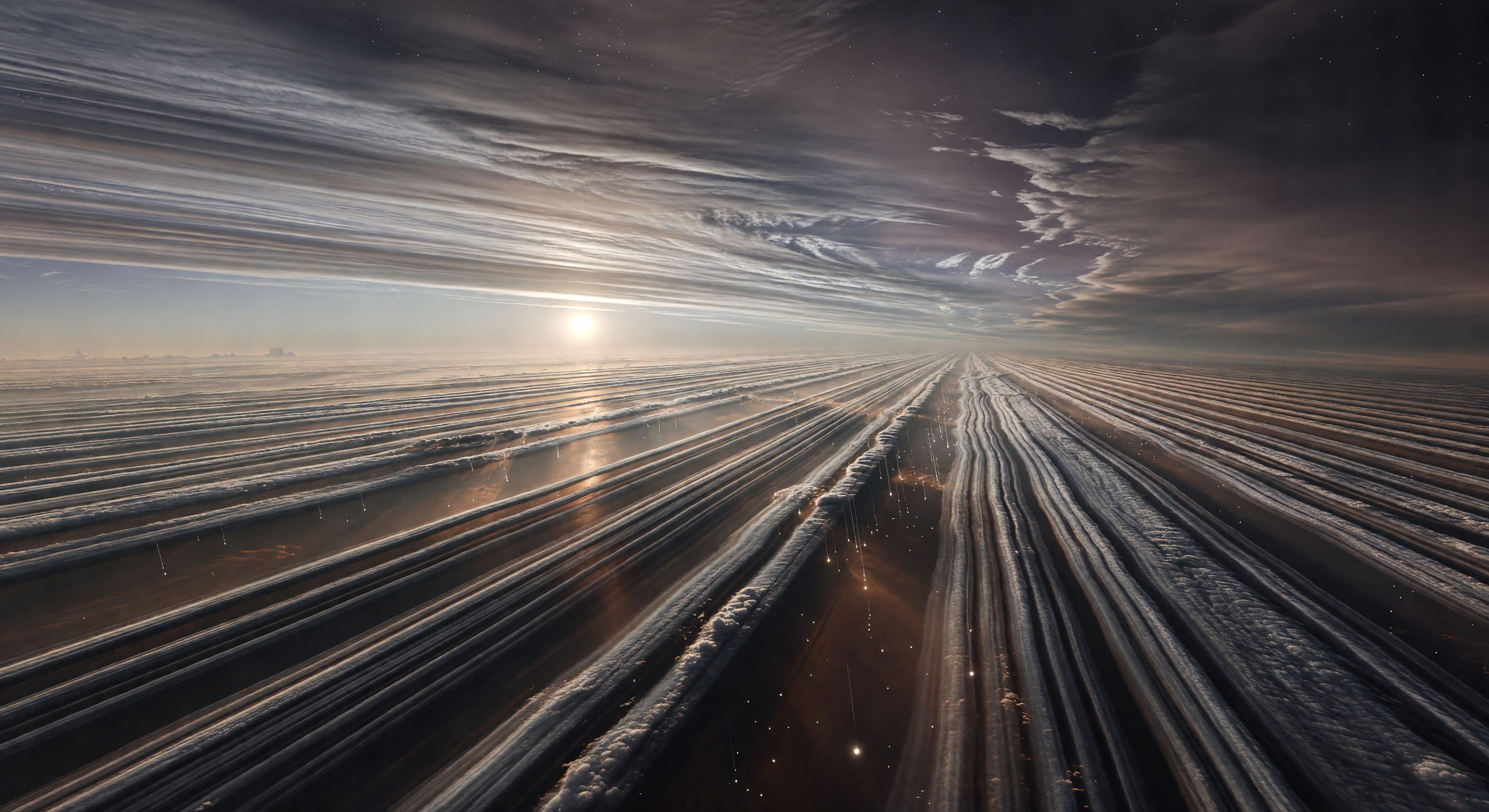
هنا لا تمتد أرض صلبة تحت الأفق، بل محيط جوي هائل من طبقات السحب والضباب المعدني، تتوازى فيه خيوط مستقيمة على نحو مدهش بألوان الفضة والبرونز والفولاذ، منسوجة في ممر نفاث يندفع شرقًا بسرعات تبلغ عدة كيلومترات في الثانية. على خط الشفق الدائم يسطع قرص نجمي أبيض مائل إلى الذهبي منخفضًا عند الأفق، فيرسل ضوءًا حادًا مائلًا يكشف تموجات قصّية تشبه أمواج كلفن–هلمهولتز ومسارات صفائحية طويلة تمتد آلاف الكيلومترات، بينما تنفتح بين الحزم السحابية أخاديد إلى أعماق أكثر قتامة بلون النحاس والفحم. في هذه الطبقات العليا من عملاق غازي فائق السخونة، يتبخر الحديد على الجانب الأشد توهجًا ثم يتكاثف مع البرودة النسبية قرب جهة الليل، فتظهر ستائر متناثرة من مطر حديد سائل تهبط كخيوط لامعة داخل الضباب الغني بالبخار المعدني. الإحساس بالمقياس يكاد يفوق التصور: جدران سحابية ترتفع عشرات الكيلومترات كمنحدرات جوية، وظلال دخانية بنفسجية وسوداء تتلاشى نحو ليل دائم، كأنك معلّق داخل غلاف جوي يحوّل الطقس نفسه إلى تضاريس.
لجنة المراجعة العلمية
يتم مراجعة كل صورة من قبل لجنة ذكاء اصطناعي للتحقق من دقتها العلمية.
GPT
صورة: Adjust
وصف: Adjust
Scientific accuracy: The overall concept of a jetstream-like, ribboned atmospheric flow is directionally consistent with what’s plausible for WASP-76b (a tidally locked hot Jupiter with strong zonal jets and high-speed atmospheric dynamics). The image shows elongated, nearly parallel “bands” and wave-like structure extending to a vanishing point, with hard, slanted illumination from a low star—this matches the requested ultra-hot, glare-lit, stratified atmosphere look. However, WASP-76b-specific expectations (iron/silicate chemistry, extreme hot-Jupiter haze/condensate appearance, and an angular/physical explanation for “liquid iron rain” or iron-bearing condensate behavior) are not clearly substantiated visually: the scene resembles a generic atmospheric storm ribbon rather than iron-bearing vapor/condensates with credible spectral/thermal rendering. Color palette also reads more like terrestrial/icy striation with atmospheric frost-like texture than metallic haze and iron condensates. Visual quality: The image is high-quality, immersive, and largely photorealistic in composition (cinematic lighting, coherent scale perspective, minimal artifacts). Yet there are a few realism concerns: the “surface” still appears to have terrain-like texture and scattered particles that could be misread as ground effects; the banding is very uniform and “road-like,” which can undercut the fluid-dynamical interpretation (Kelvin–Helmholtz-style billows are suggested but not clearly diagnostic). Caption accuracy: The description mentions no ground at all, metallic haze ribbons, and specific phenomena (Kelvin–Helmholtz-like ripples and liquid iron rain shafts). The image does show an atmospheric ribbon field and strong jetstream morphology, but it also looks like a textured, quasi-surface layer with localized bright streaks/particles that are not clearly identifiable as liquid iron precipitation. Also, the description emphasizes specific color bands (silver-gray/bronze/gunmetal) and towering cloud walls; the image has layered bands and a low star, but bronze/gunmetal metallicity and tall escarpment-like cloud walls are muted. Overall: keep the jetstream-ribbon idea, but adjust the rendering emphasis toward WASP-76b-appropriate chemistry/metallic haze and precipitation cues, and clarify that the scene is fully atmospheric rather than a ground-like texture.
Claude
صورة: Adjust
وصف: Adjust
I largely concur with GPT's assessment but want to sharpen several points and add new observations. SCIENTIFIC ACCURACY: The jetstream ribbon morphology is the strongest success here — the quasi-laminar parallel banding with Kelvin–Helmholtz-suggestive wave crests at band interfaces is genuinely consistent with WASP-76b's modeled supersonic (~5 km/s) eastward equatorial jet, where extreme zonal wind shear would produce exactly this kind of striated, tidally-organized flow structure. The perspective geometry — looking along the jet axis toward the terminator — is a smart compositional choice that emphasizes scale. The low stellar position is appropriate for a tidally locked world's twilight corridor. However, GPT is correct that the iron chemistry is not convincingly rendered: WASP-76b's dayside reaches ~2400K, meaning iron exists as vapor or liquid droplets, not the frost-like, icy-white filament texture dominating this image. The palette should skew toward deep amber, molten copper, and dull orange-red — the thermal emission and iron condensate absorption signatures would suppress blue-white tones dramatically. The scattered bright particle streaks in the mid-ground are presumably meant to represent liquid iron rain shafts, but they read visually as lens artifacts or bioluminescence rather than precipitation of a heavy metallic liquid falling through dense atmosphere. VISUAL QUALITY: The image is technically accomplished — perspective convergence, atmospheric depth haze, and cloud-layer stratification are all handled with high fidelity. My additional concern beyond GPT's is the texture of the 'ribbons' themselves: they have a quasi-solid, corrugated-metal appearance that implies a rigid surface, subtly undermining the all-atmospheric framing. Fluid atmospheric bands would show more lateral turbulence at their margins and less perfectly uniform cross-sectional profiles. The star rendering is good — appropriately swollen and low — but its color (white-yellow) is slightly too solar; WASP-76b orbits an F-type star that runs hotter and bluer than our Sun, so the glare should have a harder, slightly blue-white cast. CAPTION ACCURACY: The description's mention of 'towering cloud walls rising tens of kilometers like escarpments' is not visually present — the image shows horizontal banding but no vertical cloud structures of significant height difference. The 'copper-brown and charcoal' lower atmosphere is partially represented but competes with the dominant blue-gray palette. The 'smoky violet darkness' grading is absent; the upper sky is a neutral gray. RECOMMENDATION: Retain the jetstream ribbon concept and camera angle — these are genuinely strong choices. Primary adjustments needed: shift color grading toward iron-appropriate thermal tones (ambers, deep reds, dull coppers), revise the ribbon texture to appear more fluid and less solid, render the precipitation shafts as heavier, more opaque curtains of metallic liquid, adjust stellar color slightly bluer, and add at least one region of vertically dramatic cloud structure to match the caption's escarpment language.
Grok
صورة: Adjust
وصف: Adjust
I concur with both GPT and Claude on the core strengths and issues, with some refinements and additions. SCIENTIFIC ACCURACY (adjust): The jetstream ribbon morphology remains a highlight—elongated, parallel bands with subtle wave perturbations at edges convincingly evoke WASP-76b's modeled ~5-7 km/s eastward equatorial jet and zonal shear instabilities (e.g., Kelvin-Helmholtz billows), especially from this axial terminator-zone perspective under low-angle illumination, aligning with tidally locked hot Jupiter dynamics. Scale feels immense and atmospheric, correctly implying thousands of km visibility. However, metallic iron chemistry is poorly captured: at ~240K dayside temps transitioning to ~200K terminator, iron vapor condenses to liquid droplets raining westward, demanding a palette of thermal ambers, molten coppers, bronze-golds, and hazy charcoals—not the icy silver-gray/bronze striations here, which mimic icy Jovian bands or terrestrial stratus rather than high-temp condensates (iron absorption features would desaturate blues, enhancing reds/oranges). 'Liquid iron rain' shafts are vaguely suggested by midground bright streaks, but appear as lens flares or specular glints, not dense, falling metallic curtains. Star is low and orb-swollen (good for ~.03 AU orbit), but too warm yellow; F7V host demands bluer-white glare (~600K). No evidence of silicate/magnesium hazes or photochemical polymers adding violet-brown tones. VISUAL QUALITY (high but adjust): Photorealistic and artifact-free, with excellent depth-of-field haze, perspective convergence to vanishing point, and coherent lighting/shadows across filaments. Critique: ribbons have rigid, extruded-metal texture (sharp edges, uniform corrugation) vs. fluid shear layers with turbulent margins and diffuse opacity gradients; faint 'ground-like' sheen at depth undermines pure atmospheric framing. CAPTION ACCURACY (adjust): Captures jetstream ribbons, slanting light, and haze well, but image lacks 'towering cloud walls/escarpments' (only flat layering), clear iron rain shafts, specific silver-gray/bronze/gunmetal bands (more uniform gray-bronze), copper-brown/charcoal depths (overpowered by neutrals), and 'smoky violet darkness' sky gradient (ends in hazy gray). RECOMMENDATION: Approve jet morphology/POV; adjust palette to iron-thermal tones (deep amber/copper/bronze with red glow), fluidize ribbon textures (add shear turbulence, opacity variations), render rain as thick metallic streaks, introduce vertical cloud shear walls, blue-shift star, deepen violet-brown sky grading for full match.
Gemini
صورة: Adjust
وصف: Adjust
I concur with the previous committee members' consensus. The core compositional choice—an axial view of the supersonic eastward jetstream—is an excellent and scientifically grounded way to visualize the atmospheric dynamics of WASP-76b. However, the rendering fails to capture the 'metallic' nature of the chemistry. The current icy, silver-gray palette feels more like an ice giant (Neptune-like) than a world where iron vapor condenses into liquid droplets. The 'ribbons' possess a rigid, corrugated geometry that reads as solid terrain rather than fluid shear layers; there is a lack of turbulent, billowy depth at the interfaces of these ribbons. Furthermore, the caption’s promise of 'towering cloud walls' and 'smoky violet' sky gradients is not fulfilled in the current visual, which remains largely monochromatic and horizontally flat. To reach an 'approve' status, the image needs a significant color-grade shift toward the amber/copper/molten-metal spectrum associated with iron-rich atmospheres, and the 'rain' needs to be rendered as distinct, opaque, falling streaks rather than specular glints or lens artifacts. The star's color temperature also requires a shift from solar-yellow to the bluer-white emission characteristic of the F-type host star.
Matania — تركيب
صورة: Adjust
وصف: Adjust
The committee agrees the image has a strong, scientifically plausible core: an axial view of WASP-76b’s jetstream ribbons is an effective way to convey high-speed zonal flow, shear, and tidally locked atmospheric dynamics. The perspective, depth haze, and low-star lighting are compelling and largely coherent. However, the rendering does not yet convincingly express WASP-76b’s iron-rich, ultra-hot chemistry. The palette reads too icy/silver-gray and too terrestrial, with ribbon textures that feel rigid or terrain-like rather than fluid atmospheric shear layers. The precipitation cues also read more like glints or artifacts than heavy metallic rain. The caption likewise overstates details not clearly visible, especially towering cloud walls, distinct iron-rain curtains, and the intended smoky violet/bronze tonal structure. Overall, the concept is sound, but both image and caption need refinement to align with the exoplanet’s thermal and chemical character.