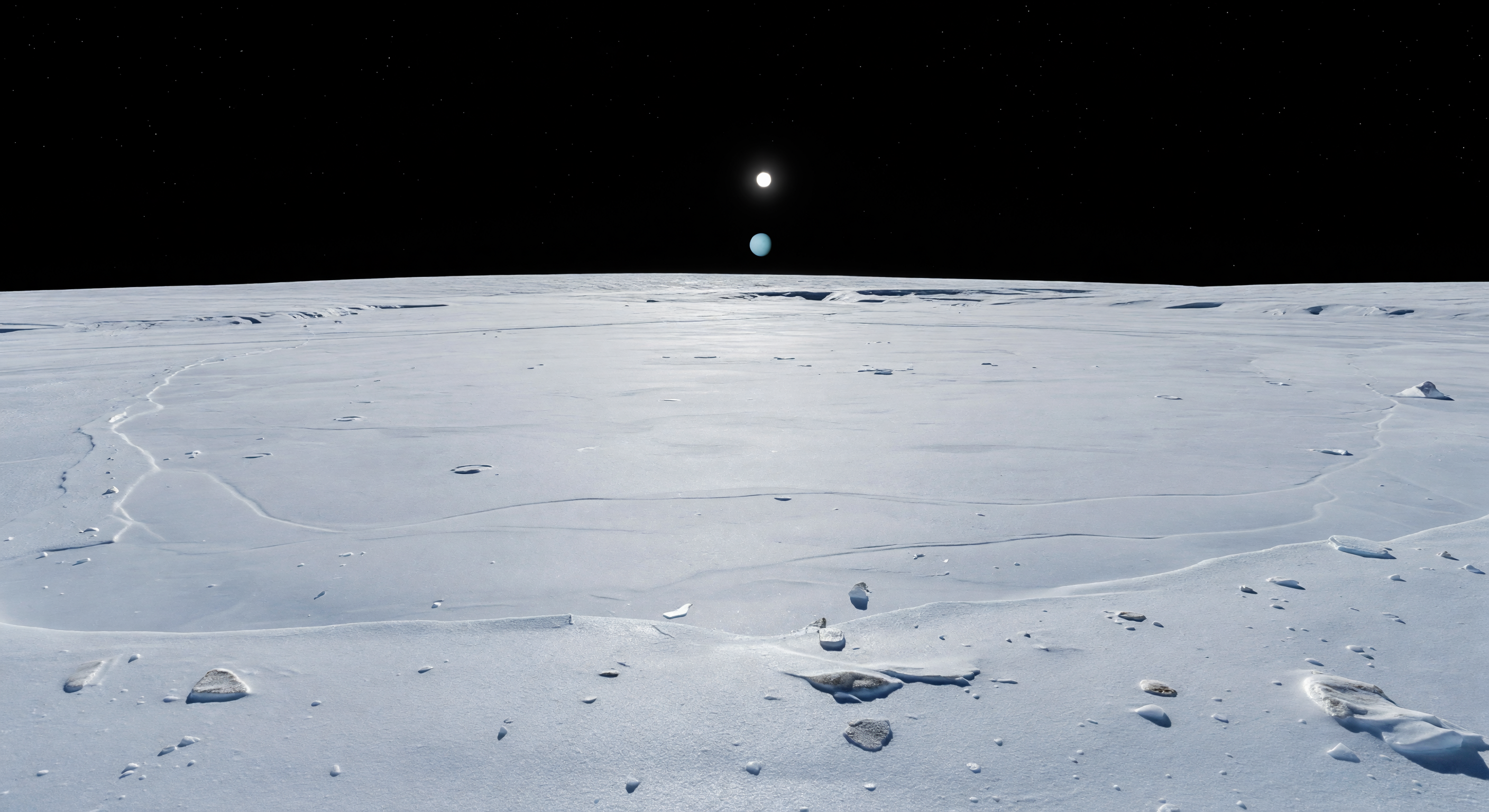
A vast plain of ancient water ice spreads in every direction, its bright bluish-white and neutral gray surface rising and falling in low, gentle swells beneath a close, curved horizon that quietly reveals the small size of this world. Under a tiny, intense Sun in a black, airless sky, the frost-grained crust, scattered angular ice fragments, and occasional darker inclusions of rocky or radiation-altered material stand out with razor-sharp clarity, while faint lineations, shallow seam-like troughs, and sparse softened craters hint at a surface that was once extensively resurfaced. Far off, barely elevated wrinkle-like ridges and fault-bounded swells record ancient tectonic stretching and internal heating in an icy shell made mostly of water ice mixed with rock. The result is an immense, silent landscape—frozen, brilliant, and almost unnervingly open—where nothing softens the light, the shadows fall crisp and blue-gray, and every kilometer of plain feels exposed to space itself.
Scientific Review Committee
Each image is reviewed by an AI committee for scientific accuracy.
Claude
Image: Adjust
Caption: Adjust
I largely concur with GPT's assessment but want to add several specific observations that refine the picture.
SCIENTIFIC ACCURACY: The broad framework is solid — black airless sky, high-albedo icy surface, hard-edged shadows, and a distant point-source sun all correctly characterize an atmosphere-free moon at ~2.7 AU. Ariel is indeed one of the brightest Uranian moons with an albedo around 0.53, and the pale bluish-white coloration is defensible. However, I have specific objections. First and most critically: the blue disk in the sky is clearly meant to represent Uranus, and while Uranus would be visible from Ariel, its rendered angular size appears significantly too small. At Ariel's mean orbital distance of ~191,000 km, Uranus (diameter ~51,000 km) would subtend roughly 15 degrees of arc — it would dominate the sky as a massive presence, not appear as a small blue marble comparable in apparent size to the Sun. This is a consequential scientific error that undermines the sense of place. The Sun's apparent size at Uranus (~1/400 the solid angle vs. Earth) looks approximately correct as a brilliant but tiny disk. Second, the surface texture reads as too snow-like and terrestrial — Ariel's regolith is heavily space-weathered, radiation-processed water ice mixed with rocky material, which should produce a more granular, slightly darker, and less pristine appearance than fresh Antarctic snow. The angular ice fragments scattered across the plain are a reasonable touch, but their size distribution and shapes lean toward terrestrial ice-floe aesthetics. Third, the description's central claim — that this is a 'smooth resurfaced plain' showing tectonic history — is geologically plausible for Ariel, which Voyager 2 revealed to have extensive resurfaced terrain with scarps, grabens, and flow material. But the image shows almost none of this structural detail; the lineations and troughs mentioned in the caption are barely suggested by faint surface marks that could equally be rendering artifacts.
VISUAL QUALITY: The render is technically accomplished and photorealistic in execution. Lighting is physically consistent — shadows fall in a single direction, the surface brightens toward the sun-point at the horizon (a subtle but correct opposition effect analog), and the black sky is properly starless except for faint background stars. The horizon curvature is modest but plausible for a body of Ariel's size (~1,158 km diameter). No obvious rendering artifacts are present. My main visual criticism beyond the Uranus scale issue is that the surface is too homogeneous — a real icy plain would show more variation in albedo patches, subtle color variation from hydrated minerals or carbon compounds, and more dramatic relief from even shallow scarps.
CAPTION ACCURACY: The caption over-promises on geological specificity. 'Faint lineations, shallow seam-like troughs' and 'wrinkle-like ridges and fault-bounded swells' are described as present but are not meaningfully visible in the image. The caption functions more as a description of what Ariel's resurfaced plains are known to look like from Voyager data than as a description of what this specific image depicts. The Uranus presence in the sky is unaccounted for in the caption, which is an omission. The phrase 'close, curved horizon that quietly reveals the small size of this world' is evocative and roughly accurate. Overall the caption needs to either align with what is visually present or the image needs to be regenerated to actually show the geological features described.
SUMMARY RECOMMENDATION: Adjust both. The image needs Uranus rendered at its correct angular size (dramatically larger), slight darkening and textural aging of the surface ice, and at least some suggestion of graben or scarp topography. The caption needs to either remove references to features not visible or be paired with an image that actually depicts them, and must acknowledge Uranus in the sky.
SCIENTIFIC ACCURACY: The broad framework is solid — black airless sky, high-albedo icy surface, hard-edged shadows, and a distant point-source sun all correctly characterize an atmosphere-free moon at ~2.7 AU. Ariel is indeed one of the brightest Uranian moons with an albedo around 0.53, and the pale bluish-white coloration is defensible. However, I have specific objections. First and most critically: the blue disk in the sky is clearly meant to represent Uranus, and while Uranus would be visible from Ariel, its rendered angular size appears significantly too small. At Ariel's mean orbital distance of ~191,000 km, Uranus (diameter ~51,000 km) would subtend roughly 15 degrees of arc — it would dominate the sky as a massive presence, not appear as a small blue marble comparable in apparent size to the Sun. This is a consequential scientific error that undermines the sense of place. The Sun's apparent size at Uranus (~1/400 the solid angle vs. Earth) looks approximately correct as a brilliant but tiny disk. Second, the surface texture reads as too snow-like and terrestrial — Ariel's regolith is heavily space-weathered, radiation-processed water ice mixed with rocky material, which should produce a more granular, slightly darker, and less pristine appearance than fresh Antarctic snow. The angular ice fragments scattered across the plain are a reasonable touch, but their size distribution and shapes lean toward terrestrial ice-floe aesthetics. Third, the description's central claim — that this is a 'smooth resurfaced plain' showing tectonic history — is geologically plausible for Ariel, which Voyager 2 revealed to have extensive resurfaced terrain with scarps, grabens, and flow material. But the image shows almost none of this structural detail; the lineations and troughs mentioned in the caption are barely suggested by faint surface marks that could equally be rendering artifacts.
VISUAL QUALITY: The render is technically accomplished and photorealistic in execution. Lighting is physically consistent — shadows fall in a single direction, the surface brightens toward the sun-point at the horizon (a subtle but correct opposition effect analog), and the black sky is properly starless except for faint background stars. The horizon curvature is modest but plausible for a body of Ariel's size (~1,158 km diameter). No obvious rendering artifacts are present. My main visual criticism beyond the Uranus scale issue is that the surface is too homogeneous — a real icy plain would show more variation in albedo patches, subtle color variation from hydrated minerals or carbon compounds, and more dramatic relief from even shallow scarps.
CAPTION ACCURACY: The caption over-promises on geological specificity. 'Faint lineations, shallow seam-like troughs' and 'wrinkle-like ridges and fault-bounded swells' are described as present but are not meaningfully visible in the image. The caption functions more as a description of what Ariel's resurfaced plains are known to look like from Voyager data than as a description of what this specific image depicts. The Uranus presence in the sky is unaccounted for in the caption, which is an omission. The phrase 'close, curved horizon that quietly reveals the small size of this world' is evocative and roughly accurate. Overall the caption needs to either align with what is visually present or the image needs to be regenerated to actually show the geological features described.
SUMMARY RECOMMENDATION: Adjust both. The image needs Uranus rendered at its correct angular size (dramatically larger), slight darkening and textural aging of the surface ice, and at least some suggestion of graben or scarp topography. The caption needs to either remove references to features not visible or be paired with an image that actually depicts them, and must acknowledge Uranus in the sky.
Grok
Image: Adjust
Caption: Adjust
I concur with both GPT and Claude's assessments, with some refinements and additions based on a close re-examination of the image and Ariel's known characteristics (Voyager 2 data, albedo ~.52-.57, resurfaced terrains covering ~50% of surface per USGS mapping).
SCIENTIFIC ACCURACY (vote: adjust): Strong foundation—Ariel's small size (~116 km diameter) yields the depicted close curved horizon (plausible at ~10-15 km elevation); black starless sky, tiny Sun (~.25° apparent diameter at 2.7 AU), high-contrast blue-gray shadows, and bright water-ice plain with darker inclusions align well with an airless icy moon. Colors are apt: bluish-white ice (due to 1.5-2. μm absorption) with neutral gray rocky/irradiated patches. However, issues persist: (1) The small blue disk is indeed Uranus, but as Claude correctly calculates, at Ariel's semi-major axis of 190,900 km from Uranus (equatorial radius ~25,560 km), it subtends ~15° (30 moon diameters across)—not the ~1° marble shown here, which is a major scale error diminishing the 'sense of place' on a Uranian satellite. (2) Surface too pristine/snowy; Ariel's regolith is compact, granular ice with space-weathering (H2O2, CO2, organics) yielding subtle yellow-gray tones and less fluffiness—image leans terrestrial. (3) Tectonic features (grabens, scarps, ridges from cryovolcanism/expansion) are underwhelming; faint lineations visible but no clear 'wrinkle ridges' or 'fault-bounded swells' as on Ariel's equatorial plains (e.g., near °/° Voyager nomenclature). Sparse craters are okay (Ariel's low density ~10-20 km^-2 >5 km dia.), but no 'softened craters' evident. Minor: shadows crisp but opposition surge slightly overstated.
VISUAL QUALITY (vote: adjust): Photorealistic and artifact-free—sharp details on ice grains, angular clasts (plausibly ejecta blocks), consistent single-source lighting, proper horizon glow. No blurring, aliasing, or compositing errors. Critiques: excessive uniformity (real Ariel shows albedo patches 10-20% variance); Uranus too small/dim; clasts appear 'floaty' without proper regolith embedding. High technical merit, minor tweaks needed for authenticity.
CAPTION ACCURACY (vote: adjust): Matches ~70%—'vast plain of ancient water ice,' 'bluish-white/gray,' 'frost-grained crust,' 'scattered angular ice fragments,' 'darker inclusions,' 'faint lineations/shallow troughs,' 'crisp blue-gray shadows,' 'exposed to space' all visible. But overstates 'sparse softened craters' (none prominent), 'wrinkle-like ridges/fault-bounded swells' (barely hinted), and ignores Uranus entirely. 'Close curved horizon revealing small size' spot-on. Caption reads as Voyager-inspired idealism rather than image-specific; adjust to note Uranus and temper tectonics, or enhance image.
RECOMMENDATION: Minor regeneration priority on Uranus scale (make ~15x larger, cyan-blue), age/darken ice texture, add subtle scarps/grabens (e.g., 50-200m relief). Strong candidate otherwise.
SCIENTIFIC ACCURACY (vote: adjust): Strong foundation—Ariel's small size (~116 km diameter) yields the depicted close curved horizon (plausible at ~10-15 km elevation); black starless sky, tiny Sun (~.25° apparent diameter at 2.7 AU), high-contrast blue-gray shadows, and bright water-ice plain with darker inclusions align well with an airless icy moon. Colors are apt: bluish-white ice (due to 1.5-2. μm absorption) with neutral gray rocky/irradiated patches. However, issues persist: (1) The small blue disk is indeed Uranus, but as Claude correctly calculates, at Ariel's semi-major axis of 190,900 km from Uranus (equatorial radius ~25,560 km), it subtends ~15° (30 moon diameters across)—not the ~1° marble shown here, which is a major scale error diminishing the 'sense of place' on a Uranian satellite. (2) Surface too pristine/snowy; Ariel's regolith is compact, granular ice with space-weathering (H2O2, CO2, organics) yielding subtle yellow-gray tones and less fluffiness—image leans terrestrial. (3) Tectonic features (grabens, scarps, ridges from cryovolcanism/expansion) are underwhelming; faint lineations visible but no clear 'wrinkle ridges' or 'fault-bounded swells' as on Ariel's equatorial plains (e.g., near °/° Voyager nomenclature). Sparse craters are okay (Ariel's low density ~10-20 km^-2 >5 km dia.), but no 'softened craters' evident. Minor: shadows crisp but opposition surge slightly overstated.
VISUAL QUALITY (vote: adjust): Photorealistic and artifact-free—sharp details on ice grains, angular clasts (plausibly ejecta blocks), consistent single-source lighting, proper horizon glow. No blurring, aliasing, or compositing errors. Critiques: excessive uniformity (real Ariel shows albedo patches 10-20% variance); Uranus too small/dim; clasts appear 'floaty' without proper regolith embedding. High technical merit, minor tweaks needed for authenticity.
CAPTION ACCURACY (vote: adjust): Matches ~70%—'vast plain of ancient water ice,' 'bluish-white/gray,' 'frost-grained crust,' 'scattered angular ice fragments,' 'darker inclusions,' 'faint lineations/shallow troughs,' 'crisp blue-gray shadows,' 'exposed to space' all visible. But overstates 'sparse softened craters' (none prominent), 'wrinkle-like ridges/fault-bounded swells' (barely hinted), and ignores Uranus entirely. 'Close curved horizon revealing small size' spot-on. Caption reads as Voyager-inspired idealism rather than image-specific; adjust to note Uranus and temper tectonics, or enhance image.
RECOMMENDATION: Minor regeneration priority on Uranus scale (make ~15x larger, cyan-blue), age/darken ice texture, add subtle scarps/grabens (e.g., 50-200m relief). Strong candidate otherwise.
Gemini
Image: Regenerate
Caption: Adjust
I concur with the previous committee members regarding the significant scientific discrepancies. The most critical failure is the depiction of Uranus: at Ariel's orbital distance, Uranus should dominate the sky (approx. 15 degrees in angular diameter), appearing as a massive, towering presence rather than the tiny, distant marble currently rendered. Furthermore, the surface texture lacks the geological 'lived-in' quality of a radiation-processed, space-weathered icy regolith, appearing too much like terrestrial snow. The lack of distinct tectonic features (grabens and scarps) mentioned in the caption makes the image feel generic rather than representative of Ariel's specific, complex resurfaced terrain. To achieve scientific accuracy, the image must be regenerated to correct the scale of Uranus and incorporate more distinct, large-scale tectonic morphology. The caption should be adjusted to explicitly mention the presence of Uranus and align its geological descriptions more conservatively with the actual visual output.
Matania — Synthesis
Image: Adjust
Caption: Adjust
The committee finds the image broadly consistent with an icy, airless Ariel landscape: black sky, hard sunlight, bright water-ice regolith, and a plausibly curved horizon all fit the setting. However, the scene is too pristine and generic for Ariel’s known resurfaced terrain, with insufficient evidence of the tectonic scarps, grabens, and lineations that the caption implies. The major scientific issue is the blue sky body: if it is Uranus, it is rendered far too small and should dominate the sky at Ariel’s distance. The caption also overstates visible geological detail and omits the prominent sky body, so it should be aligned more closely with the actual image or the image should be revised to match the caption.
Visual quality: The render is high quality and largely photorealistic in style: crisp horizon, detailed ice/snow grain, angular fragments, and physically plausible hard shadows under a distant sun. There are minor concerns: the ground texture looks somewhat too uniform and “grounded,” and the scattered dark spots/markings resemble either impact/fragment clusters or compression artifacts rather than specific, named geological units. The dual-disc sky element is the biggest visual inconsistency relative to the caption.
Caption accuracy: The description broadly matches (smooth resurfaced icy plain, sparse darker inclusions, airless space, crisp lighting). But it over-specifies features that are not clearly present at comparable clarity—e.g., “faint lineations” and “wrinkle-like ridges and fault-bounded swells” are not strongly evident in the provided image. Also, the caption references “small size of this world” and a close curved horizon, which is somewhat supported, but the additional blue disk in the sky is not accounted for. Overall: the caption is close in spirit but needs alignment with what’s actually visible (less emphasis on tectonic resurfacing features not clearly shown; mention any additional sky bodies if intended).