Scientific confidence: High
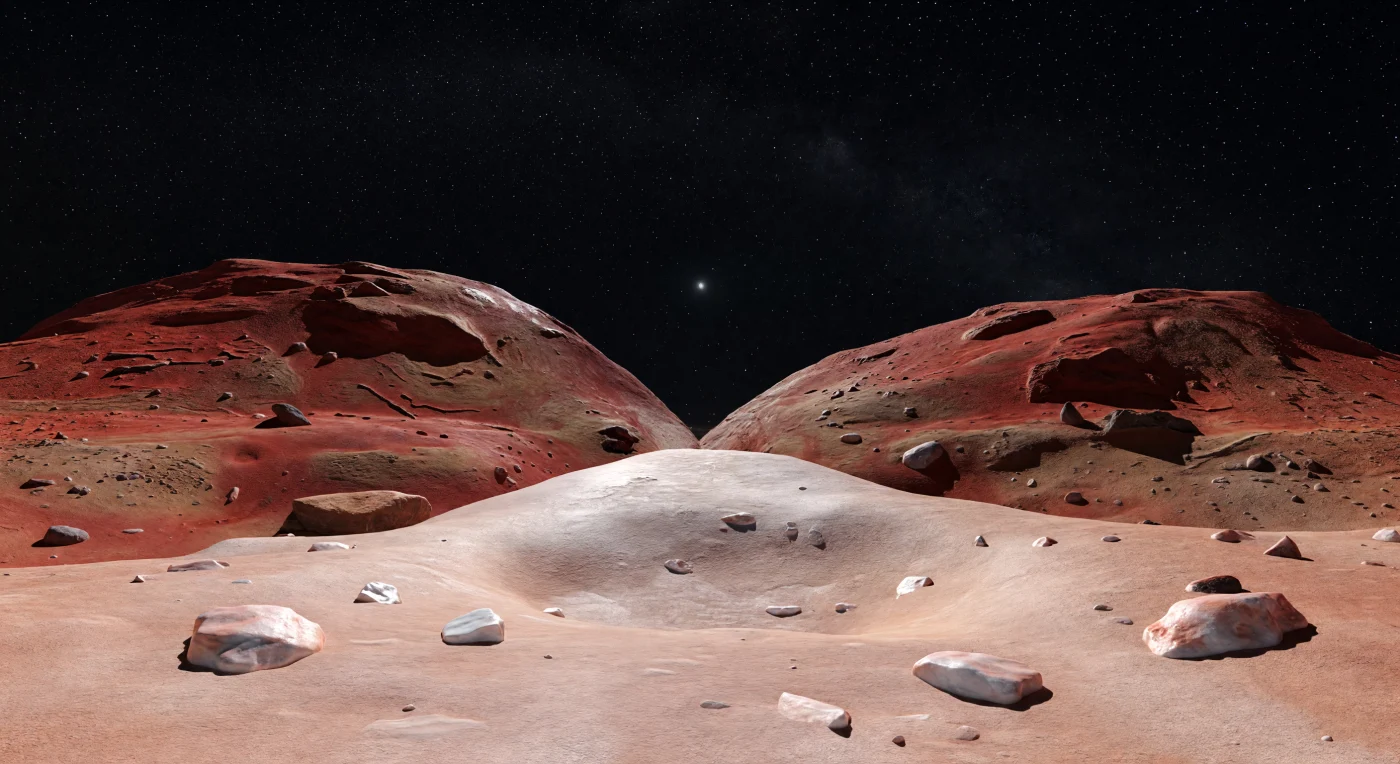
You stand in a narrow, gently scooped saddle where the two flattened lobes meet, on a surprisingly smooth patch of pale salmon-tan regolith that looks faintly frosted against the surrounding dark, ultra-red terrain. On either side, the lobe walls rise like immense rust-colored headlands, their organic-rich, tholin-coated crust marked by shallow pits, softened terraces, sparse small craters, grooves, and precariously perched icy boulders—landforms shaped not by wind or water, but by eons of impacts, sublimation, and the strange mechanics of vanishingly low gravity. This bright neck is thought to preserve fine icy material that settled into the contact region after an extraordinarily gentle merger of two primordial planetesimals, leaving behind one of the Solar System’s most pristine relic surfaces, frozen near 40 K for billions of years. Above it all hangs a perfectly black, airless sky crowded with sharp stars, while the far-distant Sun shines only as a brilliant point, casting hard, low-angle light and razor-edged shadows that make the softly reflective ices glow eerily in the deep silence.

You stand on a broad, gently domed plain of dark red to burnt-umber crust, where fine frost-cemented grains, scattered pebbles, and low hummocks stretch only a short distance before dropping below a strikingly close curved horizon. The surface is a cryogenic mix of ancient water ice, more exotic frozen volatiles, and complex radiation-processed organic material called tholins, preserved at roughly 40 K in an airless vacuum that leaves the sky perfectly black and the sunlight hard, faint, and razor-sharp. With gravity so weak and erosion essentially absent, this landscape has remained almost unchanged since the earliest solar system, its subtle texture recording gentle accretion rather than active geology. Ahead the terrain swells toward the narrow neck, while overhead the opposing lobe hangs like a colossal flattened crimson wall, making the scene feel both intimate and immense beneath a star-thick sky.

From within this shallow depression, the ground appears as a dark, ultra-reddish plain of smooth settled material, bordered by a low broken ring of ochre and brick-red crust where brittle, ice-rich substrate has fractured into sharp-edged blocks. One section of the pit wall falls abruptly into absolute blackness, its knife-clean shadow line revealing the total vacuum here: with no atmosphere to scatter sunlight, even this distant Sun casts stark, cold illumination and leaves darkness untouched. The colors and textures point to ancient regolith made of water ice mixed with complex organic compounds altered into reddish tholins, a surface preserved in deep freeze near 40 K for billions of years, with only tiny impact scars and faint cracks interrupting its stillness. Above the nearby rim, the opposite lobe towers like a colossal crimson hill against a star-crowded black sky and the bright band of the Milky Way, making the landscape feel both intimate and immense on this tiny, primordial world.

At ground level, the surface is a frozen field of knobby hummocks and brittle, angular blocks rising only a few meters from a darker, fine-grained regolith, their sunlit faces washed in muted rusty crimson while impossibly long black shadows spill across the plain. The color comes from tholins—complex organic residues that have accumulated on ancient water-ice bedrock in deep cold and total vacuum—while a few fractured edges reveal fresher pale ice beneath, untouched by wind, rain, or any active erosion for billions of years. Overhead, the opposite lobe looms like a dark curved wall, making the contact-binary shape unmistakable and reminding you that this entire strange horizon belongs to a tiny, gently assembled relic from the solar system’s birth. Under a pure black sky crowded with sharp stars and the Milky Way, a tiny brilliant Sun hangs low like a white spark, casting hard, faint light that makes this silent cryogenic landscape feel both miniature and immeasurably ancient.

At the rim of the flattened lobe, a steep scarp of coherent icy-organic material rises only a few meters yet feels monumental in the weak gravity, its brick-red face split into thin ledges, blocky shelves, and angular fractures where a few boulders balance improbably on narrow terraces. The ground is mantled in ultra-fine, dark crimson tholin-rich frost and dust, with small chips and cracks exposing brighter gray-white water ice beneath, while the rounded crest remains pristine—untouched by wind, liquid, or active erosion, preserved in near-perfect stillness at roughly 40 K. Just beyond, the horizon drops away with startling immediacy, revealing a dim maroon plain dotted with low hummocks, shallow pits, rare impact scars, and isolated blocks casting razor-sharp shadows under the faint light of a distant Sun. Above, a black sky crowded with stars and the bright arc of the Milky Way hangs over the looming opposite lobe, whose dark reddish bulk underscores that this tiny world is a gently merged contact binary, frozen almost unchanged since the earliest age of the solar system.

At your feet, the ground is a mosaic of dark wine-red plates, their polygonal and jagged outlines cut by crisp black-red fractures whose deeper interiors glow a richer burgundy against the frozen surface. This brittle crust is thought to be a primordial mixture of water ice, methanol ice, and radiation-processed organic material, with slight curled edges and tiny shifted ridges recording thermal contraction and minute stresses accumulated over billions of years in an airless vacuum. Fine reddish frost, angular ice chips, scattered blocky clasts, and occasional pale patches of fresher exposed ice sharpen every detail, because there is no wind, liquid, or atmosphere to soften or erase the landscape. Beyond the gently rolling fractured plains, the immense adjoining lobe rises like a dark crimson wall into a star-crowded black sky, its softly hummocked face and faint grooves emphasizing that this is not an active world reshaped by geology, but a nearly untouched relic from the Solar System’s earliest assembly.
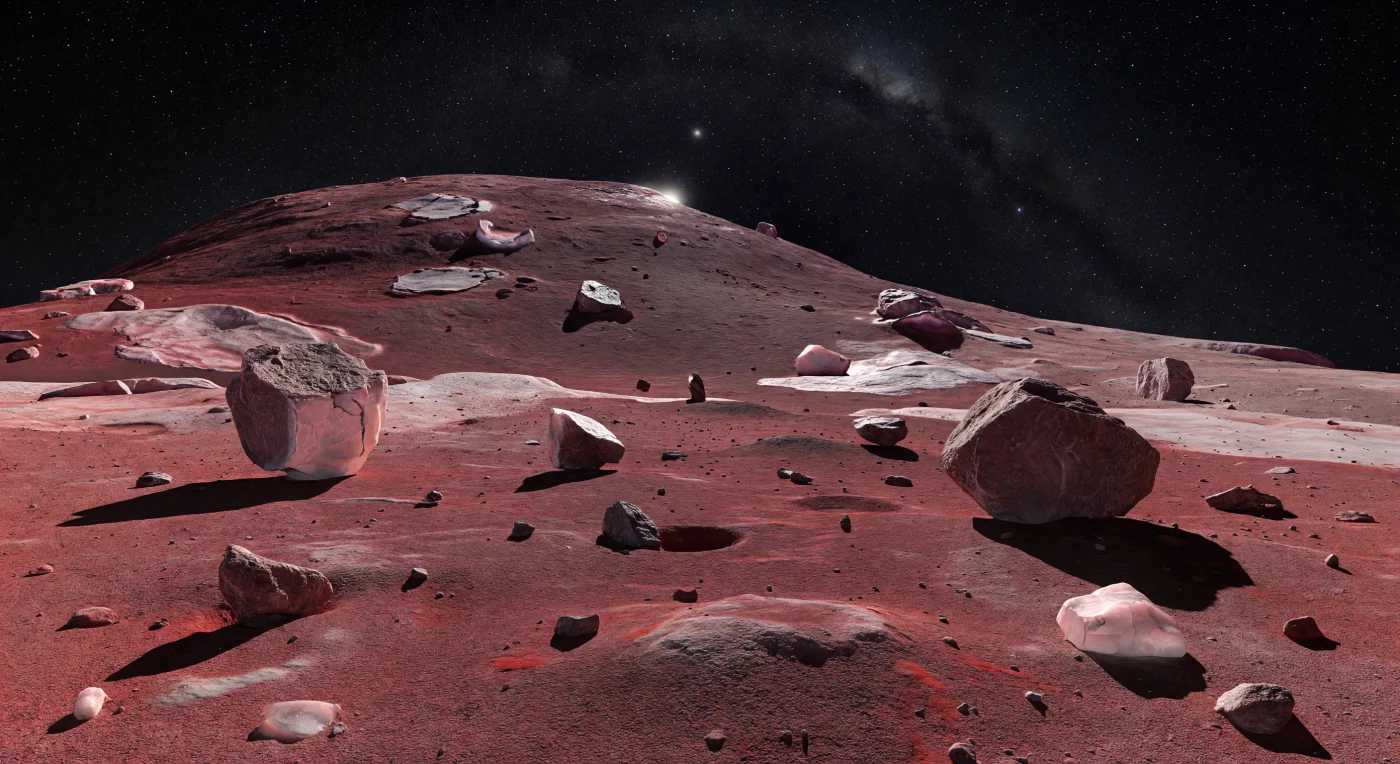
At ground level, the landscape is a frozen plain of crimson to dark maroon grains and sintered exotic ices, where meter-scale blocks of burgundy material sit improbably balanced on tiny contact points, their freshly broken faces gleaming pale pink to whitish against the ultra-red surface. In this feeble gravity, boulders can remain delicately perched on gentle slopes, while sharp black shadows collect beneath them in the airless cold and small chips, shallow pits, and low hummocks hint at an ancient surface only lightly modified since the dawn of the Solar System. Rising beyond them, the opposite lobe curves overhead like a dark, flattened wall, its smooth mantled plains, sparse shallow craters, embedded rocks, and subdued scarps preserving the shape of a primitive body assembled by an extraordinarily gentle merger. Above it all, the sky is a perfectly transparent black crowded with stars and the bright river of the Milky Way, while the Sun appears only as a tiny, piercing white point casting faint, razor-edged light across terrain that has remained undisturbed for billions of years.

You stand in a quiet hollow where the floor is mantled with unusually smooth, slightly brighter reddish-tan powder, a fine frozen regolith that lies undisturbed in the complete absence of air, its delicate grains and faintly sintered crusts picked out by a tiny, distant Sun. Around the depression, softly rounded rises of darker burgundy and brick-red terrain reveal an ancient surface rich in complex organic tholins mixed with water ice, while scattered icy clods and angular boulders dusted in red material hint at slow impact gardening and billions of years of cryogenic alteration. Along one side, the immense curved flank of the adjoining lobe rises like a dark wall on the horizon, making the sheltered basin feel intimate even as the contact-binary body’s strange, flattened form becomes unmistakable. Under a perfectly black sky crowded with hard, unwavering stars, every shadow falls razor-sharp, and the landscape feels preserved outside of time—cold, inert, and almost untouched since the birth of the solar system.

From this low rise above the narrow neck, the brighter saddle of pale orange-red frost and tholin-coated grains stretches ahead before fading into deeper maroon terrain on either side, where the two fused lobes curve away as separate bulging horizons under a black, star-thick sky. The smoother neck is mantled in ancient, undisturbed icy regolith, while low scarps, shallow pits, subdued depressions, scattered blocks, and faint polygonal fractures record a surface that has sat frozen and nearly unchanged since the solar system’s infancy. Here the contact-binary form is impossible to miss at ground level: you are standing on the seam where two once-independent planetesimals merged gently at low speed, preserving a pristine relic only about 36 kilometers long. In the far outer darkness, the Sun is reduced to a brilliant star-like point, casting weak but razor-sharp light that lets muted oranges, rusty reds, and occasional fresh ice exposures glow faintly across this silent, airless world.

From this ridge on the larger lobe, the ground is a frozen mosaic of dark rusty-red and deep burgundy material, its tholin-rich crust broken into shallow pits, low hummocks, fractured plates, and scattered icy stones half-buried in granular dust. Just beyond the sharply curving horizon, the brighter, smoother neck glows faintly with pooled pale ice, while the smaller fused lobe rises overhead like an immense wall, making the whole world feel startlingly compact—only a few tens of kilometers across from end to end. In the total vacuum and bitter cold of roughly 40 K, nothing moves: no wind, no haze, no flowing liquid, only an ancient primordial surface preserved for 4.5 billion years since a gentle merger of two planetesimals in the early solar system. Above it all, the sky is pure black and crowded with hard, steady stars and the bright river of the Milky Way, while the distant Sun shines only as an intense white point, casting crisp shadows across this tiny, untouched relic of planetary formation.
