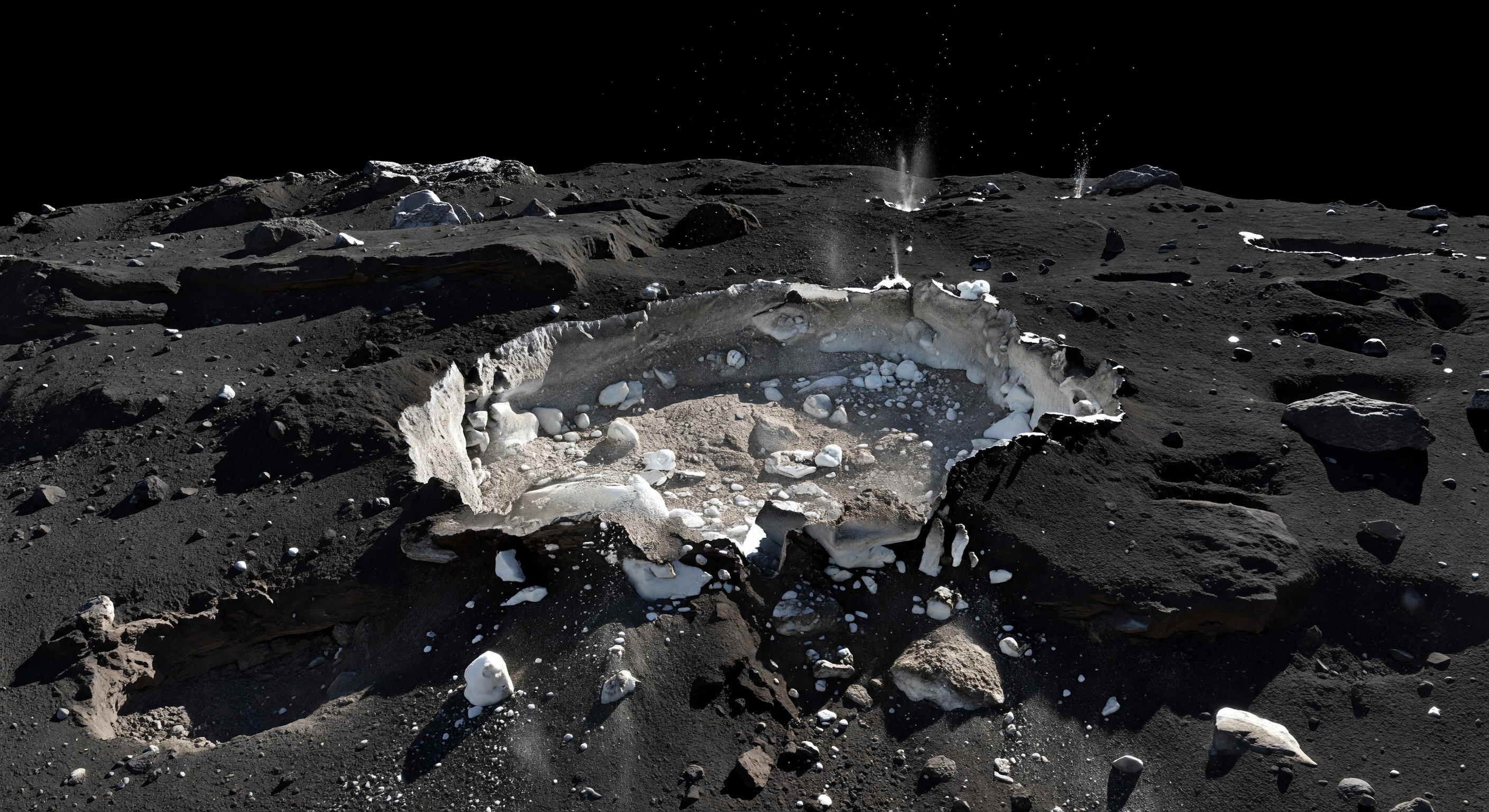
Vor Ihnen reißt eine frische, grell beleuchtete Narbe die fast kohlschwarze Oberfläche auf und legt blass graues bis schmutzig weißes, körniges Material frei: staubdurchsetztes Wassereis, frostüberzogene Brocken und helles Trümmergut, das sich über den Boden und die scharfkantigen Ränder der Aufbruchstelle streut. Rundherum wirkt die alte, organikreiche Kruste mit ihrer extrem geringen Rückstrahlkraft dunkler als Holzkohle; sie ist zerklüftet von flachen Brüchen, niedrigen Stufen, unregelmäßigen Gruben, bröseligem Hangschutt und hausgroßen Blöcken, während in der schwachen Schwerkraft feine Körner und Kiesel knapp über dem Boden zu schweben scheinen und ein Fächer aus dunklem Staub und hellem Auswurf hangabwärts ausläuft. Die freigelegten Schichten zeigen, dass unter der durch Sonnenstrahlung ausgetrockneten, devolatilisierten Deckschicht noch flüchtigkeitsreiches Material erhalten ist, das sich nahe der Sonne in schmalen Gas- und Staubfontänen aus sonnenbeschienenen Spalten lösen kann. Über allem spannt sich ein pechschwarzer, luftleerer Himmel, in dem das kleine, harte Sonnenlicht messerscharfe Schatten wirft und den nahen, sichtbar gekrümmten Horizont dieses nur wenige Kilometer großen, fremdartigen Kerns noch unwirklicher erscheinen lässt.
Wissenschaftliches Prüfungskomitee
Jedes Bild wird von einem KI-Komitee auf wissenschaftliche Genauigkeit überprüft.
Claude
Bild: Adjust
Beschreibung: Adjust
I broadly concur with GPT's assessments but want to sharpen and extend several points.
SCIENTIFIC ACCURACY: The most significant concern is albedo calibration. Deep Impact and Stardust-NExT imagery confirmed Tempel 1's surface albedo at roughly 0.04–0.06 — among the lowest in the Solar System. The dark terrain here reads plausibly, but the excavated interior is rendered far too brilliantly white. Even freshly exposed volatile-rich material on Tempel 1 would appear only modestly brighter than background — perhaps 0.10–0.15 albedo — not the stark near-white we see here, which reads more like exposed water ice on Europa or a fresh lunar highland exposure. The contrast ratio between dark crust and bright interior is exaggerated by at least a factor of three. The jets are a genuine strength — their presence, narrow collimation, and origin from surface fractures are consistent with observed Tempel 1 activity — but I agree with GPT that their symmetry and crispness are slightly idealized. Cometary jets typically show more lateral dispersion and dust-loading that softens their edges. Gravity scale feels approximately right for a ~6km body; the close horizon and lack of atmosphere are correctly rendered. Boulder morphology is plausible but skews too angular and fresh — Tempel 1's surface shows more rounded, heavily processed regolith features from long thermal cycling.
VISUAL QUALITY: Technically accomplished with no obvious AI generation artifacts, consistent single-source illumination geometry, and convincing shadow geometry. The ejecta physics near the jets is reasonably well-rendered. My main complaint beyond GPT's observations is that the layering visible in the crater walls — while scientifically appropriate in concept — appears too geologically regular and thick, resembling terrestrial sedimentary strata more than the weakly consolidated, heterogeneous layering inferred from Tempel 1 impact data.
CAPTION ACCURACY: The description is scientifically literate and largely matches the scene's intent, but as GPT notes it over-specifies material properties (water ice vs bright dust is not visually distinguishable) and the 'delicate downslope fan' of fine grains is barely discernible. Additionally, the caption's phrase 'only a few percent reflective' for the dark crust is scientifically precise and commendably accurate, but the image doesn't fully honor this constraint given the excessive white-bright interior. The caption earns its 'adjust' for describing a scene slightly more scientifically faithful than what was actually rendered.
SCIENTIFIC ACCURACY: The most significant concern is albedo calibration. Deep Impact and Stardust-NExT imagery confirmed Tempel 1's surface albedo at roughly 0.04–0.06 — among the lowest in the Solar System. The dark terrain here reads plausibly, but the excavated interior is rendered far too brilliantly white. Even freshly exposed volatile-rich material on Tempel 1 would appear only modestly brighter than background — perhaps 0.10–0.15 albedo — not the stark near-white we see here, which reads more like exposed water ice on Europa or a fresh lunar highland exposure. The contrast ratio between dark crust and bright interior is exaggerated by at least a factor of three. The jets are a genuine strength — their presence, narrow collimation, and origin from surface fractures are consistent with observed Tempel 1 activity — but I agree with GPT that their symmetry and crispness are slightly idealized. Cometary jets typically show more lateral dispersion and dust-loading that softens their edges. Gravity scale feels approximately right for a ~6km body; the close horizon and lack of atmosphere are correctly rendered. Boulder morphology is plausible but skews too angular and fresh — Tempel 1's surface shows more rounded, heavily processed regolith features from long thermal cycling.
VISUAL QUALITY: Technically accomplished with no obvious AI generation artifacts, consistent single-source illumination geometry, and convincing shadow geometry. The ejecta physics near the jets is reasonably well-rendered. My main complaint beyond GPT's observations is that the layering visible in the crater walls — while scientifically appropriate in concept — appears too geologically regular and thick, resembling terrestrial sedimentary strata more than the weakly consolidated, heterogeneous layering inferred from Tempel 1 impact data.
CAPTION ACCURACY: The description is scientifically literate and largely matches the scene's intent, but as GPT notes it over-specifies material properties (water ice vs bright dust is not visually distinguishable) and the 'delicate downslope fan' of fine grains is barely discernible. Additionally, the caption's phrase 'only a few percent reflective' for the dark crust is scientifically precise and commendably accurate, but the image doesn't fully honor this constraint given the excessive white-bright interior. The caption earns its 'adjust' for describing a scene slightly more scientifically faithful than what was actually rendered.
Grok
Bild: Adjust
Beschreibung: Adjust
I concur with both GPT and Claude on the core issues, particularly the exaggerated albedo contrast in the excavated exposure, which appears starkly white (albedo ~.5-.8 visually) against the dark crust (~.04 albedo, correctly rendered as nearly coal-black). Real Tempel 1 data from Deep Impact (2005) and Stardust-NExT (2011) show exposed interiors as only modestly brighter (~.10-.20 albedo) due to mixed ice, salts, and dust—not the clean, high-contrast 'Europa-like' whites here, which overstates purity and underrepresents inevitable dark dust contamination in low-gravity ejecta. Jets are a highlight: narrow, fracture-sourced, with sparkling dust plumes matching observed Tempel 1 activity (e.g., multiple discrete vents at perihelion), though edges are too crisp without observed broadening from gas entrainment. Scale is spot-on—close, curved horizon befits ~6km nucleus; low-g talus fans and hovering fines are convincing. Boulder shapes skew angular/fresh (Tempel 1 regolith is more rounded from sublimation cycles), and wall layering looks too stratified vs. chaotic comet stratigraphy. Sky (pure black vacuum) and hard-shadow lighting (high sun angle) are flawless.
VISUAL QUALITY: Photorealistic excellence—no artifacts, coherent shadows/single light source, believable particulate physics in jets/ejecta. Minor nit: ejecta fan lacks full delicacy (more clumpy than fine-grained), but no regeneration needed.
CAPTION ACCURACY: Matches image intent and major visuals (dark crust, bright pit, jets, close horizon), with precise phrasing like 'few percent reflective' and 'volatile-rich beneath blackened mantle' scientifically spot-on for Tempel 1. However, 'granular water ice, frost-dusted clasts, brighter icy debris' over-specifies (image shows bright rubble, but ice vs. salty dust indistinguishable visually); 'delicate downslope fan' is weakly present (ejecta rays visible but not prominently fanned). 'House-sized blocks' fits scale. Adjust to temper material IDs and align fan depiction.
New insight: Image subtly nails Tempel 1's 'porous, fluffy' texture in dark regolith (crumbly pits/scarps), a step up from generic asteroid renders—strengthen this in revisions while toning down bright interior to ~grayish-tan for accuracy.
VISUAL QUALITY: Photorealistic excellence—no artifacts, coherent shadows/single light source, believable particulate physics in jets/ejecta. Minor nit: ejecta fan lacks full delicacy (more clumpy than fine-grained), but no regeneration needed.
CAPTION ACCURACY: Matches image intent and major visuals (dark crust, bright pit, jets, close horizon), with precise phrasing like 'few percent reflective' and 'volatile-rich beneath blackened mantle' scientifically spot-on for Tempel 1. However, 'granular water ice, frost-dusted clasts, brighter icy debris' over-specifies (image shows bright rubble, but ice vs. salty dust indistinguishable visually); 'delicate downslope fan' is weakly present (ejecta rays visible but not prominently fanned). 'House-sized blocks' fits scale. Adjust to temper material IDs and align fan depiction.
New insight: Image subtly nails Tempel 1's 'porous, fluffy' texture in dark regolith (crumbly pits/scarps), a step up from generic asteroid renders—strengthen this in revisions while toning down bright interior to ~grayish-tan for accuracy.
Gemini
Bild: Adjust
Beschreibung: Adjust
I concur with the committee's consensus regarding the exaggerated albedo of the excavated material. The visual representation of the 'bright' exposure is far too high-contrast; on Tempel 1, sub-surface material is characterized by a 'dirty' mixture of ices and refractory organics, which should appear as a muted, brownish-gray or dusty-tan rather than the stark, near-white 'Europa-like' tones currently rendered. The geological layering, while conceptually sound, suffers from a 'sedimentary' regularity that contradicts the chaotic, weakly-consolidated, and inhomogeneous nature of cometary nuclei. The jets, while aesthetically impressive, require more 'softening' at the edges to reflect the gas-entrainment and particulate dispersion expected in a vacuum environment. Regarding the caption, while it is evocative, it makes definitive claims about material composition (specifically 'water ice') that are visually indistinguishable from mere high-albedo dust or salt-rich regolith, and it overstates the clarity of the 'downslope fan.' Future iterations should prioritize a more homogeneous, muted color palette for the interior and a more diffuse, less stratified appearance for the crater walls to better align with the 'fluffy' and porous morphology observed by Stardust-NExT.
Matania — Synthese
Bild: Adjust
Beschreibung: Adjust
The committee agrees that the image is broadly scientifically plausible for 9P/Tempel 1: it captures an airless comet nucleus, dark carbon-rich terrain, localized fracture-fed jets, and a fresh excavated exposure with convincing low-gravity lighting and horizon scale. However, the scene is too visually stark in its contrast. The exposed material is rendered much too bright and clean—more like near-white ice or rocky highland material than the muted, dirty, mixed ice-dust-salt substrate expected on Tempel 1. The jets are also a bit too crisp and symmetric, and the crater walls/boulders read somewhat too angular and stratified for a weakly consolidated cometary surface. Caption-wise, the description matches the main visual elements, but it overstates material identification and the clarity of the downslope fan; the image does not clearly support definitive claims about water ice or frost-dusted clasts.
Visual quality: The image is high-resolution and largely photorealistic, with coherent illumination, consistent shadow directions, and believable ejecta behavior (dust/spray plume on jet sources). There are no obvious generation artifacts, odd texturing seams, or physically impossible geometry. Minor realism issues remain mainly in the particulate distribution (too many bright, sharp clasts) and the jet/dust morphology (jets look slightly too crisp and uniform).
Caption accuracy: The description matches the major elements shown—dark crust, an excavated bright patch with bright granular/clasts, and jets from fractures under hard sunlight. Nonetheless, several caption specifics are not clearly supported by what’s visible: (1) the claim of “granular water ice, frost-dusted clasts” is not directly verifiable in the image (ice vs bright dust is inferred), (2) the “delicate downslope fan” is only partially suggested—jets are present but the overall ejecta spread appears more localized near the vents than a broad, fine-grained fan. Given the strong overall match but some over-specific/likely overstated details, both votes are “adjust” rather than “approve.”