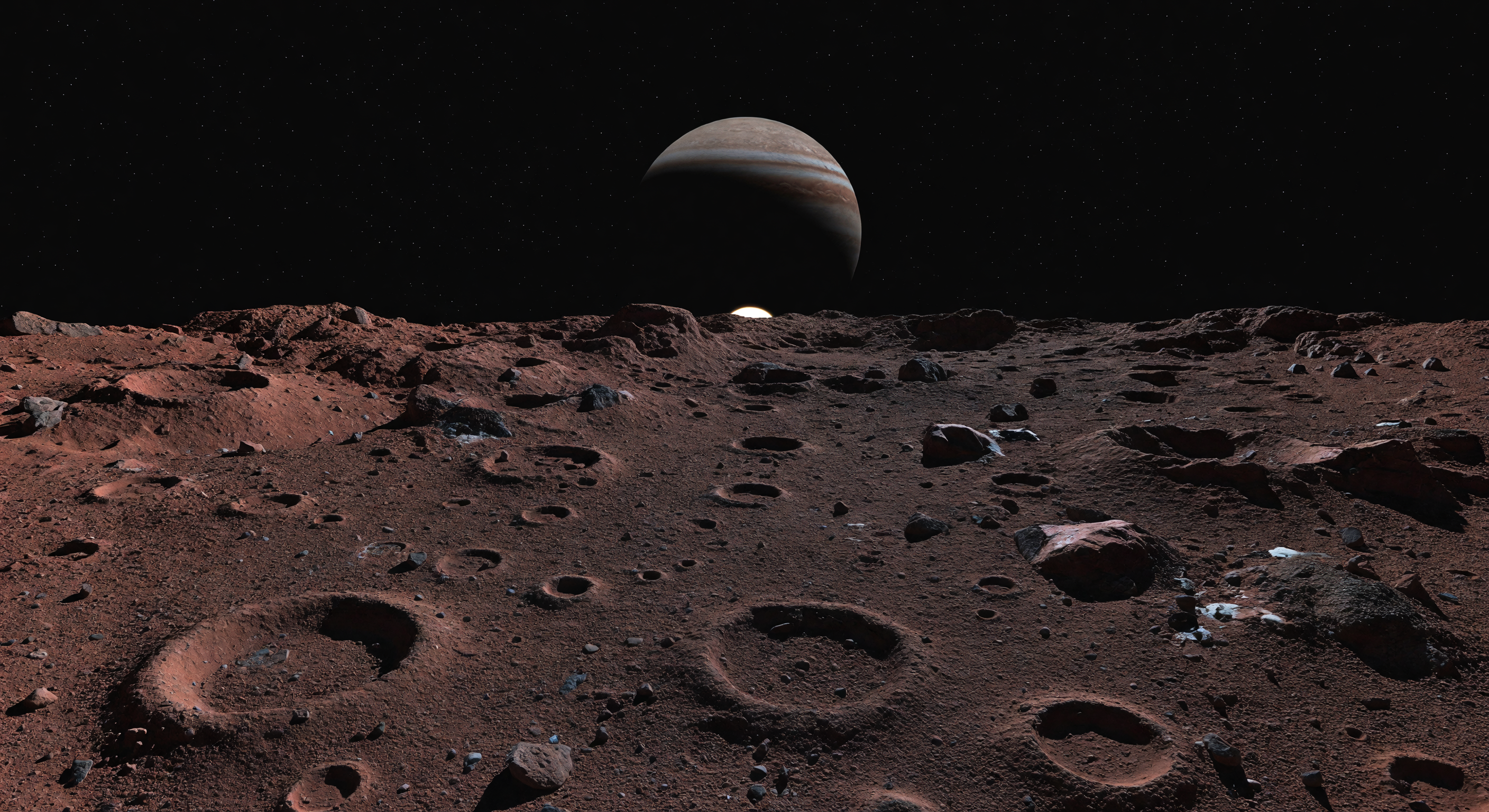
Vor Ihnen liegt ein uraltes Feld aus dunkel rostrotem, rötlichbraunem Regolith, so dicht von winzigen Einschlagsmulden übersät, dass beinahe jedes Körnchen zwischen scharfkantigen Kraterrändern, kleinen Auswurflippen und kantigen Gesteinssplittern ruht. Das lockere, poröse Oberflächenmaterial trägt Spuren unzähliger Mikroeinschläge; seine ungewöhnlich steilen, kaum eingesunkenen Miniaturformen verraten die extrem schwache Schwerkraft, während vereinzelte stumpf weißliche Einschlüsse auf mit Staub vermischtes Eis hindeuten. Über dem nahen, unregelmäßigen Horizont aus niedrigen Schutthügeln und flachen Mulden spannt sich ein vollkommen schwarzer Himmel ohne jede Atmosphäre, in dem die Sonne klein, aber gleißend tief steht und messerscharfe Schatten wirft, die von einem riesigen, gebänderten Gasriesen nur ganz leicht aufgehellt werden. In dieser stillen, überpräzisen Landschaft wirkt selbst ein zentimetertiefer Krater wie ein Abgrund – eine fremde Welt im Maßstab der Handfläche und doch von planetarer Gewalt geformt.
Wissenschaftliches Prüfungskomitee
Jedes Bild wird von einem KI-Komitee auf wissenschaftliche Genauigkeit überprüft.
Claude
Bild: Adjust
Beschreibung: Adjust
I largely concur with GPT's assessment but want to add several specific observations and one notable disagreement. On scientific accuracy: the rust-red to reddish-brown coloration is arguably the single strongest element here — Amalthea is one of the reddest objects in the solar system, likely due to sulfur compounds from Io, and the image captures this well. The airless black sky and crater morphology with preserved rim sharpness are consistent with low-gravity, atmosphere-free conditions. However, I disagree with GPT's leniency on the Jupiter rendering. The planet appears far too small and optically 'clean' for Amalthea's vantage point. Amalthea orbits at only ~181,000 km from Jupiter's cloud tops, meaning Jupiter should subtend roughly 46 degrees of sky — an absolutely overwhelming, wall-filling presence, not the modest disk shown here. This is a significant scientific inaccuracy, not a minor one, and nearly pushes my image vote toward 'regenerate.' The glowing white object at the horizon is puzzling — it reads as another moon (possibly Io in volcanic eruption?), which is not mentioned in the caption and creates an unexplained compositional element. The bright icy patches in the lower-right are too clean and spatially concentrated; irradiated, sulfur-coated ice on Amalthea's surface would be far more muted and diffuse. On the 'microcrater' scale claim: the visible craters span what appears to be meters to tens of meters, not the centimeter scale the caption implies. The caption's phrase 'every few centimeters broken by tiny bowl-shaped pits' is simply not what is depicted — these are clearly larger features. The 'low Sun knife-edged shadows' language is partially supported but the solar elevation appears higher than 'low' would suggest given shadow lengths. Caption requires adjustment to acknowledge the actual scale depicted and to correctly characterize the Jupiter angular size. The image needs adjustment primarily for Jupiter scale and the unexplained horizon object.
Grok
Bild: Regenerate
Beschreibung: Adjust
I agree with both GPT and Claude on the core issues of scale mismatch and Jupiter's inadequate angular size, but the problems are severe enough to warrant 'regenerate' for the image. Scientific accuracy: The rust-red regolith color is spot-on for Amalthea, contaminated by Io's sulfur, and the airless black sky with sharp shadows aligns with low-gravity, vacuum conditions. However, the depicted craters are clearly meter-scale (e.g., the large central bowl spans ~5-10m based on clast sizes and field of view), not the 'microcrater' 'every few centimeters' closeup required—confirming both prior reviewers. Jupiter is catastrophically undersized: at Amalthea's ~181,000 km orbital radius, it subtends ~46° (nearly wall-like from horizon), yet here it's a small ~10-15° disk on a distant horizon, a major factual error. The bright white icy patches lower-right are unnaturally clean and clustered, unlike Amalthea's irradiated, sulfur-darkened, diffuse crust (Galileo images show subtle grayish tones at best). The unidentified bright glow near Jupiter (possibly another moon or artifact) introduces an uncaptioned element. Lighting suggests moderate solar elevation, not the 'low Sun knife-edged shadows' of a terminator. Visual quality: Photorealistic regolith texture and coherent shadows are strong—no artifacts—but scientific implausibilities (Jupiter scale, ice patches, scale) undermine realism. Caption accuracy: Matches colors, clasts, black sky, and Jupiter presence, but mismatches scale ('microcrater' vs. macro view), ice description ('dull, dirty-white flecks' vs. bright patches), lighting ('low Sun barely touching' vs. prominent glow), and omits horizon anomaly; adjust to fit actual depiction. New insight: Abrupt 'close horizon' caption is contradicted by the wide, distant terrain view. Regenerate image for true cm-scale closeup, massive Jupiter, muted ice; adjust caption for current image's macro scale.
Gemini
Bild: Regenerate
Beschreibung: Adjust
I concur with the committee's consensus regarding the critical failure of scale representation. The visual discrepancy between a 'microcrater regolith closeup' and the macro-scale terrain depicted is a fundamental error. Most importantly, I must emphasize the committee's findings on the Jupiter angular size: at Amalthea's proximity, Jupiter is a dominant, horizon-spanning presence (subtending ~46°). Representing it as a distant, small disk is a significant scientific failure that destroys the immersion of the piece. Furthermore, the 'icy flecks' appear as high-albedo patches; given Amalthea's surface is heavily processed by sulfur deposition and radiation, these should be far more subtle, diffuse, and muted. The unidentified bright horizon object is a visual distraction that lacks a scientific basis in the provided context. I recommend a full regeneration to capture a true macro-lens perspective of the regolith, replacing the wide-angle landscape, and correcting the planetary scale of Jupiter.
Matania — Synthese
Bild: Regenerate
Beschreibung: Adjust
The committee agrees that the scene successfully conveys Amalthea’s reddish, airless, cratered regolith and overall photorealistic quality, but it fails on key scientific details. The dominant issue is scale: the image reads as a broad terrain view with meter-scale craters, not a true microcrater closeup with centimeter-scale texture. The depiction of Jupiter is also substantially incorrect, appearing far too small and distant for Amalthea’s vantage point, where it should dominate the sky. In addition, the bright, concentrated icy-looking patches and the unexplained luminous horizon object are not well supported by the expected surface properties or the caption. The caption is broadly directionally correct but overstates or misstates the scale, lighting, and surface details shown.
Visual quality: The render is photorealistic and cohesive overall: consistent perspective, believable regolith texture, coherent shadowing, and no obvious compositing artifacts. The main visual issues are element plausibility: the bright icy flecks are too “graphic” and the sky/Jupiter treatment looks somewhat over-idealized (over-bright planetary limb and strong specular-like highlights), reducing scientific realism even if the image is high quality.
Caption accuracy: The description matches the general presence of craterlets in dark reddish regolith and the airless setting, but several caption claims are not well evidenced by the image: (1) the “microcrater” scale and “every few centimeters” density cannot be confirmed from the wider view; (2) “dull, dirty-white icy flecks” appears more like relatively bright, clean patches; (3) the “low Sun” framing is not as strongly indicated as the caption suggests; and (4) the caption implies Jupiter’s reflected glow “barely touching the darkness,” whereas the image’s Jupiter glow is more prominent.
Overall: Good geology/airless setting and strong visual quality, but the specific Amalthea-related scale/ice-crust representation and Jupiter/lighting realism need refinement.