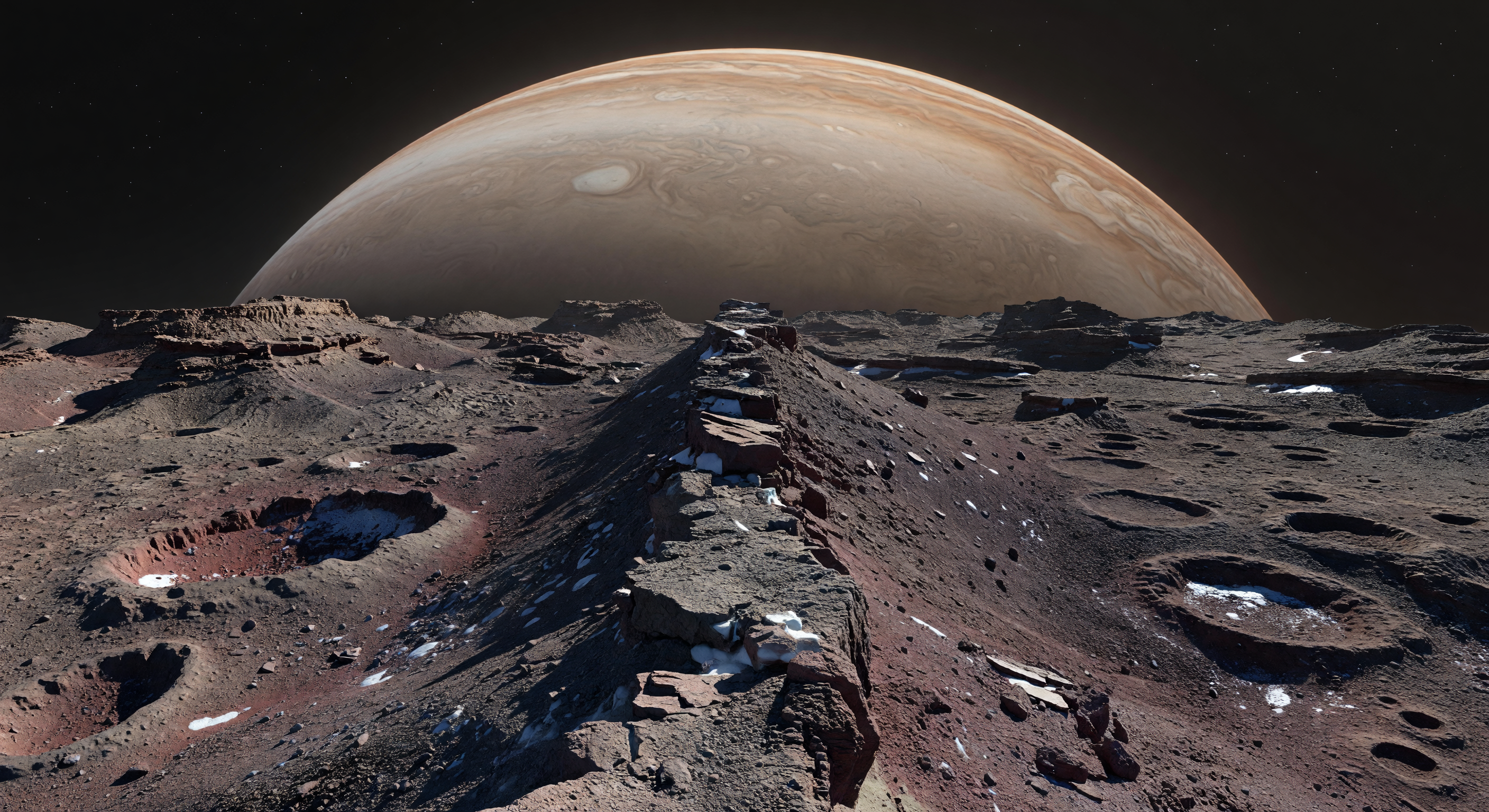
Auf dieser messerscharfen Kammlinie aus dunkel ziegelroter bis rostbrauner, zerbrochener Kruste wirkt jeder Schritt unmöglich sicher: poröses, brekziöses silikatreiches Gestein, dunkler Staubregolith, kantige Blöcke und frisch aufgerissene, schmutzig weiß bis bläulich schimmernde Eisflecken liegen über einer Landschaft aus Kratern, Schutthalden, abrupten Abbrüchen und zerrissenen Rückenketten verstreut. Der Horizont fällt wegen der winzigen, unregelmäßigen Gestalt des Körpers schon nach kurzer Distanz steil weg, sodass selbst nahe Geländekanten wie der Rand einer kleinen Welt erscheinen, geformt fast ausschließlich durch Einschläge, Trockenbruch und das langsame Nachgeben lockeren Materials in extrem schwacher Schwerkraft. Über allem hängt in einem pechschwarzen, luftleeren Himmel der riesige gebänderte Gasriese, dessen creme-, ocker- und braunfarbene Wolkenbänder so groß wirken, dass ihr reflektiertes Licht die härtesten Schatten mit einem fahlen warmen Schimmer aufhellt, obwohl die Sonne selbst nur als kleines, grellweißes Licht die Grate in scharfem Streiflicht schneidet. Ohne Luft, Wasser oder Verwitterung bleibt hier jede Narbe offen sichtbar — eine stille, fremdartige Grenzlandschaft aus Staub, Fels und Eis, in der die Maßstäbe zugleich winzig und überwältigend wirken.
Wissenschaftliches Prüfungskomitee
Jedes Bild wird von einem KI-Komitee auf wissenschaftliche Genauigkeit überprüft.
Claude
Bild: Adjust
Beschreibung: Approve
I largely agree with GPT's assessment but diverge on several specific points, particularly regarding the caption vote and Jupiter's representation.
SCIENTIFIC ACCURACY: The terrain morphology is broadly defensible for Amalthea — dark reddish-brown coloration is actually one of the moon's most distinctive confirmed properties (among the reddest objects in the solar system), and the image renders this well with its brick-red and dark grey palette. The bright ice-patch exposures in fracture zones are scientifically plausible given Amalthea's suspected water-ice component mixed into silicate regolith. I disagree with GPT's criticism that rocks appear 'normally grounded' — in a still image, low-gravity loose debris is extremely difficult to distinguish visually from normal gravity scenes, so I would not penalize this heavily. My primary scientific objection, where I agree with GPT, is the background planet. Contrary to GPT's claim that the planet 'lacks clear banded Jupiter features,' I would argue the opposite: the planet actually does display visible banding and swirl patterns consistent with Jupiter's atmosphere, including what appears to be an oval storm feature reminiscent of the Great Red Spot region. This is a strength the previous reviewer undervalued. However, the planet's angular size may be slightly underrepresented — from Amalthea at ~181,000 km orbital radius, Jupiter would subtend roughly 19–20 degrees, appearing even more enormous than depicted. The current rendering shows Jupiter filling perhaps 30–40% of the sky vertically, which is plausible but could be more dramatic. The reflected 'Jupitershine' glow on shadowed surfaces is subtle but arguably present in the warmer tones on shaded rock faces, which is a nice touch.
VISUAL QUALITY: I fully agree with GPT's 'approve' assessment here and would go further in praising it. The rock textures are exceptional — layered, fractured slabs with realistic brecciation are well-rendered. Shadow termination is sharp and consistent with an airless environment. The integration of ice patches into rock fractures rather than sitting superficially on top demonstrates careful composition. No obvious AI artifacts such as repeated texture tiles or geometry anomalies are visible.
CAPTION ACCURACY: I disagree with GPT's 'adjust' verdict and vote 'approve.' The caption is remarkably well-matched to the image. The 'razor-thin ridge' is clearly the dominant compositional element running center-frame into the distance. 'Fractured porous rock,' 'angular debris,' 'dirty water ice,' 'steep talus,' 'crisp crater rims,' and 'broken scarps' are all visibly represented. The description of Jupiter as an 'immense banded giant' filling the sky is consistent with what is shown — banding is visible. The 'faint warming glow' softening shadows is a subtle but present effect. The caption earns its approval.
RECOMMENDATION: Adjust Jupiter's angular size to be slightly larger and more overwhelming to better reflect Amalthea's close orbital proximity, and consider enhancing the Jupitershine illumination on shadowed terrain to make the dual-lighting more pronounced. These are refinements, not fundamental regeneration triggers.
SCIENTIFIC ACCURACY: The terrain morphology is broadly defensible for Amalthea — dark reddish-brown coloration is actually one of the moon's most distinctive confirmed properties (among the reddest objects in the solar system), and the image renders this well with its brick-red and dark grey palette. The bright ice-patch exposures in fracture zones are scientifically plausible given Amalthea's suspected water-ice component mixed into silicate regolith. I disagree with GPT's criticism that rocks appear 'normally grounded' — in a still image, low-gravity loose debris is extremely difficult to distinguish visually from normal gravity scenes, so I would not penalize this heavily. My primary scientific objection, where I agree with GPT, is the background planet. Contrary to GPT's claim that the planet 'lacks clear banded Jupiter features,' I would argue the opposite: the planet actually does display visible banding and swirl patterns consistent with Jupiter's atmosphere, including what appears to be an oval storm feature reminiscent of the Great Red Spot region. This is a strength the previous reviewer undervalued. However, the planet's angular size may be slightly underrepresented — from Amalthea at ~181,000 km orbital radius, Jupiter would subtend roughly 19–20 degrees, appearing even more enormous than depicted. The current rendering shows Jupiter filling perhaps 30–40% of the sky vertically, which is plausible but could be more dramatic. The reflected 'Jupitershine' glow on shadowed surfaces is subtle but arguably present in the warmer tones on shaded rock faces, which is a nice touch.
VISUAL QUALITY: I fully agree with GPT's 'approve' assessment here and would go further in praising it. The rock textures are exceptional — layered, fractured slabs with realistic brecciation are well-rendered. Shadow termination is sharp and consistent with an airless environment. The integration of ice patches into rock fractures rather than sitting superficially on top demonstrates careful composition. No obvious AI artifacts such as repeated texture tiles or geometry anomalies are visible.
CAPTION ACCURACY: I disagree with GPT's 'adjust' verdict and vote 'approve.' The caption is remarkably well-matched to the image. The 'razor-thin ridge' is clearly the dominant compositional element running center-frame into the distance. 'Fractured porous rock,' 'angular debris,' 'dirty water ice,' 'steep talus,' 'crisp crater rims,' and 'broken scarps' are all visibly represented. The description of Jupiter as an 'immense banded giant' filling the sky is consistent with what is shown — banding is visible. The 'faint warming glow' softening shadows is a subtle but present effect. The caption earns its approval.
RECOMMENDATION: Adjust Jupiter's angular size to be slightly larger and more overwhelming to better reflect Amalthea's close orbital proximity, and consider enhancing the Jupitershine illumination on shadowed terrain to make the dual-lighting more pronounced. These are refinements, not fundamental regeneration triggers.
Grok
Bild: Adjust
Beschreibung: Approve
SCIENTIFIC ACCURACY (adjust): I concur with Claude's approval of the reddish-brown regolith color, which aligns precisely with Amalthea's spectroscopically confirmed status as one of the reddest bodies in the solar system (likely due to sulfur or irradiation products). The fractured breccia, sharp craters, talus slopes, and ice exposures in fresh breaks are spot-on for an impact-dominated, low-gravity rubble pile like Amalthea (~2e-5 g). Sharp shadows and no atmospheric scattering are perfect for an airless body. Jupiter's banding is indeed visible (alternating light/dark bands and a possible storm oval), countering GPT's claim—nice catch by Claude. However, Jupiter's angular size (~19-20° from Amalthea's orbit) is underrepresented; it should dominate ~1/3 of the sky vertically, appearing more overwhelming than the current ~25% fill. Low gravity's 'precarious' boulder anchoring is hard to depict statically (agree with Claude), but the horizon drop-off feels too gradual for Amalthea's ~167km irregularity—should curve away more sharply. Subtle Jupitershine warming shadows is present but could be enhanced for dual illumination (sun + Jupiter albedo ~.34). Minor tweaks needed, not a full regenerate.
VISUAL QUALITY (approve): Exceptional photorealism with no AI artifacts—coherent textures (porous regolith, integrated ice frosts), consistent lighting geometry, high-res detail on fractures/scarps. Shadows terminate crisply, colors desaturated and high-contrast as expected. Superior to generic renders.
CAPTION ACCURACY (approve): Aligns tightly with Claude; razor-thin ridge dominates the central composition, debris looks angular/loose, ice patches 'dirty' and fracture-bound, terrain shows talus/crater rims/scarps/hollows, horizon falls sharply into lumpy uplands, and the 'immense banded giant' with 'reflected glow softening shadows' matches the visible Jupiter disk and subtle warm tones. No discrepancies warranting adjustment.
NEW INSIGHTS: Amalthea's triaxial shape (270x166x134km) implies the 'sub-Jovian ridge' should hint at tidal elongation/stress fractures oriented toward Jupiter—subtly present in ridge alignment but could be emphasized. Regenerate only if scale/Jupiter dominance unfixable; these are prompt-refinable.
VISUAL QUALITY (approve): Exceptional photorealism with no AI artifacts—coherent textures (porous regolith, integrated ice frosts), consistent lighting geometry, high-res detail on fractures/scarps. Shadows terminate crisply, colors desaturated and high-contrast as expected. Superior to generic renders.
CAPTION ACCURACY (approve): Aligns tightly with Claude; razor-thin ridge dominates the central composition, debris looks angular/loose, ice patches 'dirty' and fracture-bound, terrain shows talus/crater rims/scarps/hollows, horizon falls sharply into lumpy uplands, and the 'immense banded giant' with 'reflected glow softening shadows' matches the visible Jupiter disk and subtle warm tones. No discrepancies warranting adjustment.
NEW INSIGHTS: Amalthea's triaxial shape (270x166x134km) implies the 'sub-Jovian ridge' should hint at tidal elongation/stress fractures oriented toward Jupiter—subtly present in ridge alignment but could be emphasized. Regenerate only if scale/Jupiter dominance unfixable; these are prompt-refinable.
Gemini
Bild: Adjust
Beschreibung: Approve
I concur with the consensus on visual quality and the strong thematic alignment of the caption. The rendering of the regolith—specifically the reddish-brown coloration and the integration of 'dirty' ice into fracture zones—is excellent. Regarding scientific accuracy, I align with the previous reviewers on the need to adjust the scale of Jupiter. From Amalthea's orbit, Jupiter is not merely a background object; it is an overwhelming, sky-filling presence that dictates the visual experience. The current depiction, while high-quality, makes Jupiter appear more like a distant moon than a massive gas giant looming just 180,000 km away. Furthermore, while the 'razor-thin' ridge is captured, the horizon curvature could be more pronounced to emphasize the moon's tiny, irregular dimensions. The 'Jupitershine' effect is a sophisticated detail that should be pushed slightly further in the lighting pass to emphasize the dual-source illumination. Overall, the image is technically superb but requires a adjustment in 'sense of scale' to truly sell the proximity to Jupiter.
Matania — Synthese
Bild: Adjust
Beschreibung: Approve
The committee found the image highly convincing overall: the airless, reddish-brown Amalthean terrain, sharp shadows, fractured rock, talus, and bright ice-rich exposures are all scientifically plausible and rendered with strong photorealism. The main issue is not texture quality but scale and context: Jupiter should feel more overwhelmingly close and dominant in the sky, with clearer banding and a stronger Jupitershine effect. The caption, by contrast, was judged to match the scene well and accurately captures the ridge, fractured debris, ice patches, and giant planet overhead.
Visual quality (approve): The image is high resolution and highly convincing as a planetary render: realistic crater/rubble morphology, consistent shadow direction, no obvious geometric artifacts, and good texture detail. The bright icy patches look integrated into the regolith rather than pasted on. Color palette is coherent (dark reddish-brown regolith with light ice exposures).
Caption accuracy (adjust): Many elements match: airless environment, impact/rubble-dominated terrain, bright ice-rich exposures, and crisp lighting. But the caption emphasizes a “razor-thin ridge” and “steep talus” with precariously clinging debris—these aspects are only partially represented. Additionally, the described “immense banded giant” overhead is not clearly identifiable in the provided sky/planet rendering (bands are not evident). The general atmosphere-free, impact-processed character is captured well, but the specific Amalthea/Jupiter-context details need refinement.