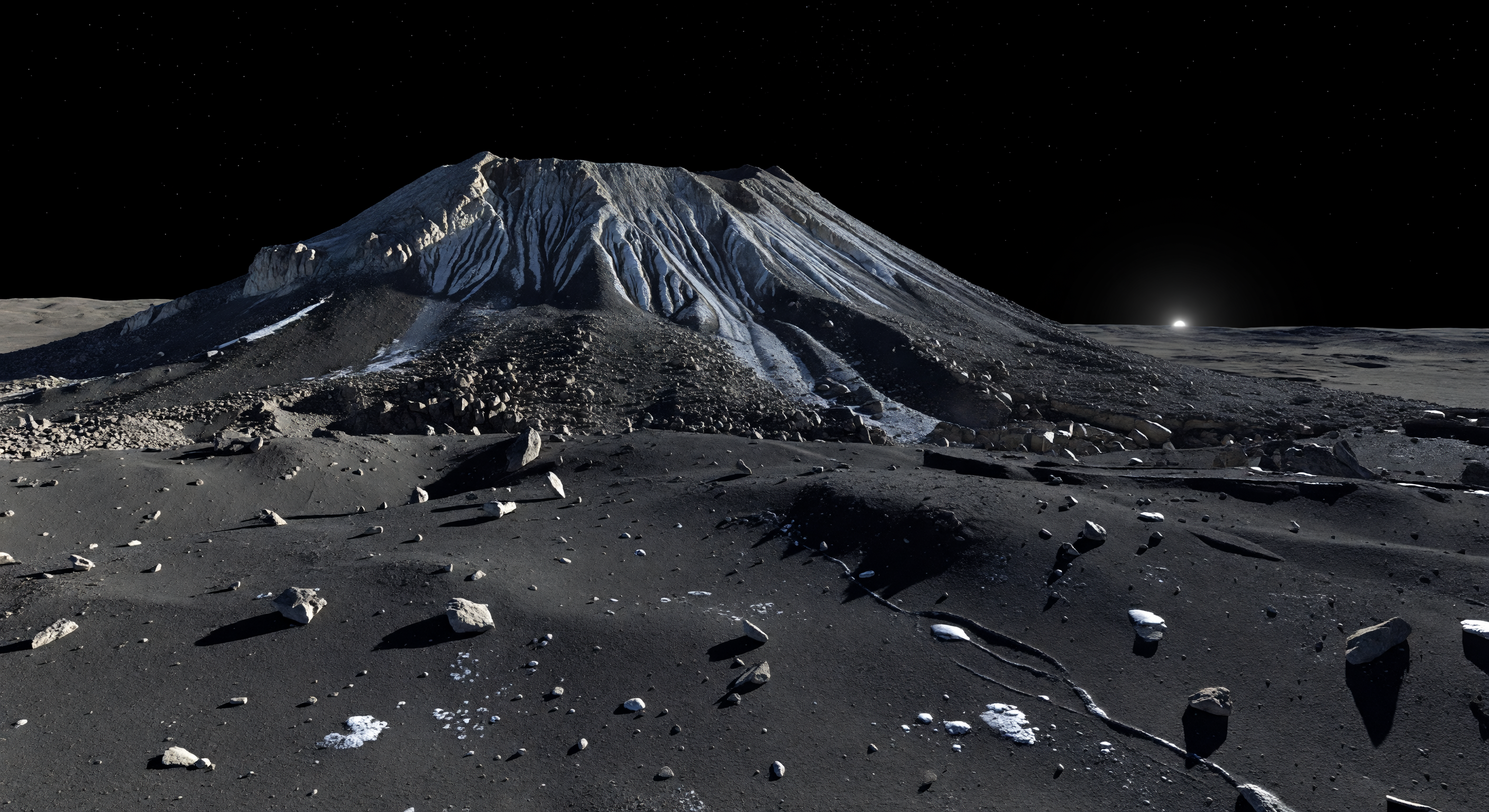
Am Fuß eines gewaltigen, steil aufragenden Berges erstreckt sich eine kalte, ausgedörrte Ebene aus dunklem, kohlenstoffreichem Regolith, übersät mit kantigen Blöcken, Schutt und vereinzelten hellen Flecken aus salz- und eisreichem Material. Darüber ragen die blassgrauen bis leicht bläulichen, tief gefurchten Flanken eines kryovulkanischen Massivs auf, dessen helle Streifen vermutlich frisch freigelegte Salze oder eisreiches Material markieren, während dunkle Schutthalden und eingestürzte Debris-Fächer seinen Fuß umgeben. Das kleine, tief stehende Sonnenbild wirft in der nahezu luftleeren Umgebung ein hartes, kaltes Licht über die Landschaft: Die Oberhänge glitzern stellenweise, doch Rinnen, Nischen und die tiefsten Furchen versinken in absolut schwarzem Schatten, messerscharf begrenzt, weil weder Atmosphäre noch Dunst das Licht streuen. Am nahen, sanft gekrümmten Horizont wird die geringe Größe dieser Welt spürbar, und zwischen alten, abgeflachten Einschlagsformen wirkt dieser einsame Eis- und Salzvulkan wie ein geologisch junges Monument aus gefrorenen Resten eines verborgenen, brinenreichen Inneren.
Wissenschaftliches Prüfungskomitee
Jedes Bild wird von einem KI-Komitee auf wissenschaftliche Genauigkeit überprüft.
Claude
Bild: Adjust
Beschreibung: Adjust
I largely concur with GPT's assessment but want to add several specific observations that sharpen the critique.
SCIENTIFIC ACCURACY: The fundamental architecture is credible — a solitary, steep-sided dome rising from a flat, dark plain with no atmospheric scattering and hard-edged shadows all align well with Ceres's airless, low-gravity environment. The bright white patches on the foreground regolith are a genuine strength: they evoke the bright spot deposits (likely sodium carbonate brines) documented by Dawn, and their placement scattered across the dark plain feels scientifically motivated. However, I flag one significant inaccuracy GPT did not stress: Ahuna Mons is notably dome-shaped with a flattened summit plateau and relatively smooth flanks compared to what is depicted here. The rendered mountain shows pronounced vertical fluting and erosional channeling that looks more like a terrestrial or Martian volcanic edifice subjected to fluid erosion — Ceres has no liquid surface water and insufficient gravity-driven mass wasting to produce such deeply incised gullies. The texturing overstates dynamic erosional processes. The regolith color in the foreground reads as mid-gray rather than the distinctly dark, carbon-rich material (albedo ~0.09) Ceres actually exhibits — it should be considerably darker. The Sun's angular size appears somewhat large for 2.77 AU; it should read as noticeably smaller than Earth's sun.
VISUAL QUALITY: Photorealism is high. Particle distribution on the regolith, shadow sharpness, and the absence of atmospheric haze are all executed well. No obvious warping artifacts or geometry inconsistencies. The bright point on the horizon (labeled as sunrise) is a nice compositional touch but reads ambiguously — it could be interpreted as an artificial light source rather than the Sun, which undermines narrative clarity.
CAPTION ACCURACY: The caption's language is evocative and directionally correct but consistently overstates feature definition. 'Deep flutes, scarps, and debris chutes' are present but lack the sharpness the prose implies. 'Charcoal plain of carbon-rich regolith' is thematically right but the rendered color is too bright. 'Sunrise' in the title is not convincingly established — the illumination angle suggests mid-elevation sun rather than a near-horizon sunrise geometry. I recommend darkening the regolith, softening and smoothing the flank texture to better match Dawn imagery of Ahuna Mons, slightly reducing the Sun's disk size, and clarifying the solar elevation to justify the 'sunrise' framing.
SCIENTIFIC ACCURACY: The fundamental architecture is credible — a solitary, steep-sided dome rising from a flat, dark plain with no atmospheric scattering and hard-edged shadows all align well with Ceres's airless, low-gravity environment. The bright white patches on the foreground regolith are a genuine strength: they evoke the bright spot deposits (likely sodium carbonate brines) documented by Dawn, and their placement scattered across the dark plain feels scientifically motivated. However, I flag one significant inaccuracy GPT did not stress: Ahuna Mons is notably dome-shaped with a flattened summit plateau and relatively smooth flanks compared to what is depicted here. The rendered mountain shows pronounced vertical fluting and erosional channeling that looks more like a terrestrial or Martian volcanic edifice subjected to fluid erosion — Ceres has no liquid surface water and insufficient gravity-driven mass wasting to produce such deeply incised gullies. The texturing overstates dynamic erosional processes. The regolith color in the foreground reads as mid-gray rather than the distinctly dark, carbon-rich material (albedo ~0.09) Ceres actually exhibits — it should be considerably darker. The Sun's angular size appears somewhat large for 2.77 AU; it should read as noticeably smaller than Earth's sun.
VISUAL QUALITY: Photorealism is high. Particle distribution on the regolith, shadow sharpness, and the absence of atmospheric haze are all executed well. No obvious warping artifacts or geometry inconsistencies. The bright point on the horizon (labeled as sunrise) is a nice compositional touch but reads ambiguously — it could be interpreted as an artificial light source rather than the Sun, which undermines narrative clarity.
CAPTION ACCURACY: The caption's language is evocative and directionally correct but consistently overstates feature definition. 'Deep flutes, scarps, and debris chutes' are present but lack the sharpness the prose implies. 'Charcoal plain of carbon-rich regolith' is thematically right but the rendered color is too bright. 'Sunrise' in the title is not convincingly established — the illumination angle suggests mid-elevation sun rather than a near-horizon sunrise geometry. I recommend darkening the regolith, softening and smoothing the flank texture to better match Dawn imagery of Ahuna Mons, slightly reducing the Sun's disk size, and clarifying the solar elevation to justify the 'sunrise' framing.
Grok
Bild: Adjust
Beschreibung: Adjust
I concur with both GPT and Claude's assessments, with additional insights on key discrepancies. SCIENTIFIC ACCURACY (adjust): The image captures Ceres' airless void well—black sky, hard-edged shadows, curved near horizon, and scattered bright white patches (likely salts/ice) on dark regolith align with Dawn mission data (e.g., Occator crater spots, low albedo ~.03-.09). Ahuna Mons' isolated dome shape rising abruptly from plains is spot-on, as is the pale bluish-gray cryovolcanic material with streaks. However, foreground regolith is mid-gray rather than the charcoal-black carbon-rich hue (albedo too high); mountain flanks show overly incised flutes/gullies inconsistent with Ahuna's smoother, dome-like profile and minimal mass-wasting in Ceres' microgravity (Dawn images show subtle talus, not deep scarps). Sun disk size is marginally too large for 2.77 AU (should subtend ~.4° vs Earth's .5°); lighting suggests elevated sun, not low-angle sunrise. Scale feels plausible (~5 km base, 4-5 km height). VISUAL QUALITY (high, minor adjust): Photorealistic excellence in regolith texture, blocky debris, shadow acuity, and no haze/artifacts; subtle AI grain adds authenticity. Sun appears plausibly stellar but ambiguous position. CAPTION ACCURACY (adjust): Description poetically overstates visible details—'deep flutes, scarps, debris chutes' and 'charcoal plain' lack sharpness/ darkness in image; 'sunrise' unsupported by low solar angle or warm gradient (cold light is accurate but not horizon-timed). Suggestions: Darken regolith to albedo ~.05, smooth flanks to match Ahuna's gentle slopes, shrink Sun slightly, lower solar elevation for true sunrise shadows, enhance subtle talus aprons.
Gemini
Bild: Adjust
Beschreibung: Adjust
I concur with the previous committee members. The visual representation of Ahuna Mons suffers from 'terrestrial bias,' where the AI has applied erosional features—specifically deep, longitudinal fluting and sharp gullies—that are physically inconsistent with a cryovolcanic dome on a low-gravity, airless body like Ceres. The morphology should reflect a more rounded, viscous-flow profile with subtle, diffuse mass-wasting rather than aggressive fluid-style incision. Furthermore, the albedo of the regolith is significantly too bright; Ceres is one of the darkest bodies in the solar system, and the foreground should be rendered closer to a deep, neutral charcoal or near-black rather than the current mid-gray. Regarding the caption, the term 'sunrise' is conceptually disconnected from the lighting geometry; to fix this, the solar disk should be positioned partially occluded by the horizon to create the characteristic long, dramatic shadows and high-contrast 'twilight' silhouette effect. I recommend a revision that prioritizes the dome's characteristic 'pancake' or 'steep-sided mound' geometry over the current jagged mountain aesthetic.
Matania — Synthese
Bild: Adjust
Beschreibung: Adjust
The committee finds the scene broadly convincing as an airless Ceres landscape centered on Ahuna Mons, with strong photorealism, hard shadows, dark regolith, and scattered bright salt/ice-like patches that fit Dawn-era observations. However, the mountain morphology is too aggressively fluted and gullied for Ahuna Mons, which should read as a smoother, dome-like cryovolcanic edifice with subtler mass-wasting textures. The foreground is also too bright for Ceres’ very low-albedo surface, and the sun/lighting do not clearly support a true sunrise scene. The caption is directionally correct but overstates visible detail and leans into a sunrise framing that is not well established by the image.
Visual quality: The image is high-quality and largely photorealistic in style, with convincing particulate regolith, good surface texture, and generally consistent shadows. No obvious major AI artifacts (warping, inconsistent geometry, or implausible objects) are apparent. The main concern is geologic specificity: some features described (e.g., numerous deep flutes/talus aprons) are not strongly evidenced.
Caption accuracy: The caption generally fits (Ceres, Ahuna Mons-like solitary mountain, dark regolith foreground, bright pale material on the mountain, airless sky). But several descriptive claims are stronger than what is clearly visible: the “deep flutes, scarps, and debris chutes” and the “charcoal carbon-rich plain” are not distinctly demonstrated. Also, “Sunrise” is somewhat inconsistent—shadows are sharp, but the scene doesn’t show a strong sunrise color/illumination gradient or sun-at-horizon timing that would make the title feel certain.