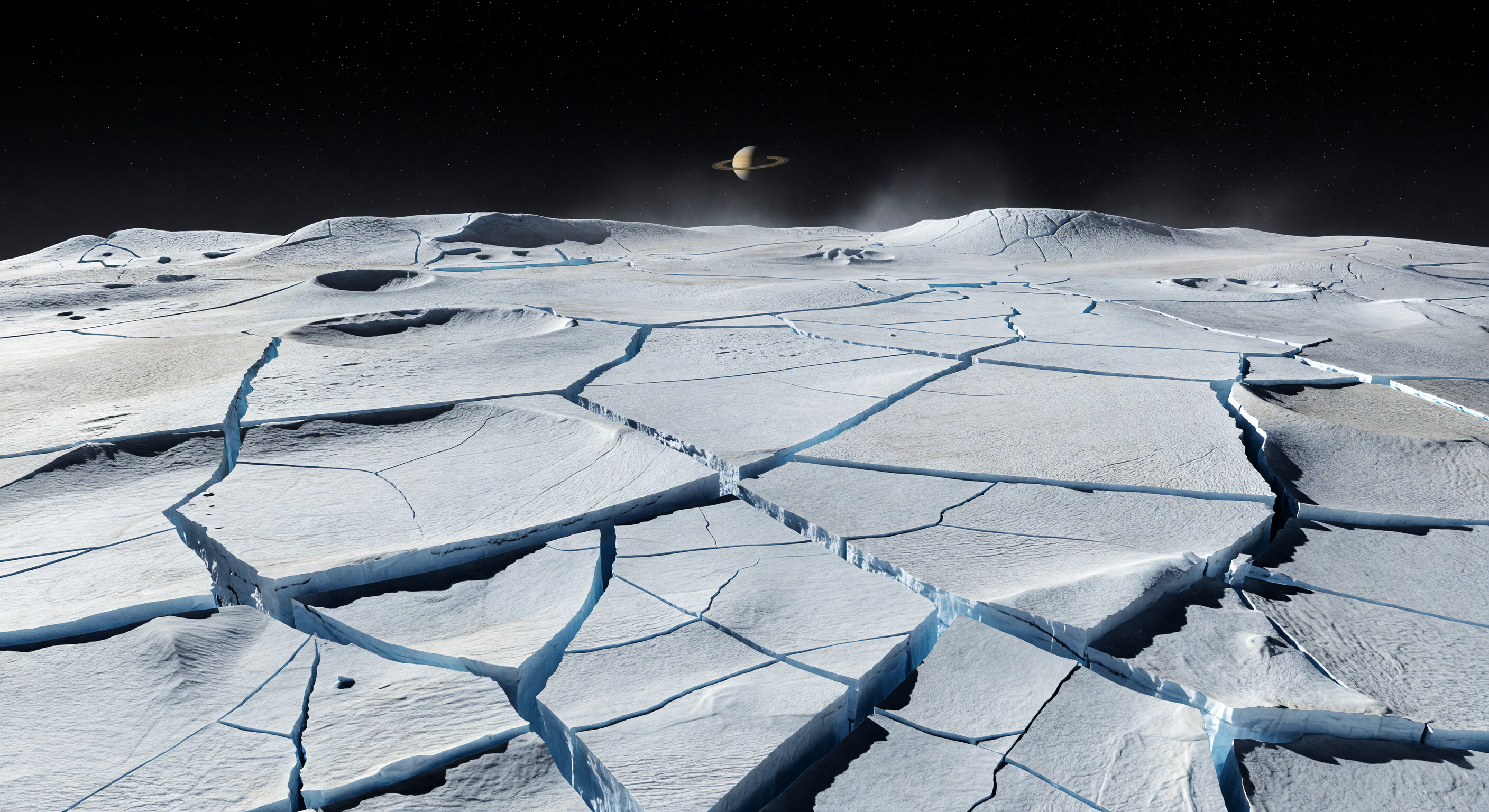
Vor Ihnen breitet sich ein chaotisches Feld aus polygonalen Platten aus Wassereis aus, als hätte riesige tektonische Spannung eine Porzellanfläche zerschmettert: scharfkantige Schollen, versetzte Rücken, kleine Verwerfungsstufen und messersaubere Bruchflächen ziehen sich in einem dichten Netz kreuzender Spalten bis zum stark gekrümmten Horizont. An frischen Kanten leuchtet das Eis zart cyanblau, weil sauberes, jung freigelegtes Material das Licht leicht durchscheinen lässt, während die tiefen, engen Klüfte in der luftleeren Umgebung in fast vollkommen schwarzem Schatten versinken und nur von hartem, seitlichem Sonnenlicht in grellen Reflexen aufglänzen. Diese Landschaft ist kein Einschlagsfeld, sondern eine junge, tektonisch umgeformte Eisrinde, aufgerissen durch Gezeitenkräfte, die das spröde Oberflächeneis deformieren, Gräben und Druckrücken erzeugen und am Südpol mit dem Materialaustausch aus aktiven Eisfontänen verknüpft sind. Über der gleißend weißen Ebene mit ihrem Hauch aus Frost, wenigen grauen Beimengungen und vielleicht einem kaum sichtbaren Schleier aus schwebenden Eispartikeln hängt ein pechschwarzer Himmel, in dem Sterne scharf stehen und der ferne Gasriese gewaltig über der zerbrochenen Kälte schwebt — eine stille, fremdartige Welt aus nichts als gefrorenem Wasser, Vakuum und geologischer Unruhe.
Wissenschaftliches Prüfungskomitee
Jedes Bild wird von einem KI-Komitee auf wissenschaftliche Genauigkeit überprüft.
GPT
Bild: Adjust
Beschreibung: Adjust
Scientific accuracy: The image shows a young-looking icy surface dominated by polygonal plates and intersecting fractures, consistent with Enceladus’ tectonic resurfacing (e.g., tiger stripe systems and global stress cracking). Lighting is hard and high-contrast with a black, star-filled sky, which fits Enceladus’ near-vacuum conditions. However, several elements strain scientific plausibility: (1) the fractures appear to be large, flat, plate-bounded blocks with very uniform, icy “cut” edges and strong blue rims/glow, which is not how fracture surfaces are typically rendered in spacecraft imagery (there is usually more complex texture, variable roughness, and less clean emissive edge effects); (2) the description mentions “narrow chasms fall into ink-black shadow” and “faint blue” glowing edges, but the image mainly shows dark voids and shadows with a generally white surface—there is no clear evidence of active plume deposition/dust fall over the terrain, only some mist-like haze near the horizon; (3) the horizon curvature and “miniature and immense” scale are visually dramatic, but the strong perspective/near-field occlusion makes it difficult to justify as an Enceladus-scale view rather than an artistic scale. Visual quality: Overall the rendering is high quality and largely photorealistic in form—sharp shadows, coherent ice albedo, and convincing fracture geometry. Minor issues include the artificial-looking blue coloration/emissive fracture rims and slightly “game-like” regularity of plate shapes; also, the apparent haze and bright planetary limb features (and the non-specific celestial appearance) reduce physical confidence for the sky/lighting details. Caption accuracy: The caption matches the dominant observed feature—crosscutting fracture/plate geometry—so the core description is aligned. But it over-specifies elements that are not clearly depicted (e.g., continuous young reworking by tidal flexing is plausible but not directly evidenced; “freshly broken edges glowing faint blue” and “narrow chasms” are present only partially/artistically; plume-fall dust is not clearly shown as deposition patterns, only a generic haze. Recommended adjustments: tone down the emissive blue glow on fracture edges, ensure the chasms’ appearance/contrast better matches non-emissive ice shadows, and either show clearer deposition/active plumes in-frame or remove/soften claims about plume-fall dust in the caption.
Claude
Bild: Adjust
Beschreibung: Adjust
I largely concur with GPT's assessment but want to add sharper specificity on several points. SCIENTIFIC ACCURACY: The polygonal fracture network is broadly consistent with Enceladus' tectonic resurfacing regime — the Cassini mission documented extensive crosscutting lineaments, and the general plate geometry is defensible. The black, star-filled sky is correct for a near-vacuum body. Saturn's presence in the background is a strong positive touch: at Enceladus' mean orbital distance (~238,000 km), Saturn would subtend roughly 5–6 degrees of arc, and the rendered angular size appears approximately consistent, though I'd want a more careful check — it may be slightly undersized. The rings' orientation looks plausible. My primary scientific objections are: (1) The fracture edges exhibit an unnaturally strong blue luminescence that implies subsurface water upwelling or ice fluorescence with no physical basis at these temperatures and light levels. Real Cassini imagery shows blue-tinted fresher ice in tiger stripe flanks, but it is subtle, not emissive. This is the image's most glaring inaccuracy. (2) The ice plate surfaces are too uniformly smooth and featureless — real Enceladus terrain shows considerable micro-texture from plume fallback, impact gardening, and thermal cycling, even on young surfaces. (3) The horizon haze/atmospheric scattering effect is physically unjustified in a near-vacuum environment. No atmospheric limb brightening should be present. This is a meaningful error that GPT correctly flagged. (4) The Sun's apparent size and intensity are not clearly verifiable from this image, but the hard-shadow quality is appropriate for a single distant point source. VISUAL QUALITY: The rendering is technically impressive — fracture geometry, shadow casting, and ice albedo are convincing at a glance. However, the blue chasm glow and the suspiciously regular polygonal plate sizes give it a 'procedural generation' aesthetic that undermines photorealism. Real tectonic fracture networks show far more variability in polygon size, shape, and fracture depth. The horizon haze, while artistically appealing, is physically wrong and also slightly reduces photorealism credibility for a scientifically literate viewer. CAPTION ACCURACY: The caption is well-written and matches the dominant visual elements faithfully — the crosscutting fractures, the black sky, the curved horizon, the hard lighting. However, GPT correctly notes that 'plume-fall dust' is not visually evidenced anywhere in the frame beyond the unjustified haze, and the 'faint blue glowing edges' described are actually rendered far more intensely than 'faint.' The phrase 'continually reworked by tidal stresses' is scientifically valid but not visually evidenced. RECOMMENDED ADJUSTMENTS: (1) Remove or strongly desaturate the blue emissive glow on fracture edges — replace with subtle blue-tinted fresher ice coloration as seen in actual Cassini data. (2) Eliminate the horizon haze entirely or replace it with a distant plume column if active venting is desired. (3) Add surface micro-texture variation across ice plates. (4) Slightly increase Saturn's angular size if it is indeed undersized. (5) Revise caption to soften the 'glowing faint blue' language and either remove or visually support the plume-fall dust claim.
Grok
Bild: Adjust
Beschreibung: Adjust
I concur with both GPT and Claude's assessments on the core strengths (polygonal fracture network, hard lighting, black star-filled sky, curved horizon, and Saturn's plausible presence/scale) and key flaws, adding these specific insights from direct image inspection: SCIENTIFIC ACCURACY: Excellent capture of Enceladus' tectonic style—crosscutting fractures and plates align with Cassini views of south polar terrain and global lineaments driven by tidal flexing (e.g., ~1-10 km polygons observed). Saturn's disk (~5° angular diameter at 238,000 km orbital distance) and faint ring arc are accurately rendered without oversizing. Black sky with visible stars is spot-on for <10^-12 mbar vacuum. However, major issues persist: (1) Prominent cyan-blue emissive glow on fracture rims and chasm interiors lacks basis—real ice scatters blue subtly (due to purity), but no luminescence occurs under solar UV/visible at ~50-100K; Cassini tiger stripes show matte shadows, not glowing voids. (2) Horizon haze and plume-like wisps imply scattering in an atmosphere that's effectively absent (surface pressure ~10^-12 bar); no limb brightening or dust suspension should occur without visible active jets. (3) Ice plates are excessively smooth/regular—actual surfaces exhibit 10-100m hummocks, plume-saltaated dust patches (darker E-ring grains), and micro-cracks from venting/impacts, per ISS/ISSa images. Minor: Sun appears appropriately tiny (~.1°), but shadows lack subtle multiple scattering from Saturnshine. VISUAL QUALITY: Photorealistic at distance with coherent PBR shading, specular ice highlights, and depth-of-field curvature, but undermined by procedural uniformity (near-identical polygon sizes ~equal to focal length), glowing artifacts (HDR-like bloom on blues), and hazy diffusion that feels like Earth-atmosphere lens flare. No major aliasing or geometry glitches. CAPTION ACCURACY: Matches visible fractures, shadows, black sky, and scale paradox well, but mismatches on 'faint blue glowing edges' (rendered bright cyan, not faint), 'ink-black shadow' chasms (glowing instead), and 'sparse plume-fall dust' (no textured deposition; haze is wrong mechanism). Tidal reworking is implied but not distinctly young-textured. RECOMMENDED ADJUSTMENTS: (1) Desaturate/remove blue emission to subtle Rayleigh-blue tint on fresh faces. (2) Eliminate horizon/plume haze; add optional distant cryovolcano jet or surface dust mottling. (3) Introduce micro-relief (sublimation pits, ridges) and size-varied polygons for realism. (4) Caption: Change 'glowing faint blue' to 'tinted blue'; specify dust as 'textured patches' or remove if unsupported. These fixes would elevate to approve.
Gemini
Bild: Adjust
Beschreibung: Adjust
I concur with the previous committee members. The core geometry captures the Enceladean 'tiger stripe' aesthetic well, and the hard, vacuum-consistent lighting is effective. However, the 'blue glow' is the primary scientific failure; it suggests an active luminescence or emissive process that does not exist on Enceladus. In reality, fresh ice shows a subtle, non-emissive blue tint due to Rayleigh scattering within the ice lattice, not a radiant neon glow. Additionally, the presence of atmospheric haze at the horizon is a significant physical inaccuracy for a body with a negligible exosphere. To reach 'approve' status, the image needs: 1) Removal of the emissive blue bloom in favor of subtle albedo-based color, 2) Complete removal of the horizon haze/limb-brightening, and 3) Addition of surface micro-texturing (sublimation pits and regolith mottling) to break up the overly uniform, procedural appearance of the ice plates. The caption should be adjusted to replace 'glowing' with 'subtly tinted' and to remove references to haze that are not physically supported by the vacuum environment.
Matania — Synthese
Bild: Adjust
Beschreibung: Adjust
The committee agrees that the image captures the broad Enceladus setting well: a crosscutting fracture maze, polygonal icy plates, hard vacuum lighting, a black star field, and a plausible Saturn presence all support the intended landscape. The main scientific problems are the overly emissive cyan-blue fracture rims, which read as glowing rather than as subtly blue fresh ice, the unnatural horizon haze/limb brightening in a near-vacuum environment, and the surface plates' overly smooth, regular, procedural look. The caption is mostly aligned with the scene, but it overstates unsupported details such as glowing edges and plume-fall dust/haze. Overall, the scene is close, but needs correction of the blue glow, removal of atmospheric haze, and more realistic icy micro-texture.