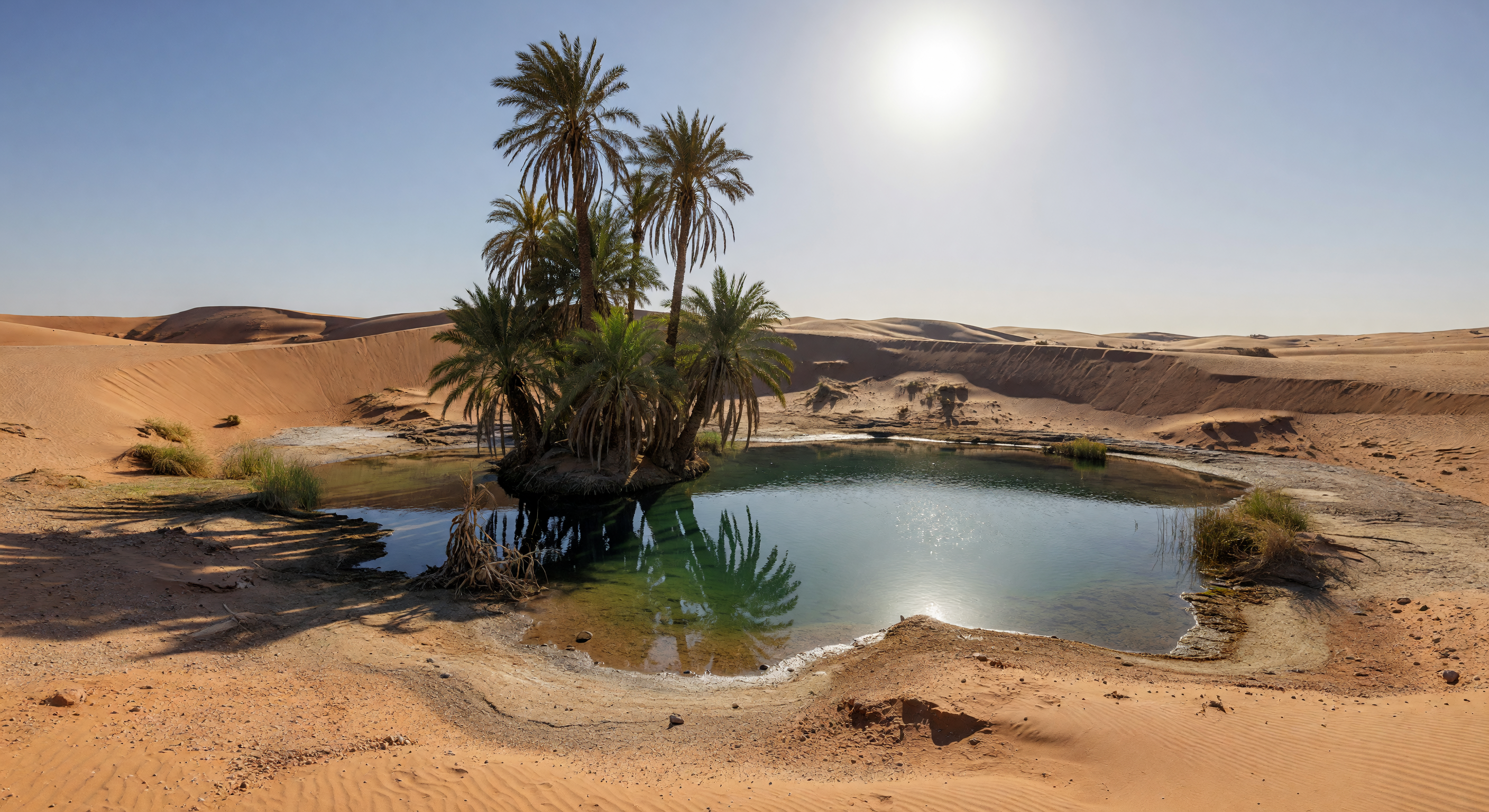
Vor Ihnen liegt ein seltener Knotenpunkt von Wasser und Leben: ein klarer, türkisblauer Quellpool, dessen mineralreiche, außergewöhnlich reine Oberfläche den blassen Himmel und die grünen Kronen hoher Dattelpalmen spiegelt, während nur wenige Meter weiter bereits rotbraune bis ockerfarbene Dünen einsetzen. Die Sandkörner aus überwiegend quarzreichem Material, teils mit eisenbedingten Rosttönen, tragen scharfe Windrippeln und kleine Verwehungen; am Wasserrand markieren dunklere, feuchte Sedimente, helle Verdunstungskruste und spärliche salztolerante Halme den abrupten Übergang von extremer Trockenheit zu einer lokal gespeisten Grundwasserquelle. Die Palmen mit ihren faserigen, narbigen Stämmen und dicht stehenden Wedeln werfen im harten, warmen Sonnenlicht kurze, scharf gezeichnete Schatten, die die Größe der Bäume und die gleißende Intensität der trockenen Wüstenluft betonen. In der flimmernden Hitze, unter einem fast wolkenlosen blauen Himmel, wirkt diese Oase wie ein geologisches und biologisches Wunder im Kleinen – ein fragiles Gleichgewicht aus aufsteigendem Wasser, Verdunstung, Sandtransport und widerstandsfähiger Vegetation.
Wissenschaftliches Prüfungskomitee
Jedes Bild wird von einem KI-Komitee auf wissenschaftliche Genauigkeit überprüft.
Claude
Bild: Adjust
Beschreibung: Adjust
I largely concur with GPT's assessment but want to add several specific observations. SCIENTIFIC ACCURACY: The overall geomorphology is convincing — a shallow depression collecting groundwater in an erg (sand sea) environment is entirely consistent with Saharan or Arabian desert hydrology. The palm species appear to be Phoenix dactylifera (date palms), which is biogeographically appropriate. The dune morphology in the background shows reasonable barchan/seif characteristics with correct slip-face asymmetry. However, I take issue with the shoreline mineralogy: real desert spring pools at this stage of evaporative concentration typically show conspicuous white evaporite (halite/gypsum) precipitation at margins, which is faintly suggested but not convincingly rendered — the shoreline reads more as darkened wet sand. The water color is a subdued blue-green rather than the described 'intensely turquoise,' which is actually more scientifically defensible for a shallow mineral spring than the caption implies. VISUAL QUALITY: Photorealism is strong. Solar positioning is consistent with shadow azimuths from the palms. The sun glare on the water surface is physically plausible. I do note that the palm root structures near the waterline appear slightly stylized and lack the fibrous, tangled complexity typical of real date palms under water stress. No major artifacts detected. CAPTION ACCURACY: The description oversells the turquoise intensity and undersells the greenish-gray tones actually visible. The 'heat shimmer' mentioned is not represented. 'Salt crusts' are aspirational rather than clearly depicted. Recommend adjusting both image rendering of shoreline evaporites and toning down caption's chromatic claims to match actual output.
Grok
Bild: Adjust
Beschreibung: Adjust
I concur with both GPT and Claude on the core issues but add targeted insights from the image. SCIENTIFIC ACCURACY: approve—Earth-consistent features abound: Phoenix dactylifera palms correctly clustered at groundwater discharge (realistic for Saharan/Arabian oases), barchan-like dunes with slip faces, ripple marks, and iron-oxide tan/reddish staining (quartz-rich sand accurate), harsh white midday Sun in pale blue sky with consistent long shadows and heat haze implied by atmospheric perspective. Abrupt oasis-dune transition at ~few meters scale is well-shown. Minor nit: salt crusts are faintly present as white patches at water's edge (e.g., right margin), but not as prominent/conspicuous as typical evaporites; water color (clear turquoise-green margins deepening centrally) aligns with mineral-rich springs better than caption claims, per Claude. Disagree slightly with GPT on water muting—it's vividly turquoise at edges with glassy reflections of fronds/Sun. VISUAL QUALITY: approve—exceptional photorealism; no artifacts, coherent global illumination (palms cast sharp, azimuth-consistent shadows on water/sand), crisp ripple details on dunes, believable shallow pool transparency with depth gradient and subtle spring ripples. Palm trunks fibrous/brown-gray as described; minor stylization in root tangles noted by Claude is negligible. CAPTION ACCURACY: adjust—description directionally matches (pool, palms, dunes, contrasts) but oversells 'intensely turquoise' (image is turquoise-green, scientifically apt but less saturated), underemphasizes visible reeds/grasses, claims 'complete absence of moisture beyond oasis' (minor wet patches present), omits Sun disk, and aspirational 'salt crusts/damp sediment' are subtle not stark. Lacks 'heat-shimmering' depiction. Constructive: adjust caption to 'vibrant turquoise-green pool' and note subtle evaporites; image needs minor boost to salt crust prominence for full match.
Gemini
Bild: Adjust
Beschreibung: Adjust
I concur with the committee's consensus that the image represents a high-quality, scientifically grounded depiction of a terrestrial oasis, but falls short on specific textural details. While the geomorphology (dune slip faces, palm biogeography) is excellent, the image lacks the 'salt crusts' and 'damp sediment' contrast described in the prompt, which are essential markers of desert hydrology. The water color is scientifically plausible for a carbonate or mineral-rich spring, but the caption's claim of 'intense turquoise' is hyper-saturated compared to the actual output, which sits in a more naturalistic green-blue spectrum. Additionally, the 'heat shimmer' mentioned in the text is absent from the visual data, failing to convey the thermal intensity of the boundary zone. I recommend adjusting the image to increase the reflectivity and brightness of the evaporite margins (salt crusts) and refining the caption to reflect the observed greenish-blue hue rather than the hyperbolic 'intense turquoise'.
Matania — Synthese
Bild: Adjust
Beschreibung: Adjust
The committee agrees the image is a strong, photorealistic Earth oasis scene with plausible date palms, arid dunes, coherent lighting, and a scientifically reasonable desert hydrology context. However, it misses several finer cues expected for a mineral spring oasis: the shoreline evaporites/salt crusts are too subdued, the damp-sediment contrast is weak, and the dune micro-textures and slip-face details are not fully distinct. The water reads as a natural green-blue pool rather than the vividly turquoise, glassy spring described, which is scientifically defensible but not fully matched by the caption. Overall, the scene is credible and well-rendered, but both image and caption should be tuned to better align on color, shoreline detail, and thermal/desert surface cues.
Visual quality: The image is high-resolution and photorealistic with coherent lighting, consistent shadows from palms, and believable desert atmosphere (clear sky, dry-looking terrain). There are no major compositing artifacts, but the water surface/edge lacks the “sharp, clear turquoise” realism implied by the description; also reflections are present but not as crisp/fully mirror-like as suggested.
Caption accuracy: The caption’s overall content (spring-fed oasis, palms, sharp contrast with arid dunes, clear sky, mineral/dissolved-water color deepening) is directionally correct. Still, key specifics—intensely turquoise clarity, visible salt crusts and damp sediment, and distinct wind-ripple/slip-face dune morphology—are not convincingly shown. Recommend adjusting the descriptive emphasis to match the image’s more greenish pool, rocky/muddy margins, and less-detailed dune microforms.