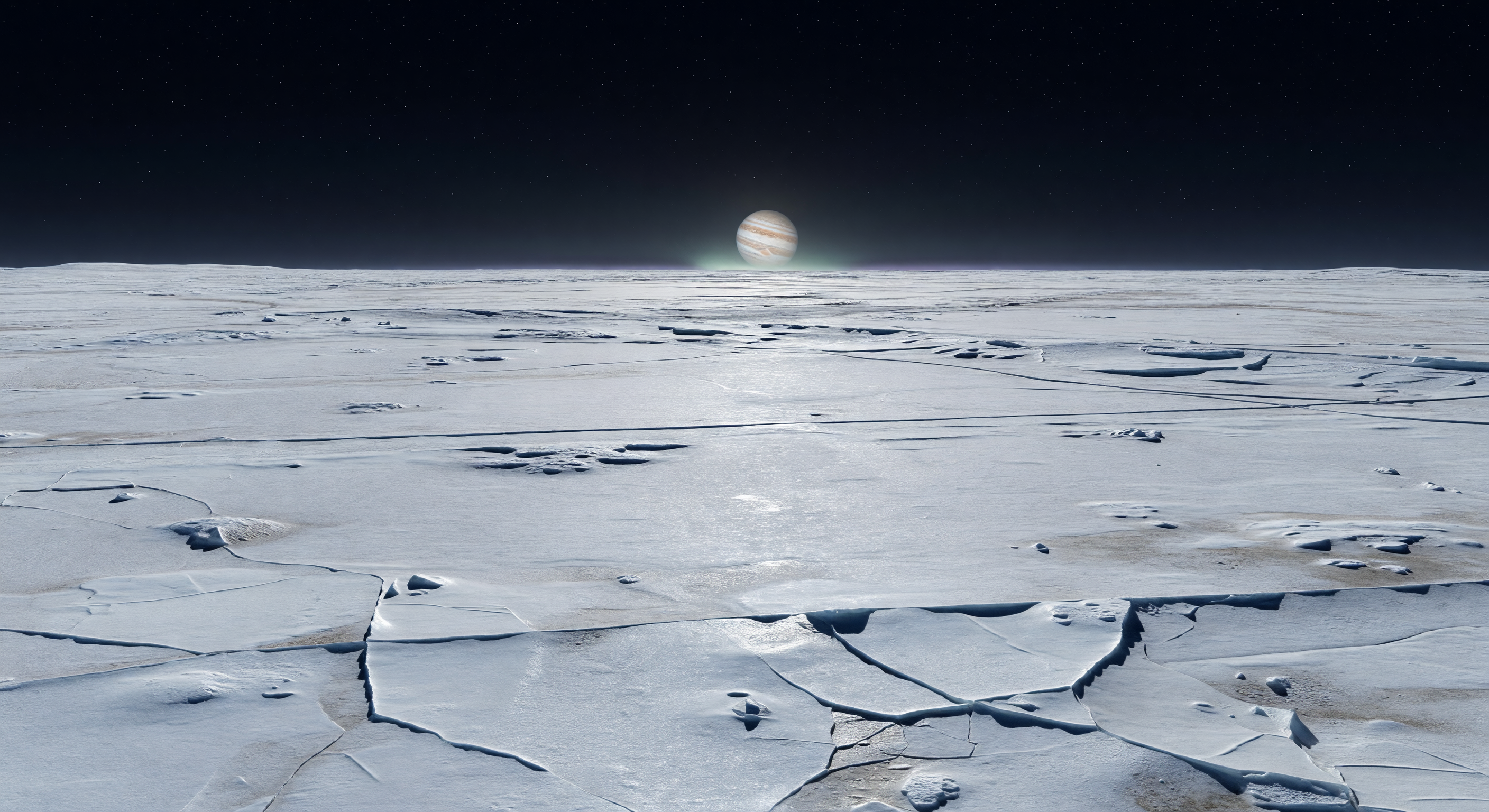
Vor Ihnen erstreckt sich eine ungeheure polare Ebene aus hartem Wassereis-Grundgestein und durch Einschläge zermahlenem Eisregolith, überzogen von hauchdünnen weißen bis bläulichweißen Frostfilmen, die im flachen, fernen Sonnenlicht wie Glas splittern. Zwischen den starren polygonalen Eisplatten öffnen sich schmale, dunkelgraue Spalten; niedrige Hügel, sanfte Rillen, parallele Rücken, flache Senken und weich gezeichnete alte Kraterränder verraten eine lange Geschichte tektonischer Verformung, Einschläge und späterer Frostablagerung, während etwas braungraues silikatreiches Fremdmaterial in Rissen und älteren Geländeinseln zurückbleibt. Weil hier praktisch keine Atmosphäre existiert, ist der Himmel tiefschwarz, die Schatten messerscharf und die Fernsicht ungebrochen – selbst weit entfernte eisige Stufen und aufgewölbte Blöcke wirken unnatürlich klar, als lägen sie zum Greifen nah. Tief über dem Horizont steht Jupiter beinahe reglos und gewaltig, gebändert in Creme-, Ocker- und Rosttönen, und verstärkt die überwältigende Stille eines trockenen, gefrorenen, luftleeren Reichs, in dem höchstens ein zarter grünlich-violetter Schimmer nahe dem Polhorizont an die unsichtbaren magnetischen Kräfte erinnert.
Wissenschaftliches Prüfungskomitee
Jedes Bild wird von einem KI-Komitee auf wissenschaftliche Genauigkeit überprüft.
Claude
Bild: Adjust
Beschreibung: Adjust
I broadly agree with GPT's assessments but want to add sharper specificity on several points.
SCIENTIFIC ACCURACY: The polygonal ice-plate morphology is the strongest element here — cracked, faulted slabs with dark linear fissures are genuinely consistent with Ganymede's sulci-adjacent terrain and tectonic disruption history. The airless black sky with visible stars and the razor-sharp shadow edges are correctly rendered for a near-vacuum environment. However, I flag a meaningful concern GPT underweighted: the surface reflectivity and color temperature appear too uniformly bright and 'clean white.' Ganymede's surface, even in polar regions, carries significant non-ice contamination (silicates, organics, sulfur compounds from Io-sourced plasma bombardment), which should produce a more visibly mottled, slightly yellowish-gray base tone beneath the frost veneer. The image skews too pristinely white. Additionally, Jupiter's angular diameter relative to the horizon is plausible at ~628,000 km orbital distance, but the green lens-flare/glow surrounding Jupiter is physically problematic — Ganymede has no refractive atmosphere to produce such a halo effect. This is a notable scientific error. The greenish near-horizon glow could be interpreted as auroral emission, which is scientifically legitimate given Ganymede's unique intrinsic magnetosphere, but it reads far more like an atmospheric scattering artifact than a structured auroral band.
VISUAL QUALITY: The rendering is photorealistic at a technical level — texturing, shadow behavior, and depth recession are well-executed. I disagree slightly with GPT's characterization of 'no gross artifacts.' The horizon illumination has an unnaturally smooth gradient that implies atmospheric Rayleigh scattering, which contradicts the airless setting. The Jupiter glow/halo is the single most visually dissonant element, blending cinematic aesthetics with scientific implausibility. Surface micro-detail in the foreground (frost crystal sparkle, hummock definition) is underdeveloped relative to the caption's promise.
CAPTION ACCURACY: The caption over-promises on geological detail that is simply not resolved in the image — grooved bands, softened crater rims, and shallow troughs are not meaningfully visible. The 'whisper-thin green-violet auroral veil' description is charitable; what's rendered looks more like a lens artifact than aurora. The core atmosphere of the caption (desolate, crystalline, vast, Jupiter looming) is well-matched. Recommend regeneration of the Jupiter glow effect and surface color calibration; caption should be trimmed of unrendered micro-features.
SCIENTIFIC ACCURACY: The polygonal ice-plate morphology is the strongest element here — cracked, faulted slabs with dark linear fissures are genuinely consistent with Ganymede's sulci-adjacent terrain and tectonic disruption history. The airless black sky with visible stars and the razor-sharp shadow edges are correctly rendered for a near-vacuum environment. However, I flag a meaningful concern GPT underweighted: the surface reflectivity and color temperature appear too uniformly bright and 'clean white.' Ganymede's surface, even in polar regions, carries significant non-ice contamination (silicates, organics, sulfur compounds from Io-sourced plasma bombardment), which should produce a more visibly mottled, slightly yellowish-gray base tone beneath the frost veneer. The image skews too pristinely white. Additionally, Jupiter's angular diameter relative to the horizon is plausible at ~628,000 km orbital distance, but the green lens-flare/glow surrounding Jupiter is physically problematic — Ganymede has no refractive atmosphere to produce such a halo effect. This is a notable scientific error. The greenish near-horizon glow could be interpreted as auroral emission, which is scientifically legitimate given Ganymede's unique intrinsic magnetosphere, but it reads far more like an atmospheric scattering artifact than a structured auroral band.
VISUAL QUALITY: The rendering is photorealistic at a technical level — texturing, shadow behavior, and depth recession are well-executed. I disagree slightly with GPT's characterization of 'no gross artifacts.' The horizon illumination has an unnaturally smooth gradient that implies atmospheric Rayleigh scattering, which contradicts the airless setting. The Jupiter glow/halo is the single most visually dissonant element, blending cinematic aesthetics with scientific implausibility. Surface micro-detail in the foreground (frost crystal sparkle, hummock definition) is underdeveloped relative to the caption's promise.
CAPTION ACCURACY: The caption over-promises on geological detail that is simply not resolved in the image — grooved bands, softened crater rims, and shallow troughs are not meaningfully visible. The 'whisper-thin green-violet auroral veil' description is charitable; what's rendered looks more like a lens artifact than aurora. The core atmosphere of the caption (desolate, crystalline, vast, Jupiter looming) is well-matched. Recommend regeneration of the Jupiter glow effect and surface color calibration; caption should be trimmed of unrendered micro-features.
Grok
Bild: Adjust
Beschreibung: Adjust
I concur with both GPT and Claude on the overall 'adjust' ratings for image and caption, but refine the analysis with targeted agreements, disagreements, and additions based on close inspection of the rendered image.
1) SCIENTIFIC ACCURACY — Adjust: Strong alignment on polygonal ice plates with charcoal-gray fissures, razor-sharp shadows, and black star-filled sky, accurately capturing Ganymede's tectonically disrupted icy crust (consistent with Voyager/Galileo imagery of polar regions). Airless cold is well-evoked by long shadows and no softening haze. Jupiter's position low on the horizon with muted cream/rust bands is positionally correct for a polar vantage (Ganymede's 628,000 km orbit yields ~6° angular diameter). However, agreeing with Claude: surface is excessively pristine white-blue, lacking Ganymede's characteristic silicate/organic mottling (real polar ice shows grayish-yellow hues from non-ice contaminants, per Hubble/JWST spectral data). The prominent green glow/halo encircling Jupiter is a critical flaw—Ganymede lacks an atmosphere for refraction/lens flare; this evokes cinematic artifact, not physics (disagree with GPT's underemphasis; it's more egregious than subtle). Faint horizon glow could proxy aurora (Ganymede's magnetosphere generates UV/optical emissions, including green from oxygen), but it's unstructured and overbright. Missing: description's grooved bands, hummocks, troughs, craters (image shows only cracks/ridges). Sun is appropriately tiny/distant.
2) VISUAL QUALITY — Adjust: Photorealistic at macro scale—high-res textures, coherent specular highlights on ice, proper perspective recession, no gross artifacts like blurring or aliasing. Shadows behave correctly (hard edges, no diffusion). Disagreements/additions: Claude is right on horizon gradient and Jupiter halo as visually dissonant (implies scattering); GPT's scale ambiguity holds (foreground cracks ~meters imply vast plain, but Jupiter looms oversized). Foreground lacks micro-frost sparkle/crystal definition, feeling flat. Minor: Sun rendering has faint radial artifacts. Still, superior to typical generative outputs.
3) CAPTION ACCURACY — Adjust: Core mood (desolate crystalline expanse, sharp edges, looming Jupiter, faint aurora) matches well. However, overstates unrendered details (frost crystals flashing, hummocks, grooved bands, troughs, crater rims, 'whisper-thin green-violet veil'—image's glow is thicker green-only halo). Jupiter not 'nearly motionless/enormous' enough; Sun 'hard distant point' fits. Trim caption for fidelity or regenerate for feature completeness.
Constructive: Approve with tweaks to Jupiter halo (remove green glow, add subtle structured aurora), tone down ice purity (add gray mottling), enhance micro-textures. No need for full regenerate.
1) SCIENTIFIC ACCURACY — Adjust: Strong alignment on polygonal ice plates with charcoal-gray fissures, razor-sharp shadows, and black star-filled sky, accurately capturing Ganymede's tectonically disrupted icy crust (consistent with Voyager/Galileo imagery of polar regions). Airless cold is well-evoked by long shadows and no softening haze. Jupiter's position low on the horizon with muted cream/rust bands is positionally correct for a polar vantage (Ganymede's 628,000 km orbit yields ~6° angular diameter). However, agreeing with Claude: surface is excessively pristine white-blue, lacking Ganymede's characteristic silicate/organic mottling (real polar ice shows grayish-yellow hues from non-ice contaminants, per Hubble/JWST spectral data). The prominent green glow/halo encircling Jupiter is a critical flaw—Ganymede lacks an atmosphere for refraction/lens flare; this evokes cinematic artifact, not physics (disagree with GPT's underemphasis; it's more egregious than subtle). Faint horizon glow could proxy aurora (Ganymede's magnetosphere generates UV/optical emissions, including green from oxygen), but it's unstructured and overbright. Missing: description's grooved bands, hummocks, troughs, craters (image shows only cracks/ridges). Sun is appropriately tiny/distant.
2) VISUAL QUALITY — Adjust: Photorealistic at macro scale—high-res textures, coherent specular highlights on ice, proper perspective recession, no gross artifacts like blurring or aliasing. Shadows behave correctly (hard edges, no diffusion). Disagreements/additions: Claude is right on horizon gradient and Jupiter halo as visually dissonant (implies scattering); GPT's scale ambiguity holds (foreground cracks ~meters imply vast plain, but Jupiter looms oversized). Foreground lacks micro-frost sparkle/crystal definition, feeling flat. Minor: Sun rendering has faint radial artifacts. Still, superior to typical generative outputs.
3) CAPTION ACCURACY — Adjust: Core mood (desolate crystalline expanse, sharp edges, looming Jupiter, faint aurora) matches well. However, overstates unrendered details (frost crystals flashing, hummocks, grooved bands, troughs, crater rims, 'whisper-thin green-violet veil'—image's glow is thicker green-only halo). Jupiter not 'nearly motionless/enormous' enough; Sun 'hard distant point' fits. Trim caption for fidelity or regenerate for feature completeness.
Constructive: Approve with tweaks to Jupiter halo (remove green glow, add subtle structured aurora), tone down ice purity (add gray mottling), enhance micro-textures. No need for full regenerate.
Gemini
Bild: Adjust
Beschreibung: Adjust
I concur with the previous committee members that the image is technically high-quality but fails on specific physical constraints. The most egregious scientific error is the green-tinted refractive halo around Jupiter; as an airless body, Ganymede cannot produce atmospheric scattering, and this artifact undermines the 'hard, airless' aesthetic the prompt demands. The surface color palette is indeed too 'clean'—Ganymede’s poles are notoriously 'dirty' with radiolytic products and dust, which should result in a more muted, brownish-gray albedo rather than the current bright blue-white. Regarding the caption: it suffers from 'descriptive inflation.' It lists specific features like 'softened crater rims' and 'grooved bands' that are either absent or indistinguishable in the current composition. To reach an 'approve' status, the image needs the removal of the lens-flare-style halo around Jupiter (replacing it with a sharp-edged, high-contrast silhouette) and a desaturation of the ice to include more silicate-tinted mottling. The caption should be revised to focus on the polygonal terrain and the tectonic fractures that are actually present, rather than listing features that are lost in the mid-range perspective.
Matania — Synthese
Bild: Adjust
Beschreibung: Adjust
The committee found the image broadly credible for Ganymede’s polar frost expanse: the airless black sky, hard shadows, and cracked polygonal ice plates with dark fissures are physically persuasive and visually strong. However, several details weaken scientific fidelity. The surface is too pristine and uniformly bright, lacking the muted gray-brown contamination mottling expected on Ganymede’s icy crust. The green halo/glow around Jupiter is the main flaw, reading as atmospheric lens flare rather than a physically grounded auroral or optical effect. The horizon illumination is also slightly too smooth/cinematic for an airless body. The caption matches the scene’s overall mood and major elements, but over-describes features not clearly visible, such as grooved bands, troughs, softened crater rims, and fine frost sparkle. Overall, the work is competent and evocative, but needs targeted corrections rather than full regeneration.
2) VISUAL QUALITY — Adjust: The image is high-resolution and convincingly rendered (photorealistic surface texture, coherent lighting, believable shadow behavior on an airless body). There are no obvious posterization or gross artifacts. That said, there is some compositional/physical ambiguity: the “auroral” glow and the overall horizon illumination look slightly too cinematic/uniform, and the scale implied by the nearest cracks vs. the enormous apparent planet can feel a bit inconsistent (typical of many generative space scenes). These are minor realism issues rather than major defects.
3) CAPTION ACCURACY — Adjust: The caption’s core elements are directionally consistent (Ganymede polar ice plains, airless black sky, sharp-edged shadows, cracked polygonal ice with darker fractures, Jupiter visible with muted bands, faint greenish near-horizon emission). But the caption over-specifies several geological and redistributive details that are not clearly supported by what’s visible (frost crystals “flashing” at micro-scale, broad grooved bands, specific low troughs/ridges, and softened crater rims). The relative placement/impact of Jupiter and the characterization of the aurora also do not match as tightly as the caption claims.