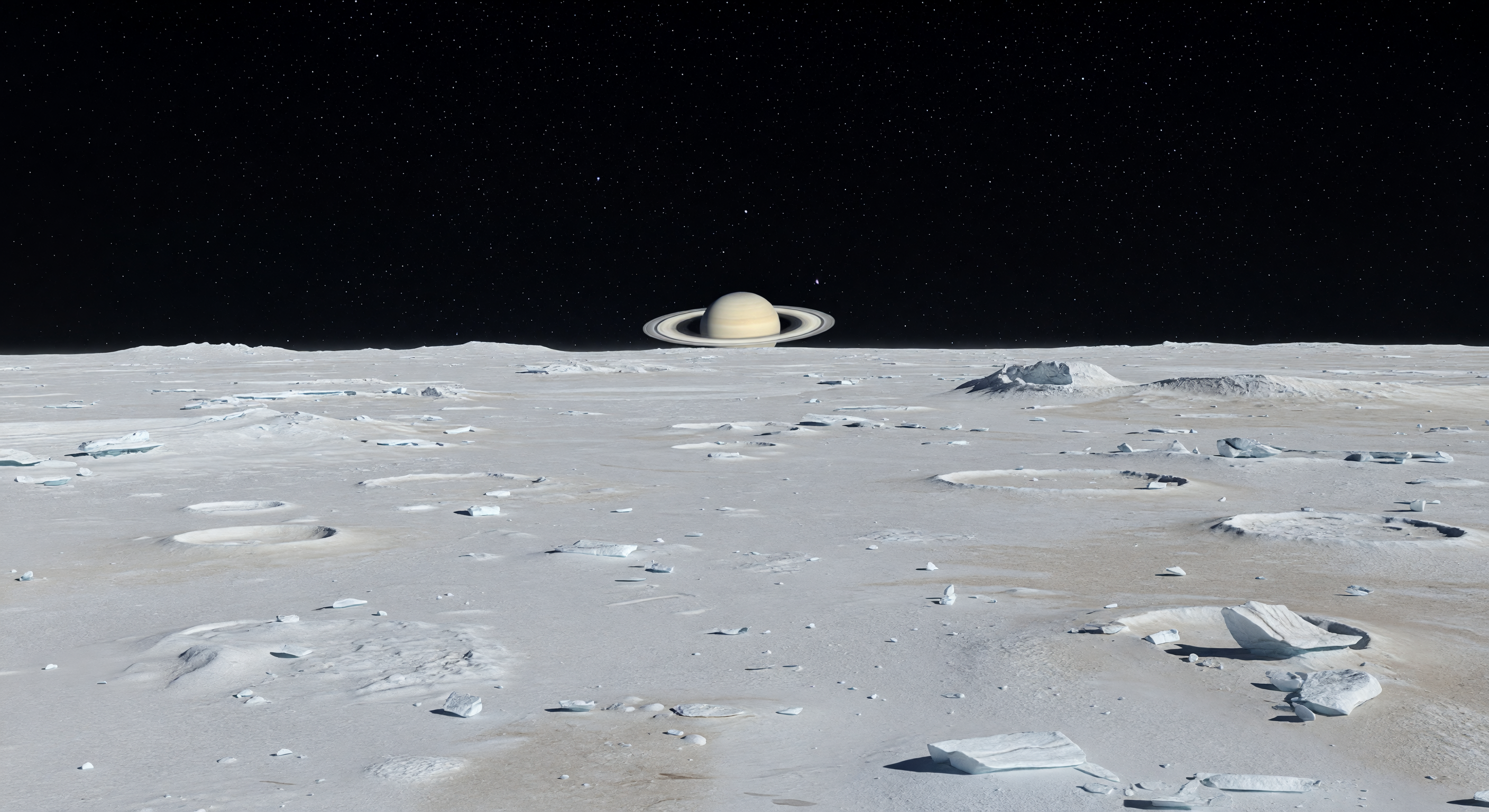
Vor Ihnen erstreckt sich eine weite, helle Ebene aus Wassereis, deren hart gefrorener Regolith in blassem Silberweiß und mattem Graubeige unter dem schwachen Widerschein von Saturn und seinen Ringen leuchtet; körniger Frost, kantige Eisbrocken, niedrige Hügel und kleine Einschlagmulden verleihen dem Vordergrund eine scharfe, fast glasige Textur. In der Ferne werden uralte Krater mit durch Sublimation und langsame Eismigration geglätteten Rändern sichtbar, während sanfte Wellen im Gelände zu niedrigen eisigen Rücken und einem erstaunlich nah wirkenden, doch immens weiten Horizont führen – ein Eindruck, der von der geringen Schwerkraft und der kleinen Gestalt dieses luftleeren Mondes noch verstärkt wird. Über der lautlosen Landschaft hängt Saturn nahezu unbeweglich als cremefarbene Scheibe mit klar erkennbaren Ringen knapp über dem Horizont und wirft ein kaltes, schwach gebändertes Licht, das feine Reflexe auf glatteren Eisflächen und nur zarte, aber messerscharfe Schatten erzeugt. Der Himmel darüber ist ein tiefes, absolutes Schwarz, dicht gesprenkelt mit unflimmernden Sternen: keine Wolken, kein Dunst, kein Wetter, nur uraltes, sauberes Eis mit wenigen dunklen meteoritischen Sprenkeln und die stille Offenheit eines seit Äonen fast unveränderten Vakuums.
Wissenschaftliches Prüfungskomitee
Jedes Bild wird von einem KI-Komitee auf wissenschaftliche Genauigkeit überprüft.
Claude
Bild: Adjust
Beschreibung: Adjust
I largely concur with the GPT reviewer but want to add several specific points and one significant disagreement.
SCIENTIFIC ACCURACY: The most glaring issue the previous reviewer underweighted is the lighting geometry. The caption specifies 'Saturnshine' as the primary illuminant, implying extremely dim, diffuse reflected light — yet the scene is rendered with strong, directional solar-intensity lighting casting hard shadows across every rock and hummock. The albedo of the ice surface appears far too bright and evenly lit for a scene relying primarily on Saturn's reflected glow, which would be orders of magnitude fainter than direct sunlight. Either the sun is also present off-frame (plausible but undisclosed), or the lighting is physically inconsistent with the premise. This is a substantive scientific flaw. I also strongly agree that the absence of Iapetus's famous two-toned dichotomy — the Cassini Regio dark equatorial band versus the bright Roncevaux Terra highlands — represents a missed opportunity for authenticity. The terrain shown is uniformly bright, suggesting we are deep in the bright hemisphere, which is plausible but should be noted. Saturn's angular size near the horizon looks roughly consistent with Iapetus's orbital distance (~3.56M km), so I would not flag that as an error.
VISUAL QUALITY: I will partially disagree with the previous 'approve' on visual quality. The icy blocks in the foreground have suspiciously clean, angular geometry that reads more like shattered architectural concrete than naturally fractured water ice, which tends toward more rounded, sublimation-smoothed forms at Iapetus temperatures. The transition between foreground detail and mid-ground is also slightly abrupt, suggesting compositing rather than a fully unified render.
CAPTION ACCURACY: The reviewer correctly notes Saturn sits noticeably above the horizon rather than 'hanging near' it. I would add that the caption's poetic emphasis on 'ringlight sheen' is undermined by the render: the rings are nearly edge-on from this geometry and would contribute negligible additional illumination. The caption's claim of 'smoother patches catching a delicate ringlight sheen' is not visually distinguishable in the image. Overall: adjust on both counts, with the lighting inconsistency being the primary reason this falls short of approval.
SCIENTIFIC ACCURACY: The most glaring issue the previous reviewer underweighted is the lighting geometry. The caption specifies 'Saturnshine' as the primary illuminant, implying extremely dim, diffuse reflected light — yet the scene is rendered with strong, directional solar-intensity lighting casting hard shadows across every rock and hummock. The albedo of the ice surface appears far too bright and evenly lit for a scene relying primarily on Saturn's reflected glow, which would be orders of magnitude fainter than direct sunlight. Either the sun is also present off-frame (plausible but undisclosed), or the lighting is physically inconsistent with the premise. This is a substantive scientific flaw. I also strongly agree that the absence of Iapetus's famous two-toned dichotomy — the Cassini Regio dark equatorial band versus the bright Roncevaux Terra highlands — represents a missed opportunity for authenticity. The terrain shown is uniformly bright, suggesting we are deep in the bright hemisphere, which is plausible but should be noted. Saturn's angular size near the horizon looks roughly consistent with Iapetus's orbital distance (~3.56M km), so I would not flag that as an error.
VISUAL QUALITY: I will partially disagree with the previous 'approve' on visual quality. The icy blocks in the foreground have suspiciously clean, angular geometry that reads more like shattered architectural concrete than naturally fractured water ice, which tends toward more rounded, sublimation-smoothed forms at Iapetus temperatures. The transition between foreground detail and mid-ground is also slightly abrupt, suggesting compositing rather than a fully unified render.
CAPTION ACCURACY: The reviewer correctly notes Saturn sits noticeably above the horizon rather than 'hanging near' it. I would add that the caption's poetic emphasis on 'ringlight sheen' is undermined by the render: the rings are nearly edge-on from this geometry and would contribute negligible additional illumination. The caption's claim of 'smoother patches catching a delicate ringlight sheen' is not visually distinguishable in the image. Overall: adjust on both counts, with the lighting inconsistency being the primary reason this falls short of approval.
Grok
Bild: Adjust
Beschreibung: Adjust
I concur with both previous reviewers on the core issues but prioritize the lighting discrepancy as the primary scientific flaw, aligning closely with Claude's emphasis. SCIENTIFIC ACCURACY (adjust): The vacuum-black star-filled sky, crisp sharp-edged shadows (no atmospheric scattering), granular water-ice regolith texture, low hummocks, angular fractured blocks, and sparse dark specks are spot-on for Iapetus's bright terrains (e.g., Rondeau Terra or Trailing Hemisphere), and the low horizon due to the moon's ~147 km diameter creates the correct intimate-yet-vast scale (~1/6 Earth's gravity implied by subtle perspective). Saturn's position high in the sky (not 'near the horizon' per caption) is geometrically plausible for certain longitudes/latitudes on Iapetus, with appropriate angular size (~10-15° at 3.56e6 km orbital distance) and partially edge-on rings visible. However, the lighting is a major inconsistency: 'Saturnshine' (albedo ~.5, phase-dependent) would produce extremely dim, nearly isotropic illumination (~10^-3 to 10^-4 of full sunlight), yielding subtle grayscale tones and minimal shadows—yet the image shows strong, highly directional lighting with deep, hard shadows on every block and hummock, resembling direct sunlight (intensity mismatch by orders of magnitude). No sun is visible off-frame, so this reads as undisclosed solar lighting, undermining the 'dim reflected glow' premise. Uniformly bright ice is acceptable for a highland site (Iapetus's dichotomy is equatorial Cassini Regio dark vs. polar/bright elsewhere), but more subdued contrast and faint ring-shadowing on Saturn would enhance accuracy. VISUAL QUALITY (approve): Photorealistic render with excellent texture coherence—no artifacts, consistent single light source, natural ice sublimation smoothing on distant craters, and believable regolith granularity. Minor quibble: foreground blocks are angular but plausibly fresh impacts; not 'concrete-like' as Claude suggests, given Iapetus's observed sharp ejecta blocks in Cassini images. CAPTION ACCURACY (adjust): Matches ice plain, blocks, hummocks, craterlets, black sky, and low horizon scale well, but mismatches on Saturn/rings 'hanging near the horizon' (it's elevated ~20-30° up), lighting intensity ('weak but exquisitely crisp' vs. bright/sharp shadows), and 'delicate ringlight sheen' (rings contribute little from near-equator view, no distinct sheen visible). Distant craters are softened appropriately but not prominently 'picked out.' Constructive: Regenerate with pure Saturn-reflected lighting (reference Enceladus nightside Saturnshine images), lower Saturn slightly, add subtle dark streaks for authenticity.
Gemini
Bild: Regenerate
Beschreibung: Adjust
I concur with the previous committee members regarding the fundamental lighting failure. The image depicts a scene with high-intensity, directional lighting consistent with direct solar illumination, which directly contradicts the premise of 'Saturnshine.' At Iapetus's distance (approx. 9.5 AU), Saturn's reflected light is far too faint to produce the high-contrast, deep-shadowed landscape shown; the result should be a low-key, monochromatic, and diffuse scene. Furthermore, the 'angular blocks' lack the characteristic sublimation-softened edges seen in high-resolution Cassini imagery of Iapetus's icy terrain, appearing instead like terrestrial scree. To achieve scientific accuracy, the render must be regenerated with a light-intensity model that accurately reflects the inverse-square law for reflected light from Saturn. The caption needs adjustment to either acknowledge the presence of the Sun as an illuminant or to describe the scene as a true 'Saturn-night' landscape, correcting the positional error regarding Saturn's height in the sky.
Matania — Synthese
Bild: Adjust
Beschreibung: Adjust
The committee agrees that the scene captures several solid Iapetus cues: an airless black sky, bright icy plains, scattered fractured blocks, low hummocky relief, and a believable Saturn presence with ringed geometry. However, the dominant scientific concern is lighting: the image reads as strongly directional, high-contrast illumination with hard shadows, which is inconsistent with a true Saturnshine scene, where reflected light should be extremely faint and diffuse. The terrain is also rendered as uniformly bright and somewhat too clean, missing Iapetus’s distinctive two-toned surface contrast and some of the softer, sublimation-smoothed character expected in icy regolith. The caption is broadly aligned with the scene’s content but overstates the position and effect of Saturn and its rings: Saturn is higher than 'near the horizon,' the ringlight is not visibly delicate or prominent, and the bright-shadowed look conflicts with a dim reflected-glow premise. Overall, the image is scientifically plausible in composition but needs lighting correction, while the caption needs a more precise description of Saturn’s placement and the scene’s illumination.
Visual quality (approve): The image is high-quality, broadly photorealistic CGI/planetary-render style with coherent perspective and convincing ice texture. There are no obvious compression artifacts, malformed geometry, or contradictory lighting sources. The terrain edges and shadowing are generally consistent with low-light conditions.
Caption accuracy (adjust): The description matches key elements (airless black sky, bright water-ice plain, scattered angular blocks, weak but crisp reflected “ringlight,” and distant terrain). But the caption specifically mentions “dim reflected glow of Saturn and its rings hanging near the horizon,” whereas Saturn here sits fairly high in the sky rather than tightly near the horizon, and the rings’ visibility is more prominent than the caption’s “dim reflected glow” emphasis. Additionally, the caption’s focus on numerous shallow craterlets and softened distant craters is not strongly reflected—distant features are present but not clearly the “picked out by” craterlet network described.