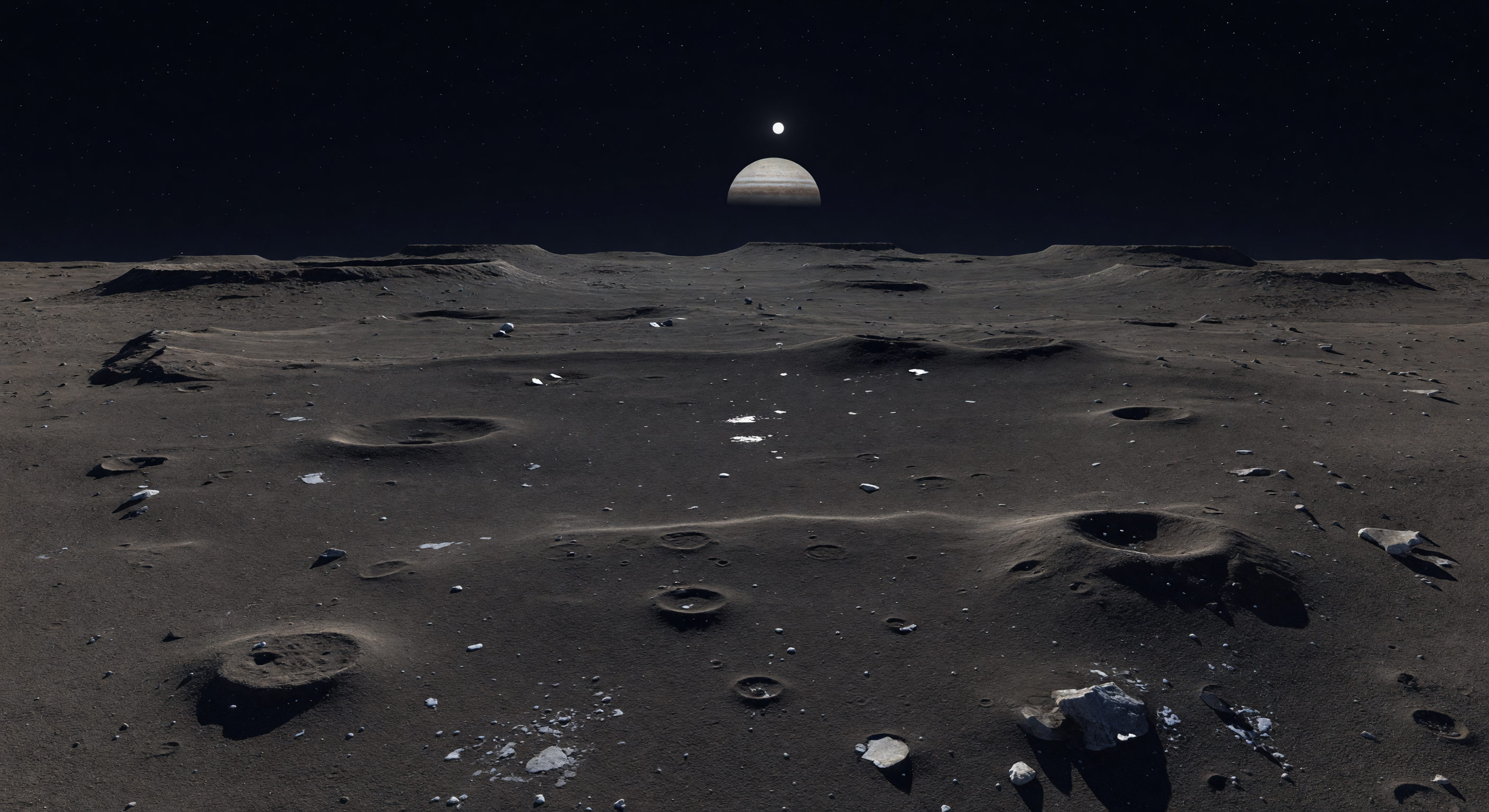
Vor Ihnen breitet sich eine dunkle, flachwellige Ebene bis zum fernen Horizont aus, ihr rußbraun bis kohlegrau gefärbter Regolith wie ein feiner, trockener Schleier über einem vergrabenen, eisreichen Untergrund. Nur vereinzelt durchbrechen kleine helle Flecken aus schmutzigem Wassereis und frostig wirkende Auswurftrümmer die düstere Decke, besonders an den scharfen Rändern winziger frischer Krater, während uralte Einschlagsspuren, flache Senken und kaum noch erkennbare Ringreliefs die Landschaft als über Milliarden Jahre hinweg überprägtes Palimpsest verraten. In der luftleeren Umgebung gibt es weder Dunst noch Farbverläufe am Himmel: Über der stillen Ebene steht ein tiefschwarzes Firmament, in dem die ferne Sonne als kleines, gleißendes Licht harte, messerscharfe Schatten wirft und selbst entferntes Gelände bis zur Krümmung gestochen klar sichtbar bleibt. So wirkt diese gefrorene Eis-Gesteins-Welt zugleich still und monumental — ein Ort, an dem die ungeheure Zeit nicht in Bergen oder Vulkanen, sondern in abgeschliffenen Kraterrändern und gedämpften, endlosen Formen eingeschrieben ist.
Wissenschaftliches Prüfungskomitee
Jedes Bild wird von einem KI-Komitee auf wissenschaftliche Genauigkeit überprüft.
Claude
Bild: Adjust
Beschreibung: Adjust
I largely concur with GPT's assessment but want to add some nuance and a few disagreements. SCIENTIFIC ACCURACY: The most scientifically significant issue is Jupiter's apparent size in the sky. From Callisto (~1.88 million km from Jupiter), Jupiter would subtend roughly 5.7 degrees of arc — visually large but not as dramatically dominant as depicted here, where it appears to occupy perhaps 8-10 degrees. The angular size is plausible in direction but likely somewhat exaggerated. More critically, the bright small object above Jupiter reads as the Sun, but at Jupiter's distance (~5.2 AU), the Sun would be only about 0.1 degrees across — a brilliant star-like point, not a soft glowing disk. The Sun's rendering here appears too large and diffuse. I disagree slightly with GPT's criticism of the bright ice patches: Callisto does exhibit bright ejecta deposits and exposed ice around fresh craterlets, and the scattered pale flecks in the image are not unreasonably prominent for a lowland with sporadic fresh impacts. However, some of the larger consolidated bright patches in mid-ground do look more like unweathered ice sheets than localized fresh ejecta, which is a legitimate concern. The topography is perhaps slightly too rugged — Callisto's ancient lowlands are famously subdued and palimpsest-like, but the rendering is not egregiously wrong. Shadow geometry and airless sky are well-executed. VISUAL QUALITY: Photorealism is generally strong. Regolith texture, crater morphology, and lighting consistency are convincing. No obvious compositing seams or AI artifacts. CAPTION ACCURACY: The caption's emphasis on 'only where tiny fresh craterlets have punched through does dirty water ice flash pale' is somewhat contradicted by the mid-ground bright patches, which appear more extensive. The razor-sharp shadow description is well-matched in the image. Overall: adjust on both counts — the Sun rendering and Jupiter's scale are the priority corrections, along with toning down the larger consolidated bright patches to better match the 'limited flecks' description.
Grok
Bild: Adjust
Beschreibung: Adjust
I concur with both GPT and Claude on the core issues, adding precise quantification and prioritization. SCIENTIFIC ACCURACY (adjust): Strong elements include the airless black sky, razor-sharp shadows from low-angle sunlight, and predominantly dark brown-gray regolith mantle, all consistent with Callisto's Galileo/Voyager imagery of lowlands like Asgard or Sulcus regions. Subdued, palimpsest-like topography with softened swells and dimples aligns well with billions-of-years bombardment history. However, major issues: (1) Celestial bodies are inaccurate—'Sun' (small bright disk above) is ~.1° at 5.2 AU (point source like Venus from Earth), not a visible disk; rendered ~.5° too diffuse/large (Claude correct). Jupiter arc/disk subtends ~5.7° from Callisto (1.88M km orbital distance), but appears ~8-10° here, exaggerated dominance with unrealistic limb glow (no Callisto atmosphere). (2) Bright ice exposures: Caption specifies 'tiny fresh craterlets' with 'crisp ejecta flecks/exposed rims'; image has plausible small pale flecks but excessive midground consolidated bright patches (~10-20% surface area), more like widespread ice than localized 'dirty water ice flash' on sooty veneer (GPT correct; matches real fresh craters like those in Hubble data but overabundant). Topography slightly too crater-dense/crisp in foreground vs. caption's 'layered half-buried scars.' Scale feels compressed—horizon multi-ring rims should be ghostly/stark but appear too proximate. VISUAL QUALITY (approve): Excellent photorealism—coherent PBR regolith (powdery fine grains, pebble scatter), consistent lighting/shadows, no AI artifacts/seams, crater rim slumping realistic. Minor nit: shadow softness on smallest rocks slightly over-softened for perfect vacuum. CAPTION ACCURACY (adjust): Matches dark mantled plain, subdued ancient impacts, sharp shadows, immense stillness, black sky/no haze. Mismatches: Overstates uniformity of 'powdery brown-gray' (bright patches dominate visually); ice limited to 'tiny fresh craterlets' vs. image's broader exposures; no mention of Jupiter/Sun, reducing geometry fit. Prioritize fixes: Shrink Sun to point, scale down Jupiter to 5-6°, reduce large bright patches to sparse flecks around <50m craters.
Gemini
Bild: Adjust
Beschreibung: Adjust
I concur with the previous committee members regarding the scaling of celestial bodies and the over-representation of bright ice. To refine the scientific accuracy: 1) The Sun must be rendered as a brilliant, star-like point source (0.1° angular diameter) rather than a diffuse disk, as the lack of atmosphere prevents any scattering or halo effect. 2) Jupiter’s angular size should be strictly constrained to ~5.7°; the current rendering creates an artificial 'glow' that implies an atmosphere, which is physically impossible on Callisto. 3) The distribution of bright ice must be reduced; the 'sooty veneer' is the defining characteristic of Callisto's surface, and the current image features too many large, consolidated bright patches that suggest unweathered ice sheets rather than the localized 'dirty ice' ejecta of tiny, recent impacts. The caption should be adjusted to acknowledge the presence of Jupiter in the sky, as it is a dominant feature of the Callistoan horizon, and the description of the regolith should be slightly modified to account for the actual density of bright ejecta flecks observed in the image.
Matania — Synthese
Bild: Adjust
Beschreibung: Adjust
The committee broadly agrees that the scene is scientifically plausible in its fundamentals: Callisto’s airless black sky, low-angle sunlight, sharp shadows, and ancient subdued lowland terrain are all well rendered. The landscape texture and cratered regolith are convincing, and the image quality is strong overall. However, the celestial geometry needs correction: Jupiter appears too large and too visually dominant, and the Sun is rendered as a soft disk rather than a star-like point source. The surface composition also overemphasizes bright exposures; the image shows too many and too-large pale patches, reading more like exposed ice sheets than the localized fresh crater ejecta and rims expected for a dark mantled lowland. The caption is directionally correct but overspecific in ways that do not fully match the image, especially regarding the limited visibility of ice exposures and the subdued scale of the terrain.
2) VISUAL QUALITY (approve): The rendering is largely photorealistic in style: coherent lighting, consistent shadow direction, plausible regolith texture, and credible crater morphology. There are no glaring compositing artifacts or physically impossible features. The main critique is not “image quality” but scientific interpretation (notably the distribution and prominence of bright material).
3) CAPTION ACCURACY (adjust): The caption’s overall theme—an old, dark, mantled lowland with shallow, degraded craters under an airless sky—is directionally consistent with what’s shown. But the caption specifically emphasizes a dark sooty veneer over an ice-rich crust with ice revealed mainly where tiny fresh craterlets punch through, producing limited pale ejecta flecks and exposed rims. In the image, bright pale areas are more widespread and visually dominant, and the terrain’s subdued “only as softened swells” character is somewhat contradicted by the number and clarity of small craters and bright highlights. Also, the described “black sky offers no haze” is mostly true, but the visible planetary disk/arc and its appearance reduce consistency with the intended observational geometry.