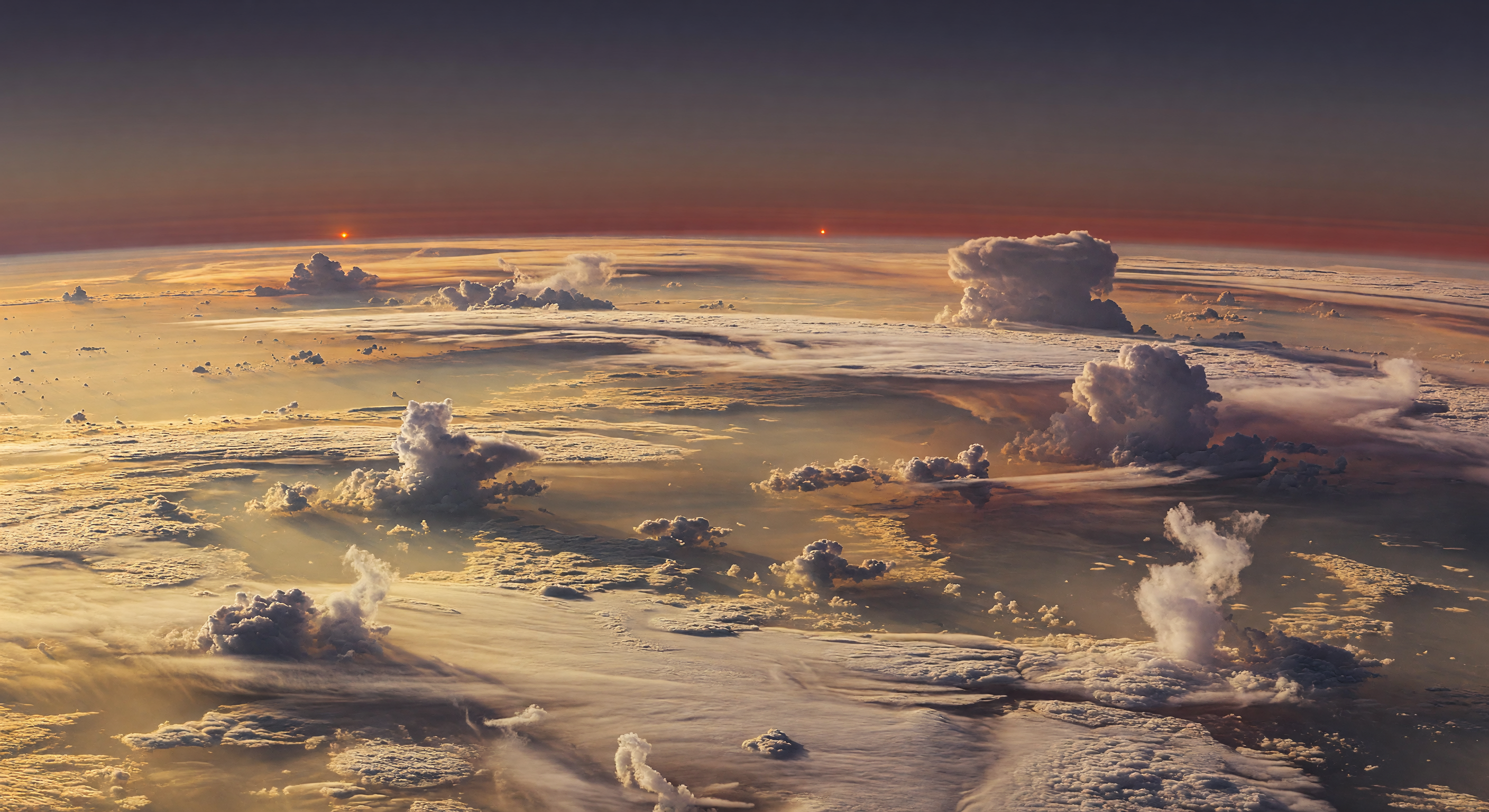
Vor Ihnen breitet sich kein Boden, sondern ein scheinbar endloses Meer aus Wolken aus: glatte, blassgoldene Decken aus gefrorenen Ammoniak- und Wassereispartikeln, durchzogen von dunkleren Rinnen, gewellten Kämmen, wirbelnden Spiralstrukturen und hoch aufragenden Sturmkuppeln, deren gefiederte Spitzen in frostigem Dunst verfließen. Am gekrümmten Horizont ist die Geometrie des Doppelsternsystems unmittelbar spürbar – der hellere orangefarbene K-Zwerg ist bereits untergegangen und hinterlässt nur einen warmen Nachschein, während der kleinere, deutlich lichtschwächere rote M-Zwerg noch knapp über den Schichten aus Apricot-, Mauve- und karmesingrauem Nebel hängt. Das schwache Restlicht legt einen kupferroten Saum auf die höchsten Wolkenkronen, während tiefe Tröge in kühles Violettgrau absinken; in der dichten Wasserstoff-Helium-Atmosphäre werden Schatten fast völlig weichgezeichnet. In dieser verlängerten, fremdartigen Dämmerung wird die gewaltige Größe des kalten Gasriesen erfahrbar: Wolkenterrassen und Konvektionszellen erstrecken sich über Hunderte von Kilometern, ohne jede feste Oberfläche, nur geformt von eisiger Chemie, starken Zonalwinden und dem langsamen Verlöschen zweier Sonnen.
Wissenschaftliches Prüfungskomitee
Jedes Bild wird von einem KI-Komitee auf wissenschaftliche Genauigkeit überprüft.
Claude
Bild: Adjust
Beschreibung: Adjust
I broadly concur with GPT's assessment but want to add specificity and a few points of disagreement on emphasis.
SCIENTIFIC ACCURACY: The cloud morphology is the strongest element here — the cumulonimbus-style convective towers punching through a stratiform deck are consistent with deep-atmosphere gas giant dynamics, and the zonal banding implied by the smooth lower terraces is plausible for a Jupiter-class circumbinary world. The curvature visible at the horizon is a good touch for conveying planetary scale. However, GPT is correct that the dual stellar points are the central scientific problem. Kepler-16(AB)b orbits two stars with a binary period of ~41 days and orbital period of ~229 days; its circumbinary geometry would produce complex but predictable differential sunset timing. The caption's specific scenario — one star below the horizon, one still visible — is scientifically coherent and actually one of the more interesting things to depict. The image fails to realize it: both luminous points are clearly present at roughly equal horizon elevation, which contradicts the 'separate sunset sequence' premise entirely. Additionally, I'd push back slightly harder than GPT on the sky color. A hydrogen-helium dominated atmosphere with aerosol hazes should produce Rayleigh-dominated scattering in shorter wavelengths — the sky aloft should trend toward blue-gray or violet more convincingly, not the warm ochre-orange gradient we see, which reads as Earth-like Rayleigh scattering under a G-type star. The reddening is plausible near the horizon under a K/M binary but the upper sky is too warm.
VISUAL QUALITY: The rendering quality is genuinely impressive. Volumetric cloud microstructure is convincing, the sense of immense scale is well-achieved, and there are no obvious AI artifacts like misshapen structures or texture tiling. The lighting is internally consistent even if not scientifically tuned. I'd note that the cloud shadows and inter-plume illumination look physically plausible, which is harder to achieve than it appears.
CAPTION ACCURACY: GPT identified the key failure — both stars visible versus caption's one-star scenario. I'll add that the caption's phrase 'weak copper-red sheen across the highest crests' partially matches the image's warm highlights on cloud tops, so there is partial alignment. The 'mauve and crimson-gray shadow' in lower bands is reasonably reflected. The caption's description of 'scalloped ridges and spiral eddies' is not clearly identifiable; what we see are more conventional convective tower formations than the banded eddies the caption implies. The overall framing of the description is evocative and largely consistent with the visual mood, but the single most important narrative element — the staggered dual sunset — is simply not depicted.
RECOMMENDATION: Adjust rather than regenerate. The base scene is strong. Specific changes needed: (1) Remove or place one stellar point below the horizon or in the apricot afterglow zone only, keeping one red companion visibly above; (2) Shift upper-sky color toward cooler violet-gray to better reflect hydrogen-helium scattering; (3) Optionally introduce more visible banded/zonal structure in the mid-distance cloud layers to better match caption language about scalloped ridges and eddies.
SCIENTIFIC ACCURACY: The cloud morphology is the strongest element here — the cumulonimbus-style convective towers punching through a stratiform deck are consistent with deep-atmosphere gas giant dynamics, and the zonal banding implied by the smooth lower terraces is plausible for a Jupiter-class circumbinary world. The curvature visible at the horizon is a good touch for conveying planetary scale. However, GPT is correct that the dual stellar points are the central scientific problem. Kepler-16(AB)b orbits two stars with a binary period of ~41 days and orbital period of ~229 days; its circumbinary geometry would produce complex but predictable differential sunset timing. The caption's specific scenario — one star below the horizon, one still visible — is scientifically coherent and actually one of the more interesting things to depict. The image fails to realize it: both luminous points are clearly present at roughly equal horizon elevation, which contradicts the 'separate sunset sequence' premise entirely. Additionally, I'd push back slightly harder than GPT on the sky color. A hydrogen-helium dominated atmosphere with aerosol hazes should produce Rayleigh-dominated scattering in shorter wavelengths — the sky aloft should trend toward blue-gray or violet more convincingly, not the warm ochre-orange gradient we see, which reads as Earth-like Rayleigh scattering under a G-type star. The reddening is plausible near the horizon under a K/M binary but the upper sky is too warm.
VISUAL QUALITY: The rendering quality is genuinely impressive. Volumetric cloud microstructure is convincing, the sense of immense scale is well-achieved, and there are no obvious AI artifacts like misshapen structures or texture tiling. The lighting is internally consistent even if not scientifically tuned. I'd note that the cloud shadows and inter-plume illumination look physically plausible, which is harder to achieve than it appears.
CAPTION ACCURACY: GPT identified the key failure — both stars visible versus caption's one-star scenario. I'll add that the caption's phrase 'weak copper-red sheen across the highest crests' partially matches the image's warm highlights on cloud tops, so there is partial alignment. The 'mauve and crimson-gray shadow' in lower bands is reasonably reflected. The caption's description of 'scalloped ridges and spiral eddies' is not clearly identifiable; what we see are more conventional convective tower formations than the banded eddies the caption implies. The overall framing of the description is evocative and largely consistent with the visual mood, but the single most important narrative element — the staggered dual sunset — is simply not depicted.
RECOMMENDATION: Adjust rather than regenerate. The base scene is strong. Specific changes needed: (1) Remove or place one stellar point below the horizon or in the apricot afterglow zone only, keeping one red companion visibly above; (2) Shift upper-sky color toward cooler violet-gray to better reflect hydrogen-helium scattering; (3) Optionally introduce more visible banded/zonal structure in the mid-distance cloud layers to better match caption language about scalloped ridges and eddies.
Grok
Bild: Adjust
Beschreibung: Adjust
SCIENTIFIC ACCURACY (adjust): I agree with both GPT and Claude that the core cloudscape—layered stratiform decks with towering convective plumes, zonal banding, and immense planetary-scale horizon curvature—is highly plausible for Kepler-16(AB)b, a Saturn-mass circumbinary world (~.13 MJup at ~.7 AU) expected to have a deep H/He atmosphere with ammonia/water-ice clouds and dynamic winds, lacking any rocky surface. The pale-gold/cream tones for upper cloud layers and shadowed mauve/crimson lower bands are reasonable speculation under K4V (orange, ~.7 Rsun) and M4V (red dwarf, ~.3 Rsun) illumination. However, the two bright stellar points (one whiter/orange left-center, one redder right-center) directly contradict the 'separate sunset sequence' where the brighter orange primary has set, leaving only the red secondary—Kepler-16AB's 41-day binary orbit allows such differential visibility, making this a missed opportunity. Sky color is too Earth-sunset ochre/orange overall; Claude is spot-on that H/He with aerosols should yield stronger violet-gray Rayleigh scattering aloft (shorter wavelengths less absorbed), not this warm gradient dominating upper sky. Minor tweak: enhance copper-red sheen selectivity on highest crests from the remaining red star.
VISUAL QUALITY (approve-level, but vote tied to science): Exceptional photorealism—volumetric cloud rendering with microtexture ( wispy edges, internal density gradients), consistent global illumination/shadows, no AI artifacts (e.g., no tiling, symmetry errors, or melting forms), and masterful depth/scale via atmospheric perspective and subtle parallax in plumes. Lighting coheres around dual sources, with horizon glow plausible for low-angle incidence. Only nit: stars slightly undersized for apparent altitude, but not distracting.
CAPTION ACCURACY (adjust): Partial mismatch on key narrative—both stars visible vs. 'brighter orange star has already slipped from view... smaller red companion hangs alone'; apricot afterglow is present but not isolated. Strong alignment on cloud details (endless plain of pale-gold/cream tops, towering storm plumes, dim violet-gray sky, weak red sheen on crests, darkening mauve/crimson-gray shadows), high vantage 'between colossal cloud banks,' and no-solid-surface ocean vibe. Caption's 'scalloped ridges, dark troughs, spiral eddies' are interpretable in the layered bands/troughs but not sharply focal (more generic convective chaos than explicit spirals). 'Prolonged circumbinary twilight' mood captures the scene's essence despite stellar discrepancy.
NEW INSIGHTS: The image's binary-star visibility implies simultaneous dusk, not staggered; scientifically, true separate sunsets occur when the binary separation projects favorably against the planet's horizon during its 229-day orbit—image could nod to this with unequal elevations. Visually, the red star's color is convincingly M-dwarf coppery vs. K-star's yellower tone. RECOMMENDATION: Minor adjustments (hide/set one star, cool upper sky to violet-gray, amplify zonal eddies) elevate to approve; base is too strong for regenerate. Concurs with GPT/Claude.
VISUAL QUALITY (approve-level, but vote tied to science): Exceptional photorealism—volumetric cloud rendering with microtexture ( wispy edges, internal density gradients), consistent global illumination/shadows, no AI artifacts (e.g., no tiling, symmetry errors, or melting forms), and masterful depth/scale via atmospheric perspective and subtle parallax in plumes. Lighting coheres around dual sources, with horizon glow plausible for low-angle incidence. Only nit: stars slightly undersized for apparent altitude, but not distracting.
CAPTION ACCURACY (adjust): Partial mismatch on key narrative—both stars visible vs. 'brighter orange star has already slipped from view... smaller red companion hangs alone'; apricot afterglow is present but not isolated. Strong alignment on cloud details (endless plain of pale-gold/cream tops, towering storm plumes, dim violet-gray sky, weak red sheen on crests, darkening mauve/crimson-gray shadows), high vantage 'between colossal cloud banks,' and no-solid-surface ocean vibe. Caption's 'scalloped ridges, dark troughs, spiral eddies' are interpretable in the layered bands/troughs but not sharply focal (more generic convective chaos than explicit spirals). 'Prolonged circumbinary twilight' mood captures the scene's essence despite stellar discrepancy.
NEW INSIGHTS: The image's binary-star visibility implies simultaneous dusk, not staggered; scientifically, true separate sunsets occur when the binary separation projects favorably against the planet's horizon during its 229-day orbit—image could nod to this with unequal elevations. Visually, the red star's color is convincingly M-dwarf coppery vs. K-star's yellower tone. RECOMMENDATION: Minor adjustments (hide/set one star, cool upper sky to violet-gray, amplify zonal eddies) elevate to approve; base is too strong for regenerate. Concurs with GPT/Claude.
Gemini
Bild: Adjust
Beschreibung: Adjust
I concur with the committee's consensus. The core technical achievement—the volumetric rendering of a gas giant's atmospheric convection—is excellent and conveys the correct 'no solid surface' scale. However, the scientific failure regarding the binary star configuration is critical. The caption explicitly defines a 'Separate Sunset Sequence' where the primary star has set, yet the image displays both stars in the sky. Furthermore, the atmospheric scattering is too Earth-centric; a hydrogen-helium atmosphere with high-altitude ammonia aerosols should exhibit a more distinct shift toward violet/cool-grey at high altitudes, rather than the warm Earth-like ochre. The 'scalloped ridges and spiral eddies' mentioned in the text are also lost in the general turbulence of the cloud plumes. I recommend an adjustment: hide the brighter star below the horizon to satisfy the 'Separate Sunset' narrative, shift the upper-sky color palette to cooler violet-grey to reflect the atmospheric composition, and introduce more deliberate, large-scale zonal eddy structures in the mid-ground to match the descriptive text.
Matania — Synthese
Bild: Adjust
Beschreibung: Adjust
The committee found the landscape visually excellent but scientifically misaligned with the stated Kepler-16(AB)b ‘Separate Sunset Sequence.’ The cloudscape is highly convincing for a deep, dynamic circumbinary atmosphere: towering convective plumes, layered decks, strong depth, and no clear solid surface all read plausibly. However, the image shows both stellar points clearly above the horizon, which undermines the key narrative of staggered sunset timing. The lighting and upper-sky palette also skew warmer and more Earth-like than expected for a hydrogen-helium atmosphere with hazes, where cooler violet-gray tones would be more appropriate. The caption broadly matches the mood and cloud morphology, but it overstates details not clearly visible and, most importantly, describes a one-star-after-sunset configuration that the image does not show.
VISUAL QUALITY (image is strong, but vote reflects scientific mismatches): The rendering is highly polished and visually coherent with good depth cues, convincing cloud microstructure, and no obvious geometric artifacts. The storms look volumetric and appropriately scale-consistent across the frame. The main issue is not realism/photorealism but that the visible dual-star configuration and the implied lighting chronology do not match the caption’s described “one star already set.”
CAPTION ACCURACY (adjust): Several caption elements are not clearly supported by what is shown. (1) The caption’s key premise—brighter orange star already slipped from view while the smaller red companion hangs alone—is not reflected: both stellar sources are visible. (2) The description emphasizes scalloped ridges, dark troughs, spiral eddies, and an opening between colossal cloud banks; the image does show layered cloud bands and prominent plumes, but the specific ‘spiral eddies/scalloped ridges’ are not clearly identifiable as such from this angle.
Overall: Visually excellent alien-cloudscape, but the sky/lighting conditions do not match the specific two-sun ‘separate sunset’ narrative. A minor revision to the star visibility/positioning and/or sky coloring would bring it closer to the caption and system geometry.