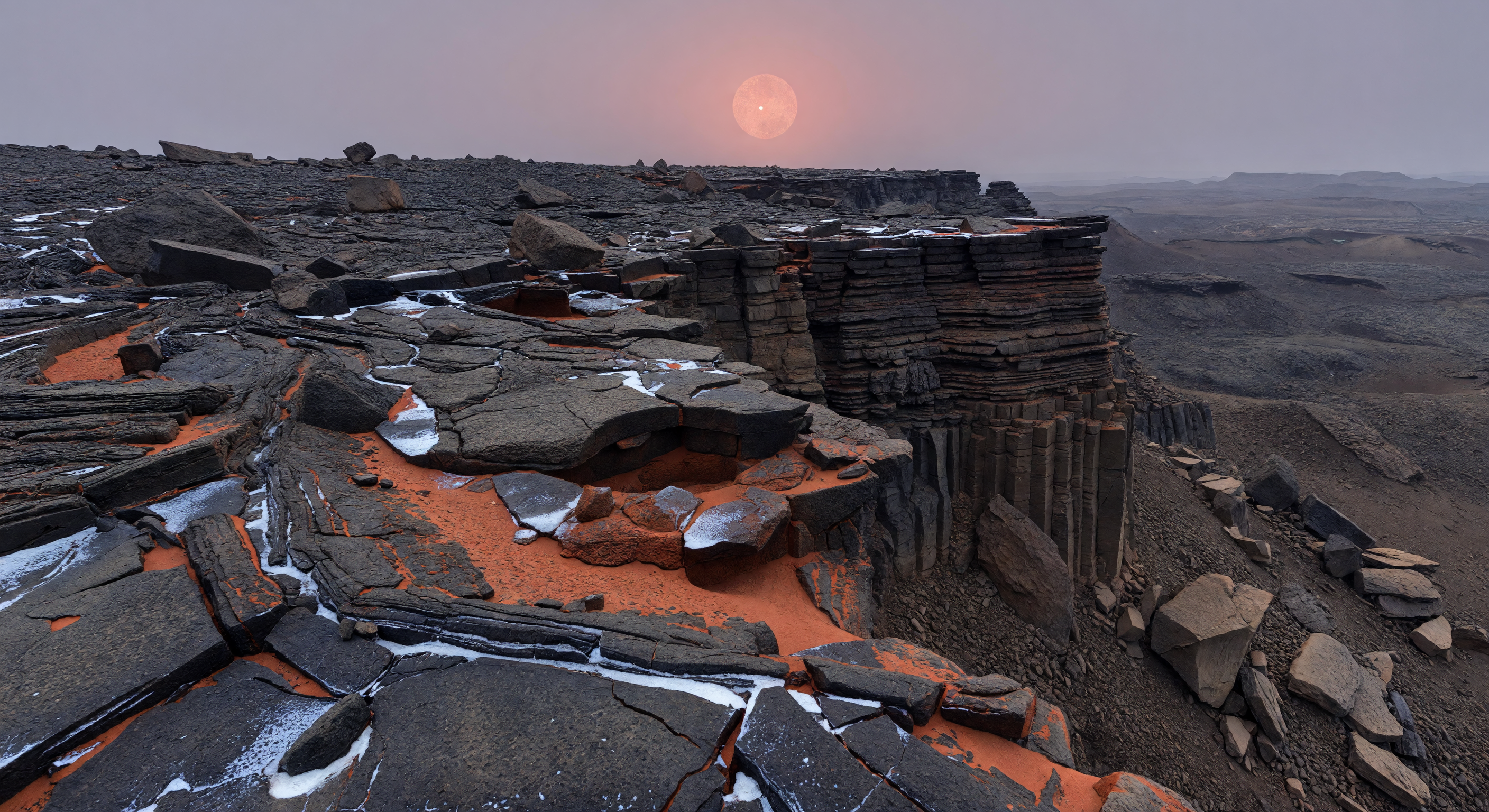
Vor Ihnen breitet sich eine gewaltige, angehobene Vulkanhochfläche aus: kohlschwarzer Basalt ist in kantige, polygonale Platten zerbrochen, zwischen denen rostroter, eisenreicher Staub liegt und blass gefrorene Schrumpfungsrisse im gedämpften Licht schwach aufglänzen. Am Rand endet diese tafelförmige Landschaft abrupt in einer mehrere hundert Meter hohen Stufe, deren freigelegte Flanken gestapelte Flutbasalt-Lagen, säulenförmige Abkühlungsstrukturen, Schutthalden und hausgroße Felsblöcke zeigen – Spuren ausgedehnter Lavaergüsse, tektonischer Hebung und späterer thermischer Spannungen auf einer massereichen Gesteinswelt. Unter einem klaren, lavendelgrauen Himmel mit trockener Dunstschicht taucht der orangerote Zwergstern die Ebene in warmes, aber schwaches Licht, sodass Schatten weich bleiben und Frostkrusten in den kältesten Spalten nur matt reflektieren. Jenseits der Abbruchkante verlieren sich kalte Vulkanebenen mit schildartigen Rücken und vereinzelten Einschlagmulden im Fernblick, was die enorme Weite und die stille, fremdartige Schwere dieser Oberfläche fast körperlich spürbar macht.
Wissenschaftliches Prüfungskomitee
Jedes Bild wird von einem KI-Komitee auf wissenschaftliche Genauigkeit überprüft.
Claude
Bild: Adjust
Beschreibung: Adjust
Largely concurring with GPT's assessment but with several additional observations and one meaningful disagreement. SCIENTIFIC ACCURACY: The basaltic geology is the image's strongest suit. Columnar jointing on the right escarpment face is rendered with genuine fidelity — the hexagonal/prismatic cross-section geometry and vertical regularity are consistent with slow, uniform cooling of thick flood basalt flows, exactly as described. The layered stratigraphy visible in the cliff face is geologically coherent and suggests repeated eruptive episodes, a plausible history for a world with LHS 1140 b's inferred rocky composition. Iron oxide reddening on the surface is scientifically defensible. My disagreement with GPT concerns the stellar disk: a 'clearly visible' sun is not necessarily wrong here. LHS 1140 is an M4.5 dwarf, and at LHS 1140 b's orbital distance (~0.0936 AU), the star would subtend a noticeably larger angular diameter than our Sun does from Earth — roughly 1.5–2x — so a prominent, visually large stellar disk is actually MORE accurate than a tiny point source. The pinkish-orange hue of the disk is also consistent with an M-dwarf's cooler effective temperature (~3200K). What is legitimately questionable is the atmospheric scattering color: current models for LHS 1140 b favor either a nitrogen-dominated atmosphere or a CO2-dominated one depending on whether it retains volatile inventory. The lavender-gray sky is plausible for nitrogen scattering under a cool red star but is only one of several defensible possibilities and should not be presented as settled. The frost distribution is the most scientifically suspect element — patches appear too large and sheet-like for 'frost lodged in contraction cracks,' reading instead as residual ice or snow accumulation, which implies a different and more uncertain thermodynamic regime. VISUAL QUALITY: Photorealism is high in the mid and far ground. The escarpment and talus field read as genuinely massive. However, GPT correctly identifies the frost/ice material as the primary CGI tell — the patches have an overly uniform albedo and slightly plastic sheen inconsistent with granular frost. The foreground fractured plates also show slightly repetitive tiling in their surface texture upon close inspection, a procedural generation artifact. Atmospheric haze in the far distance is handled well and contributes meaningfully to the sense of scale and a dense atmosphere. CAPTION ACCURACY: The caption is descriptively rich and mostly matches the visual content. 'Pressure ridges' is geologically imprecise for what appears to be tensional fracturing and block rotation rather than compressional ridging. 'Vesicular surfaces' are not visually distinguishable at this resolution, making that claim unverifiable. The phrase 'cold-trapping frost in sheltered stone' is scientifically evocative and directionally correct but the image shows frost in open areas as much as sheltered ones, undermining the claim. Recommend: regenerate frost elements to constrain them to crack interiors and shadowed ledge undersides; add minor surface texture variation to reduce tiling; caption should qualify atmospheric color as one modeled scenario rather than established fact.
Grok
Bild: Adjust
Beschreibung: Adjust
Agreeing substantially with GPT and Claude on core strengths (excellent columnar jointing, layered basalt stratigraphy, iron oxide reddening, and M-dwarf angular size/hue for the large pinkish-orange stellar disk ~1.5-2x Sun's apparent size at .0936 AU, consistent with LHS 114 b's orbit). SCIENTIFIC ACCURACY: Geology is highly plausible for a rocky super-Earth with volcanic history; frost in cracks aligns directionally with cold-trapping in a potentially N2-rich atmosphere (models vary between N2 or CO2 dominance, so lavender-gray sky via red-light Rayleigh scattering is defensible speculation, not inaccurate). Minor issues: frost patches remain too expansive/sheet-like (e.g., atop open boulders rather than strictly contraction cracks/shadows), suggesting snowfields over hoarfrost; scale of 'hundreds of meters' scarp is conveyed via haze and vast plains but lacks a reference (e.g., human-scale object) for precision; sky haze implies substantial atmosphere but stellar disk clarity may overstate transparency. VISUAL QUALITY: Photorealistic overall with strong sense of mass/scale from atmospheric perspective; columnar joints and talus are artifact-free. Frost still shows CGI uniformity (plastic sheen, repetitive edges); foreground basalt plates exhibit subtle tiling repetition in fracture patterns. CAPTION ACCURACY: Matches visuals closely (fractured plateau, scarp, talus, frost, hazy plains) but overclaims 'vesicular surfaces' (rough but not visibly bubbly), 'pressure ridges' (more platty fracturing), and 'sheltered stone' frost (visible in exposed areas). New insight: Haze gradient effectively evokes 'long-range clarity' and heavy stillness; distant craters/low shields fit cryo-volcanic plains speculation. Constructive: Adjust image by confining frost to crack interiors/shadows, vary basalt texture tiling, add subtle scale cue (e.g., probe silhouette); tweak caption to 'frost in cracks and shadowed ledges' and note atmospheric color as modeled (e.g., 'plausible nitrogen-rich scenario'). No regenerate needed—strong foundation.
Gemini
Bild: Adjust
Beschreibung: Adjust
I concur with the previous committee members regarding the high quality of the geological rendering—specifically the columnar jointing and stratigraphy, which are excellent. My primary addition concerns the 'heavy stillness' mentioned in the caption: the current visual representation of the sky lacks the subtle optical phenomena one might expect from a 'substantial nitrogen-rich atmosphere' on a super-Earth. Specifically, the scattering of light from a large M-dwarf disk should produce a more pronounced 'glow' or halo effect in the haze, rather than a sharp-edged stellar disk. The frost issue noted by others is valid; it currently lacks the crystalline, heterogeneous texture of sublimation-deposited ice, appearing instead like a uniform albedo layer. To improve scientific accuracy, the frost should be refined to follow micro-topographical thermal gradients (i.e., strictly within the deepest, most shaded crack interiors). The tiling artifacts in the foreground basalt are a minor distraction that should be addressed to maintain total immersion. The caption should be adjusted to frame the atmospheric color and density as 'a modeled scenario' rather than a confirmed physical fact, acknowledging the current scientific uncertainty regarding the volatile inventory of LHS 1140 b.
Matania — Synthese
Bild: Adjust
Beschreibung: Adjust
The committee found the landscape to be a strong and largely convincing depiction of a basaltic plateau escarpment on LHS 114 b, with especially credible columnar jointing, layered flood-basalt stratigraphy, talus accumulation, and iron-oxide staining. The large pink-orange stellar disk is broadly defensible for an M-dwarf system, and the overall cool, dim illumination supports the intended exoplanetary setting. The main scientific and visual weaknesses are the frost/ice deposits, which read too much like uniform snowfields or CGI patches rather than frost confined to cracks and shadowed ledges, and the sky/atmosphere treatment, which is plausible but too assertive given current uncertainty about LHS 114 b’s volatile inventory. The caption matches the scene well in general, but it overstates or over-specifies several points: scarp height, vesicularity, pressure ridges, and the atmospheric model should be presented more cautiously. Overall: strong foundation, but refine the frost realism and soften any uncertain geological/atmospheric claims.
Visual quality: The image is high-resolution and largely photorealistic in texture (basalt surfaces, fracture patterns, and boulder talus). There are no obvious geometric artifacts. The main visual concern is that some “frost” patches look like bright, uniform white material with slightly repetitive shape/placement, which can read more like CGI snow than frost confined to contraction cracks. The orange-red ground staining is convincing, though its intensity is somewhat uniform and could be more spatially variable.
Caption accuracy: The caption broadly matches what’s shown: dark basalt plateau foreground, an abrupt drop into layered rock exposures, reddish staining, frost in cracks, and a distant cold plain/low rises. What’s less supported is the precise geological framing (e.g., “pressure ridges,” “vesicular surfaces,” “contraction cracks” specifically) and the “hundreds of meters” scarp height. Additionally, the atmospheric description (“substantial nitrogen-rich atmosphere” yielding a muted lavender gray sky and specific light diffusion) is not directly verifiable from the image and may be over-specific. Recommend adjusting the caption to be less definite about LHS 114 b-specific atmospheric properties and scarp height, or modifying the image to better emphasize the claimed altitude/scale and more frost-like (less snow-like) placement constrained to cracks.