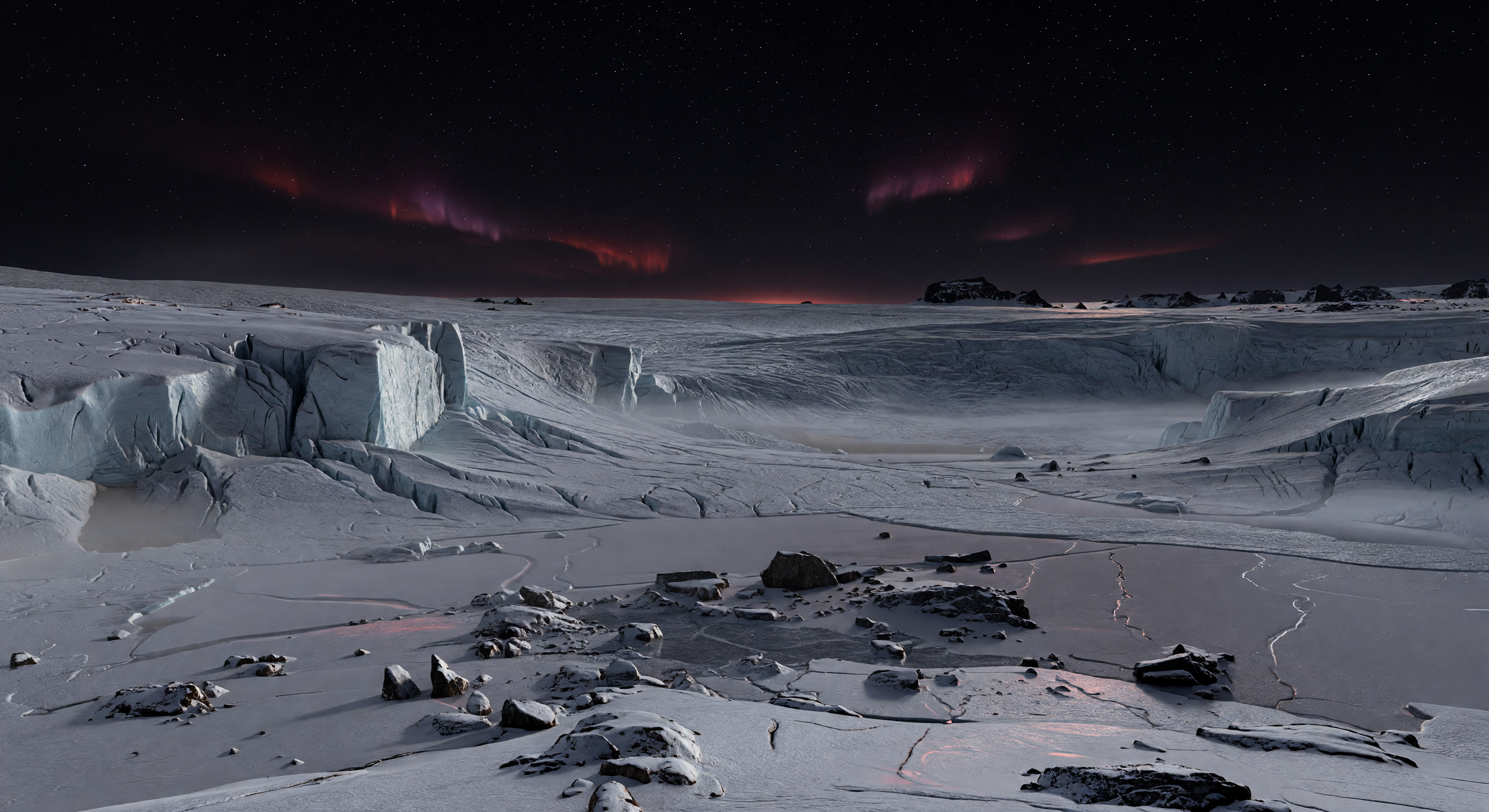
Vor Ihnen breitet sich ein Becken von nahezu kontinentalem Maßstab aus: grauweißes Wassereis, verhärtete Schneefelder und bläulich verdunkelte Spaltenbänder verschwinden unter einem sternreichen, fast schwarzen Himmel in die gekrümmte Ferne, während gezackte, von Reif überzogene Basaltblöcke wie winzige Schuttreste aus der gefrorenen Ebene ragen. Gewaltige Eisabbrüche und zerborstene Gletscherwände fallen in den weiten Beckenboden ab, darüber zeichnen sich schwarze Nunataks und halb verschüttete Gebirgskämme ab; die langgezogenen Sastrugi verraten anhaltende katabatische Winde, die Schnee und feines Kristalleis über die permanent dunkle Hemisphäre treiben. Das schwache, tiefrote Leuchten des Terminators liegt nur als schmaler Saum am Horizont, gedämpft durch eine dichte, stickstoffreiche Atmosphäre und dünne Eisnebel, während rotviolette Polarlichter über dem Eis flimmern – ein plausibler Effekt energiereicher Teilchenströme eines aktiven roten Zwergsterns. In dieser extrem kalten, trockenen Landschaft gibt es kein flüssiges Wasser, kein Leben, keinen vertrauten Maßstab: nur kolossale Gletscher, vulkanisches Grundgestein und eine stille, fremde Welt, die im Zwielicht aus Frost, Aurora und endloser Nacht zu verschwinden scheint.
Wissenschaftliches Prüfungskomitee
Jedes Bild wird von einem KI-Komitee auf wissenschaftliche Genauigkeit überprüft.
Claude
Bild: Adjust
Beschreibung: Adjust
SCIENTIFIC ACCURACY: I largely concur with GPT's assessment but want to add specificity regarding LHS 1140 b's known constraints. LHS 1140 b is a super-Earth (~1.7 Earth radii, ~5.6 Earth masses) orbiting in the habitable zone of an M4.5 dwarf at ~0.0875 AU. Recent JWST transmission spectroscopy (Cadieux et al. 2024) has raised the intriguing possibility of a nitrogen-rich atmosphere, which the caption correctly cites. A snowball or ocean-world scenario is plausible. The glacier basin concept is scientifically defensible. However, three specific concerns arise: (1) Aurora color and physics — M-dwarf flare-driven auroras on a super-Earth with a nitrogen-dominated atmosphere would likely produce emissions dominated by nitrogen molecular bands (blue-violet, some red from atomic oxygen), so the red-violet palette is not unreasonable, but the curtain morphology is very Earth-analog. LHS 1140 receives a different particle flux environment, and aurora structure is field-geometry-dependent — we have no constraint on this planet's magnetic field strength or topology. The curtains should arguably appear more diffuse. (2) The horizon glow representing the day-night terminator is one of the more scientifically creative and defensible choices here. For a synchronously rotating world in a nitrogen-rich atmosphere, refracted red-dwarf light could produce exactly this kind of persistent dim reddish limb glow along the terminator direction. This is actually stronger scientific reasoning than GPT gave it credit for — I would call this an 'approve' element. (3) Gravity: at ~1.4g surface gravity, ice sheet morphology would differ subtly — crevasse spacing, calving cliff heights, and flow rates would all be affected. The depicted glacier walls appear Earth-scaled, which is a minor but real inaccuracy.
VISUAL QUALITY: The rendering is technically accomplished. Lighting is physically coherent — the faint terminator glow provides a consistent low-angle illumination source that explains the blue-shadowed ice textures. The specular reflections of aurora on polished ice are a nice touch and render convincingly. I disagree slightly with GPT on the aurora saturation — for a committee image meant to be evocative while scientifically informed, the saturation is acceptable. My primary visual concern is the mid-ground transition between the foreground fractured basin floor and the glacier walls: the scale relationship feels compressed. The caption describes 'glacier walls towering far beyond' the boulders, implying continental-scale escarpments, but the walls appear perhaps 50-100m tall at most — impressive but not continent-scale. A stronger atmospheric perspective gradient (more haze in the distance) would sell the implied scale better. The ice fog is present but, as GPT noted, reads more as general atmospheric haze than a distinct near-surface fog layer.
CAPTION ACCURACY: The caption is ambitious and mostly consistent with the image but oversells several elements. 'Continent-scale escarpments' is not visually supported — the walls are large but not transcontinentally vast. 'Sastrugi' is mentioned but the wind-sculpted surface texture, while present, is subtle rather than dramatic. The 'reflections trembling on polished ice' is actually well-supported by the image — the aurora reflections on the ice surface are visible and effective. 'Katabatic winds' is a plausible process invocation but not visually distinguishable from other wind erosion patterns. I recommend the caption be toned down on scale claims and the image be adjusted to strengthen the near-surface fog layer and increase atmospheric depth cuing to better support the implied continental scale.
VISUAL QUALITY: The rendering is technically accomplished. Lighting is physically coherent — the faint terminator glow provides a consistent low-angle illumination source that explains the blue-shadowed ice textures. The specular reflections of aurora on polished ice are a nice touch and render convincingly. I disagree slightly with GPT on the aurora saturation — for a committee image meant to be evocative while scientifically informed, the saturation is acceptable. My primary visual concern is the mid-ground transition between the foreground fractured basin floor and the glacier walls: the scale relationship feels compressed. The caption describes 'glacier walls towering far beyond' the boulders, implying continental-scale escarpments, but the walls appear perhaps 50-100m tall at most — impressive but not continent-scale. A stronger atmospheric perspective gradient (more haze in the distance) would sell the implied scale better. The ice fog is present but, as GPT noted, reads more as general atmospheric haze than a distinct near-surface fog layer.
CAPTION ACCURACY: The caption is ambitious and mostly consistent with the image but oversells several elements. 'Continent-scale escarpments' is not visually supported — the walls are large but not transcontinentally vast. 'Sastrugi' is mentioned but the wind-sculpted surface texture, while present, is subtle rather than dramatic. The 'reflections trembling on polished ice' is actually well-supported by the image — the aurora reflections on the ice surface are visible and effective. 'Katabatic winds' is a plausible process invocation but not visually distinguishable from other wind erosion patterns. I recommend the caption be toned down on scale claims and the image be adjusted to strengthen the near-surface fog layer and increase atmospheric depth cuing to better support the implied continental scale.
Grok
Bild: Adjust
Beschreibung: Adjust
SCIENTIFIC ACCURACY: I concur with both GPT and Claude that the core icy glacier basin with crevasses, sastrugi-like wind erosion, basaltic boulders/nunataks, and terminator crimson glow is a strong, scientifically informed speculation for LHS 114 b—a ~1.7 R⊕ super-Earth in the habitable zone of an M4.5V dwarf with potential N2-rich atmosphere (per Cadieux et al. 2024 JWST data). The dim red horizon glow excellently captures synchronous rotation's day-night boundary with refracted M-dwarf light through a substantial atmosphere, providing coherent low-angle illumination. Red-violet aurora is plausible for N2-dominated emissions under stellar flare particle flux, though curtain morphology is Earth-like (minor issue: super-Earth magnetic field geometry might yield more diffuse structures). New insight: surface gravity (~1.4g) should widen crevasse spacing and steepen sastrugi relative to Earth analogs—depicted features are close but slightly understate this (e.g., crevasse bands appear narrowly spaced). Ice fog and haze align with cold N2 world katabatic flows. Overall minor tweaks needed for 1.4g scaling and aurora diffusion. VISUAL QUALITY: Photorealistic excellence in ice textures, specular aurora reflections, consistent shadows from terminator light, and no artifacts—scale feels vast via boulder-to-wall ratios. However, mid-ground compression limits 'continent-scale' impression (walls ~100m, not km-high escarpments); add deeper haze gradient for perspective. Aurora saturation is evocative and acceptable for visualization, not overly stylized; starfield is realistic. Near-surface fog is subtle—boost layering for distinction from general haze. CAPTION ACCURACY: Matches well on basin, crevasses, boulders, glow, aurora/reflections, but oversells 'towering glacier walls far beyond' (walls prominent but not continent-spanning), 'staggering scale' (good but compressed), 'thin ice fog clings' (present but faint), and 'sastrugi' (textured but subdued). Tone down scale/hyperbole or adjust image for stronger depth cues/fog. Agree with Claude on gravity nuance and terminator strength; partially disagree with GPT on aurora (more defensible than 'speculative').
Gemini
Bild: Adjust
Beschreibung: Adjust
I concur with the committee's consensus. The image is a high-quality visualization, but the discrepancy between the 'continent-scale' description and the visual representation of the glacier walls is a primary issue. To achieve scientific fidelity for a 1.4g super-Earth, the rendering should emphasize deeper atmospheric perspective (haze gradient) to push the walls further into the distance, which would simultaneously enhance the sense of scale and better justify the 'towering' descriptor. The near-surface ice fog needs to be visually distinct from the high-altitude haze to satisfy the caption. Regarding the physics, while the red-violet auroral curtains are a scientifically sound interpretation of N2 emissions, the morphology should indeed be adjusted to appear more diffuse or field-aligned to reflect the likely complex magnetic topology of a super-Earth, moving away from simple Earth-like 'curtains.' The caption should be revised to be more descriptive of the visible features rather than using hyperbolic 'continent-scale' language that the current frame cannot support.
Matania — Synthese
Bild: Adjust
Beschreibung: Adjust
The committee found the scene scientifically plausible in broad strokes for LHS 114 b: an icy Night Glacier Basin with crevasses, wind-sculpted ridging, dark rock outcrops, a dim red terminator glow, and possible auroral illumination all fit a cold super-Earth interpretation. The rendering is technically strong and photorealistic, with coherent lighting and convincing ice textures. However, the image still reads too Earth-analog in a few places: the auroral forms are somewhat too curtain-like and vivid, the near-surface ice fog is too subtle to clearly register as a distinct layer, and the glacier walls do not fully convey the vast scale implied by the caption. The caption likewise matches the visible terrain in general, but it overstates the scale of the basin and walls, and it names fog and towering escarpments more strongly than the image supports. Overall, the committee recommends adjustment rather than approval, mainly to improve physical nuance and align the text with what is actually depicted.
VISUAL QUALITY: Overall the rendering is high quality and largely photorealistic in terrain detail: consistent lighting direction, coherent ice texture, and believable scale cues from the crevasses/pressure ridges and boulder sizes. There are no obvious geometric or compositing artifacts. Minor concern: the aurora intensity and color saturation appear somewhat over-boosted (more dramatic than many plausible exoplanet aurora depictions), and the night-sky star density/intensity may be stylized rather than observation-like. Still, these are “taste” issues rather than severe technical flaws.
CAPTION ACCURACY: Several elements in the caption match what’s visible: icy basin, blue-tinted crevasse bands (crevasses/ice fractures present), scattered dark rocks, horizon glow, and auroral curtains overhead with reflections on ice. But the caption includes details that are not clearly supported: “wind-sculpted sastrugi” is present but could be more explicit/strongly textured; “immense glacier walls towering far beyond them” is not as prominent as the foreground escarpment—there’s a wall, but the continent-scale walling implied by the wording isn’t strongly conveyed. “Thin ice fog clings to the surface” is only weakly visible; haze is present but not clearly “fog clinging” in the near-ground layer. Because of these mismatches, the caption should be toned down or the image should be adjusted to better show the described fog and the more distant towering escarpment scale.