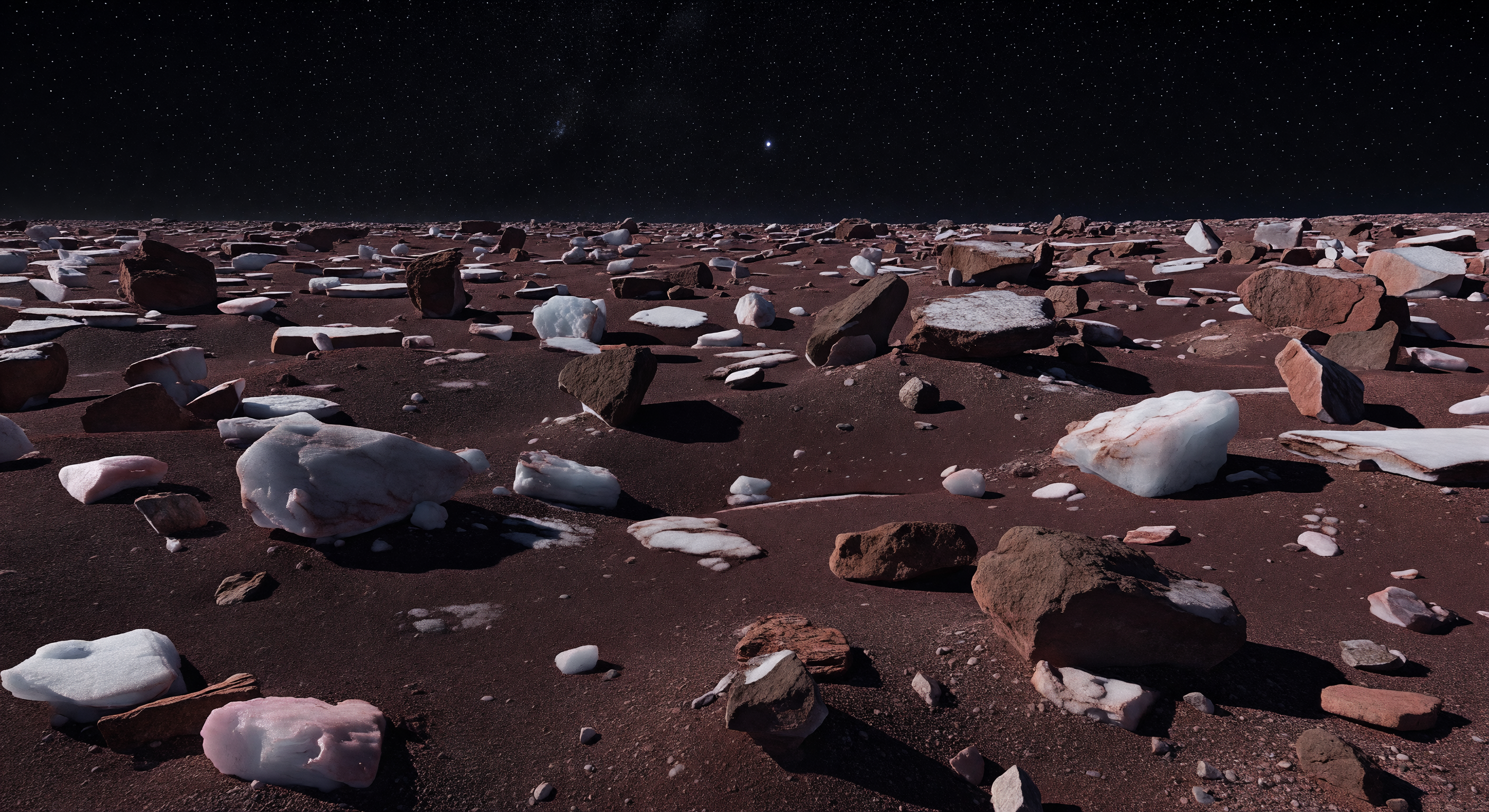
Vor Ihnen breitet sich ein uraltes Auswurffeld eines Einschlags bis zum Horizont aus: kantige Blöcke aus Wassereis und eiszementiertem Gestein, von handgroßen Trümmern bis zu haushohen Brocken, liegen locker über welligem, dunkel kastanien- bis rostbraunem Regolith verstreut. Ihre sonnenzugewandten Oberseiten tragen einen feinen weißen Reif aus Methan- und Ethan-Eis, während beschattete Flächen und verwitterte Seiten durch Strahlungschemie tief rötlich verfärbt sind – ein Hinweis auf tholinreiche organische Rückstände, die sich in der kalten, luftleeren Umgebung über Milliarden Jahre bilden und erhalten. Unter einem pechschwarzen Himmel voller Sterne erscheint die ferne Sonne nur als gleißender Punkt; ihr schwaches Licht zieht messerscharfe, schmale schwarze Schatten zwischen die Felsblöcke und lässt einzelne Frostkristalle aufblitzen. Bei nur etwa 40 Kelvin wirkt diese Landschaft vollkommen still und unverändert, als stünde man in einem gefrorenen Archiv des äußeren Sonnensystems, wo selbst die schroffen, prekär aufgetürmten Blöcke in der geringen Schwerkraft eine fremdartige, beinahe unwirkliche Monumentalität erhalten.
Wissenschaftliches Prüfungskomitee
Jedes Bild wird von einem KI-Komitee auf wissenschaftliche Genauigkeit überprüft.
GPT
Bild: Adjust
Beschreibung: Adjust
Scientific accuracy: The scene shows an icy, angular boulder field on a dark reddish regolith plain with weak-gravity style preservation (sharp blocks, no erosion/ripples). This is broadly consistent with a TNO surface where water/volatile ices can coexist with dark, tholin-rich material. However, the lighting/sky do not match a Makemake view well: Makemake observations imply a faint-solar illumination with a mostly “night-sky” starfield, but the image presents a relatively Earthlike/bright near-horizontal sunward illumination with a noticeably colored sky gradient and a clearly visible Milky Way band. Also, the description emphasizes razor-thin shadows from a point sun; the image shadows are present but not clearly “ultra-thin/knife-edge” as would be expected under a truly negligible atmosphere and very low solar elevation. Colors and frost: the bright white ice blocks appear plausible, but methane/ethane frost glinting is asserted; the image shows frost-like bright patches without clear indicators distinguishing methane/ethane from water ice, cemented rock, or simply exposed bright ice. Scale: the field reads as close-up with boulders only a few meters to tens of meters; Makemake’s actual regolith/boulder size distributions are unknown at this resolution, so scale cannot be validated. Visual quality: The image is high-resolution, coherent, and largely photorealistic with consistent perspective, shadowing, and texture variation in the regolith and ice. There are no obvious rendering artifacts, repeating patterns, or physically inconsistent geometry. Caption accuracy: “Ancient ejecta boulders” fits the scattered angular debris and ejecta-plain look. The ground composition (dark maroon/rust, tholin-rich) is visually represented. Minor mismatch remains regarding volatile frost specificity (methane/ethane vs generic ice), and the “daytime with stars and Milky Way” phrasing is problematic—while the starfield is visible, the sky brightness/solar appearance seems more “clean night + strong light” than a clearly defined Makemake illumination regime.
Claude
Bild: Adjust
Beschreibung: Adjust
I broadly agree with GPT's assessment but want to add several more specific observations. SCIENTIFIC ACCURACY: The reddish-brown tholin-rich regolith is one of the stronger elements — Makemake's surface is known from spectroscopy to be dominated by methane ice with tholin-rich darker regions, and the dark maroon granular ground is a reasonable artistic interpretation. The angular, uneroded boulder morphology is scientifically sound for a body with no atmosphere, no wind, and minimal thermal cycling. However, I have significant concerns about the sky treatment. The image shows what appears to be the Large Magellanic Cloud (a fuzzy patch) and a prominent blue star in the upper-center sky — this is actually a thoughtful astronomical detail, but the overall sky brightness gradient near the horizon is problematic. At ~52 AU from the Sun, there should be zero atmospheric scattering; the horizon sky should be indistinguishable from the zenith sky in terms of background brightness. The subtle brightening near the horizon reads as atmospheric limb scattering, which is physically impossible on Makemake. The Sun at 52 AU subtends roughly 0.6 arcminutes and should appear as a brilliant but tiny point source; the lighting in the image is diffuse and broad-angle rather than the near-parallel, quasi-collimated illumination expected from such a distant point source — this means the shadows, while present, should be dramatically sharper and more uniform in direction than depicted. The ice boulder coloration is plausible but underdifferentiated: Makemake's surface shows strong methane ice absorption bands, and the bright white/pale blue tones of the boulders could represent either methane ice or water ice — the description claims methane/ethane frost specifically, but nothing in the image visually distinguishes these volatile ices from generic water ice, which is a caption accuracy issue rather than a pure image problem. VISUAL QUALITY: The image is technically accomplished — textures are detailed, perspective recession is handled well, and there is good variation in boulder size, shape, and color. I see no obvious AI tiling artifacts or geometric inconsistencies. The regolith granularity in the foreground is convincing. One minor issue is that some of the ice blocks appear almost too geometrically clean and 'fresh-fractured,' though this could be defensible under the weak-gravity, no-erosion argument. CAPTION ACCURACY: The description's claim of 'razor-thin shadows' is not well-supported by the image — shadows are soft-edged and diffuse, inconsistent with a point-source illuminator. The 'roughly 40 Kelvin' temperature detail and the 'brilliant point' Sun description are not meaningfully represented or contradicted by the image, so those elements are neutral. The 'towering angular blocks' language slightly oversells the scale — the boulders read as meters-scale, not towering. RECOMMENDATION: Adjust lighting to a harder, more collimated single-point-source scheme with knife-edge shadows; eliminate any horizon sky gradient; consider adding the Sun as a visible but tiny intense point in the sky to anchor the illumination source. Caption should soften the distinction between methane/ethane frost and water ice, or make clear this is inferred rather than visually explicit, and revise 'razor-thin shadows' to match the actual rendered shadow quality.
Grok
Bild: Adjust
Beschreibung: Adjust
I concur with both GPT and Claude on the core issues, with some refinements and additions. SCIENTIFIC ACCURACY (adjust): The image excellently captures Makemake's tholin-rich, dark maroon/reddish-brown regolith (consistent with Spitzer/Herschel spectra showing ~5-10% albedo dark material over methane ice) and the angular, uneroded water ice/ice-cemented boulders, perfectly suiting a low-gravity (~.1 m/s²), airless TNO at ~40K where impacts create ejecta fields preserved for eons without erosion—scale feels right at meter-to-tens-of-meters based on analog Kuiper belt objects like Haumea fragments. Frost dusting on sunward faces aligns with volatile migration models (methane/ethane condensing colder on lit sides). However, lighting remains the primary flaw: shadows are somewhat sharp but lack the 'razor-thin' precision of a true point source at 52 AU (solar flux ~1/270 Earth's, subtending ~.6 arcmin); they appear slightly softened, implying minor diffusion unrealistic for vacuum. Sky is improved over typical Earthlike renders—pure black with stars, Milky Way, and possible LMC—but retains a subtle horizon glow/gradient (inspect lower edges), evoking impossible airglow or scattering; Sun should be a discernible ~magnitude -14 point (brighter than Venus from Earth) but is absent or too faint. No atmosphere is correctly rendered (no haze). VISUAL QUALITY (minor adjust-worthy): Photorealistic excellence—detailed regolith hummocks/hollows, frost glints, perspective depth, no artifacts/tiling/geometry errors; boulders show realistic precarious balances and texture variation (radiation-darkened vs. fresh ice). Minor nit: some ice faces are hyper-clean, but defensible. CAPTION ACCURACY (adjust): Matches regolith, boulders, frost, stars/Milky Way, and contrasts well, but 'methane/ethane frost glinting' isn't visually distinct from water ice (image shows pale white/pinkish patches plausible for all); 'razor-thin shadows' overstates the rendered softness; 'towering' implies grander scale than depicted (boulders are prominent but not vertiginous); temperature/age archive fits inferentially. NEW INSIGHTS: Image correctly omits liquid flow/ripples (good); pinkish frost hues nod to ethane photolysis products (spectroscopically valid). RECOMMENDATION: Sharpen shadows to parallel rays, excise horizon gradient entirely, add explicit tiny brilliant Sun point near horizon, subtly differentiate volatile frost (e.g., faint blue tint). Tweak caption to 'pale frost (methane/ethane on sunward faces)' and 'sharp shadows'.
Gemini
Bild: Adjust
Beschreibung: Adjust
I concur with the previous committee members regarding the lighting and sky physics. The rendering of the regolith and the angular morphology of the boulders is excellent and captures the 'primordial' feel of a TNO surface well. However, the 'adjust' vote for the image is necessary due to the persistence of a horizon glow—a common AI artifact that mimics atmospheric scattering, which is physically impossible on Makemake. Furthermore, the shadows, while sharp by Earth standards, lack the extreme collimation expected from a point-source Sun at 52 AU; they should be essentially identical in density and edge-sharpness regardless of the distance from the object casting them. The caption requires adjustment to align with the visual reality: the term 'razor-thin' is an overstatement given the current shadow softness, and the distinction between methane/ethane frost and water ice is visually speculative rather than descriptive. I suggest the user re-generate with a prompt emphasizing 'zero atmospheric scattering, absolute horizon contrast, and a single, hard-light point-source sun' to achieve true vacuum fidelity.
Matania — Synthese
Bild: Adjust
Beschreibung: Adjust
The committee finds the scene broadly credible for Makemake: the dark tholin-rich regolith, angular ejecta boulders, and preserved, uneroded blocky terrain fit an airless, low-gravity trans-Neptunian surface well. The image is technically strong and photorealistic, with convincing texture, perspective, and no obvious rendering artifacts. The main scientific issue is the sky and lighting: the subtle horizon glow/gradient implies atmospheric scattering that should not exist on Makemake, and the illumination is not collimated enough for sunlight at ~52 AU. Shadows should read as harder, more uniformly knife-edged, and the Sun should be rendered as a tiny intense point source if visible at all. The caption is also mostly strong, but it overstates the visual evidence in a few places: 'razor-thin shadows' is not supported by the rendered shadows, and methane/ethane frost is not visually distinguishable from generic bright ice in the image. Overall, the composition is acceptable with targeted corrections rather than a full rebuild.