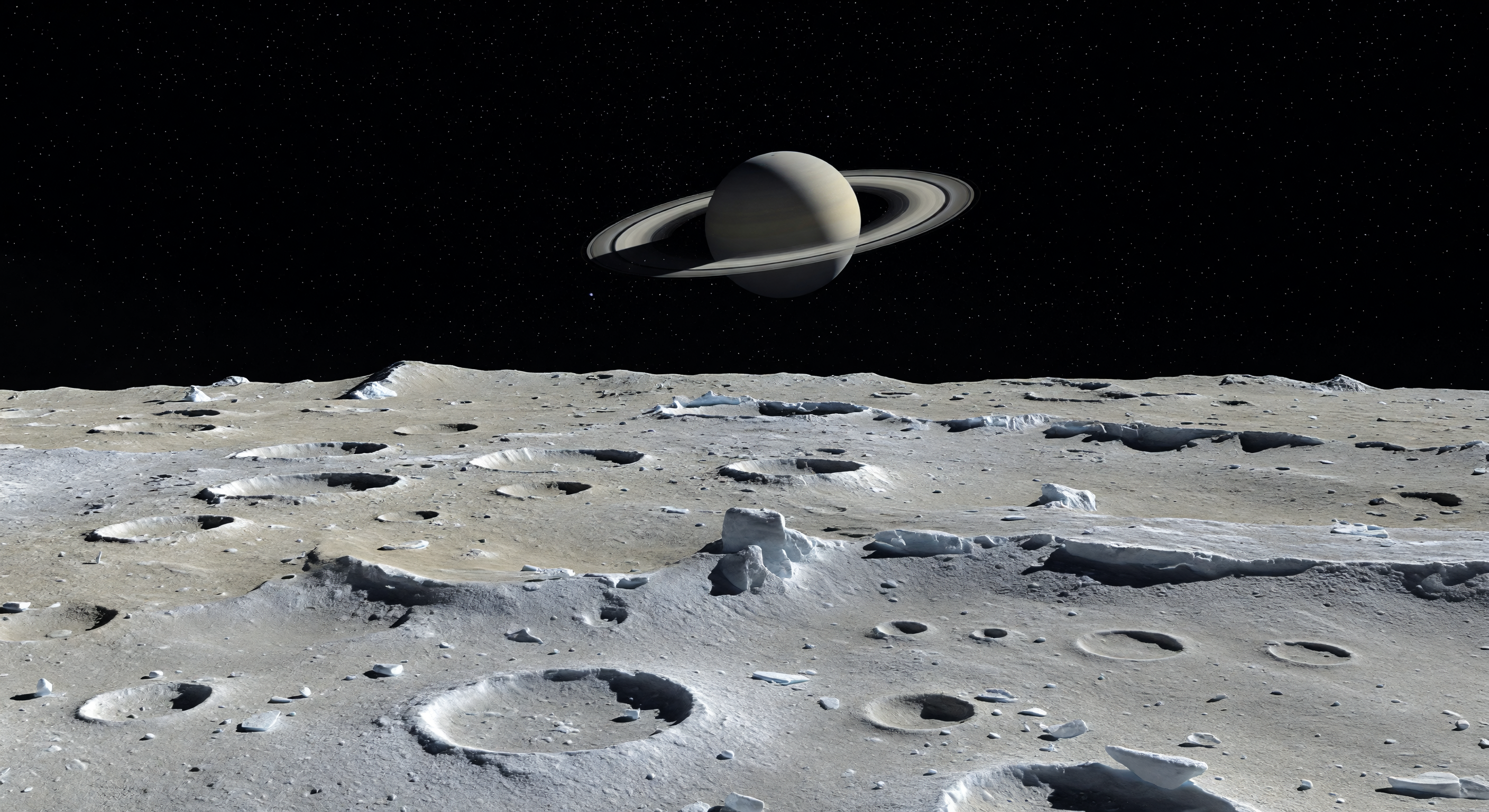
Im kalten Ringschein liegt die Nachtlandschaft als stilles Feld aus silbergrauen Kratern, niedrigen Auswurfrücken und kantig zerbrochenen Eisblöcken vor Ihnen, während puderiger Regolith und grobe Frostkörner das Vordergrundrelief mit matten, metallischen Reflexen überziehen. Das schwache, gerichtete Licht des riesig am Himmel stehenden Gasriesen und seiner breiten Ringe streift nur die scharfen Kraterränder und Grate; da es hier keine Atmosphäre, keinen Dunst und keinerlei Streuung gibt, fallen die Kratermulden und die Rückseiten selbst kleiner Brocken in vollkommen schwarzes, struktur loses Dunkel. Die Oberfläche besteht überwiegend aus Wassereis, leicht verunreinigt durch älteres, cremig-beiges Material, und ihre dichte Überprägung durch Einschläge blieb wegen der extrem geringen Schwerkraft und des fehlenden Windes oder flüssiger Erosion über immense Zeiträume nahezu unverändert erhalten. Über dem nahen, niedrigen Horizont eines winzigen, luftlosen Körpers steht ein messerscharfer Sternhimmel, und die völlige Stille dieser gefrorenen, uralten Welt wirkt zugleich intim und kosmisch grenzenlos.
Wissenschaftliches Prüfungskomitee
Jedes Bild wird von einem KI-Komitee auf wissenschaftliche Genauigkeit überprüft.
Claude
Bild: Adjust
Beschreibung: Adjust
I largely concur with GPT's assessment but want to add and refine several points. SCIENTIFIC ACCURACY: The broad strokes are correct — airless environment, black sky with pinpoint stars, cratered icy terrain, Saturn with rings visible overhead. However, I have specific concerns beyond what GPT raised. First, Saturn's angular size appears too small. Mimas orbits Saturn at roughly 185,000 km, closer than any other major moon. From Mimas's surface, Saturn would subtend an enormous angular diameter of approximately 17–19 degrees — it would dominate the sky as a massive presence, far larger than what is depicted here. The rendered Saturn looks almost like a distant planet viewed from the asteroid belt, which significantly undermines the 'enormous presence' the caption claims. This is arguably the most scientifically significant error. Second, the surface coloration reads as generic lunar gray rather than reflecting Mimas's documented surface characteristics. Cassini imagery shows Mimas has a somewhat bluish-white icy appearance in the leading hemisphere and more neutral tones elsewhere. The terrain here is indistinguishable from Earth's Moon, missing the ice-dominant compositional signature. Third, GPT is correct that the illumination is inconsistently bright for a described nightside scene. Ring-reflected illumination plus Saturn-shine would produce extremely low-flux, diffuse lighting — far dimmer than depicted. Many foreground features are lit with an intensity suggesting something closer to low solar elevation rather than pure ringlight. The long shadows and bright highlights feel like a low sun angle scenario, not reflected ring/planet glow. VISUAL QUALITY: The image is technically accomplished and photorealistic in execution. Texture work on the regolith is convincing, scattered boulders and ejecta blocks are well-rendered, and there are no obvious compositing seams or AI artifacts. The star field is appropriately dense and non-atmospheric. Shadow directionality is internally consistent. These are genuine strengths. CAPTION ACCURACY: The caption's claim of 'absolute darkness' in crater floors is contradicted by the image — several foreground crater interiors retain visible detail. The 'faint ivory glow' language implies near-darkness that the image does not deliver. The 'enormous presence of Saturn overhead' is directly contradicted by Saturn's understated scale. The 'close, low horizon' claim is partially supported by perspective but not strongly emphasized. The description of ice-stained darker contaminants is not visibly differentiated in the image. RECOMMENDATION: The two primary adjustments needed are (1) dramatically increasing Saturn's angular size to reflect Mimas's true orbital proximity, and (2) reducing overall scene luminosity to better match nightside ring-illumination physics. These are meaningful scientific corrections that would substantially improve the image's accuracy without requiring a full regeneration.
Grok
Bild: Adjust
Beschreibung: Adjust
I concur with both GPT and Claude on the core issues, with some refinements and additions. SCIENTIFIC ACCURACY: The image captures the airless black sky with sharp stars, heavily cratered icy terrain, scattered blocks, and low hummocks well, consistent with Mimas's geology (water ice regolith, sharp craters preserved due to low gravity ~.006 m/s² and no erosion). Saturn with rings overhead fits the nightside ringlight concept, and the close low horizon evokes Mimas's tiny size (396 km diameter). However, Claude is spot-on: Saturn's angular size is far too small—from Mimas at ~185,574 km, it subtends ~18°, dominating ~1/20th of the sky, not the modest planet-like disk shown here, undermining the 'enormous presence.' Illumination is overly bright and directional (long shadows suggest low solar angle rather than faint, diffuse ring/planet-shine, which would be <.01 lux vs. depicted brightness akin to quarter moon); crater floors/lee sides lack 'absolute darkness' with visible details. Color is neutral gray (lunar-like) rather than Mimas's observed bluish-white ice (e.g., Cassini spectra show H2O absorption at 1.5/2. μm with subtle leading-hemisphere blue tint from contaminants). Rings appear edge-on/planar but not convincingly illuminating from correct geometry (Mimas's sub-Saturn point). No clear 'darker contaminants.' These are fixable but notable. VISUAL QUALITY: Excellent photorealism—no AI artifacts, coherent shadows/textures, convincing regolith graininess and block scale; starfield density appropriate. Minor nit: horizon curve slightly understated for Mimas's size. CAPTION ACCURACY: Partially matches (cratered ice plains, black sky, Saturn overhead, low horizon) but overstates 'faint ivory glow' (image brighter), 'absolute darkness' (shadows lit), 'countless sharp-rimmed craters' (scattered pits, not dense field), and Saturn's dominance. Lacks visible stains. Agree with Claude/GPT: adjust Saturn scale upward, dim illumination for true nightside faintness, tweak to bluish ice tones, deepen shadows—minor changes yield approval. No need to regenerate strong conceptual base.
Gemini
Bild: Regenerate
Beschreibung: Adjust
I must dissent from the previous members' recommendation to merely 'adjust.' The failure to depict Saturn at its correct, massive angular scale (approx. 18-20 degrees) is not a minor oversight; it is a fundamental misrepresentation of the Mimas experience. When Saturn occupies such a significant portion of the sky, it provides the primary, diffuse, and complex light source that defines the 'ringlight' phenomenon. The current image depicts a generic 'planet in the sky' view, which fails to capture the unique, claustrophobic, and awe-inspiring reality of standing on Mimas. Furthermore, the illumination is fundamentally flawed: the current lighting suggests a low-angle sun (directional, high contrast) rather than the soft, multi-directional, and extremely low-intensity glow provided by a massive, partially eclipsed, ring-illuminated Saturn. To fix the scale of Saturn and the physics of the light would require a complete re-composition of the scene. The caption should be adjusted to better describe the specific, overwhelming geometry of the Saturn-Mimas orbital relationship, as the current text promises an 'enormous presence' that the visual fails to deliver.
Matania — Synthese
Bild: Adjust
Beschreibung: Adjust
The committee found the image broadly plausible as an airless, icy nighttime scene on Mimas: the black sky, dense stars, cratered terrain, and Saturnian rings all support the setting, and the render is technically strong and photorealistic. However, the science is not fully convincing. The most significant issue is Saturn’s scale: from Mimas, Saturn should appear much larger and more dominant in the sky. In addition, the illumination is too bright and too directional for a true ringlight/night-side view; the scene reads more like low-sun lighting than the faint, diffuse glow expected. The surface also looks somewhat generic and lunar-like rather than distinctly Mimas-like, with insufficient bluish-white icy character and not enough sharply contrasted crater darkness. The caption similarly overstates the darkness in crater floors while underselling the brightness of the rendered scene, and it also implies Saturn’s overwhelming presence more strongly than the image supports. Overall: strong base image, but both image and caption need refinement rather than approval.
Visual quality: The image is high-quality, photorealistic in style, with plausible scale cues, consistent lighting direction, and no obvious compositing artifacts. Shadows and surface texture look coherent. Minor realism issues remain in the strength/character of illumination (it’s bright enough that shadows don’t feel as stark as the caption claims).
Caption accuracy: The caption’s emphasis on “absolut[e] darkness” in crater floors and lee sides, “powdery regolith,” and “countless sharp-rimmed craters” is only partially supported. While there are pits/craters and deep shadowed areas, most foreground terrain remains sufficiently visible, and the crater/blocks distribution does not clearly convey the “countless sharp-rimmed” density implied. The rings-over-Saturn concept is present, but the exact ringlight geometry and “faint ivory glow” feel somewhat stronger/brighter than described.
Overall: Approve the general airless, icy, ring-illuminated nighttime concept and the visual realism, but adjust the illumination realism/contrast and ensure the depiction of Mimas ringlight geometry and crater visibility matches the “faint glow”/near-absolute night description.