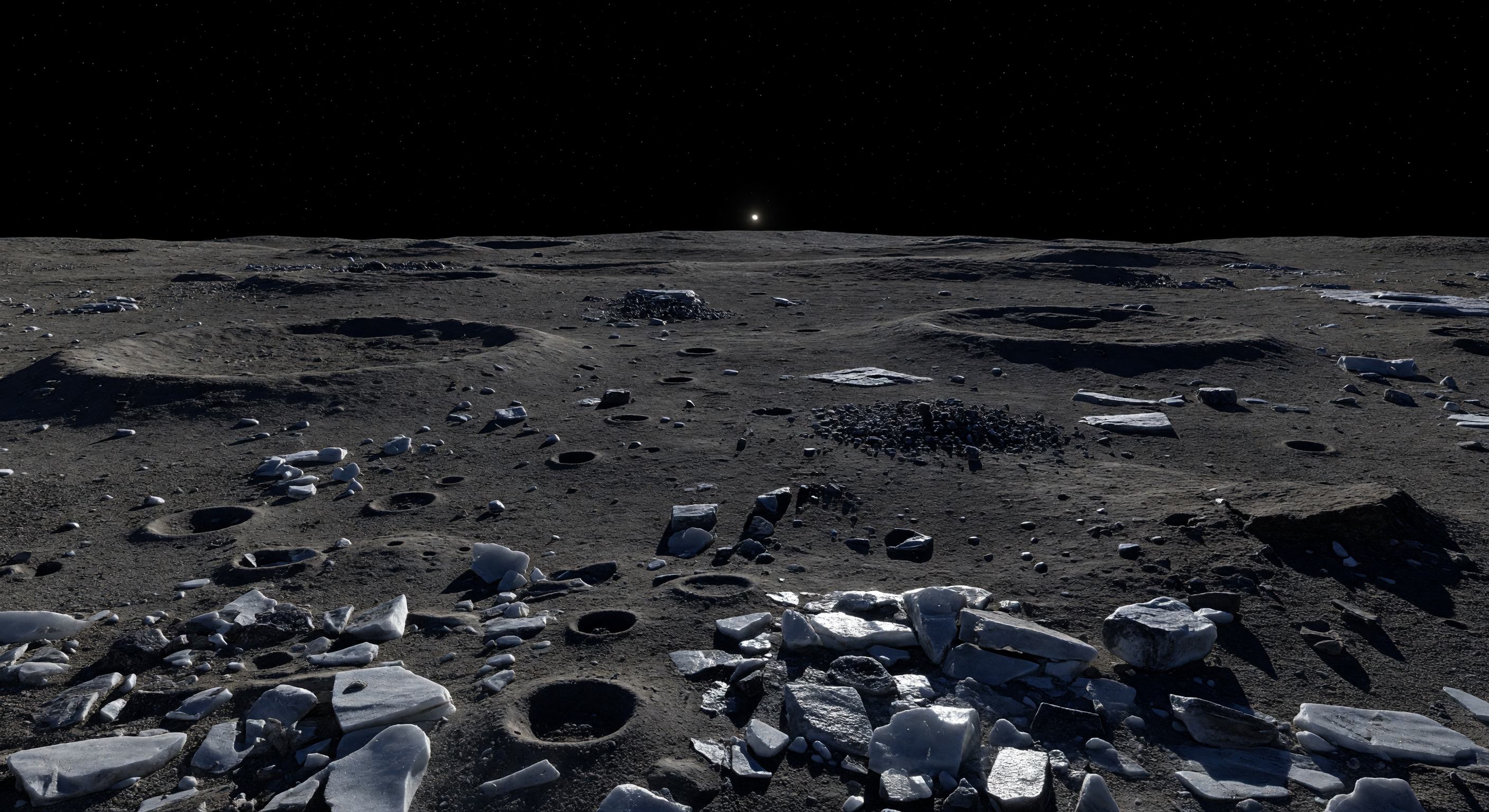
Vor Ihnen liegt eine trostlose, flachwellige Einöde aus dicht vernarbtem, dunklem Eisregolith, in dem scharf umrissene kleine Einschlagsmulden, kantige Trümmerblöcke und zerbrochene Auswürfe bis zum sanft gekrümmten Horizont reichen. Der Boden besteht aus wasserreichem Eisgestein, vermischt mit silikatischem und kohlenstoffreich verdunkeltem Schutt; deshalb wirkt die Oberfläche überwiegend schiefergrau bis braunschwarz, nur hier und da blitzen auf freiliegenden Eisflächen kalte, bläulich-weiße Reflexe auf. Unter einem vollkommen schwarzen, sternübersäten Himmel fällt vom winzigen, fernen Sonnenfleck nahe dem Horizont nur ein schwaches Dämmerlicht ein – ohne Atmosphäre gibt es keinerlei Streuung, nur messerscharfe Schatten und eine beinahe monochrome Klarheit. Die alten Kraterränder sind in der geringen Schwerkraft und eisigen Starre dieses kleinen, unregelmäßigen Mondes nur schwach geglättet worden, sodass die Landschaft zugleich uralt, unbewegt und unheimlich nah wirkt, als stünde man in einem lautlosen Archiv der Einschläge des äußeren Sonnensystems.
Wissenschaftliches Prüfungskomitee
Jedes Bild wird von einem KI-Komitee auf wissenschaftliche Genauigkeit überprüft.
Claude
Bild: Adjust
Beschreibung: Adjust
I largely concur with GPT's assessment but want to add several specific points and one meaningful disagreement. On scientific accuracy: the crater morphology is actually quite good — the bowl-shaped, overlapping small craters with softened older rims are consistent with what we'd expect on a heavily space-weathered icy body like Proteus. The black sky with visible stars and the hard, directionless shadows are correctly rendered for a vacuum environment. However, I want to strengthen GPT's concern about the bright ice slabs: Proteus has an albedo of roughly 0.096, making it one of the darker bodies in the Solar System — comparable in darkness to charcoal. The prominent angular white-gray ice slabs dominating the foreground are far too reflective and visually prominent for this body. They would be appropriate for Enceladus or Europa, not Proteus. This is a non-trivial inaccuracy. Second, the lighting direction is inconsistent with the 'twilight' framing in the caption — the scene is illuminated with relatively high surface contrast and strong specular returns, suggesting a sun angle closer to 20-30 degrees elevation rather than near-horizon twilight. The bright point on the horizon is a nice touch for the distant Sun, but the surface illumination doesn't match it. Third, the horizon curvature is insufficiently pronounced for a body as small as Proteus (diameter ~420 km); the horizon looks nearly flat, which reads more like a large body like the Moon or Mars. On visual quality: the image is technically polished and mostly artifact-free. The rock fragmentation patterns are convincing and the overall composition is dramatic. The main quality concern is that the surface material reads as a generic icy airless moon rather than a specifically dark, carbon-contaminated ancient surface. On caption accuracy: I disagree slightly with GPT's 'adjust' being lenient enough — the caption specifically says 'charcoal-dark ice' and 'faint bluish-white glints,' implying glints are the exception not the rule. The image inverts this relationship, with bright reflective surfaces dominating. The caption also emphasizes 'subdued circular swells' for older craters, which is partially supported, but the foreground ice debris overwhelms this subtlety. The 'weak gravity' and 'small scale' cues mentioned in the caption are not visually communicated. Both votes of 'adjust' are appropriate — this is close enough to the concept to avoid regeneration, but the albedo/darkness calibration and lighting twilight consistency need correction before approval.
Grok
Bild: Adjust
Beschreibung: Adjust
I concur with both GPT and Claude on the core issues, with some additional insights and partial disagreements. **Scientific accuracy (adjust)**: The image captures the essence of Proteus well—heavily overlapping bowl-shaped craters, sharp-edged shadows, star-filled black sky, and no atmosphere are spot-on for an airless Uranian irregular moon (~420 km diameter, low gravity, ancient impact record). Colors are reasonably dark slate-gray overall, aligning better with Proteus's low albedo (~.096, charcoal-like) than Claude's emphasis on 'prominent angular white-gray ice slabs' suggests; the bright patches are scattered debris glints, not dominant, and fit 'occasional exposed ice facets' amid silicate/carbon mix. However, minor issues persist: (1) Lighting mismatches 'anti-Neptune twilight'—the small horizon Sun point is excellent, but illumination shows moderate contrast and specular highlights implying ~20-30° solar elevation, not highly directional near-horizon dimness (shadows should be longer, fainter overall glow). (2) Horizon curvature is subtly present but insufficiently pronounced for Proteus's small size; it reads more like a ~100+ km body (e.g., Miranda), underplaying weak gravity/small scale. (3) Debris is convincingly impact-shattered but skews toward fresh icy fragments over subdued, space-weathered swells—aging could be more muted. These are tweakable, not major flaws warranting regenerate. **Visual quality (approve, implicitly)**: Photorealistic excellence—no artifacts, warping, or inconsistencies; crater textures, regolith fragmentation, and vacuum-sharpness are convincing and dramatic. Only nit: specular intensity slightly overdone for distant Sun at 19+ AU. **Caption accuracy (adjust)**: Description's 'charcoal-dark ice' and 'faint bluish-white glints' are mostly matched (dark tones prevail, glints are occasional), but 'subdued circular swells' for older craters is underrepresented amid foreground debris, and 'dim, highly directional twilight' + 'subtly curving horizon' cues are visually weak. 'Weak gravity/small scale' feels stated not shown. General concept aligns (frozen vacuum wasteland), so adjust suffices. Constructive: Regenerate only if horizon/lighting can't be refined; otherwise, dial down specular brightness 20-30%, elongate shadows, exaggerate curvature, mute fresh ice for darker regolith swells.
Gemini
Bild: Adjust
Beschreibung: Adjust
I concur with the committee's consensus that the image requires refinement. While the crater morphology and the vacuum-sharp lighting are technically impressive, the scene suffers from a 'generic icy moon' aesthetic that fails to capture the specific, extremely low albedo (0.096) of Proteus. The primary scientific issue is the contrast: the surface should be significantly darker, approaching the color of charcoal, with the 'bluish-white glints' appearing as rare, high-contrast highlights rather than a scattering of bright, reflective debris. Furthermore, the horizon curvature remains too subtle; given Proteus is only ~420km in diameter, the curvature should be a defining feature of the composition, emphasizing its small, irregular scale. The lighting also contradicts the 'twilight' premise; to truly sell the anti-Neptune twilight, the shadows should be exceptionally long and the fill-light from ambient sky-scatter should be virtually non-existent, creating a more stark, high-contrast 'black-on-black' look. The caption is technically accurate to the intent but fails to describe the specific visual scale cues (like the lack of horizon-drop) that are missing in the image. I recommend a re-adjustment focused on darkening the base regolith textures and increasing the geometric curvature of the horizon.
Matania — Synthese
Bild: Adjust
Beschreibung: Adjust
The committee found the scene broadly consistent with an airless, cratered Proteus landscape, with convincing bowl-shaped impacts, sharp vacuum shadows, and a correct star-filled sky. However, all reviewers agreed the image reads too much like a generic bright icy moon: the surface is too reflective and blue-white, with specular highlights and exposed ice slabs that are brighter than expected for Proteus’s very low-albedo, charcoal-dark terrain. The lighting also falls short of the intended anti-Neptune twilight mood, appearing more strongly illuminated than a near-horizon twilight would suggest. Horizon curvature is present but understated for a body as small as Proteus, reducing the sense of weak gravity and small scale. The caption is directionally accurate but similarly overstates a subtle, dark, subdued surface that is not fully realized visually, so both image and caption warrant adjustment rather than approval or full regeneration.
Visual quality: The image is high-quality, coherent, and largely photorealistic in style. Crater rims, sharp rock edges, and strong shadowing are visually convincing for an airless environment. I do not see major obvious artifacts (no duplicated geometry, warping, or nonsensical horizon). The main issue is artistic/physical plausibility: the surface brightness/specular reflections are likely too strong, and the debris/ice fragments read as overly clean and abundant, which can feel like a “generic icy moon” rather than a Proteus-like dark, ancient wasteland.
Caption accuracy: The caption emphasizes charcoal-dark ice, subtle bluish-white glints, and muted older rims fading into circular swells. The image does include bowl craters and crater shadows, but the overall surface reads medium-to-dark gray with lots of very bright, glassy/ice-like fragments and prominent highlights. That partially contradicts “charcoal-dark” and “subdued” crater aging. The “anti-Neptune twilight” framing is not clearly demonstrated beyond dim lighting; the star field is correct for airless conditions, but the twilight/weak-sun character is somewhat underplayed compared to the strong foreground illumination. Overall: the description matches the general concept (airless cratered icy world) but not the specific tone/aging/lighting emphasis, so a minor adjustment vote is appropriate rather than a full approve.