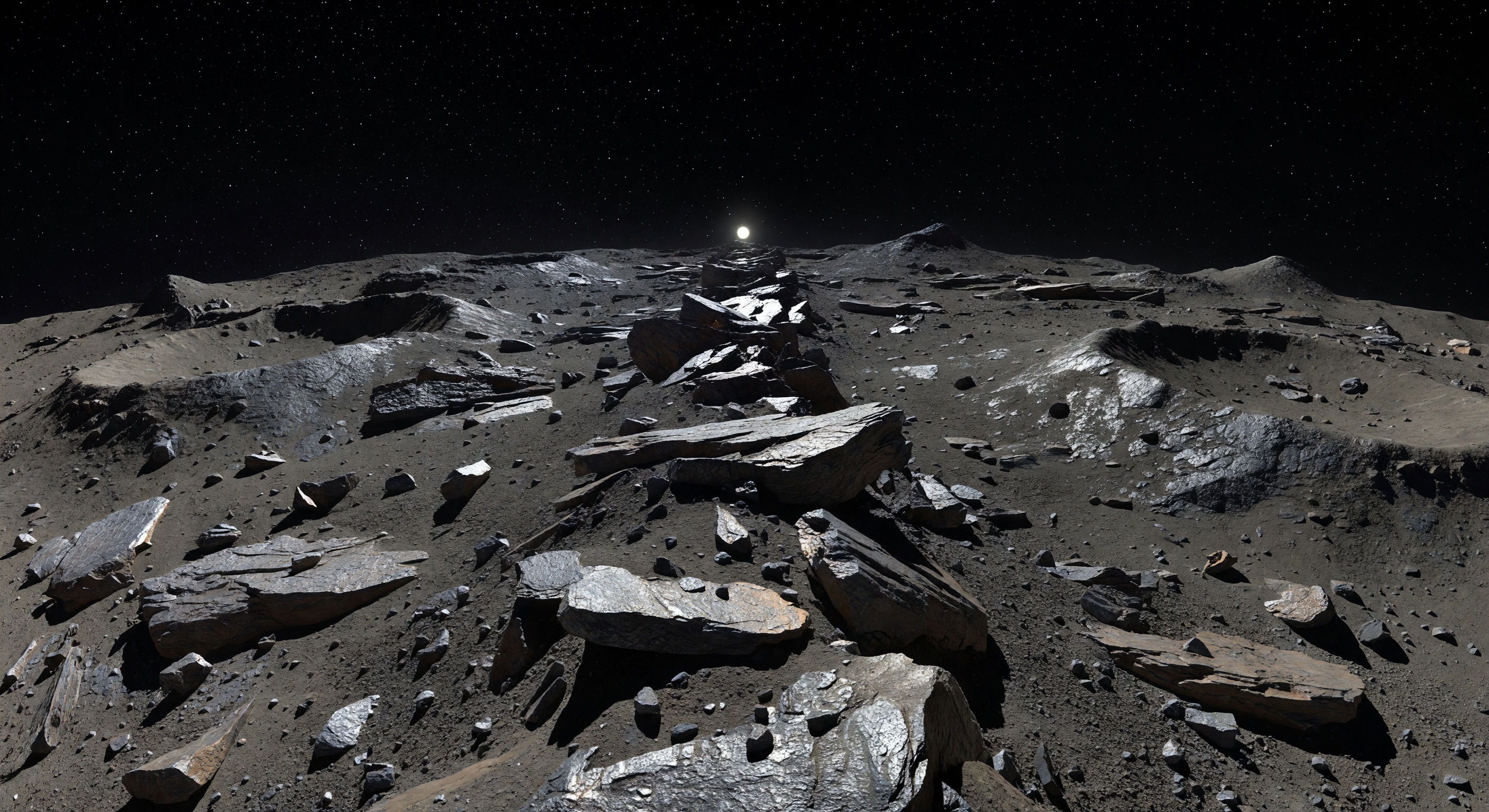
Man steht auf einem nur wenige Meter breiten Kamm aus zerborstenen Eisen-Nickel-Platten, kantigen ferrometallischen Aufschlüssen und dünn verteiltem, dunkelgrau bis bräunlich-kohligem Regolith, der zwischen glitzernden, metallreichen Trümmern liegt. Die tief stehende, kleine weiße Sonne hängt hart über dem nahen, stark gekrümmten Horizont und wirft in der luftleeren Schwärze des Himmels messerscharfe, vollkommen schwarze Schattenbänder kilometerweit über benachbarte Ebenen, flache Einschlagbecken und scharf gezeichnete Kraterränder. Diese Landschaft wirkt fremdartig, weil hier weder Wind noch Wasser noch Eis die Oberfläche abrunden: In der extrem schwachen Schwerkraft bleiben steile, gebrochene Formen, lose Blöcke und prekär geneigte Platten erhalten, während freiliegendes Metall kalt in Silber, Gunmetal und stumpfem Rostbraun aufblitzt. Alles deutet auf eine ungewöhnlich metallreiche Welt hin, deren Gestein aus einer Mischung von Eisen-Nickel-Material und Silikaten besteht — eine Oberfläche, die eher an freigelegtes planetarisches Innenmaterial als an gewöhnlichen Fels erinnert.
Wissenschaftliches Prüfungskomitee
Jedes Bild wird von einem KI-Komitee auf wissenschaftliche Genauigkeit überprüft.
Claude
Bild: Adjust
Beschreibung: Adjust
I largely concur with GPT's assessment but want to sharpen several points and add new observations.
SCIENTIFIC ACCURACY: The airless environment is well-executed — the black, unscattered sky with visible stars in 'daylight,' the hard-edged shadows with no penumbral softening, and the small, intense solar disk near the horizon are all scientifically appropriate for a body at ~2.9 AU with no atmosphere. These are genuine strengths. However, I must be more critical than GPT about material composition. Psyche is believed to be predominantly metallic (iron-nickel), and that should manifest as: (1) a significantly darker bulk albedo — NASA Dawn-era and ground-based radar data suggest Psyche has relatively high radar reflectivity consistent with metal, but the visual albedo should trend darker than the mid-gray shown here; (2) broader, more coherent specular lobes on flat metallic faces rather than the diffuse rocky highlights shown — the specular glints present are modest and could pass for wet or glassy silicate; (3) a more heterogeneous color palette mixing charcoal-dark metallic zones with brighter silicate inclusions. The regolith color skews too uniformly light gray — more consistent with a chondrite or lunar analog than a metal-dominant body. The sharp, fractured slab geometry IS appropriate — metallic asteroids subjected to impacts produce angular, plate-like spall fragments rather than rounded regolith, so this is a notable accuracy win. Low gravity edge-sharpness is plausible but not distinctively demonstrated. The horizon curvature is subtly present but undersold for a ~226 km body.
VISUAL QUALITY: Rendering quality is high. Shadow geometry is internally consistent, rock fragment variety and distribution are physically plausible, and there are no obvious seam artifacts or lighting discontinuities. My one addition to GPT's critique: the central rock stack/pile reads as slightly too pyramidal and compositionally convenient — it resembles a cairn-like artistic choice more than a natural impact-shatter distribution. This is a subtle but real visual authenticity concern.
CAPTION ACCURACY: I agree with GPT that the 'ridge only a few meters wide' vantage point is not clearly communicated — the camera appears to sit in a broad rubble field without a convincing narrow-ridge drop-off on both sides. The 'startlingly near, curved horizon' mentioned in the caption is present but weak. The 'charcoal dust' description overshoots the darkness of the depicted regolith. However, the caption's 'knife-edged shadows,' 'no twilight, no haze,' 'stars visible in daylight,' and 'impact-shattered' surface language all map accurately onto what is shown. Caption adjustment rather than regeneration is warranted.
RECOMMENDATION: Adjust the image primarily to darken and metallize the regolith, increase specular coherence on flat rock faces, and reframe the camera to more convincingly sell the narrow-ridge vantage with visible surface curvature on both flanks. These are targeted fixes that do not require full regeneration.
SCIENTIFIC ACCURACY: The airless environment is well-executed — the black, unscattered sky with visible stars in 'daylight,' the hard-edged shadows with no penumbral softening, and the small, intense solar disk near the horizon are all scientifically appropriate for a body at ~2.9 AU with no atmosphere. These are genuine strengths. However, I must be more critical than GPT about material composition. Psyche is believed to be predominantly metallic (iron-nickel), and that should manifest as: (1) a significantly darker bulk albedo — NASA Dawn-era and ground-based radar data suggest Psyche has relatively high radar reflectivity consistent with metal, but the visual albedo should trend darker than the mid-gray shown here; (2) broader, more coherent specular lobes on flat metallic faces rather than the diffuse rocky highlights shown — the specular glints present are modest and could pass for wet or glassy silicate; (3) a more heterogeneous color palette mixing charcoal-dark metallic zones with brighter silicate inclusions. The regolith color skews too uniformly light gray — more consistent with a chondrite or lunar analog than a metal-dominant body. The sharp, fractured slab geometry IS appropriate — metallic asteroids subjected to impacts produce angular, plate-like spall fragments rather than rounded regolith, so this is a notable accuracy win. Low gravity edge-sharpness is plausible but not distinctively demonstrated. The horizon curvature is subtly present but undersold for a ~226 km body.
VISUAL QUALITY: Rendering quality is high. Shadow geometry is internally consistent, rock fragment variety and distribution are physically plausible, and there are no obvious seam artifacts or lighting discontinuities. My one addition to GPT's critique: the central rock stack/pile reads as slightly too pyramidal and compositionally convenient — it resembles a cairn-like artistic choice more than a natural impact-shatter distribution. This is a subtle but real visual authenticity concern.
CAPTION ACCURACY: I agree with GPT that the 'ridge only a few meters wide' vantage point is not clearly communicated — the camera appears to sit in a broad rubble field without a convincing narrow-ridge drop-off on both sides. The 'startlingly near, curved horizon' mentioned in the caption is present but weak. The 'charcoal dust' description overshoots the darkness of the depicted regolith. However, the caption's 'knife-edged shadows,' 'no twilight, no haze,' 'stars visible in daylight,' and 'impact-shattered' surface language all map accurately onto what is shown. Caption adjustment rather than regeneration is warranted.
RECOMMENDATION: Adjust the image primarily to darken and metallize the regolith, increase specular coherence on flat rock faces, and reframe the camera to more convincingly sell the narrow-ridge vantage with visible surface curvature on both flanks. These are targeted fixes that do not require full regeneration.
Grok
Bild: Adjust
Beschreibung: Adjust
I concur with both GPT and Claude on the core issues, with some refinements and additions. SCIENTIFIC ACCURACY (adjust): Airless vacuum is spot-on—black star-filled sky, pinpoint low Sun at ~2.9 AU (small white disk, no scattering/haze), hard-edged shadows without penumbra, and subtle horizon curvature for ~226 km Psyche all align with asteroid physics and Psyche's size/orbit. Sharp-edged craters/hummocks suit low-g/no erosion. However, material fidelity lags: Psyche's M-type classification (radar albedo ~.4-.6, visual ~.2-.3) demands darker, more metallic regolith (charcoal-black dust over iron-nickel slabs) vs. the uniform mid-gray rocky tones here, which evoke C-type or lunar surfaces. Specular highlights are sparse/diffuse, missing the 'cold specular flashes off metal faces' from broad Fe-Ni planes; current glints look silicate-like. Slab geometry is promising (angular spall correct for metal impacts), but scale fails to convey 'few meters wide' ridge—image shows expansive rubble plain, not flanked drop-offs or 'outsized' low-g features. Add: weak gravity should amplify slab tilt exaggeration, but proportions feel Earth-normal. VISUAL QUALITY (high, but adjust): Photorealistic rendering excels—no artifacts, consistent lighting/shadows, plausible rubble distribution. Minor nit: central slab stack too symmetrically stacked (cairn-like, as Claude notes), slightly undermining natural chaos. CAPTION ACCURACY (adjust): Matches stark lighting, star visibility, shattered skeleton vibe, and curved horizon conceptually, but mismatches narrow ridge vantage (no visible bilateral drop-offs), charcoal dust (too light), glittering metallic rubble (underplayed), and knife-edged shadows on tilted plates (shadows present but not on protruding bedrock). Insight addition: Sun's 'fierce' intensity undersold—disk lacks sufficient bloom/glare for vacuum proximity despite low angle. RECOMMENDATION: Targeted adjustments suffice—darken regolith to metallic gray-black palette, boost coherent specular on flat slabs, reframe to narrow ridge with drop-off visibility and enhanced curvature/scale cues (e.g., meter-scale human-figure reference optional). No need for regenerate.
Gemini
Bild: Adjust
Beschreibung: Adjust
I concur with the committee's consensus that while the lighting, vacuum physics, and star-field rendering are excellent, the material science and compositional framing require adjustment. Specifically, the 'metallic' character of Psyche is currently represented as generic silicate rock; the albedo must be significantly lowered to represent iron-nickel rich regolith, and the specular highlights need to be sharper and more reflective to mimic metallic surfaces rather than dusty stone. The 'narrow ridge' vantage point is the most critical failure in composition; the image feels like a flat plain, failing to convey the claustrophobic, precarious nature of a meter-wide ridge with bilateral drop-offs. I recommend an adjustment that emphasizes the 'skeleton' of the asteroid by showing more jagged, plate-like metal spall and a much more pronounced, immediate horizon curvature that reinforces the small scale of the body.
Matania — Synthese
Bild: Adjust
Beschreibung: Adjust
The committee broadly agrees that the scene succeeds in its vacuum physics: the black star field, hard-edged shadows, and low solar disk convincingly communicate an airless body under low Sun illumination. The rendering quality is strong and physically coherent. However, the image does not yet read convincingly as Psyche-specific. The surface is too uniformly light gray and rocky, with insufficiently dark, metallic regolith and too few coherent specular reflections from iron-nickel faces. The composition also fails to sell the stated narrow-ridge viewpoint: it reads more like a broad rubble plain than a few-meter-wide ridge with obvious drop-offs and stronger curvature cues. The caption matches the general lighting and airless setting, but it overstates the visible material characteristics and ridge geometry relative to what is shown. Overall, the committee recommends adjustment rather than regeneration: the scene is close, but needs targeted material and framing corrections to align with the Psyche/Low Sun Ridge brief.
Visual quality: The image is high-quality and convincingly rendered (photorealistic style, consistent horizon/sky, coherent shadows, and no obvious geometric artifacts). Rock fragments and crater-like features are consistent and physically plausible for impact rubble. The main issue is material realism (metallicity/charcoal-dust look and “knife-edged” black shadows on metallic planes are not as pronounced as the description suggests), not rendering fidelity.
Caption accuracy: Several elements align (airless vacuum, star visibility, low Sun disk, stark lighting, fragmented impact surface). But the caption’s key details—“thin skin of charcoal dust and glittering metallic rubble,” “jagged iron-nickel bedrock plates protruding,” and the specific vantage of a “ridge only a few meters wide”—are not clearly matched by what’s shown. The image shows a rubble-strewn plain/low rise with large rocks rather than a clearly defined narrow ridge viewpoint with strong meter-scale framing. Overall, I’d recommend adjusting the materials/vantage emphasis to match the actual depiction (or regenerating with clearer low-sun ridge geometry and more distinctly metallic, darker regolith).