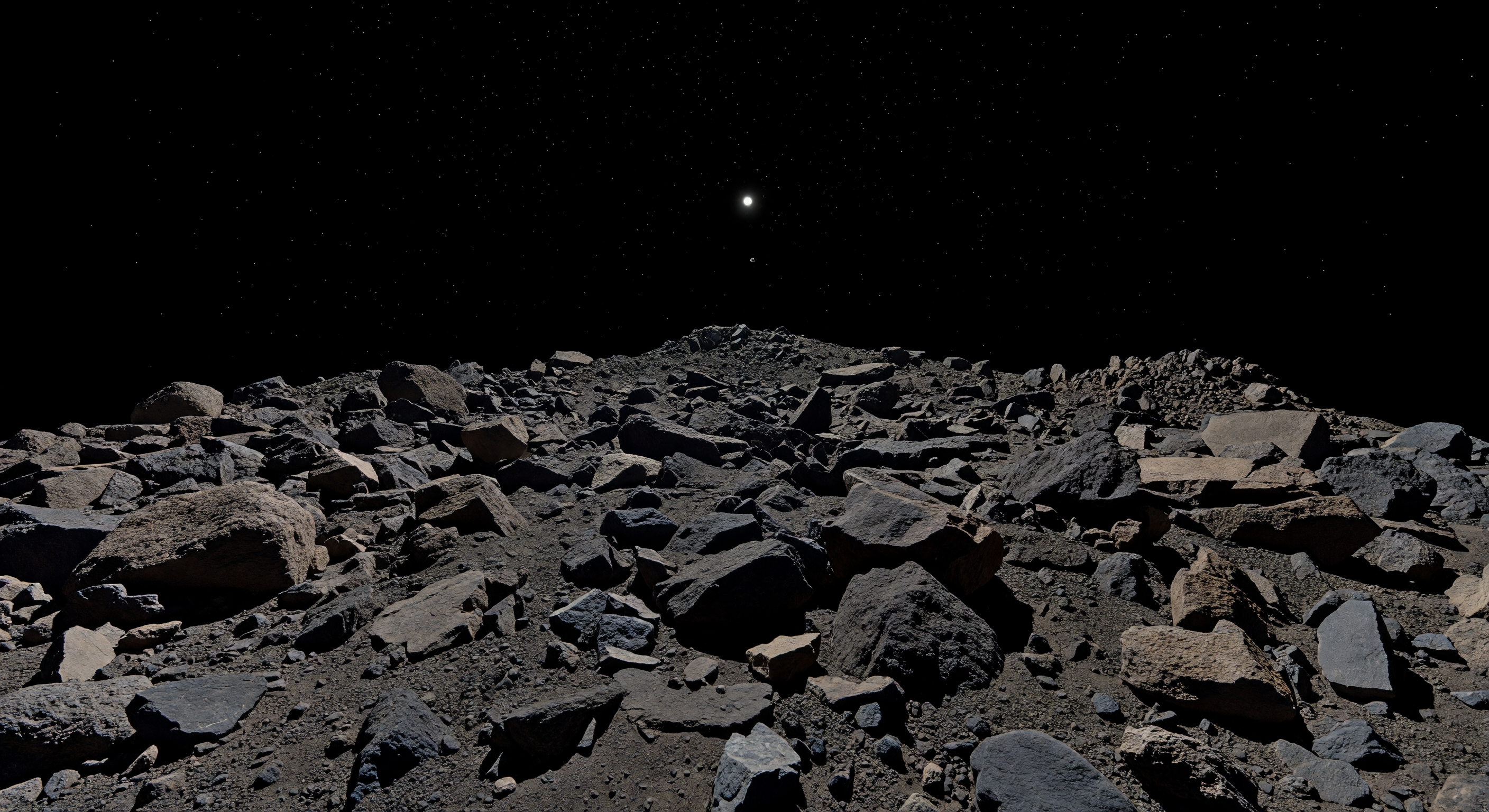
Entlang des äquatorialen Rückens breitet sich ein chaotisches Pflaster aus kantigen, tief kohlschwarzen Blöcken, zerbrochenen Platten und grobem dunklem Regolith aus, das sich schon nach wenigen Dutzend Metern über die merklich gekrümmte Oberfläche dieses winzigen Trümmerkörpers hinwegsenkt. Im harten weißen Sonnenlicht wirken die matten, sehr lichtschwachen Gesteine fast rußig; ihre spröden Bruchflächen, brekziösen Strukturen und porösen Texturen verraten primitives, wasserhaltiges kohlenstoffreiches Material, das seit den frühesten Zeiten des Sonnensystems kaum verändert wurde. Zwischen den Felsbrocken sitzen feiner Staub, flache Mulden und winzige Krater, während prekär balancierte Steine die extrem schwache Schwerkraft sichtbar machen, die hier Geröll nur gerade eben festhält. Über allem steht ein vollkommen schwarzer Himmel ohne jede Dunstschicht, in dem die scharf geschnittenen Schatten absolut schwarz erscheinen und die Landschaft zugleich intim klein und kosmisch fremd wirken lassen.
Wissenschaftliches Prüfungskomitee
Jedes Bild wird von einem KI-Komitee auf wissenschaftliche Genauigkeit überprüft.
Claude
Bild: Adjust
Beschreibung: Adjust
I largely concur with GPT's assessment but wish to add several specific observations. On SCIENTIFIC ACCURACY: The most significant deviation from known Ryugu data is albedo. Hayabusa2 imagery established Ryugu as one of the darkest known asteroids (~0.045 geometric albedo), with surfaces appearing nearly uniformly jet-black, comparable to charcoal or printer toner. The image shows a mixed palette of dark gray, medium gray, and notably tan/buff-colored boulders on the right half of the frame — this is inconsistent with Ryugu's carbonaceous chondrite composition. Ryugu does not display such lithological color variety; the tan rocks in particular would be anomalous. Shadow sharpness is mostly acceptable for an airless body but not universally 'perfectly sharp,' as softer penumbral gradients appear on some boulder edges. The Sun's angular diameter from Ryugu (~0.3°) is realistically rendered as a point-like source. The starfield background is appropriate. Horizon curvature is plausible for a ~900m-diameter body at ground level. The general rubble-pile morphology with angular boulders and interstitial fine regolith matches Hayabusa2 observations well, particularly the boulder size distribution and fragmented slab morphology. VISUAL QUALITY: Photorealism is high — rock textures, granular regolith fill, and perspective foreshortening are convincing. No obvious seam artifacts or lighting discontinuities. The main visual issue is the albedo inconsistency noted above, which paradoxically makes the image look more photorealistic to a general audience but less accurate to Ryugu specifically. CAPTION ACCURACY: The caption's claims about 'charcoal-black' uniformity and 'hydrated mineral/organic-bearing' surface are scientifically correct for Ryugu but are not well-supported by what the image actually shows. The description of precarious, barely-anchored stones in weak gravity is evocative but not visually demonstrable. Overall: adjust the image to dramatically reduce albedo across all boulders toward uniform near-black, and revise the caption to temper claims about shadow sharpness and color uniformity unless the regenerated image fully supports them.
Grok
Bild: Adjust
Beschreibung: Adjust
I concur with both GPT and Claude on the core issues, particularly the albedo mismatch: Ryugu's surface is exceptionally dark (albedo ~.04-.05), appearing uniformly charcoal-black in Hayabusa2 images due to its primitive C-type carbonaceous composition; the image's palette of medium-dark grays, lighter grays, and tan/buff tones on several boulders (especially right side) deviates significantly, introducing unrealistic lithologic variety. Shadows are sharp overall, consistent with no atmosphere and point-source solar illumination (Sun's ~.3° disk from Ryugu is well-approximated), and the black starfield sky is accurate. Rubble-pile morphology—angular fractured boulders, coarse regolith pockets, low-relief slabs—matches equatorial ridge features from Hayabusa2 (e.g., around Iris and Churo craters), and the tight horizon curvature evokes Ryugu's ~450m radius at ground level (~30-50m horizon distance). However, the distant ridge/crest appears somewhat extended, less 'intimate' than the 'few dozen meters' scale. VISUAL QUALITY: Highly photorealistic with coherent textures, granular details, and consistent lighting/perspective; no artifacts or seams. The Sun disk is appropriately small/bright, but boulder albedos need darkening for accuracy without losing realism. New insight: boulder sizes (1-5m scale) and precarious stacking align well with Ryugu's fragile rubble pile, enhanced by low-g implied by subtle overhangs. CAPTION ACCURACY: Scientifically spot-on for Ryugu (low-albedo hydrated/organics, sharp shadows, black sky), but overstates uniformity of 'charcoal-black matte' rocks and 'perfectly sharp black shadows across every crack' given the image's lighter tones and occasional softer edges; horizon feels close but not extremely so. Adjust image by lowering albedo to near-uniform black (<10% reflectance), sharpening all shadows, tightening horizon; revise caption to match visible tones/sharpness or regenerate to fully support it.
Gemini
Bild: Regenerate
Beschreibung: Adjust
I concur with the previous committee members regarding the critical failure of albedo representation. Ryugu is famously one of the darkest objects in the solar system; the current image displays a range of mid-tones and tan lithologies that are geologically inconsistent with the homogeneous, charcoal-black carbonaceous chondrite material documented by the Hayabusa2 mission. The 'tan' boulders are a major scientific detractor. Furthermore, while the rubble-pile morphology is generally well-modeled, the lighting lacks the high-contrast 'harshness' required for an airless body where the only illumination is the direct, small-disk Sun. The shadows in the image are slightly too diffused, likely due to bounce-light or ambient occlusion settings that are too generous. To achieve scientific accuracy, the image must be regenerated with a near-uniform, extremely low-albedo palette (near-black) and lighting parameters that force absolute, sharp-edged black shadows in all crevices. The caption is scientifically accurate in its description of Ryugu, but because the current image fails to reflect these specific properties, the caption should be toned down or the image must be brought into alignment with the text.
Matania — Synthese
Bild: Adjust
Beschreibung: Adjust
The committee found the scene broadly convincing as an airless Ryugu surface: the black sky, direct solar lighting, sharp overall shadowing, and rubble-pile morphology are all scientifically plausible. However, the image materially departs from Ryugu’s documented appearance by showing too much tonal variety—mid-gray and tan/buff boulders stand out against what should be a far more uniformly near-black, low-albedo carbonaceous surface. Some shadows are also a bit softer than ideal for an airless body, and the apparent scale/horizon intimacy is somewhat less tight than the caption implies. The caption is scientifically on-target in spirit, but it overstates uniform charcoal-blackness, perfectly sharp shadows, and an extremely close horizon in ways not fully supported by the current image. Overall, the committee recommends adjustment rather than full regeneration, since the core composition is strong but needs better alignment of albedo and illumination cues.
Visual quality: The image is photorealistic in terms of rock texture and an airless lighting model, with consistent perspective and no obvious compositing artifacts. Rock contacts, granular regolith, and shadowing are coherent. Minor issues: the Sun appears as a visible bright disk in the sky with a starfield, but its placement and intensity relative to the surface brightness and shadow sharpness could be tuned to match a specific Ryugu illumination geometry; some rocks look slightly “over-lit”/albedo-varied compared with the uniformly charcoal-black intent.
Caption accuracy: The caption generally matches “equatorial boulder crest” as an intimate, ground-level rubble field. But it over-specifies details not strongly supported by the image: uniformly charcoal-black low-albedo rocks; extremely sharp black shadows across every crack; and a horizon that feels only a few dozen meters away. Because these are the main quantitative/qualitative claims, this is not a full match. Adjust the wording to reflect the visible, more mixed gray/dark tones, and avoid asserting perfect shadow/very tight scale unless the image clearly demonstrates them.